All posts rooted in Royal Tunbridge Wells — its streets, its people, its history, and its character as one of England’s most distinctive and misunderstood towns.
An Introduction to Three Stories About Royal Tunbridge Wells and Its Queer History
The Chronicles
There is a version of Royal Tunbridge Wells that everyone knows. It is tweedy, it is conservative, it is faintly outraged by most things, and it almost certainly writes letters. It is the town of the mythic Disgusted of Tunbridge Wells — a place that stands, in the national imagination, as shorthand for a very particular kind of English disapproval.
That version is not entirely wrong. However, it is spectacularly incomplete.
Royal Tunbridge Wells has a queer history. It runs from the Georgian Pantiles — where fluid identity and theatrical self-presentation were, for a brief and glittering century, practically the entry requirement — all the way to a man who returned here from Birmingham in 2021, looked around, found no LGBT+ community infrastructure whatsoever, and quietly built one from scratch.
In between, there is a Council ban on a piano recital. There is a campaigning group so dedicated it operated for decades in a town that mostly pretended it didn’t exist. There is, in short, a story that Tunbridge Wells has never quite told itself.
It is time to tell it.
Why This Town, Why This History
Every place has a version of itself it prefers to project. Tunbridge Wells projects elegance, history, and a certain studied propriety. The Pantiles. The chalybeate spring. The Victorian villas. The commuter trains to London Bridge.
What it projects, rather less enthusiastically, is complexity — the messy, contradictory, thoroughly human reality beneath the curated surface. However, complexity is precisely what makes a town interesting. Furthermore, it is precisely what WalkTW exists to excavate.
Queer history is, in most English market towns, hidden history. Not because it didn’t happen — it always happened — but because it happened quietly, in spite of opposition, and without the institutional support that would have made it visible. As a result, it tends to vanish from the official record. The Assembly Rooms get a heritage plaque. The gay campaigners who were banned from the Assembly Rooms do not.
Therefore, this series exists. Not as a political statement — or not only as one — but as an act of historical accuracy. Tunbridge Wells is more interesting than its reputation. Its LGBT history is part of that.
Three Stories, Three Eras
The trilogy ahead covers three very different chapters of the same long story.,
Part One begins in 1972, when a man called Ross Burgess moved to Tunbridge Wells, looked around, and decided to do something about the fact that there was nowhere for gay people to meet. What followed — a campaigning group, a Council ban on a charity piano concert, and an acronym even better than TWERPS — is one of the most quietly extraordinary episodes in the town’s modern history. It is also almost entirely unknown.
Part Two goes further back — much further. The Georgian spa town of the 17th and 18th centuries was not the conservative retirement destination of modern imagination. It was a place of performance, transgression, and deliberate social theatre, where the usual rules of English life were, for the season at least, suspended. The Pantiles was not simply a place to take the waters. It was a stage. And, historically, stages have always attracted people who needed one.
Part Three arrives in the present. Tunbridge Wells in 2024 has no gay bar, no Pride parade, and no LGBT+ venue of any kind. It also has a growing community, a social group built by one determined man with a Facebook page, and a question worth asking: what does a queer life in a town like this actually look like — and what does it say about how much has, and hasn’t, changed?
What We Owe the Full Picture
The Disgusted of Tunbridge Wells myth is, in its way, a comfort. It is easy to understand, easy to repeat, and requires nothing of anyone. However, the real town — the one with three centuries of complicated, interesting, frequently surprising human history — requires a little more from us.
It requires us to look at the Assembly Rooms and remember not just the concerts that happened there, but the ones that didn’t. It requires us to walk The Pantiles and consider who else walked it before us, and why. It requires us to acknowledge that a community need not be visible from the outside to be real.
Royal Tunbridge Wells has always been more than its reputation. This series is, among other things, a small argument for noticing that.
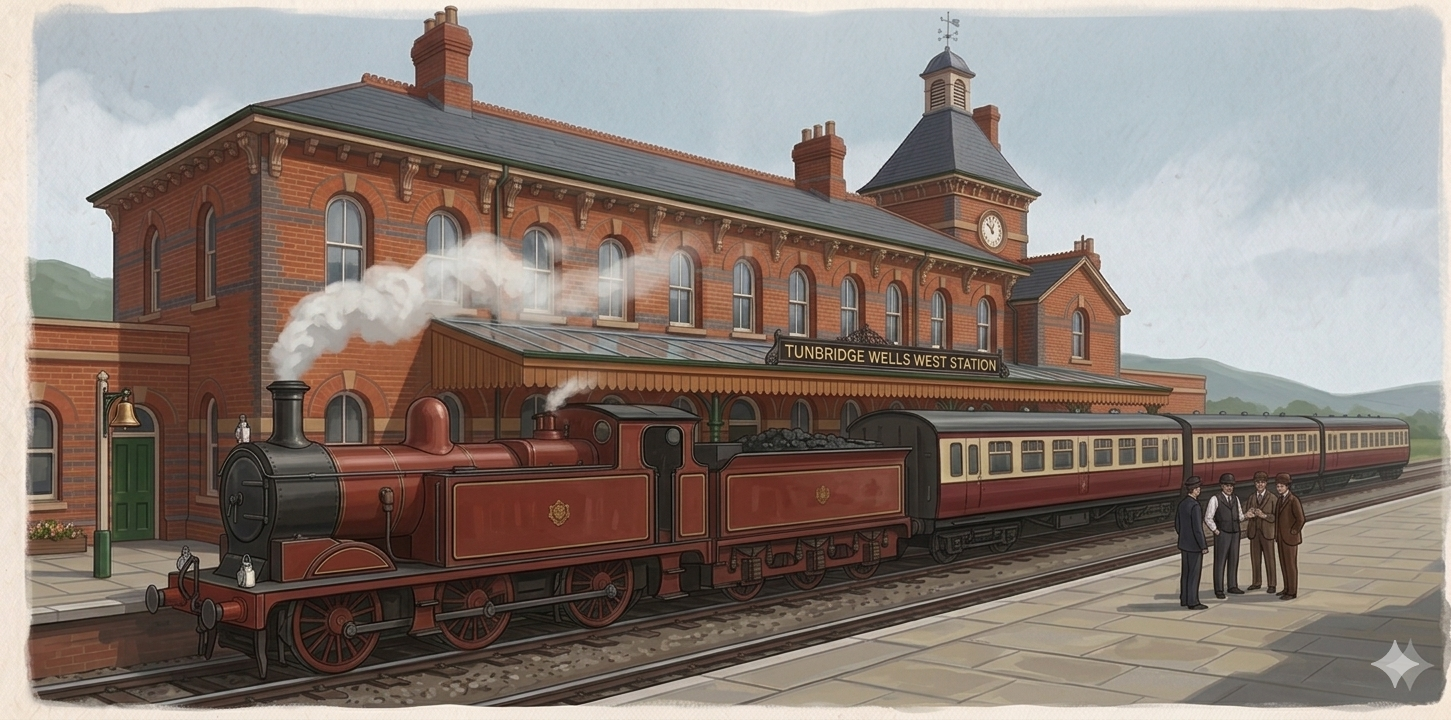
There is a building on Linden Park Road that has spent 160 years confusing people about what it is supposed to be.
It arrived in 1866 as a railway station, the LBSCR’s triumphant answer to the SER’s existing terminus half a mile away. It closed in 1985 when British Railways decided the line wasn’t worth keeping. It became a Beefeater. Then a pub. Then a Wild West steakhouse with nine hotel rooms named after South American tribes and a large decorative jail that you can book for parties.
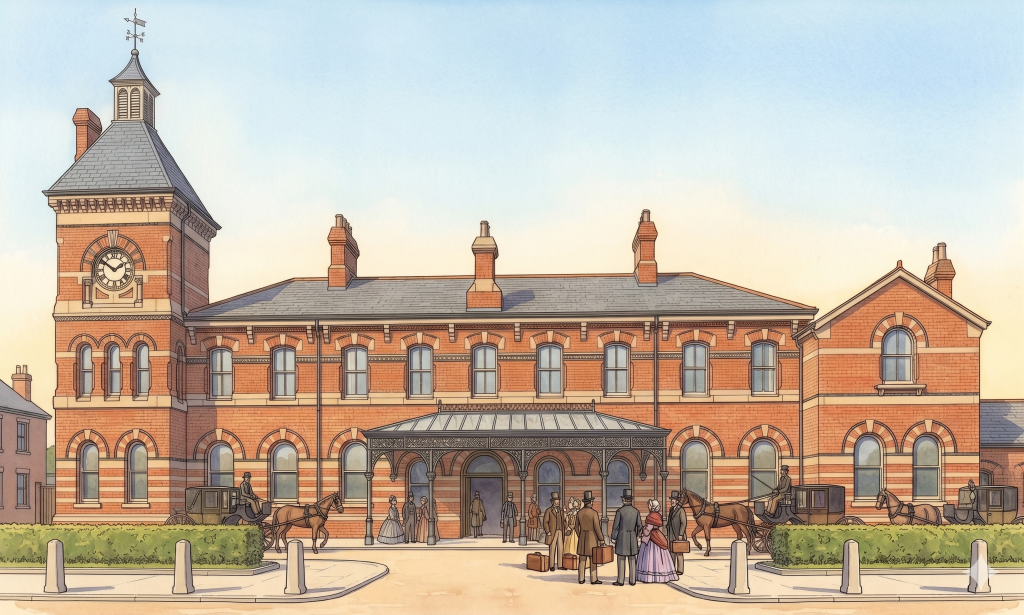
The building, for its part, has said nothing. It just stands there — red brick, round-arched windows, three-storey clocktower with a pyramidal roof and a louvred cupola — looking exactly as it did when the first LBSCR train pulled in on 1 October 1866. Which is, depending on your mood, either deeply reassuring or faintly absurd.
The Building Itself
Before we discuss what has been done to it, it is worth pausing on what it actually is.
Tunbridge Wells West station was designed by Charles Henry Driver, an engineer’s architect whose credits include the ornamental masonry of the Thames Embankment, the Abbey Mills Pumping Station, and the Crystal Palace aquarium. He was, in short, someone who understood how to make a functional structure look considerably more important than strictly necessary.
The building he gave Tunbridge Wells in 1866 reflects that instinct entirely. The facade is two storeys of red brick with ashlar and black brick dressings, arranged across a ten-bay centre block with a gable-fronted wing to the west and a three-storey clocktower to the east. The ground floor carries nine round-arched windows and an arched doorway, connected by a decorated ashlar impost band that runs the full width of the building. The eaves are serrated, with an ashlar cornice on foliated brackets. The clock tower terminates in a pyramidal slate roof, above which sits a louvred cupola with a weathervane.
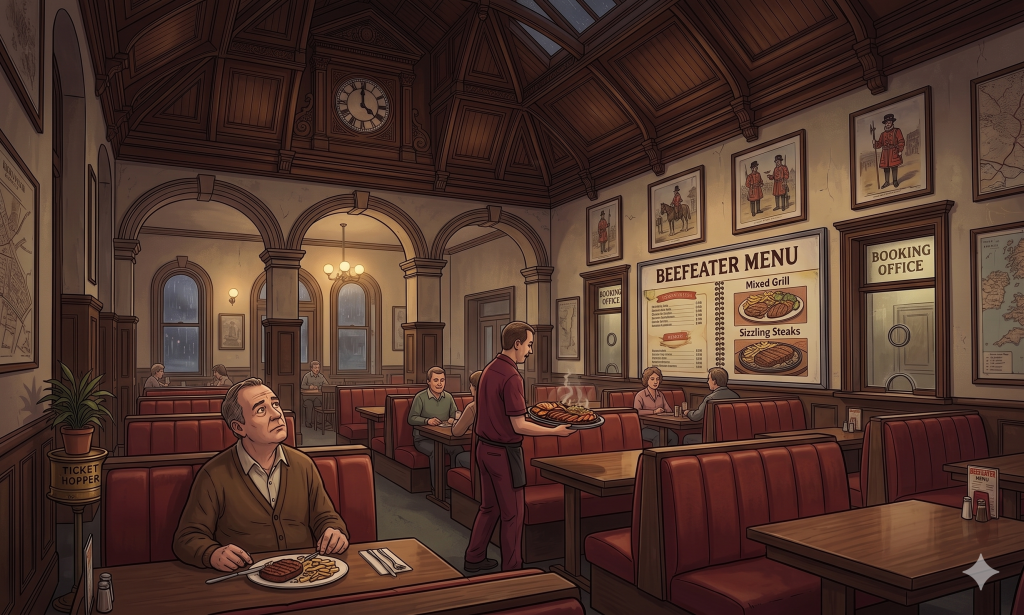
Inside, the original booking hall featured a panelled ceiling, a three-bay, columned arcade, and four gas-lit ticket windows. It was, in every sense, a statement building — the LBSCR making unmistakably clear that it had arrived in Tunbridge Wells and intended to stay.
Historic England listed it Grade II on 27 March 1986, approximately ten months after the last train departed. The listing came just in time.
What Happened Next
The building’s post-railway life has proceeded in three acts, each successively stranger than the last.
Act One arrived in the late 1980s, when the main building was converted into a Beefeater restaurant called The Old West Station. The name was apt — it is the Old West Station — though one suspects the Beefeater marketing department was gesturing at cowboys rather than Victorian railway geography. The booking hall, with its panelled ceiling and stone columns, became a dining room. The arched windows looked out over the car park where the platforms used to be.
Act Two followed when Herald Inns and Bars purchased the building and continued operating it as a pub-restaurant under the same name. The Cowboys remained notional.
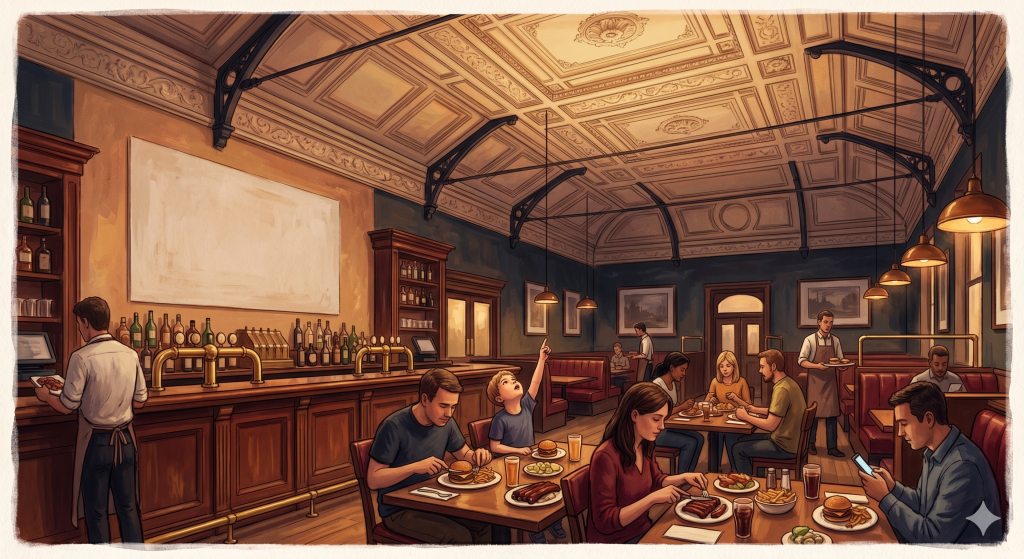
Act Three began in 2009, when Smith & Western moved in. They are a chain of American-themed steakhouses with Wild West decor, banjo music, and a menu running to ribs, burgers, and fajitas. They have leaned into the theme with total commitment. There is a saloon bar. There is a decorative jail available for private hire. The nine hotel rooms are named after South American tribes, which is a geographically inventive touch. The restaurant’s own website describes the building as “a historic landmark brought back to life,” which is one way of putting it.
The Awkward Question
Here is where this Building File has to say something honest, even if it is not entirely comfortable.
Wild West decor in a Grade II listed Victorian railway station is, on the face of it, a jarring combination. Driver’s building was conceived as a piece of civic architecture — a public gateway to a prosperous town, with the proportions and detailing to match. Filling it with cowboy hats and country music is not, by any conventional standard of heritage, a sympathetic use.
Furthermore, the context is particularly pointed in Tunbridge Wells. The station building sits directly beside the Spa Valley Railway — a preservation society that spent eleven years fighting to bring the line back, that operates steam trains through the High Weald on volunteer labour, that named itself TWERPS with cheerful obliviousness. One half of the site is a labour of love. The other half serves nachos.
And yet.
The alternative — which was very real in the late 1980s, when the building stood derelict, and the Sainsbury’s bulldozers were active next door — was not a sensitively curated heritage centre with educational panels and a gift shop selling LBSCR tea towels. The alternative was a building with no income, no maintenance budget, and no one with a financial incentive to care whether the roof held.
Adaptive reuse is how most Victorian buildings survive. Those that do not find commercial use tend not to survive at all. Churches become apartments. Pumping stations become nightclubs. Railway hotels become offices. The question is never whether the new use is architecturally ideal — it rarely is — but whether the building is being maintained, whether its structural fabric is intact, and whether the people who walk through its doors can still read the original building clearly if they look up.
On those terms, the Old West Station is doing reasonably well. The exterior is well-maintained. The nine round-arched windows are still in place. The clock tower still stands above Linden Park Road as it has since 1866. The panelled booking hall ceiling — the one that was lit by gas when the LBSCR first opened the doors — is still there above the tables.
What It Owes the Town
There is, however, one thing that adaptive reuse does not automatically provide, and which the Old West Station has so far largely declined to offer: a readable connection to its own history.
A building this significant — designed by the architect of the Thames Embankment, built as the centrepiece of a Victorian railway war, the scene of the final passenger departure in 1985 and the subsequent eleven-year preservation battle — deserves more than a passing mention on a restaurant website. It deserves an interpretation panel in the entrance. A framed history on the wall of the booking hall. Something that tells the people eating their fajitas where they actually are.
This is not a radical demand. It costs very little. Moreover, it is arguably good for business — a story this good makes the building more interesting to visit, not less. However, as things stand, the Wild West theme is the narrative, and the Victorian railway history is the backdrop.
The driver’s building has survived a bomb, a closure, a supermarket next door, and four decades of commercial tenants. It is still standing. That matters enormously. But standing is not the same as being understood — and a building in the middle of Tunbridge Wells, with this much history in its walls, deserves to be both.
The Building Files is a WalkTW series exploring the hidden histories of Royal Tunbridge Wells’s most interesting addresses. The Smith & Western is open seven days a week at 1 Linden Park Road, TN2 5QL. The Spa Valley Railway departs from the platform directly behind it.
Bombs, Bureaucrats, and a Toilet Block with a Removal Clause
Building Files, Issue 3 (continued)
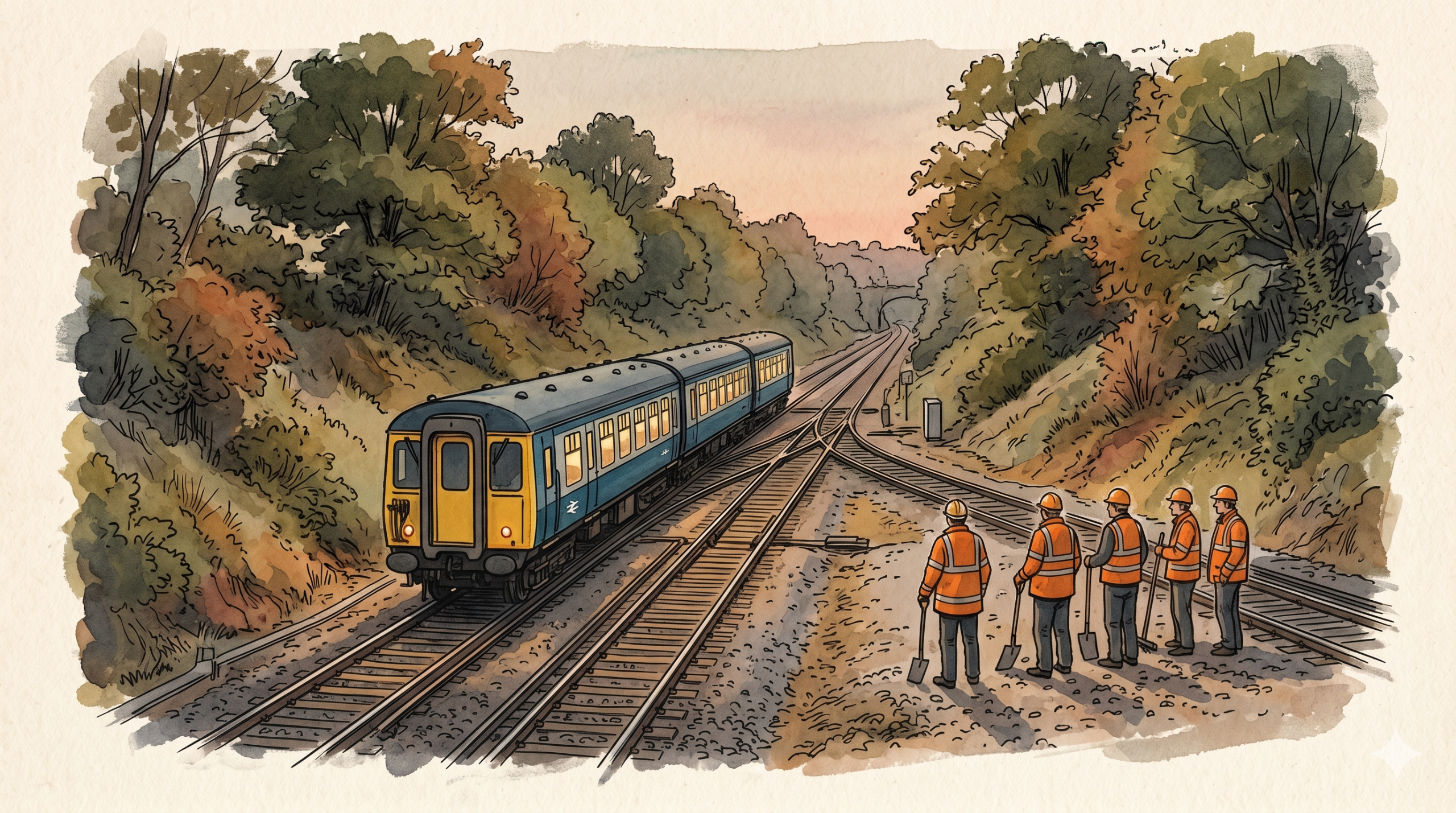
When the Southern Railway took ownership of both Tunbridge Wells stations in 1923, it inherited a peace that nobody had quite asked for. Two stations, one tunnel, decades of simmering antagonism — all of it now tidied away into a single company balance sheet. The railway war was over. What followed was something quieter, and in some ways stranger: a slow, incremental dismantling of everything the LBSCR had built.
It took sixty years. It involved a German bomb, a supermarket, and a toilet block whose planning permission came with the most unusual clause in Tunbridge Wells history.
20 November 1940
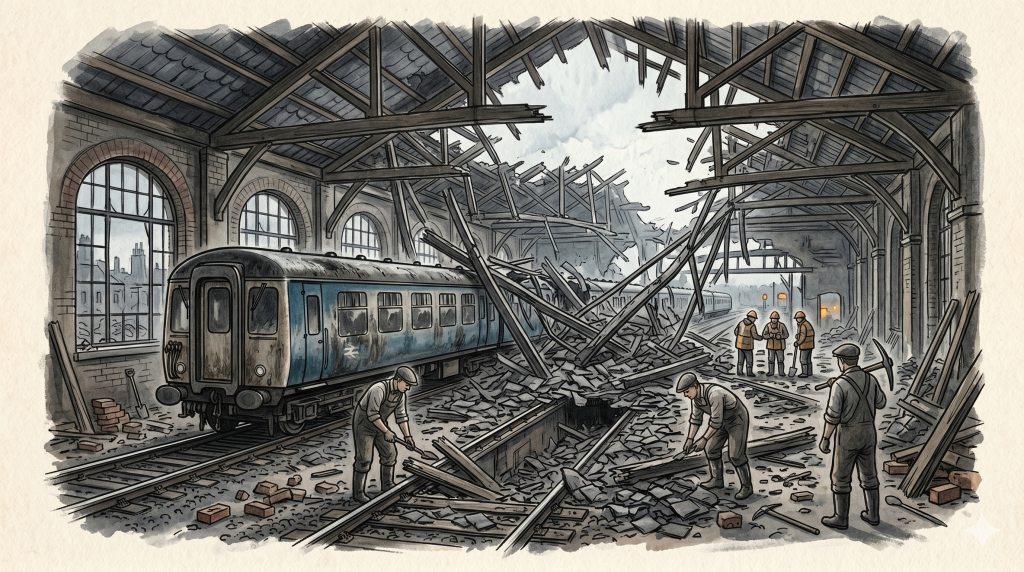
The Luftwaffe was not, as a rule, targeting railway engine sheds in medium-sized Kent spa towns. However, on 20 November 1940, a bomb found the locomotive shed at Tunbridge Wells West anyway.
The damage was significant. The original Victorian slate roof — laid in 1891 when the LBSCR expanded the depot to four roads — was destroyed. British Railways replaced it with corrugated asbestos sheeting. This was, in the fullest sense, a wartime solution: functional, immediate, and utterly without grace.
The great red-brick engine shed survived. It still stands today, its arched windows intact, its Victorian bones unshaken. The asbestos roof is long gone. However, on the night of November 20th 1940, nobody was thinking about the long term. They were thinking about getting the trains running again.
The Slow Decline
The post-war decades were not kind to Tunbridge Wells West. Meanwhile, Tunbridge Wells Central — the SER’s station, the one that had won the first round of the rivalry in 1845 — was electrified in 1986 and went from strength to strength.
West was a different story. It served the Wealden villages, the Groombridge valleys, and the old LBSCR lines through the High Weald. These were lightly used routes, operating on a shoestring. By the early 1980s, the track needed relaying, the signalling needed replacing, and British Railways had run the numbers.
The conclusion was blunt: keeping the line from Eridge to Grove Junction open would cost £175,000 a year more than it earned. Furthermore, the planned electrification of the Tonbridge to Hastings line required the removal of Grove Junction — the very connection that had been bored through the hillside in 1876 as the price of peace between two Victorian rivals. Therefore, the junction would go. And without it, Tunbridge Wells West was an island.
British Railways announced closure on 16 May 1983. Local objections were strong enough to delay it. In February 1985, the Secretary of State for Transport confirmed the decision. The last passenger service ran on 6 July 1985.
It is reported that as the final train crossed Grove Junction that evening, the permanent way team was already waiting on the other side with tools in hand. The track was lifted the following morning. After 119 years, the LBSCR’s line into Tunbridge Wells was gone.
The Group That Named Itself TWERPS
Six weeks later, on 13 September 1985, a meeting was held in Groombridge village hall. The mood, one imagines, was determined rather than cheerful.
The people in that room formed a charitable society to do something that British Railways had just declared economically indefensible: reopen the line. They named themselves the Tunbridge Wells and Eridge Railway Preservation Society. The acronym, as the Spa Valley Railway’s own history notes, was chosen by people who were “blissfully unaware of the fact that anyone would use such an acronym to poke fun at them.”
TWERPS it was. And TWERPS they remained.
The Sainsbury’s Compromise
The next few years were hard. Vegetation reclaimed the trackbed. The station buildings sat derelict. Then, in the late 1980s, the situation became dramatically more complicated.
Tunbridge Wells Borough Council granted planning permission for a large Sainsbury’s supermarket complex on the site of the former goods yard at Tunbridge Wells West. The goods shed was demolished. The signal boxes vanished. The former stabling sidings disappeared under concrete and car parking. A Homebase arrived next door.
However — and this is where the story acquires its most distinctly Tunbridge Wells character — the planning permission came with conditions.
The 1891 locomotive shed was a listed building. So was the station itself. They could not be touched. Furthermore, the council negotiated a formal agreement with Lord Sainsbury: a corridor would be preserved alongside Linden Park Road, sufficient for a reinstated railway line to pass through the site. And if, at any future point, the railway returned and any Sainsbury’s building stood in its way, the company would remove it at their own cost.
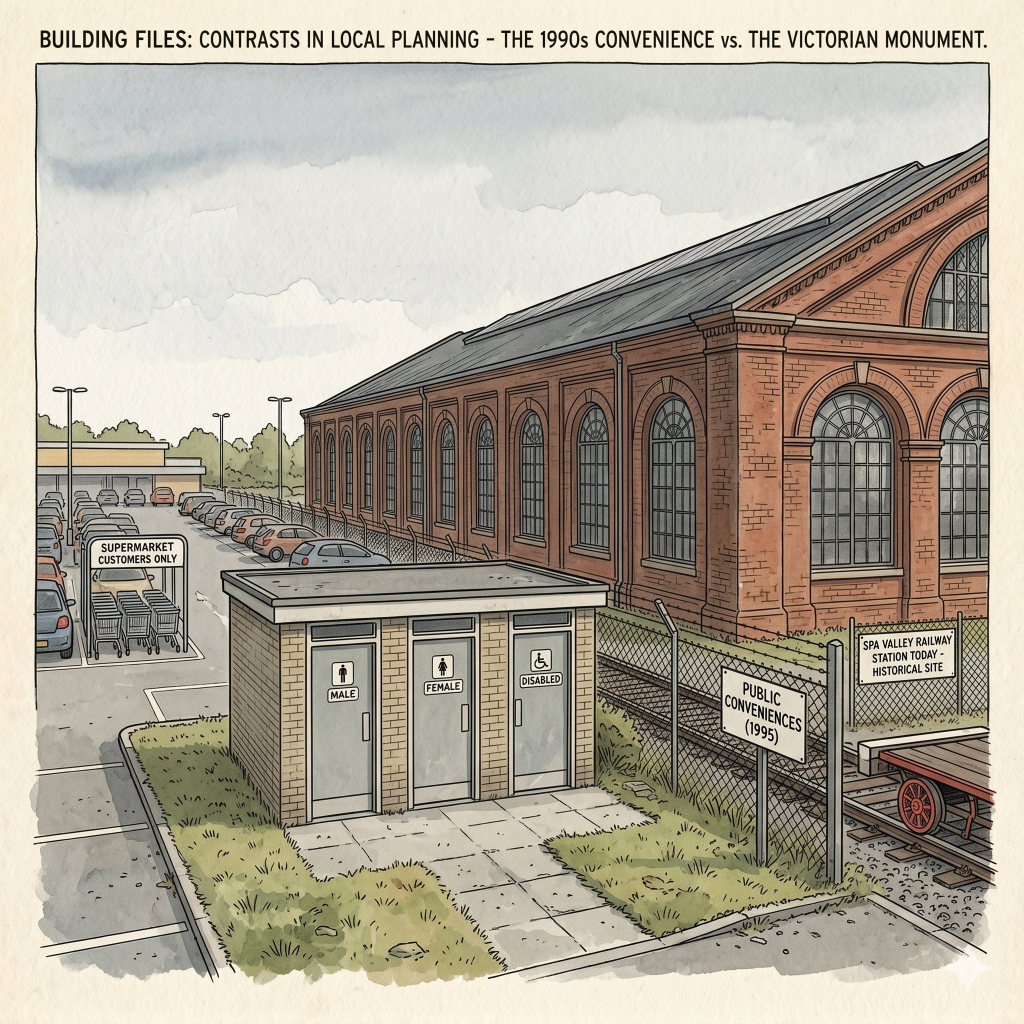
In the mid-1990s, a toilet block was built on this corridor. It stood in the path of the railway. It could, under the terms of the agreement, be demolished.
A toilet block with a legally binding removal clause. In Tunbridge Wells. Where else.
The Return
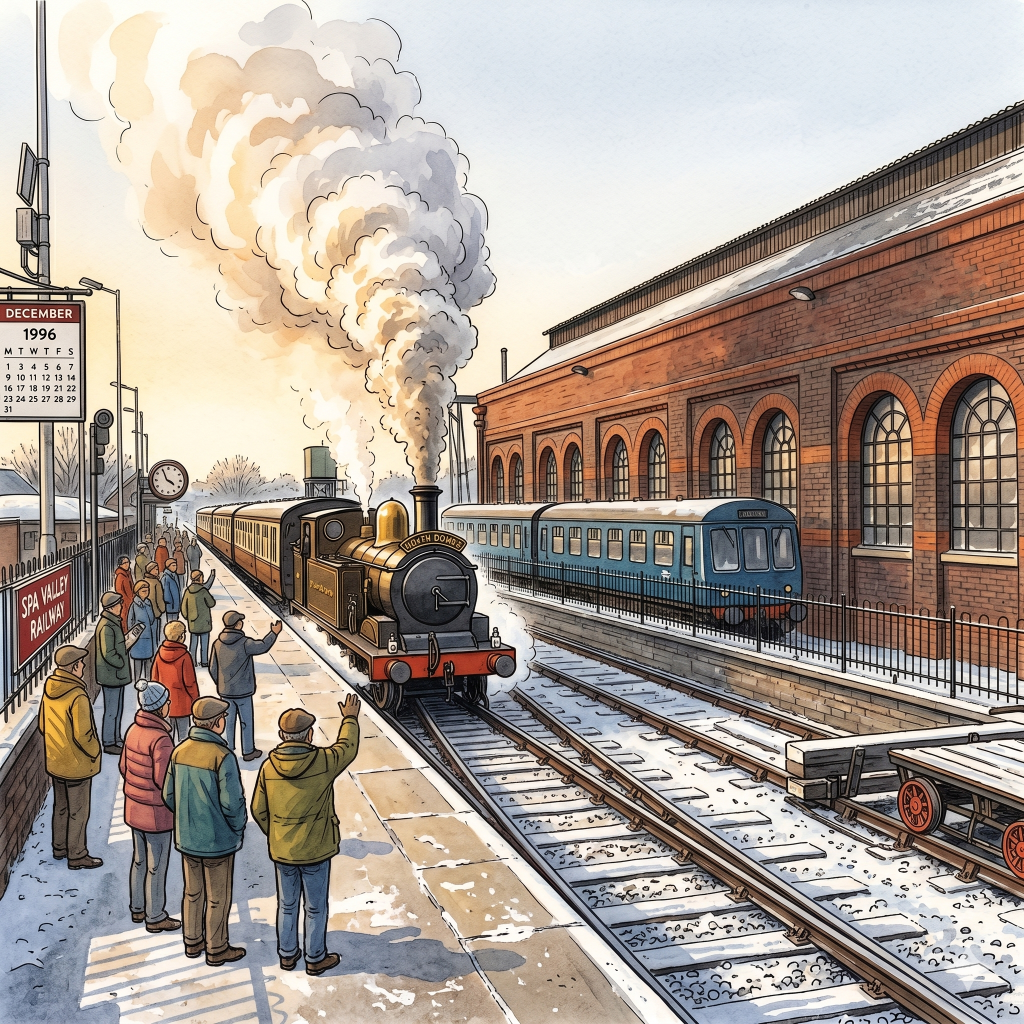
In 1994, with a loan from Tunbridge Wells Borough Council, TWERPS acquired the line. In December 1996 — eleven years after closure — the first heritage train ran from the restored station at Tunbridge Wells West toward Groombridge, hauled by a steam locomotive called North Downs. Services reached Groombridge in August 1997, Birchden Junction in 2005, and Eridge in March 2011.
The spur to Grove Junction — the peace tunnel itself, the single track bored through the hill in 1876 — was sold for £1 in 2001 to Railway Paths Ltd, a subsidiary of Sustrans. It is protected by covenant: the land can only ever be used for railway purposes. It is safeguarded in the East Sussex Structure Plan. It sits there now, overgrown, waiting.
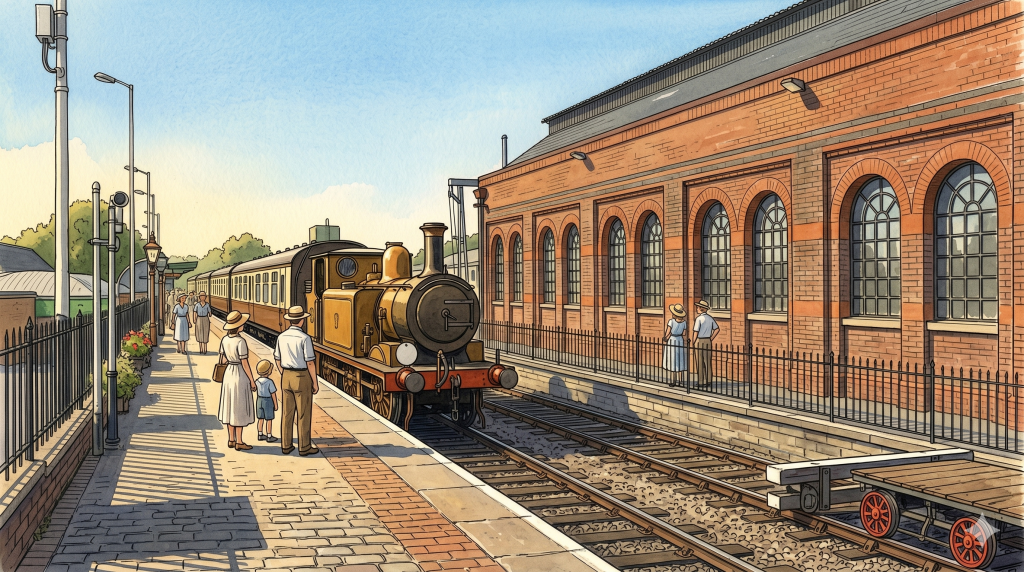
The great engine shed has been restored. The platform is busy on summer weekends. Steam trains run through the High Weald to Eridge, through Groombridge and High Rocks, through the same countryside the LBSCR carved its route through in 1866.
What Remains
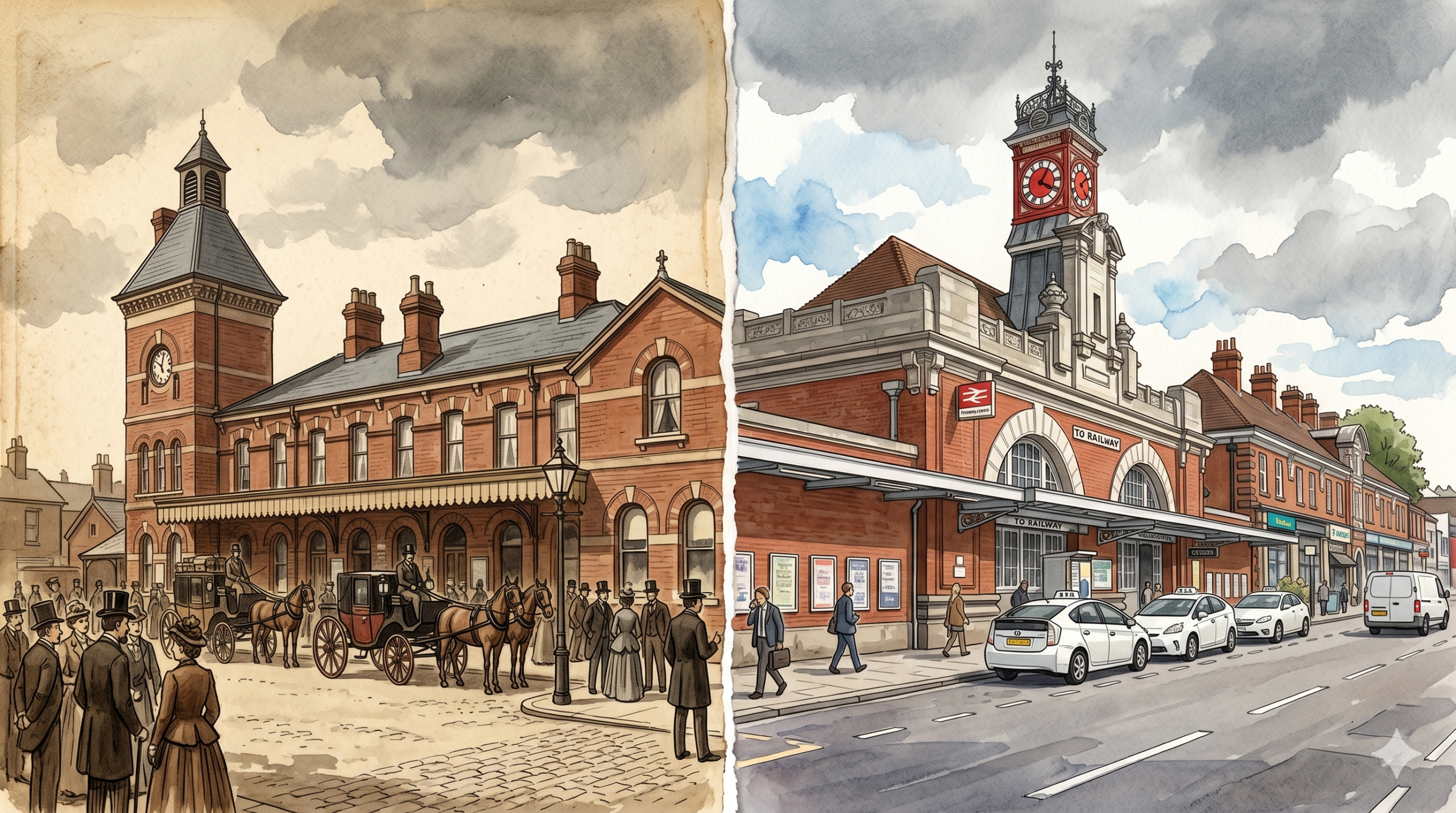
Tunbridge Wells Central — SER territory, always, is a busy commuter station. Southeastern trains to London Charing Cross, London Bridge, and Hastings. The clock tower that appears in the Victorian photographs still stands above the forecourt. The taxis queue where the horse-drawn carriages once waited.
Tunbridge Wells West is something different: a working museum, a community project, and an argument that some things are worth keeping not because they are profitable but because they are loved.
The two stations began as enemies. They ended as a pair of complementary survivors — one thriving on the main line, one thriving on nostalgia, volunteer labour, and the particular stubbornness of people who name their campaign group TWERPS and mean it.
The railway war ended in 1923. The railway, however, did not.
The Building Files is a WalkTW series exploring the hidden histories of Royal Tunbridge Wells’s most interesting addresses. Grove Tunnel remains intact beneath Grove Hill, sealed but structurally sound, its Victorian brickwork still in place.
There are towns in England where the railway arrived, and everyone was grateful. Royal Tunbridge Wells was not one of those towns. Here, the railway arrived twice — brought by two rival companies who despised each other — and the resulting feud shaped the town for the better part of a century.
It began, as most Victorian problems did, with money, ambition, and a complete absence of goodwill.
The First Arrival
The South Eastern Railway reached Tunbridge Wells on 20 September 1845. This was not, it has to be said, a triumphant entry. The line ran from Tonbridge and terminated at a temporary station called Jackwood Springs, on the northern fringe of town. It was essentially a shed. For over a year, passengers alighted into what amounted to a field.
The proper station — what would eventually become Tunbridge Wells Central — opened on 25 November 1846, once the Wells Tunnel had been excavated beneath the town. The SER now had a foothold. More importantly, it had ambitions. Hastings was next on the agenda, and after that, potentially, Lewes.
This was when the trouble started.
Enter the Rival
The London, Brighton and South Coast Railway had been watching the SER’s southward expansion with the kind of alarm that polite Victorians expressed through Parliamentary bills rather than raised voices. The SER’s push toward Hastings threatened LBSCR territory. A line toward Lewes would be a direct invasion.
So the LBSCR drew up plans for its own line into Tunbridge Wells — from the west, via Groombridge — and obtained Parliamentary authorisation on 7 August 1862. After three separate Board of Trade inspections (the Victorian equivalent of a zero-star hygiene rating), the line finally opened on 1 October 1866.
Tunbridge Wells now had two railway stations. They belonged to two companies that, for all practical purposes, regarded each other as enemy combatants.
The Tunnel Nobody Wanted to Build
Having two stations in a town is only useful if passengers can get between them. The two companies had no particular desire to help each other’s customers. However, Parliament had other ideas.
The SER was eyeing a new line to Eastbourne, which would have cut directly into LBSCR territory. Rather than fight that battle in the courts, the LBSCR made a calculation: build a connecting spur between the two stations, give the SER access to the Eastbourne route it wanted, and get them to back off.
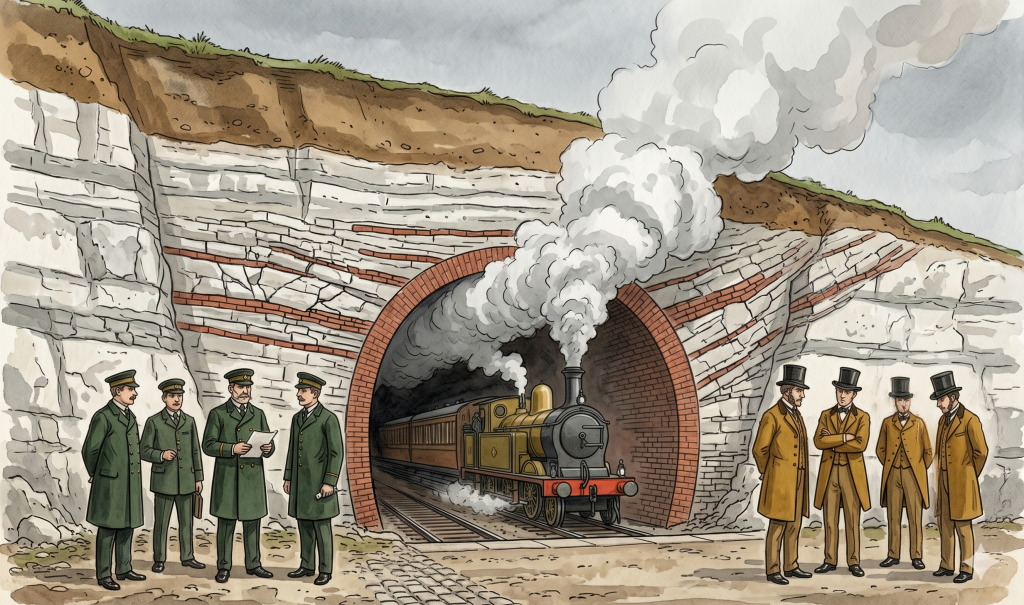
The result was the Grove Tunnel — a short, single-track connection bored through the hillside between the two stations. It opened for goods traffic in 1866 and for passengers on 1 February 1876. For the first time, a through service was possible between the SER’s Hastings line and the LBSCR’s routes to Lewes and the South Coast.
It was, in the most literal sense, a peace tunnel. Dug under Grove Hill to connect two companies that still, fundamentally, did not trust each other.
Through it ran trains from Charing Cross to Eastbourne — via a negotiated compromise buried twenty feet underground.
Rivals on Paper, Neighbours in Practice
The peculiar thing about the Tunbridge Wells railway war is how theatrical it was. The two stations sat less than half a mile apart. Passengers transferring between them could walk the distance in ten minutes. However, for most of the Victorian era, the official position of both companies was that no such transfer was necessary, because neither route needed the other.
In practice, the town required both. Tunbridge Wells West served Brighton, the South Coast, and the Wealden villages. Tunbridge Wells Central served London, Hastings, and Kent. Together, they gave the town remarkable connectivity. Apart — which they mostly insisted on being — they were a logistical inconvenience for anyone whose journey required both.
Meanwhile, the town’s population was growing rapidly. Tunbridge Wells was becoming a prosperous commuter destination. More trains, more routes, and more passengers meant that the rivalry was increasingly expensive for both sides.
The Long Road to the Grouping
By the turn of the twentieth century, the SER and LBSCR had each worn themselves down. The SER had already merged its operations — though not its legal identity — with the London, Chatham and Dover Railway in 1899, creating the South Eastern and Chatham Railway. The LBSCR carried on independently, but the Victorian era of aggressive expansion was essentially over.
For Tunbridge Wells, this meant a period of relative stability. Two stations, one tunnel, and a grudging peace. Trains ran through Grove Tunnel with increasing regularity. At its peak, Tunbridge Wells West handled more than a hundred trains per day — a figure that would have seemed extraordinary to the two sets of company directors who had spent decades trying to exclude each other from the town.
The formal end of the war came not with any local drama, but with an Act of Parliament. The Railways Act 1921 reorganised Britain’s railways into four large groups. On 1 January 1923, both the SE&CR and the LBSCR ceased to exist as independent entities. Both were absorbed into the new Southern Railway.
After nearly eighty years, the two stations in Tunbridge Wells finally belonged to the same company.
The Southern Railway promptly renamed Tunbridge Wells to Tunbridge Wells Central — a small, tidy act of administrative clarity that would have seemed impossibly utopian to every stationmaster, general manager, and Parliamentary draftsman who had come before.
What They Left Behind
The 1923 grouping ended the war. It did not end the consequences. Two stations, two sets of infrastructure, and one tunnel bored through a hill in a gesture of forced cooperation — these were not things that could simply be unified by a renaming exercise.
The Southern Railway now owned both lines, both stations, and Grove Tunnel. What it did with them over the following decades — and what British Railways did after nationalisation in 1948 — would determine the shape of Tunbridge Wells for the rest of the twentieth century.
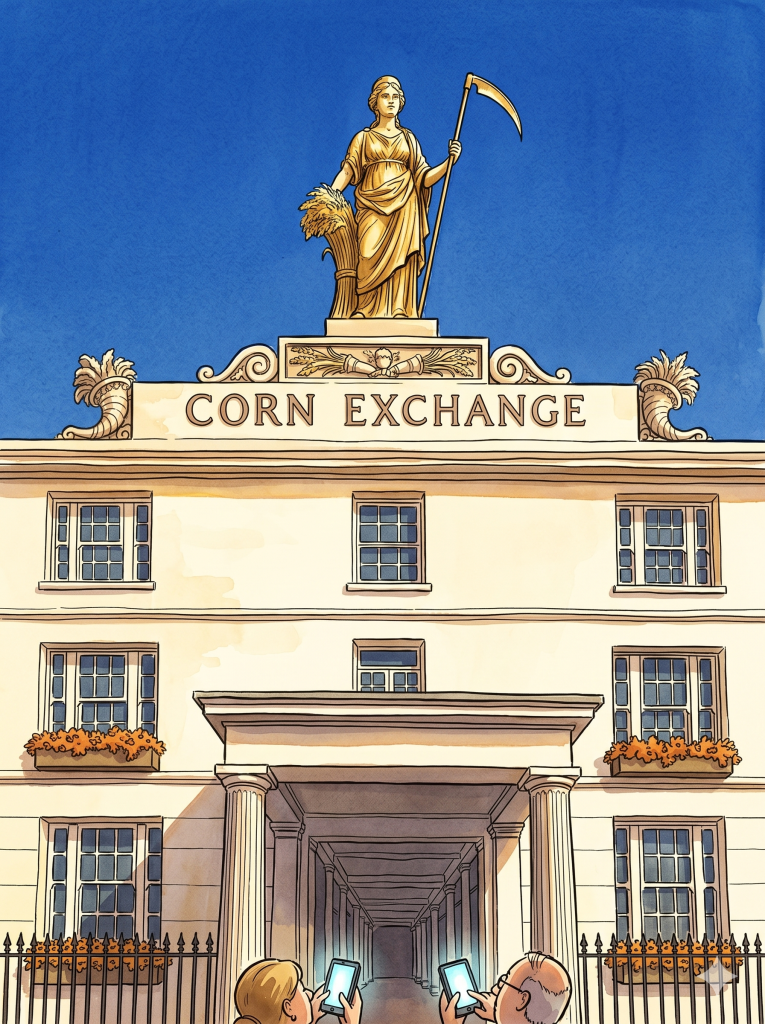
The Corn Exchange, 49 The Pantiles, Royal Tunbridge Wells, TN2 5TN is also known for being the historic Corn Exchange building at Pontiles Tunbridge Wells.
Walk south along The Pantiles on any summer afternoon. Pass the Chalybeate Spring, pass the coffee shops and the collonaded walkway. Stop when you reach the building with the statue on the roof.
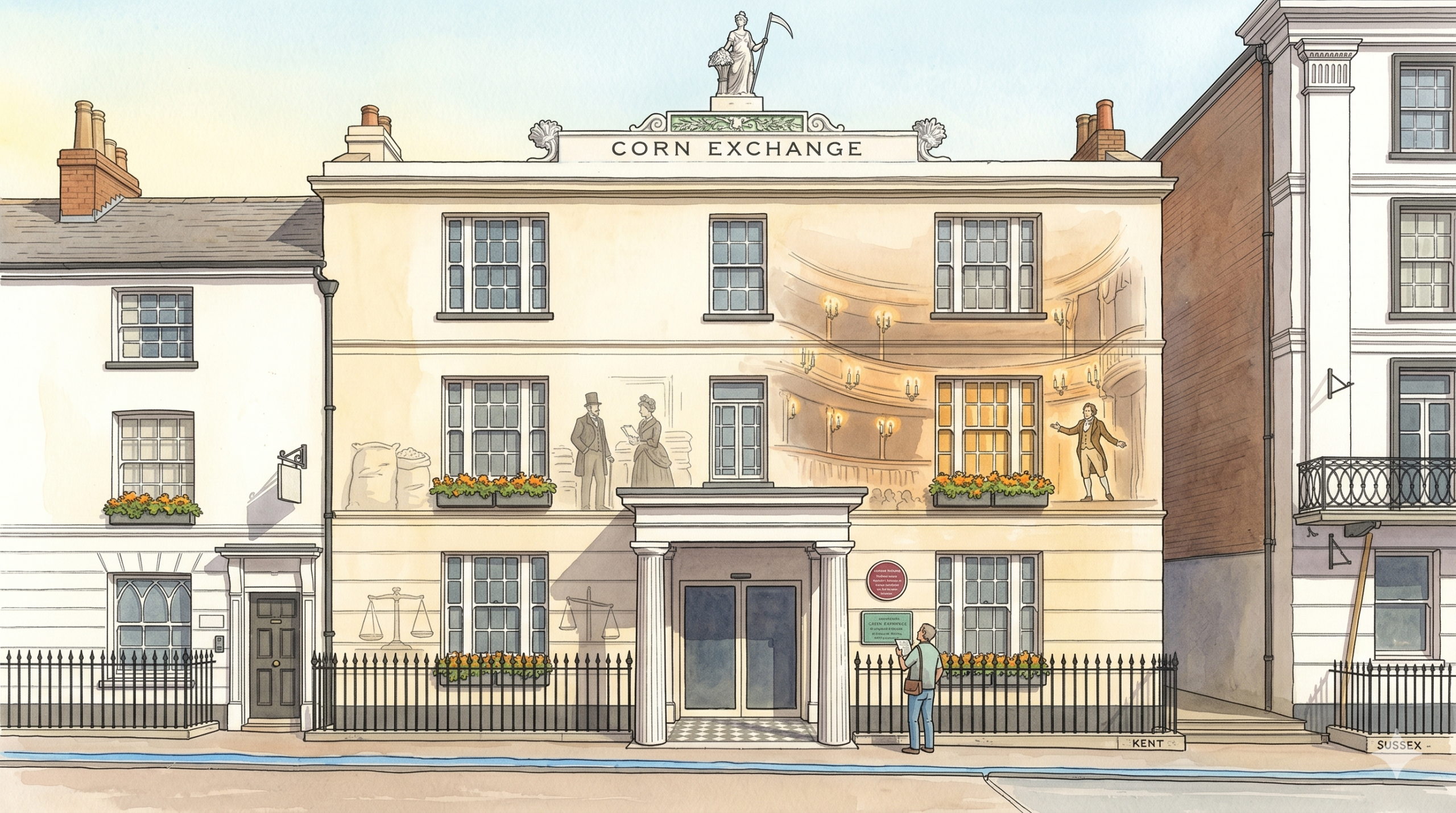
Look up. She’s been there since 1844 — Ceres, the Roman goddess of grain and harvest, standing on a parapet flanked by cornucopias, scythe in hand, looking out over The Pantiles with the expression of someone who has seen everything and is mildly amused by most of it.
The Historic England listing describes her simply as “a statue of a female figure with scythe and sheaf of corn.” However, she is considerably more interesting than that. She is watching over a building that began its life as a theatre, hosted two of the greatest actors in British history, straddled a county border, and was — at one point — technically in two different counties simultaneously.
The Corn Exchange is not what it appears to be. In fact, it never has been.
How a Fairground Performer Built a Theatre on The Pantiles
Sarah Baker was an illiterate fairground performer who became one of the most successful self-made women of her time. Born in 1737, she grew up travelling the country with her mother and younger sister, entertaining crowds at country fairs and race meetings. In the early 1770s, recently widowed and with three young children, she took over the small family troupe.
In the face of fierce opposition from male rivals, she began building a theatre empire across Kent. It was not until 1789 that Sarah — well into her fifties by then — opened the first of what she described as her “great grand” Kentish theatres in Canterbury. She went on to build three more purpose-built theatres in the county: Rochester in 1791, Maidstone in 1798, and Tunbridge Wells in 1802.
All four were built to the same plan and similar dimensions, to allow for scenery to be easily moved between them. As a result, Sarah ran what was effectively a theatrical touring circuit across the entire county — moving actors, sets and costumes between four identical buildings, each playing to a different Kent audience.
The Tunbridge Wells theatre cost her approximately £1,600 to build. It officially opened on 8 July 1802, designed in the neoclassical style, built in brick with a stucco finish, and featuring a symmetrical main frontage of three bays facing onto The Pantiles.
That original frontage is still exactly what you’re looking at today.
The Stage in Sussex, The Audience in Kent
Here is the detail that belongs on every heritage trail in this town and is on none of them.
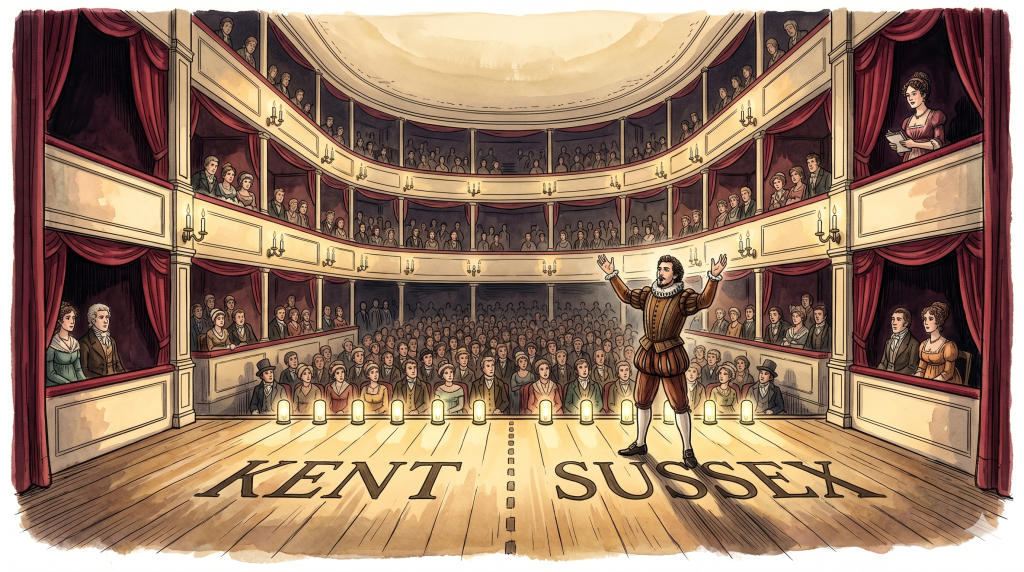
The Corn Exchange was built in 1802 over the Grom Brook, which carried the county boundary between Kent and Sussex. As a result, the actors on the stage would perform in Sussex while the audience watched from Kent.
Think about what that means in practice. Every actor who walked onto that stage stepped from Kent into Sussex. Every entrance was a county crossing. Every exit was a return to England’s garden county. The audience, meanwhile, sat in Kent and watched people perform in a different county entirely.
Before the alteration of the county boundary, the theatre had the stage in Sussex and the auditorium in Kent. It later became the Corn Exchange. In 1894, however, the administrative boundary was redrawn to encompass the entire expanding town. Under the Local Government Act 1894, the boundary between the Administrative County of Kent and the Administrative County of East Sussex was moved two miles south, incorporating the entirety of the growing town.
Therefore, the county-straddling stage disappeared not because anything about the building changed, but because a government act moved the border. The theatre didn’t move. England simply redrew itself around it.
The Actor Who Left Town Ahead of a Mob
The actors Edmund Kean and Charles Kemble both performed on the stage in the building in the first half of the 19th century. In addition, the plaque on the wall outside confirms this plainly. However, the plaque does not mention what happened next.
Edmund Kean went on to become arguably the greatest Shakespearean actor of the 19th century. He was one of the greatest of English tragic actors — a turbulent genius noted as much for his megalomania and ungovernable behaviour as for his portrayals of villains in Shakespearean plays.
Before all of that, however, he was a young actor in Mrs Baker’s company at Tunbridge Wells. He joined Mrs Baker’s company in Tunbridge Wells and spent a year there. Furthermore, he probably would have stayed longer, except he found himself in trouble with a townsman — he had seduced the man’s wife — and was forced to leave just ahead of a vengeful mob.
The man who would later be described by Coleridge as watching his acting being “like reading Shakespeare by flashes of lightning” left Tunbridge Wells one step ahead of an angry husband. He then went to Gloucester, met a woman called Mary Chambers, married her, and eventually became the most celebrated actor in England.
The stage where all of this began is now an antiques market. However, the frontage is unchanged. Next time you walk past, note the three neoclassical bays, the fluted Doric columns at the porch, and the parapet above. That is exactly what Edmund Kean saw when he first arrived — and rather hastily when he left.
From Theatre to Grain Market to Antiques
After Baker died in 1816, the theatre passed to her son-in-law, William Dowton. However, audiences dwindled, and the theatre closed in 1843.
In consequence, the building became a corn exchange — a market where grain was bought and sold. The corn exchange conversion was completed, and the building reopened in November 1844 by John Nevill, 3rd Earl of Abergavenny, whose seat was at Eridge Park. Furthermore, it was at this point that the Ceres statue appeared on the roof — the Roman goddess of grain, finally appropriate to the building’s new purpose.
For a century, therefore, the building that Sarah Baker built as a theatre sold wheat. Then it became a Tourist Information Centre. Finally, it is today an antiques and fine art market — Grade II listed, officially designated on 20 May 1952.
However, the interior you see today is not entirely original. The building was extensively reconstructed in 1989. As a result, the original theatrical interior — the stage, the auditorium, the boxes where Georgian audiences watched performances in a different county — is gone. What remains is the 1802 frontage, unchanged and still facing The Pantiles.
What the Plaque Doesn’t Tell You
There is a green plaque on the wall. It reads, accurately, that this was formerly the Tunbridge Wells Theatre, built in 1802 by Sarah Baker, that Edmund Kean and Charles Kemble performed here, and that the stage was in Sussex while the auditorium was in Kent.
However, it doesn’t mention that Sarah Baker was illiterate. She reputedly never learned to write more than her name, yet when she died at Rochester in February 1816, just months before her eightieth birthday, her estate was estimated at more than £20,000 — equivalent to well over £1.5 million today.
Furthermore, it doesn’t mention that Edmund Kean left the building toward an angry mob. It doesn’t mention the county boundary running beneath the stage, or the Grom Brook that carried it. It doesn’t mention that the woman watching from the roof has been standing there since 1844, long before anyone now alive was born, watching everything that happens on The Pantiles with the patient attention of someone who has absolutely nowhere else to be.
🗺️ Go Find It Today
The Corn Exchange is at 49 The Pantiles, TN2 5TN — on the south side of the Lower Walk, impossible to miss. Look for Ceres on the roof. The green plaque is on the wall to the right of the entrance.
The antiques market inside is open most days. Therefore, this is the one Building File entry where you can walk around inside the building freely — browsing furniture and vintage prints on the site of a stage that was once in a different county.
Meanwhile, if you want the full Sarah Baker picture, the Theatre Wars post and the Theatre Queen of The Pantiles cover the remarkable story of how she built her empire in much more detail.
🕵️ The Open Questions
Three things the WalkTW archive cannot yet answer:
Question 1: The Grom Brook. The county boundary ran along the Grom Brook, which flowed beneath the building. However, where exactly is the Grom Brook today? It has clearly been culverted — built over, diverted underground — at some point between 1802 and the present. Does it still flow beneath The Pantiles? Does anyone know where it goes?
Question 2: The Mob. Edmund Kean left Tunbridge Wells ahead of a vengeful townsman whose wife he had seduced. The sources confirm this. However, they do not name the townsman, the wife, or the street. Does any local record — newspaper archive, diary, parish record — fill in the gap?
Question 3: The Original Interior. The 1989 reconstruction removed the theatrical interior entirely. However, before it was reconstructed, did anyone photograph the original auditorium? Was there anything left of the Georgian theatre inside by 1989 — original boxes, gallery ironwork, backstage machinery? Does anyone know what was lost?
Drop what you know in the comments. The Building Files are open. 👇
The WalkTW Building Files continue. Next up: the hotel on The Pantiles where a young woman leapt from a window, a ghost has been throwing furniture in Room 16 since at least 1997, and the building itself has been watching the promenade since before Tunbridge Wells was Royal.
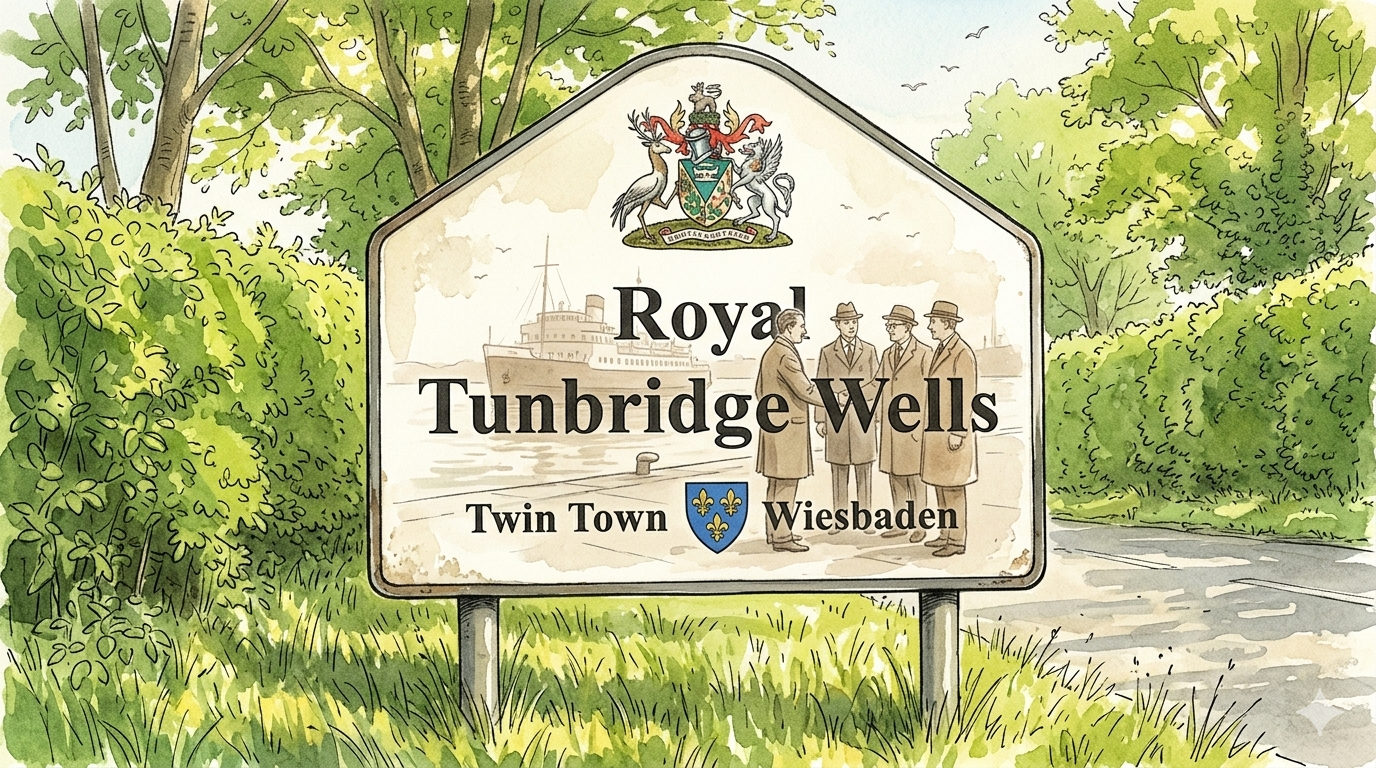
Every time you drive into Tunbridge Wells, you pass it. A white sign, a coat of arms, the word “Royal” in elegant lettering — and underneath, in smaller type, three words that almost nobody stops to think about: Twin Town Wiesbaden.
Most people register it the way you register a speed limit sign. A fact about the town, filed away, never investigated. Did you know that Wiesbaden is the twin town with Tunbridge Wells? What is Wiesbaden? Why is Tunbridge Wells twinned with it? Who decided this, and why?
The answer is one of the warmest stories in the entire WalkTW archive — and it starts with four men getting on a boat.
1960: Fifteen Years After the War
In March 1960, four ex-servicemen from Tunbridge Wells travelled to Germany to meet their counterparts in Wiesbaden.
Sit with that for a moment. The Second World War had ended fifteen years earlier. These were men who had fought — actually fought, in the war that had only just finished reshaping the entire world. They were keen to heal the wounds of the Second World War and to build a better world for the future.
The one-time combatants discovered they spoke a common language of active reconciliation. Two groups of men who had been on opposite sides of the most destructive conflict in human history sat down together in Wiesbaden and found that what they actually had in common was the desire for it never to happen again.
One of those four men was Tom MacAndrew, a former Royal Marine Commando. He went on to lead the Tunbridge Wells Twinning & Friendship Association as its first President, a role he held until his death in 2010. A Royal Marine Commando — a man trained for combat against exactly the kind of people he was now travelling to meet as friends — spent the next fifty years of his life building that friendship.
The Slow Build: Thirty Years to a Handshake That Counted
What’s striking about this story is how unhurried it was. Nobody rushed to declare reconciliation. It was built, deliberately, over decades.
The handshake of 1960 led to a partnership agreement in 1961. This was followed by a ‘Treaty of Friendship’ in 1971. Eleven years between the first meeting and a formal treaty. And then, in 1989, the two towns signed a Twinning Charter — a delegation from Royal Tunbridge Wells travelling to Wiesbaden to sign the city’s Golden Book, extending the existing friendship treaty to a full town twinning.
Twenty-nine years from the first tentative meeting to the formal arrangement that put “Twin Town Wiesbaden” on the sign at the edge of town. This wasn’t a gesture. It was a relationship, built the way relationships actually get built — slowly, through repeated contact, through people choosing again and again to keep showing up.
The “Little Tiddler” and the State Capital
Here’s the detail that gives the story its proper WalkTW twist.
Michael Holman, a former chairman of the Tunbridge Wells Twinning and Friendship Association, put it plainly: “It was hard work, I am sure, to convince Wiesbaden, a town of now 300,000 people, to twin with a little tiddler like Tunbridge Wells. Our population of the Borough is only about 120,000. At the time, it would have been much less. It’s a town on a grand scale, compared with Tunbridge Wells. But Tunbridge Wells has its attractions and is a lovely town to visit.”
Wiesbaden lies between the River Rhine and the foothills of the Taunus Mountains, just 40 kilometres west of Frankfurt, and has a population of about 290,000. Since 1945, it has been the capital of the State of Hesse.
Royal Tunbridge Wells — a market town in Kent — is formally twinned with the capital city of an entire German federal state. Somehow, four ex-servicemen and three decades of careful relationship-building talked a city of nearly 300,000 people into a friendship with a “little tiddler.” That’s not a bad outcome for a handshake.
Two Towns, Same Idea, Different Scale
The connection makes more sense once you know what Wiesbaden actually is. Sometimes called the “Nice of the North,” Wiesbaden once boasted 26 hot springs.
Tunbridge Wells and Wiesbaden are both fundamentally the same idea — a town that exists because of what comes out of the ground. One chalybeate spring built an entire English spa town around it, complete with promenades, Assembly Rooms, and three centuries of people coming to take the waters. Twenty-six hot springs did something similar on a much grander scale in Hesse.
Some of Tunbridge Wells’s attractions have direct links with Wiesbaden — the bicycle-shaped cycle-stands around town were made by a blacksmith from the German town, and there’s a Wiesbaden plaque incorporated into the water feature at The Pantiles‘ 1887 building, referencing the fact that both towns were founded on springs.
There is a small plaque, on The Pantiles, referencing the town’s German twin — built into a water feature, on the street everyone walks down every single day. Next time you’re there, look for it. The WalkTW archive would love to know exactly where it is, because we haven’t found it yet either.
Still Going, Sixty-Five Years Later
This isn’t a relationship that was formalised once in 1989 and then forgotten. The Twinning Association has organised member visits to Wiesbaden for the summer Wine Festival, the traditional Christmas Market, and the pre-Lenten “Fasching” Carnival. It has facilitated concerts in Tunbridge Wells for musical groups from Wiesbaden and made it possible for local musical groups to perform there. It has also supported school groups from Wiesbaden coming to Tunbridge Wells — one school has brought students for the past 17 years to undertake two weeks of work experience.
In 2022, the two towns celebrated 33 years of official twinning with Weisbaden. That means the formal relationship has now passed its 36th year — and the friendship itself, counting from that first meeting in 1960, is now in its sixty-fifth year. Tom MacAndrew, the Royal Marine Commando who made that first trip, didn’t live to see all of it — but the association he led for fifty years is still organising trips, still bringing German schoolchildren to Kent, still finding excuses for people from two towns on opposite sides of a continent to spend time together.
🗺️ Go Find It
The sign itself is at several of the main approaches into Royal Tunbridge Wells — you’ve almost certainly driven past one without registering it.
The Wiesbaden plaque on The Pantiles is, as far as the WalkTW archive currently knows, unlocated. If you spot it, or know exactly where it is, this is officially an open case.
And if you’re ever in Wiesbaden — forty kilometres west of Frankfurt, on the Rhine, in the foothills of the Taunus Mountains — there’s a vineyard there named after Queen Victoria, with its own bottle of wine, planted to commemorate a royal visit in 1845. A Tunbridge Wells connection, hiding inside a German wine label, four hundred miles from The Pantiles.
🕵️ The Open Question
Who were the other three? Tom MacAndrew’s name survives because he went on to lead the Twinning Association for fifty years. But he was one of four ex-servicemen who made that first trip in March 1960. Who were the other three? What did they do afterwards? Did any of their families know what they’d started?
Four names, from 1960, are sitting in someone’s local archive or someone’s family memory. If you know any of them, the WalkTW archive — and quite possibly the Twinning Association itself — would very much like to hear from you. 👇
You’ve walked past these places a hundred times. The Pantiles on a Saturday morning. The cricket ground on the Common. That moated house everyone’s been to for the maze and the dinosaurs.
What you may not know is that every one of these locations has, at some point, stood in for somewhere else entirely — a Victorian drapery, a fictional Hertfordshire estate, an American city, a Roman-occupied Britain, and the venue for India’s greatest cricketing triumph. In fact, there are 10 top movies filmed in Tunbridge Wells that highlight the town’s versatility on screen.
This weekend’s homework: pick one from the list below, watch it, and then go stand in the actual spot. Sorted from oldest to newest, so you can watch Tunbridge Wells’ screen career unfold in order.
1. The Draughtsman’s Contract (1982) — Groombridge Place
Peter Greenaway’s strange, elegant murder mystery marks the beginning of Groombridge Place’s screen career. The country house is Groombridge Place, a 1655 moated house set in landscaped grounds, in Groombridge, four miles southwest of Royal Tunbridge Wells on the Kent/Sussex border. Anthony Higgins plays a draughtsman commissioned to draw the estate, who gets pulled into an “enigmatic murder plot” — and the gardens became so associated with the film that the Apostle Walk at Groombridge is now commonly known as the Draughtsman’s Garden.
Go see it: Groombridge Place gardens are open to the public from spring to early November.
2. Half a Sixpence (1967) — The Pantiles
The deep-cut classic. Half a Sixpence, based on H.G. Wells’s novel Kipps, is a musical starring Tommy Steele and directed by Golden Globe winner George Sidney. The Pantiles in Royal Tunbridge Wells is the set for Shalfords Emporium — the draper’s shop where Kipps apprentices.
Next time you’re getting a coffee on The Pantiles, you’re standing where a 1960s movie musical built a working Victorian shop window.
Go see it: The Pantiles, obviously. You’re probably there already.
3. Pride & Prejudice (2005) — Groombridge Place as Longbourn
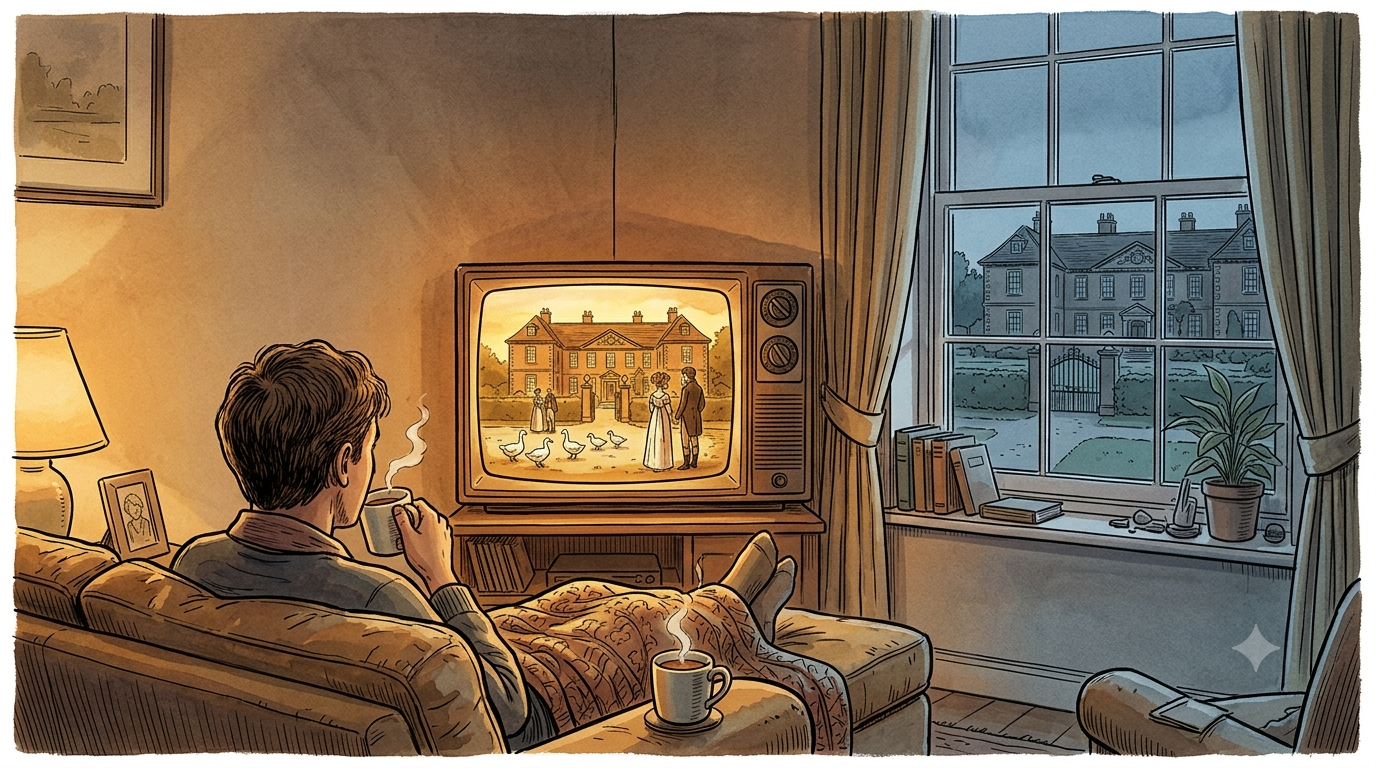
The big one. ‘Longbourn’, the Bennet family home, is a moated manor house, Groombridge Place, near Tunbridge Wells in Kent. The crew transformed Groombridge into a bustling, shabby-chic Bennet home — building a duckboard bridge across the moat, altering windows, and filling the courtyard with geese, chickens and manure piles to give Longbourn its lively, lived-in atmosphere.
Keira Knightley’s Elizabeth Bennet grew up, fictionally, four miles from Royal Tunbridge Wells. Austen describes Longbourn as “a comfortable house, though not handsome” — Groombridge’s charm and lived-in authenticity captured that perfectly.
Go see it: Same gardens as #1. The geese are (probably) gone.
(Editorial note: Chartwell is just outside our patch, in Westerham — close enough that it keeps coming up in searches, but not actually a Tunbridge Wells location. We’re not including it, because we’d rather give you ten that are real than pad the list. Onwards.)
4. The Day of the Triffids (2009, BBC) — Groombridge Place
Groombridge Place’s third screen credit, and its strangest. Groombridge Place has been used as a location for the 2009 BBC production of The Day of the Triffids. A genuinely menacing post-apocalyptic thriller about carnivorous plants taking over Britain, filmed partly at the same moated manor that played Jane Austen’s family home four years earlier.
The contrast is the entire point. Same gates, same moat, same gravel drive — one year it’s the Bennets having tea, the next it’s the last survivors of civilisation barricading themselves in against killer vegetation.
Go see it: Same gardens as #1 and #3. At this point, you should probably just buy a season ticket.
5. The Royals (2016-2018) — Tunbridge Wells area
The Royals (2016-2018) is noted by the Kent Film Office as a recent production to have filmed in the Tunbridge Wells area. This was an American E! network drama imagining a fictional version of the British royal family — meaning an American show about fictional British royals was, at some point, filmed in the one English town with “Royal” actually in its name.
We don’t yet know the specific locations used. If you remember crew vans or filming notices around town in 2016-2018, the WalkTW archive would love to hear from you.
6. Queens of Mystery (2020-2021) — Tunbridge Wells area
Queens of Mystery (2020-2021) is listed by the Kent Film Office as a recent production filmed in the Tunbridge Wells area. A gentle, Sunday-night murder mystery series set in a fictional English seaside town — exactly the kind of cosy crime drama where a Georgian spa town would make a perfect backdrop.
Again — specific locations not yet confirmed. Watch carefully and see if anything looks familiar.
7. Britannia, Series 3 (2021) — Claremont Gardens and Town Hill Road
The genre swerve of the list. During filming, the production visited Tunbridge Wells to film short scenes in Claremont Gardens and Town Hill Road. Britannia is a big, blood-soaked historical fantasy about Roman Britain and warring Celtic tribes — David Morrissey, druids, prophecy, the works.
Somewhere in Claremont Gardens or on Town Hill Road, a scene depicting Roman-occupied Britain was filmed within walking distance of the station. Look at those streets differently next time.
Go see it: Claremont Gardens and Town Hill Road are both public — walk past and see if you can guess what they stood in for.
8. This Way Up, Series 2 (2021) — Speldhurst
The “wait, that’s near here?” entry. This Way Up Series 2 (2021), created by and starring Aisling Bea, alongside Sharon Horgan and Tobias Menzies, used Tunbridge Wells in Kent as a filming location. The strikingly modern home featured in the opening episode of series two — where Shona settles into her fiancé Vish’s “super sleek” home while he’s away in New York — is in real life in the village of Speldhurst in Tunbridge Wells, designed by London architecture firm Architecturall.
An ultra-modern architect’s house in a Kent village, standing in for the kind of glossy London apartment that only exists on TV. The gap between “rural Speldhurst” and “the flat of someone’s tech-millionaire fiancé in London” is doing a lot of work here.
Go see it: Privately owned — admire from the road, don’t knock.
9. ’83 (2021) — Nevill Cricket Ground
The most unexpected entry on this list, by a distance. ’83, directed by Kabir Khan and starring Ranveer Singh and Deepika Padukone, is a major Bollywood film about India’s 1983 Cricket World Cup victory, and used Nevill Cricket Ground in Tunbridge Wells as a filming location.
One of the biggest Indian films of recent years — a national sporting triumph, one of the most celebrated moments in Indian cricket history — recreated, at least in part, on a ground in Hawkenbury, on the southern edge of Tunbridge Wells.
The choice of location isn’t random. The Nevill Ground’s only One Day International was, fittingly, a 1983 World Cup group match between India and Zimbabwe — the game in which Kapil Dev scored an extraordinary 175 not out. (Kirkus Reviews) If you’ve ever played a club match at the Nevill, you’ve stood on a ground with a genuine claim to 1983 World Cup history — which is presumably exactly why the Bollywood crew chose it.
Go see it: Nevill Ground, Nevill Gate, Warwick Park, TN2 5ES — about a mile south of the town centre, near Hawkenbury. Home of Tunbridge Wells Cricket Club, with matches most summer weekends.
10. Tuesdays and Fridays (2021, Netflix) — Danemore Park
The most recent entry, and the grandest house. Danemore Park is a Grade II-listed Georgian country house set in 80 acres, with a stable block, woodland, and a long driveway, in the district of Royal Tunbridge Wells, and was used for the Netflix film Tuesdays and Fridays.
A Georgian country house within the borough, on Netflix, released in 2021. If you’ve got a Netflix subscription and a free evening, this is the newest addition to TW’s screen CV.
🗺️ The WalkTW Weekend Challenge
Three of these are genuinely visitable: Groombridge Place (four separate productions across nearly forty years), The Pantiles (you’re there already), and Nevill Cricket Ground (turn up to a match).
If you watch any of these and spot something else — a street, a shopfront, a bit of garden you recognise — let us know. The Royals and Queens of Mystery entries on this list are still open cases. WalkTW would love to close them.
The pattern worth noticing: Groombridge Place alone has played a Georgian family home, a murder-mystery estate, Sherlock Holmes’s Birlstone Manor, and the last refuge from carnivorous plants — sometimes within a few years of each other. The same gates, the same moat, completely different worlds. That’s not a bad metaphor for Tunbridge Wells itself.
Every WalkTW story so far has followed a person — a writer, a mathematician, a Russian baroness, a playwright — and used the buildings of this town as their backdrop (Thackeray’s window. Cumberland’s playwright. Defoe’s promenade.). In this piece, however, we’ll turn our attention to an event: The Battle of Little Mount Sion. The buildings were always there, waiting patiently in the margins.
This is the series where the buildings get their turn.
Tunbridge Wells is 400 years old. That is 400 years of people living, arguing, dying, drinking, conspiring and occasionally dropping dead of shock inside the same walls. Some of those walls are still standing. Some of them are on streets you walked past this morning without a second glance.
The WalkTW Building Files is a new series — one building per post, investigated properly. Confirmed history, contested claims, rumours that won’t go away, and at least one question that nobody has yet managed to answer. Each post comes with directions, because the whole point is that you can go and stand in front of the building yourself and see what history has left behind.
We start where Tunbridge Wells itself started — on the hill above the Chalybeate Spring, in the oldest streets in town, where two pubs have been arguing about the same thing for four hundred years.
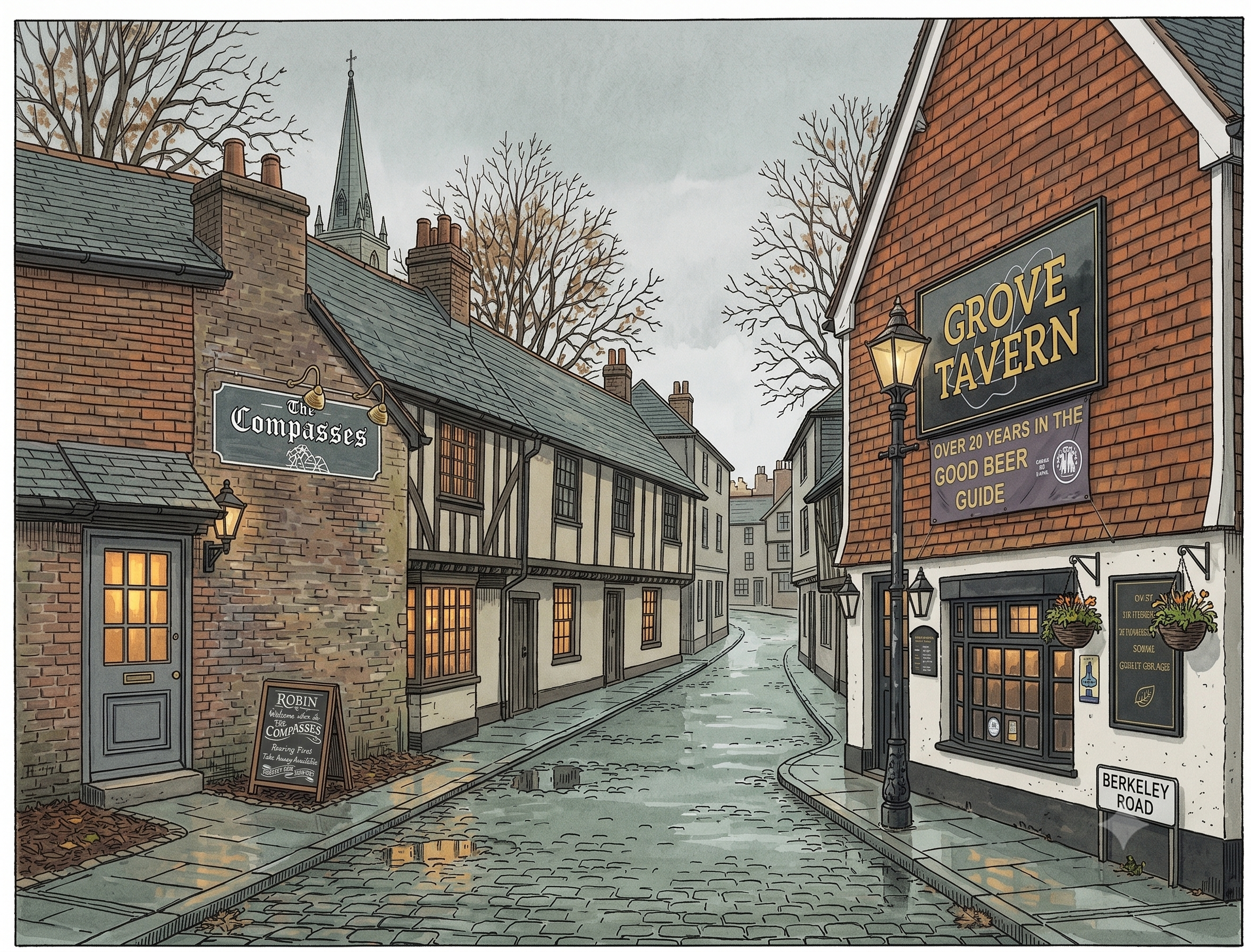
The Compasses, 45 Little Mount Sion, TN1 1YP, and
The Grove Tavern, 19 Berkeley Road, TN1 1YR
They face each other across a quiet backstreet in the oldest part of Tunbridge Wells. Two small pubs, forty metres apart, both claiming to be the oldest buildings in town. Both with beams, open fires and ghost stories. Both have reasons to doubt the other’s claim.
The Compasses is owned by Greene King and will tell you its history on a laminated card. The Grove Tavern is owned by its landlord and will tell you its history if you ask nicely and stay for a second pint.
Between them, they contain more of Tunbridge Wells’s original character than almost anywhere else in the town. The question of which one is older may never be settled. The more interesting question is why nobody is properly asking it.
The Hill Before the Town
To understand Little Mount Sion, you need to understand what it was before Tunbridge Wells existed.
When Lord North stumbled upon the Chalybeate Spring in 1606, there was nothing here — no town, no streets, no buildings. Just a spring in a field, two forested ridges on either side, and the ancient track between them. Tunbridge Wells was something of an artificial creation in the early to mid-17th century. Initially, there were no houses or hotels, just the spring, some shops, coffee houses and perhaps a pub or two in the area now called The Pantiles. Residential development only really started in the 1690s on Mount Sion and Mount Ephraim.
But before that formal development, before the lodging houses and the Assembly Rooms and the paving scandal, there were encampments. Visitors to the spring in the earliest decades pitched tents and temporary structures on the hillsides. And where there are encampments, there is always, eventually, somewhere to drink.
Those two ridges — Mount Sion and Mount Ephraim — were not neutral territory. If you have read our Mountain Feud post, you already know that the two hills were engaged in a cold war of competing religious and political identities throughout the 17th century. Mount Sion was Puritan, Parliamentarian, Nonconformist. Mount Ephraim was Royalist, Anglican, and fashionable. Little Mount Sion sat squarely in Puritan territory.
One of the first buildings on Mount Sion was an ale-house, which is now the Grove Tavern. That claim comes from the Tunbridge Wells Civic Society — not from the pub’s own marketing. It is as authoritative as anything in the historical record.
The Compasses, forty metres away on the same hill, says the same thing about itself.
The Name That Greene King Doesn’t Mention
The Greene King laminated card tells you the pub has had many names over the centuries — Compasses, Compasses Hotel, Compasses Inn, Three Compasses, Compasses and Horseshoe, Hogshead and Compasses.
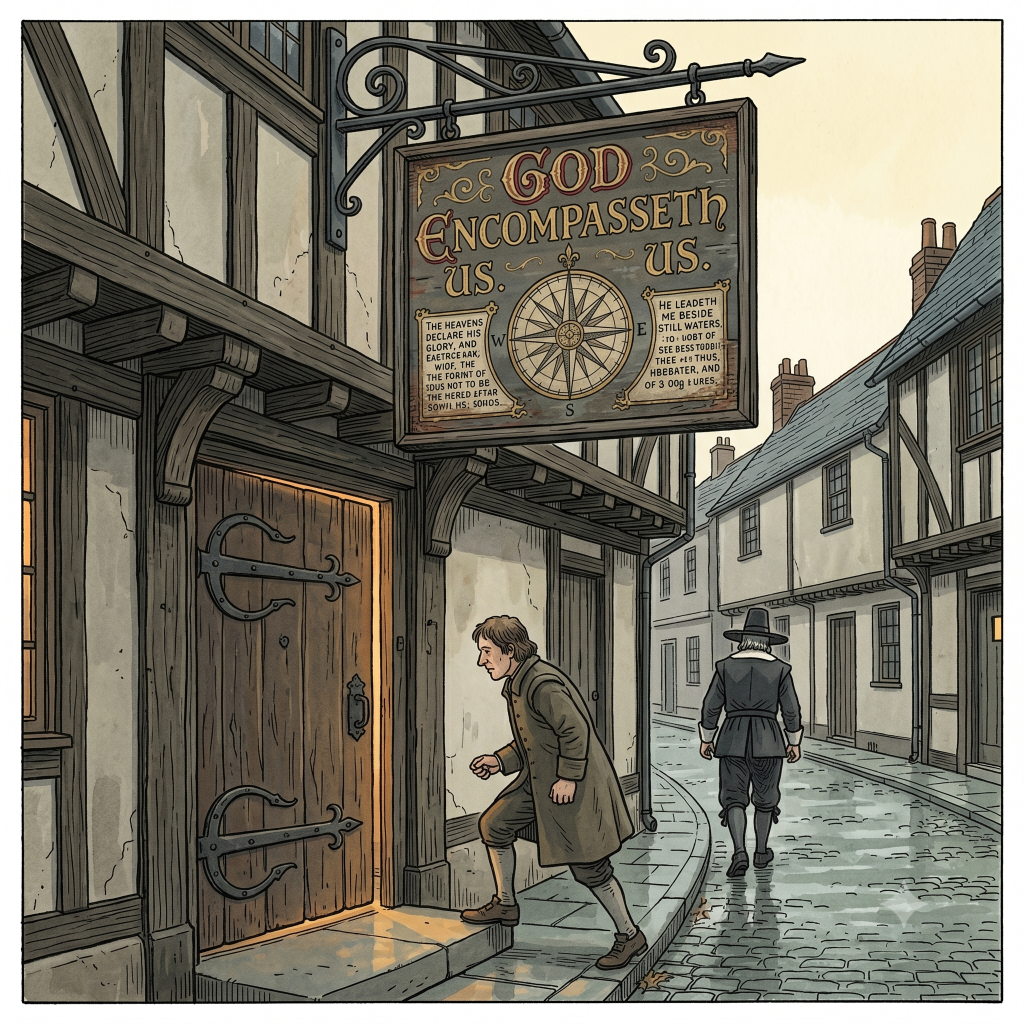
What it doesn’t tell you is what it was called before all of those. Searching in the local library reveals that it used to be called The Goat and Compass, which is a very strange name. However, when you dig deeper, you discover that it was originally an inn called God Encompasseth Us — a reference to the Bible’s view of God surrounding or encompassing his people, found in Psalm 139:5 and Hebrews 12:1-2.
Think about what that tells you. The earliest inn on this hill — in the 1630s, at the height of the Mountain Feud between the Puritan Mount Sion and the Royalist Mount Ephraim — was named after a Puritan scripture. God Encompasseth Us. This was a Puritan drinking house, on a Puritan hill, at a moment when the two ridges of Tunbridge Wells were engaged in a cold war of competing religious identities.
The pub was, from its very beginning, a theological statement. It just gradually shortened its name until nobody remembered what it meant.
The Night Mrs Pek Dropped Dead
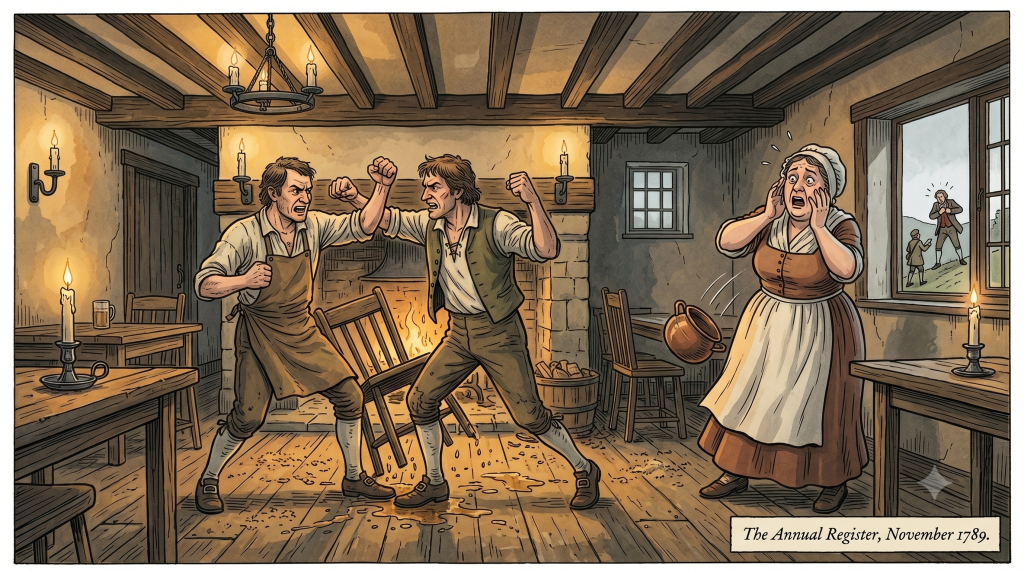
The Greene King card contains a story sourced from the Annual Register of November 1789 that deserves to be far better known than it is.
The landlady at the time was a Mrs Pek. One evening, a turner called Fenner — believed to be related to William Fenner, one of the best-known makers of Tunbridge Ware — and a carpenter called Philpot were drinking together at the pub. A quarrel arose between them, which proceeded to blows. The fight went on for some time.
The sight of the brawl so greatly affected Mrs Pek that she dropped dead. Although she was given medical help immediately, it was fatal.
But here is the detail that elevates this from a pub fight into something stranger. When news of Mrs Pek’s death was relayed to a Mr Field at Mount Ephraim — about half a mile away, who was a relative of the deceased — the shock was so great that he dropped dead too, while the story was being related to him.
Two people died as a direct result of a carpenter and a turner having an argument in a Tunbridge Wells pub in 1789. One of them was half a mile away when it happened. This is documented in the Annual Register. It is real. The next landlord, a Mr D. Schooler, also died at the inn in 1803.
The Exorcist, the Little Girl and the Angry Spirit
At some point in the pub’s history, one landlord had an exorcist attend, due to what the card describes only as “some activity.” The Compasses is said to be haunted by the spirit of a little girl who allegedly died on the premises. Her mother — described in the card as a prostitute — was murdered by her father on the same site.
Witnesses report shadows moving around the ground floor, sudden cold spots, the feeling of someone breathing over their shoulders, whispering in their ears. One member of staff has seen the ghost of a woman wearing a white coat-like garment.
Soul Searchers Kent, a paranormal investigation team, investigated the pub after receiving a call from the landlord. One ghost hunt ended when an angry and aggressive spirit shouted “Get out” at the paranormal team.
The paranormal team left.
Whether the spirit was the little girl, the murdered mother, the deceased Mrs Pek, the late Mr Schooler, or simply a Greene King customer who had been waiting too long for their food is not recorded.
This is not, incidentally, the only violent history on this street. The Capital of Infidelity series has already established that Georgian Tunbridge Wells ran on assignations, gambling and the management of appearances. The backstreets of Mount Sion were where the less respectable ends of that economy operated. Little Mount Sion was never quite as genteel as it looked.
Across the Street: Josh in the Cellar
While The Compasses accumulates its catalogue of deaths, exorcists and aggressive spirits, the Grove Tavern, forty metres away, has been quietly conducting its own supernatural affairs with rather more specificity.
The Grove Tavern was originally known as Brett’s boarding house, Chapel House, and the Grove in Mount Sion. The Brett family had extensive land holdings in the area. Later, the tap house was no doubt added to quench the visitors’ thirst.
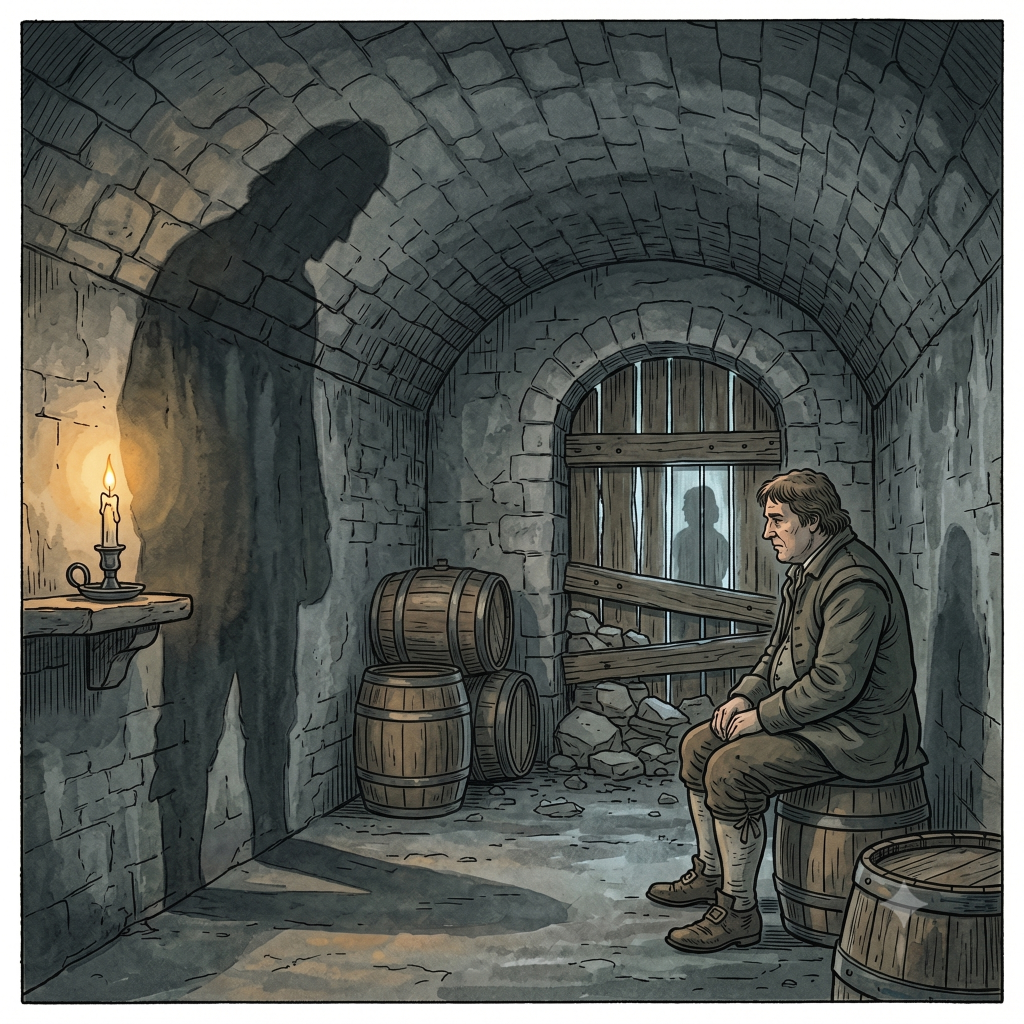
The ghost at the Grove Tavern has a name. The ghost reported to be haunting there is named Josh. The owner reported that he was a former cellar man waiting for his lady to come through the tunnel to the cellar for a clandestine meeting.
This detail requires unpacking. Legend states that tunnels ran beneath Little Mount Sion and other areas of the town. One is said to have led from a house across the street to the cellar of the Grove Tavern, and this house was one of ill repute. The gentlemen of the inn would greet ladies of the night there or even in the tunnel for some discreet meetings.
This puts Josh firmly in the same world that Daniel Defoe documented when he rode into town in 1722 and noted the “gaming, sharping, intriguing” with the eye of a man who had seen everything. The tunnels beneath Little Mount Sion were, apparently, part of the infrastructure of that intriguing.
Josh, the cellar man, is still waiting. The tunnel presumably still exists beneath the street, whether blocked or forgotten. The house of ill repute across the road is now something else entirely. The lady never arrived. Josh has been in the cellar since the 17th century.
The Grove Tavern is Grade II listed. Its listing was granted on 7 June 1974. English Heritage saw fit to protect this building. Nobody mentioned Josh in the paperwork.
The Grove Behind the Compasses
One detail from the Greene King card that connects both pubs to the wider history of the hill: behind The Compasses was the old Grove Park, where visitors to the spa would take their strolls after dining or listen to the orchestra on the bandstand, which is no longer there.
That same promenading culture — the performance of respectability over a private reality of gaming and assignation — runs through the entire Capital of Infidelity trilogy. The Georgian visitors who strolled in Grove Park after dinner were the same people conducting their less reputable business in the tunnels beneath the street. Tunbridge Wells has always been very good at holding both in balance.
The bandstand is gone. The grove is gone. The spa visitors are gone. The orchestra is gone. The tunnel may or may not still be there.
What remains: two small pubs, forty metres apart, still arguing about which one is older, on a hill that has been continuously occupied since before Tunbridge Wells had a name.
The WalkTW Verdict on the Oldest Pub Question
Honest answer: We cannot settle it. The historical record is genuinely ambiguous.
The Compasses has the more documented paper trail — the 1718 ownership record, the Annual Register account, and the multiple name changes that suggest continuous operation over centuries. The name God Encompasseth Us anchors it to the very earliest years of the town’s development.
The Grove Tavern has the more credible origin story — Brett’s boarding house predating the formal development of Mount Sion, the Civic Society’s assessment that it was one of the first buildings on the hill, the Grade II listing that formally recognises its historic significance.
One of the first buildings on Mount Sion was an ale-house, which is now the Grove Tavern. But there may have been places on The Pantiles that we would consider pubs, too.
The honest answer is that the question of the oldest pub in Tunbridge Wells may have no clean resolution — because the town itself grew too gradually and informally in its earliest decades to leave the kind of paper trail that would settle it definitively.
What we can say with confidence: both pubs are on the oldest surviving street in Tunbridge Wells, in buildings that have been serving drinks since the town was new, forty metres apart, and both are worth your time.
🗺️ Go Find Them Today
Both pubs are on Little Mount Sion — the quiet backstreet running parallel to the High Street, five minutes from the station and two minutes from The Pantiles. Walk up from the Chalybeate Spring, turn left past the Church of King Charles the Martyr, and you will find them facing each other across the street.
The Compasses — 45 Little Mount Sion, TN1 1YP. Greene King pub, food served, family friendly, open fires in winter. The laminated history card is on display inside. Ask about the exorcist.
The Grove Tavern — 19 Berkeley Road, TN1 1YR. Independent, no food, proper real ale, dog friendly, one bar. Steve Baxter has been a landlord since 2003 and knows the building better than anyone. Ask about Josh.
Visit both in the same afternoon. The pubs are forty metres apart, and the beer is better at the Grove. The ghost stories are better at The Compasses. Order accordingly.
🕵️ The Open Questions
Three things the WalkTW archive cannot yet answer:
Question 1: The Tunnel. Does the tunnel beneath Little Mount Sion still exist? Is it blocked, bricked up, forgotten, or still accessible from somewhere? The Grove Tavern’s cellar presumably connects to something. Has anyone looked?
Question 2: The Little Girl. The Greene King card says the researchers are currently unable to locate any children living at the inn in the historical record, but will keep researching. Has anyone found her? A child dying on licensed premises would have generated a coroner’s record, a newspaper report, something. Does anyone know where to look?
Question 3: The Original Name.God Encompasseth Us is the most extraordinary pub name in Tunbridge Wells history. When exactly did it change, and why? Was it a deliberate secularisation as the town’s Puritan character faded? Was it simply worn down by generations of drinkers who couldn’t be bothered with the theology? The local library apparently has the records. Has anyone checked?
Drop what you know in the comments. The Building Files are open. 👇
The WalkTW Building Files continue. Next up: the building on The Pantiles where a stage crossed a county border, a Ceres statue watches from the roof, and the ghost of a Georgian actress may or may not be taking a curtain call in the antiques market below.
There is a grave in Poets’ Corner, Westminster Abbey, that almost nobody visits.
It lies in the most literary postcode on earth — between Chaucer and Shakespeare and Dickens and Hardy, in the stone-flagged southern transept where Britain buries its writers. It belongs to playwright and novelist Richard Cumberland. He is best known as the Richard Cumberland playwright associated with Tunbridge Well. In addition, it sits next to the grave of actor John Henderson, near the grave of his closest friend Dr Samuel Johnson.
He died in Tunbridge Wells.
Not visited here, not merely connected here — he died here, in the house on this town’s streets that a subsequent owner named Cumberland House in his honour. He had arrived in 1785, when the town was in visible decline after Beau Nash’s era. His presence as a celebrity resident genuinely helped attract visitors back.
The most famous playwright in Georgian England retired to a spa town in need of saving. He wrote his most influential essays on its streets, and then died here. His house has been knocked down. His name means nothing to the town that named a building after him.
In Poets’ Corner, he lies near Samuel Johnson. In Tunbridge Wells, he is entirely forgotten.
The Man at the Top of Georgian Theatre
To understand what arrived in Tunbridge Wells in 1785, you need to understand what Richard Cumberland had been.
He was a prolific author and playwright best known for his highly successful sentimental comedies, including The Brothers (1769) and The West Indian (1771). He also wrote tragedies and historical novels. In addition, he wrote a history of Spanish painting and an autobiography which records his friendships with some of the greatest celebrities of the day, including the actor David Garrick and the writer and critic Samuel Johnson.
The West Indian, first produced by the great actor-manager David Garrick, enjoyed an extraordinary first run of twenty-eight nights and held the stage throughout the 18th century. Twelve thousand copies of the script were sold. When his third comedy, The Fashionable Lover, also succeeded in 1772, Cumberland was established as the leading dramatist of the sentimental school.
He moved in the circles that defined Georgian intellectual life. At the British Coffee House, he met Samuel Johnson, Sir Joshua Reynolds, Edmund Burke and Samuel Foote. He patronised the painter George Romney, whose portrait of Cumberland now hangs in the National Portrait Gallery. He was, for a decade, the most produced playwright in England.
And then things went somewhat sideways.
The Secret Mission That Ruined Everything
Here is the part of the story that nobody tells — because it is both deeply serious and faintly farcical, which is exactly the WalkTW register.
During the American War of Independence, Cumberland was sent by the government on a secret diplomatic mission to Madrid, with instructions to negotiate a separate peace with Spain and keep the Spanish out of the war. He spent months there. He spent £4,500 of his own money on the mission. He returned to England without the desired results and discovered the money would never be repaid. With the abolition of the Board of Trade soon after his return, and with but half his salary as compensation, he retired to Tunbridge Wells, where he remained until his death.
A failed secret agent. A government that wouldn’t cover his expenses. A job was abolished while he was abroad on its behalf. It is the kind of story that, in a different century, would make a very good television series.
He arrived in Tunbridge Wells in 1785: short, stout, red-faced, neatly dressed, and furious about Spain.
Sir Fretful Plagiary — The Most Famous Joke in Georgian London
There is one more thing he arrived carrying, invisible but heavy.
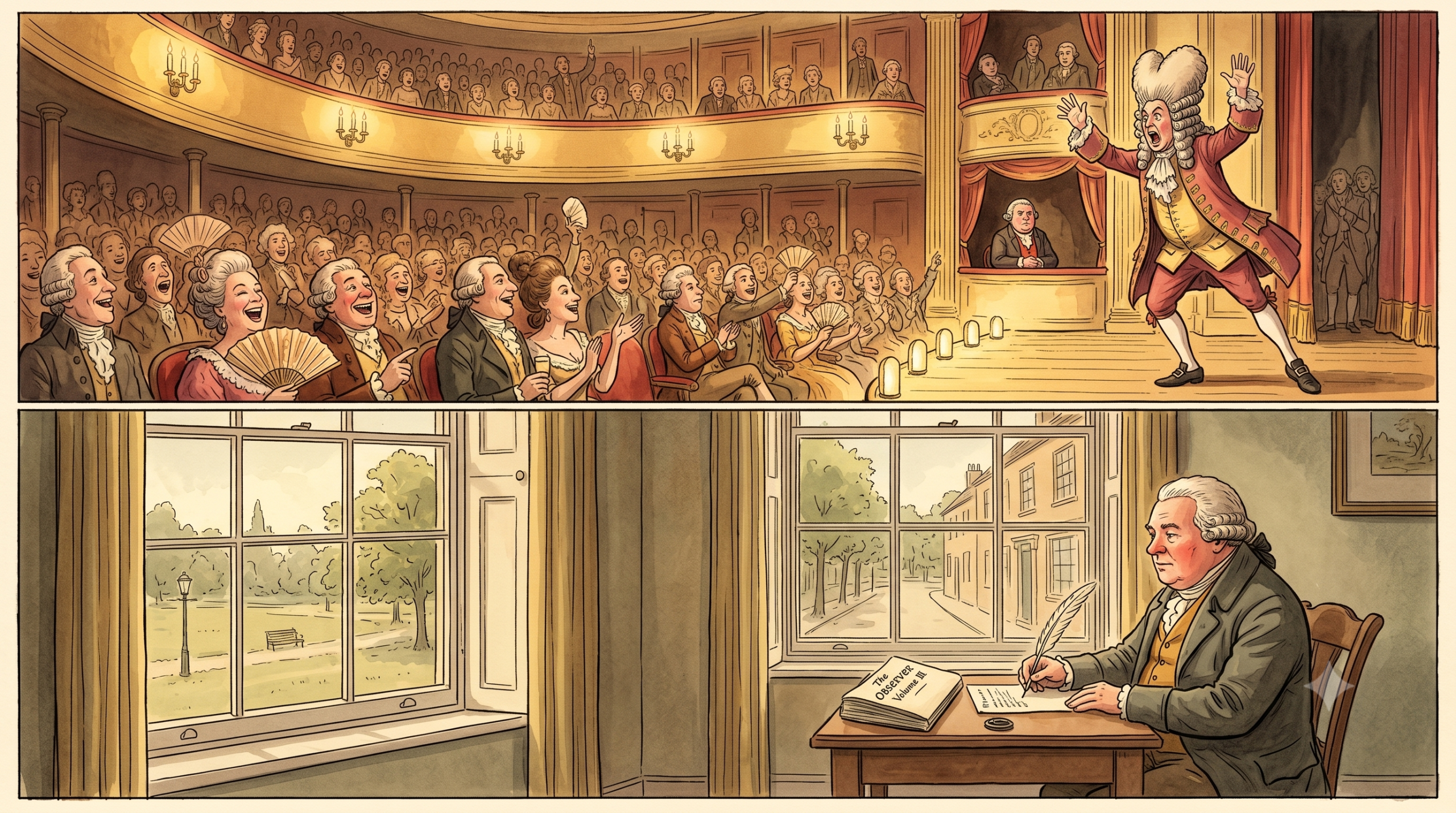
Six years before he came to Tunbridge Wells, Richard Brinsley Sheridan had written a play called The Critic. One of its major roles, Sir Fretful Plagiary, is a caricature of Richard Cumberland — a direct satirical portrait of the vanity of authors.
Sir Fretful Plagiary is thin-skinned, vain, obsessively sensitive to criticism, and incapable of hearing a negative word about his work without visible distress. He is, in Sheridan’s gleeful hands, everything a playwright should not be. He was immediately recognised by Georgian audiences as Cumberland. Garrick had already called Cumberland “a man without a skin” — meaning he had no protective layer against criticism, that every barb went straight in. Sheridan took that observation and turned it into one of the most memorable comic characters of the 18th century.
The most cutting satirical portrait in Georgian theatre was modelled on the man who would shortly retire to Tunbridge Wells. He knew it. London knew it. Everyone at the theatre knew it.
He came to this town carrying that knowledge. He sat in Cumberland House — wherever exactly it stood, on whichever street it occupied before being knocked down — and he wrote, and he kept writing, and he refused to stop.
What He Actually Did Here
His next prose work was a periodical paper called The Observer, which appeared in five volumes between 1786 and 1790 and contains 152 essays. The essays range across moral, literary and familiar subjects.
One hundred and fifty-two essays, written from this town, published over four years. Whatever the exact address of Cumberland House, 152 pieces of Georgian prose journalism were written somewhere on these streets — observations on literature, on morality, on the nature of comedy and tragedy, on the human condition as observed from a failing spa town in Kent by a man who had been to Madrid on a secret mission and come back with nothing but debt.
The essays were widely read. They were influential. In the late 18th century, Tunbridge Wells began to attract visitors once again, at least in part due to the presence of well-known residents such as Richard Cumberland.
He saved the town’s reputation simply by being here. The celebrity playwright in residence, writing his essays, receiving visitors, lending the place a cultural respectability it had been quietly losing since Beau Nash’s era ended. He was, without quite intending it, doing for Tunbridge Wells in the 1780s what Thackeray’s Restaurant does for the town today — giving it a reason to feel distinguished.
The Final Irony
Richard Cumberland is buried in Poets’ Corner, Westminster Abbey. His grave is near to the grave of his friend Dr Samuel Johnson.
He lies among Chaucer and Spenser, Dickens and Hardy, Johnson and Garrick. The Dean of Westminster decides who receives a place in Poets’ Corner based on merit. Cumberland was considered worthy of that company.
He had died in Tunbridge Wells. He had written his most enduring prose work here. The house that bore his name has been knocked down. There is no plaque, no commemorative bench, no reference on any heritage trail in the town.
In Westminster Abbey, he is remembered. In the town where he spent the last quarter of his life, he is invisible.
That is, come to think of it, the most Tunbridge Wells outcome imaginable.
🕵️ Fact or Fiction? The WalkTW Archive
Three questions for the comment section — and this time, one of them has a practical answer that someone in this town might actually know:
Question #1: Where Was Cumberland House? The house Richard Cumberland lived in was named Cumberland House in his honour by a subsequent owner and has since been demolished. It stood somewhere in Tunbridge Wells. Does anyone know which street it was on, or which building replaced it? The WalkTW archive would very much like to put a pin in the map.
Question #2: Did He Ever Watch Sarah Baker’s Theatre?Sarah Baker’s famous two-county theatre — the building now known as the Corn Exchange on The Pantiles — was operating throughout Cumberland’s years in Tunbridge Wells, from 1785 until his death. The most celebrated playwright in England was living in the same town as the most unconventional theatre manager in England. Did they ever meet? Did he ever sit in the audience? There is no record either way.
Question #3: Sir Fretful in Tunbridge Wells. Sheridan’s The Critic, which contains the Sir Fretful Plagiary caricature of Cumberland, was regularly performed in Georgian theatres throughout the period Cumberland was living here. Is it possible that Sarah Baker’s company ever staged The Critic in Tunbridge Wells while its subject was living in the town? The possibility alone is worth contemplating.
Drop what you know in the comments. 👇
The Writers Who Watched Us now has four parts: Thackeray, the man they laughed at, who outlasted them all in Poets’ Corner.
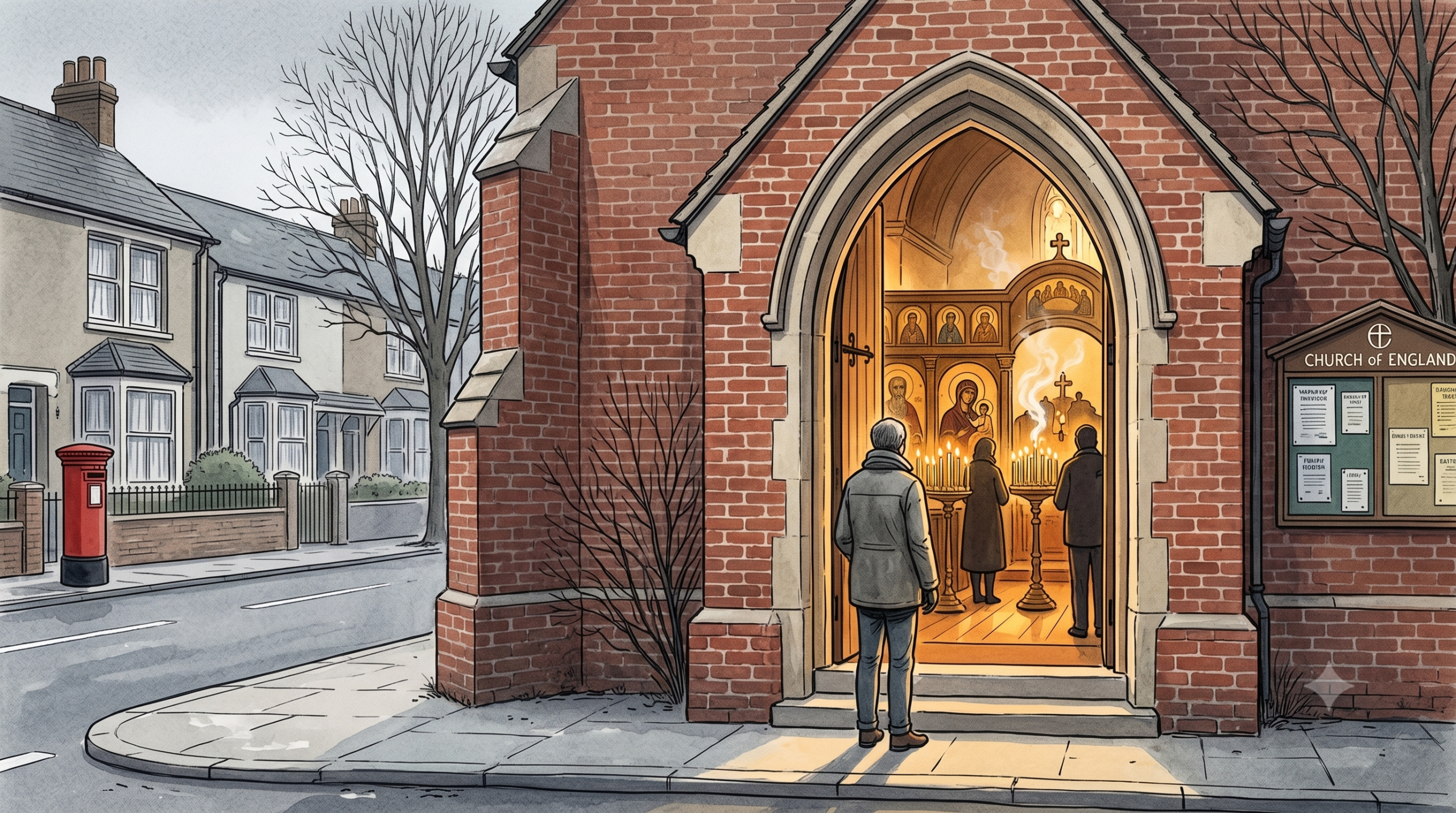
Stand on St Luke’s Road, TN4, on a Saturday morning. Look at the Victorian brick church on your left. Note the Church of England noticeboard. The familiar English parish signage. The entirely unremarkable, entirely ordinary appearance of a building that has stood here for over a century.
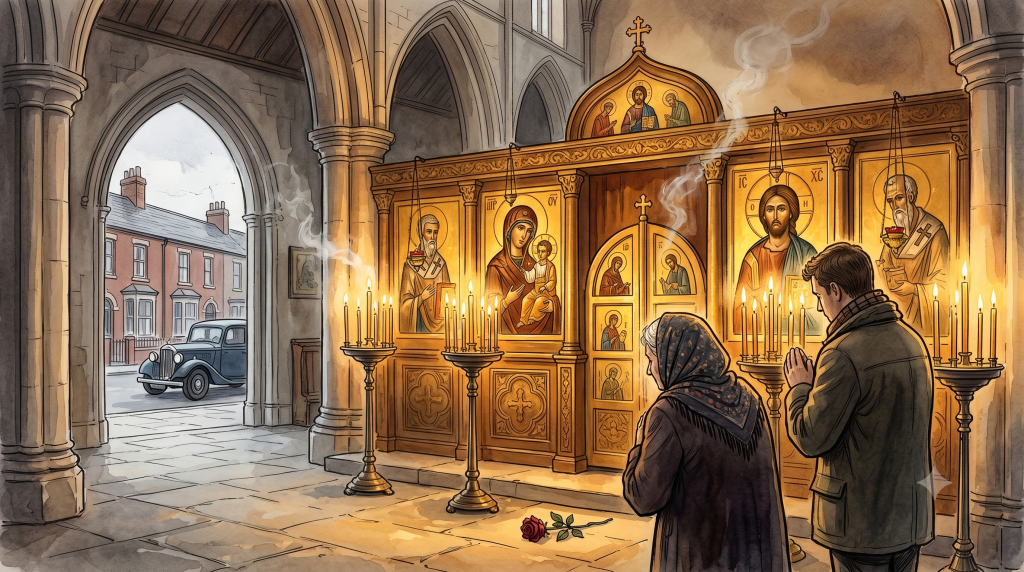
Nothing about it tells you what happens inside once a month. The Russian Orthodox Church in Tunbridge Wells holds a unique atmosphere for its community.
The Eucharistic Community of St Luke — patron saint St Luke, Diocese of Sourozh, Moscow Patriarchate — worships at St Luke’s Church, St Luke’s Road, Tunbridge Wells, TN4 9JH, with Fr Vitalii Polishchuk as rector and Dennis Flower as churchwarden.
A Russian Orthodox congregation. In Tunbridge Wells. Currently active, currently meeting, currently unknown to the overwhelming majority of the town in which it gathers.
The Russian Orthodox presence in Britain is far older and stranger than most people imagine.
The origins of the Diocese of Sourozh lie in the Parish of the Dormition in London, which, from 1716, served as the Russian Embassy Church and was relocated several times over its history. Three hundred years. Russian Orthodox Christians have been gathering in borrowed English buildings since the reign of George I — since before the Pantiles were properly paved, since before Beau Nash arrived to impose order on the promenade, since before almost anything in Tunbridge Wells’s modern history happened.
The Anglican Bishop of London agreed to allow Orthodox worship at the church, with the stipulation that the services remain private, that English people be excluded, and that singing not be loud “lest common crowds cause any harm.”
Services must remain private. English people excluded. Singing kept quiet.
Three hundred years later, on St Luke’s Road, the congregation still gathers in a building that belongs to the Church of England. They still keep themselves largely to themselves. The town still doesn’t know they’re there. Some things have a very long continuity.
The Man Who Built the Church That Reached Tunbridge Wells
To understand how a Russian Orthodox congregation ended up in TN4, you need to understand one extraordinary man.
Metropolitan Anthony of Sourozh — born Andrei Borisovich Bloom in Lausanne in 1914 — led the Diocese of Sourozh, the Russian Orthodox Church in Great Britain and Ireland, from 1962 until he died in 2003. His father had been a member of the Russian Imperial Diplomatic Corps. His mother was the sister of Alexander Scriabin, the composer. He grew up in Russia and Persia, fled with his family to Paris after the revolution, took a medical doctorate from the Sorbonne, served as a surgeon in German-occupied France, and arrived in Britain in 1949.
From the difficulties of Russian émigré life that had conditioned him as a monk without a monastery, through the trials of war and revolution, he moved between many changing landscapes, striving always to take his bearings in prayer and contemplation.
He became one of the most beloved spiritual writers in Britain. In its initial decades, the diocese consisted mainly of upper-middle-class ex-Anglican converts and families of the first emigration from Russia following the 1917 revolution. Metropolitan Anthony encouraged the development of a distinctive style, liturgical practice and ethos that reflected the fusion of Franco-Russian émigrés and Oxford-London ex-Anglicans.
Many Orthodox Christians in Great Britain and around the world consider Metropolitan Anthony a saint.
The congregation he built — from a London embassy church, through decades of quiet growth, through the Cold War years when the Moscow Patriarchate could exercise virtually no control over its British communities — eventually extended its reach to a quiet residential street in Tunbridge Wells. The grandson of a revolutionary disruption, still gathering, still praying, still entirely invisible from the outside.
What Happens Inside
Here is what you would find if you went in.
The building would look Anglican from the nave — Victorian proportions, familiar stonework, English light through English windows. But the space would be transformed. Icons — the gilded, luminous faces of Orthodox saints — arranged in the Eastern manner. Candles burning in the particular way of Orthodox worship, not placed in rows but clustered at focal points, filling the space with warm, uneven light. The smell of incense. The sound, when the liturgy begins, is of a tradition of sung worship that stretches back through Byzantium to the earliest centuries of Christianity.
The service would be in Church Slavonic — the ancient liturgical language of Orthodox Slavic worship — and in English. In the Orthodox tradition, the congregation would stand for most of the service. There would be no pews to retreat into.
It is, in every way, unlike anything else in Tunbridge Wells.
The Personal Thread
This trilogy began with a woman in a cloche hat and jade earrings on the streets of 1920s Tunbridge Wells — Baroness Olga, the town’s only acknowledged Russian Revolution refugee, noticed by a historian’s child and recorded in a prize-winning book that the town itself has never read.
It continued with the Romanovs, who almost came to Sussex, the cousins who called each other Georgie and Nicky, the Royal prefix granted in 1909 by a king who would shortly make the worst decision of his life.
It ends here. On St Luke’s Road. With a congregation that has been quietly gathering, in one form or another, for longer than anyone in the town suspects — the living thread that connects 1917 to the present, the revolution to the here and now, the jade earrings on a 1920s street to a monthly liturgy in a Victorian Church of England building that gives nothing away from outside.
There is a Russian in Tunbridge Wells who has lived here for seven years and never knew this congregation existed until a few weeks ago.
There are almost certainly others.
If you are Russian, or Orthodox, or simply curious, the contact is Dennis Flower, churchwarden, at [email protected]. The door is open. The candles are lit. The congregation is smaller than it should be, in a town that doesn’t know it’s there.
Now you know.
🕵️ The WalkTW Archive: Final Questions for the Trilogy
Three closing questions — one for each post in the series:
From Post 1: Who was Baroness Olga? Richard Cobb gives us her cloche hat, her jade earrings, and her title and nothing else. The WalkTW archive has been asking since the first post. Does anyone know her full name, her address, her story beyond Cobb’s single paragraph?
From Post 2: Which Sussex estates did Grand Duke Michael Alexandrovich own? He formally requested permission to return to them in 1917. They were real. They had an address. Did they border Kent? Could he, in another history, have taken the train through Tunbridge Wells Central on his way home?
From Post 3: How old is the Tunbridge Wells Russian Orthodox congregation? The Diocese of Sourozh was formally constituted in 1962, but its roots go back to the 1917 émigré wave. If Baroness Olga was in Tunbridge Wells in the 1920s, was there already a small Orthodox community gathering somewhere in this town — informally, invisibly, in someone’s drawing room — before there was ever a parish listing or a churchwarden’s email address?
The archive is listening. Drop what you know in the comments. 👇
And that, for now, is the end of The Russians Are Among Us — three posts, three centuries, one town that kept its Russian connections entirely to itself. Until now.