The Building That Broke the Law by Existing
The Corn Exchange, 49 The Pantiles, Royal Tunbridge Wells, TN2 5TN is also known for being the historic Corn Exchange building at Pontiles Tunbridge Wells.
Walk south along The Pantiles on any summer afternoon. Pass the Chalybeate Spring, pass the coffee shops and the collonaded walkway. Stop when you reach the building with the statue on the roof.
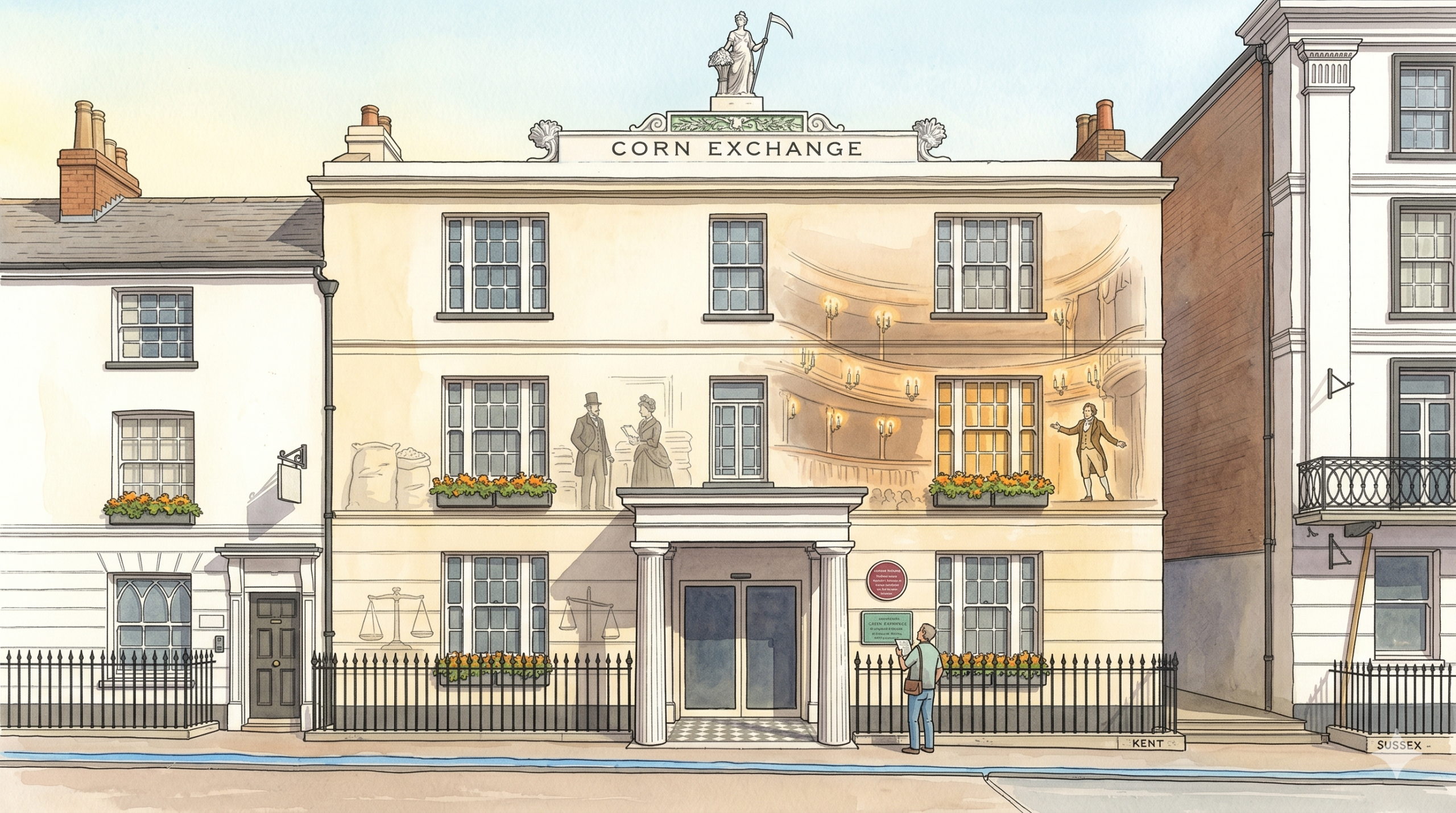
Look up. She’s been there since 1844 — Ceres, the Roman goddess of grain and harvest, standing on a parapet flanked by cornucopias, scythe in hand, looking out over The Pantiles with the expression of someone who has seen everything and is mildly amused by most of it.
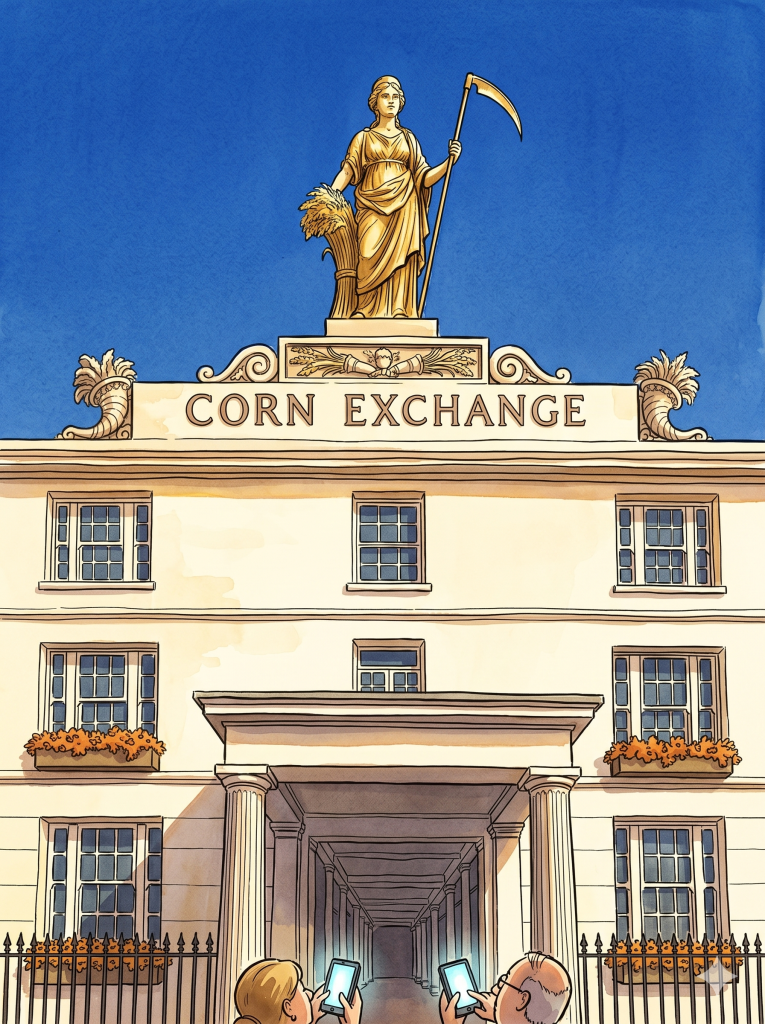
The Historic England listing describes her simply as “a statue of a female figure with scythe and sheaf of corn.” However, she is considerably more interesting than that. She is watching over a building that began its life as a theatre, hosted two of the greatest actors in British history, straddled a county border, and was — at one point — technically in two different counties simultaneously.
The Corn Exchange is not what it appears to be. In fact, it never has been.
How a Fairground Performer Built a Theatre on The Pantiles
Sarah Baker was an illiterate fairground performer who became one of the most successful self-made women of her time. Born in 1737, she grew up travelling the country with her mother and younger sister, entertaining crowds at country fairs and race meetings. In the early 1770s, recently widowed and with three young children, she took over the small family troupe.
In the face of fierce opposition from male rivals, she began building a theatre empire across Kent. It was not until 1789 that Sarah — well into her fifties by then — opened the first of what she described as her “great grand” Kentish theatres in Canterbury. She went on to build three more purpose-built theatres in the county: Rochester in 1791, Maidstone in 1798, and Tunbridge Wells in 1802.
All four were built to the same plan and similar dimensions, to allow for scenery to be easily moved between them. As a result, Sarah ran what was effectively a theatrical touring circuit across the entire county — moving actors, sets and costumes between four identical buildings, each playing to a different Kent audience.
The Tunbridge Wells theatre cost her approximately £1,600 to build. It officially opened on 8 July 1802, designed in the neoclassical style, built in brick with a stucco finish, and featuring a symmetrical main frontage of three bays facing onto The Pantiles.
That original frontage is still exactly what you’re looking at today.
The Stage in Sussex, The Audience in Kent
Here is the detail that belongs on every heritage trail in this town and is on none of them.
The Corn Exchange was built in 1802 over the Grom Brook, which carried the county boundary between Kent and Sussex. As a result, the actors on the stage would perform in Sussex while the audience watched from Kent.
Think about what that means in practice. Every actor who walked onto that stage stepped from Kent into Sussex. Every entrance was a county crossing. Every exit was a return to England’s garden county. The audience, meanwhile, sat in Kent and watched people perform in a different county entirely.
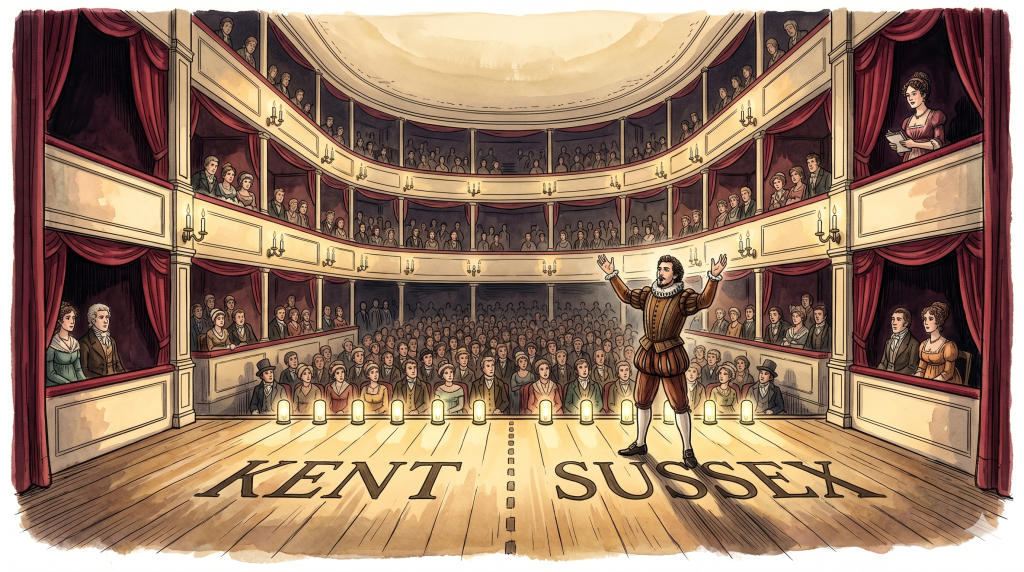
Before the alteration of the county boundary, the theatre had the stage in Sussex and the auditorium in Kent. It later became the Corn Exchange. In 1894, however, the administrative boundary was redrawn to encompass the entire expanding town. Under the Local Government Act 1894, the boundary between the Administrative County of Kent and the Administrative County of East Sussex was moved two miles south, incorporating the entirety of the growing town.
Therefore, the county-straddling stage disappeared not because anything about the building changed, but because a government act moved the border. The theatre didn’t move. England simply redrew itself around it.
The Actor Who Left Town Ahead of a Mob
The actors Edmund Kean and Charles Kemble both performed on the stage in the building in the first half of the 19th century. In addition, the plaque on the wall outside confirms this plainly. However, the plaque does not mention what happened next.
Edmund Kean went on to become arguably the greatest Shakespearean actor of the 19th century. He was one of the greatest of English tragic actors — a turbulent genius noted as much for his megalomania and ungovernable behaviour as for his portrayals of villains in Shakespearean plays.
Before all of that, however, he was a young actor in Mrs Baker’s company at Tunbridge Wells. He joined Mrs Baker’s company in Tunbridge Wells and spent a year there. Furthermore, he probably would have stayed longer, except he found himself in trouble with a townsman — he had seduced the man’s wife — and was forced to leave just ahead of a vengeful mob.
The man who would later be described by Coleridge as watching his acting being “like reading Shakespeare by flashes of lightning” left Tunbridge Wells one step ahead of an angry husband. He then went to Gloucester, met a woman called Mary Chambers, married her, and eventually became the most celebrated actor in England.
The stage where all of this began is now an antiques market. However, the frontage is unchanged. Next time you walk past, note the three neoclassical bays, the fluted Doric columns at the porch, and the parapet above. That is exactly what Edmund Kean saw when he first arrived — and rather hastily when he left.
From Theatre to Grain Market to Antiques
After Baker died in 1816, the theatre passed to her son-in-law, William Dowton. However, audiences dwindled, and the theatre closed in 1843.
In consequence, the building became a corn exchange — a market where grain was bought and sold. The corn exchange conversion was completed, and the building reopened in November 1844 by John Nevill, 3rd Earl of Abergavenny, whose seat was at Eridge Park. Furthermore, it was at this point that the Ceres statue appeared on the roof — the Roman goddess of grain, finally appropriate to the building’s new purpose.
For a century, therefore, the building that Sarah Baker built as a theatre sold wheat. Then it became a Tourist Information Centre. Finally, it is today an antiques and fine art market — Grade II listed, officially designated on 20 May 1952.
However, the interior you see today is not entirely original. The building was extensively reconstructed in 1989. As a result, the original theatrical interior — the stage, the auditorium, the boxes where Georgian audiences watched performances in a different county — is gone. What remains is the 1802 frontage, unchanged and still facing The Pantiles.
What the Plaque Doesn’t Tell You
There is a green plaque on the wall. It reads, accurately, that this was formerly the Tunbridge Wells Theatre, built in 1802 by Sarah Baker, that Edmund Kean and Charles Kemble performed here, and that the stage was in Sussex while the auditorium was in Kent.
However, it doesn’t mention that Sarah Baker was illiterate. She reputedly never learned to write more than her name, yet when she died at Rochester in February 1816, just months before her eightieth birthday, her estate was estimated at more than £20,000 — equivalent to well over £1.5 million today.
Furthermore, it doesn’t mention that Edmund Kean left the building toward an angry mob. It doesn’t mention the county boundary running beneath the stage, or the Grom Brook that carried it. It doesn’t mention that the woman watching from the roof has been standing there since 1844, long before anyone now alive was born, watching everything that happens on The Pantiles with the patient attention of someone who has absolutely nowhere else to be.
🗺️ Go Find It Today
The Corn Exchange is at 49 The Pantiles, TN2 5TN — on the south side of the Lower Walk, impossible to miss. Look for Ceres on the roof. The green plaque is on the wall to the right of the entrance.
The antiques market inside is open most days. Therefore, this is the one Building File entry where you can walk around inside the building freely — browsing furniture and vintage prints on the site of a stage that was once in a different county.
Meanwhile, if you want the full Sarah Baker picture, the Theatre Wars post and the Theatre Queen of The Pantiles cover the remarkable story of how she built her empire in much more detail.
🕵️ The Open Questions
Three things the WalkTW archive cannot yet answer:
Question 1: The Grom Brook. The county boundary ran along the Grom Brook, which flowed beneath the building. However, where exactly is the Grom Brook today? It has clearly been culverted — built over, diverted underground — at some point between 1802 and the present. Does it still flow beneath The Pantiles? Does anyone know where it goes?
Question 2: The Mob. Edmund Kean left Tunbridge Wells ahead of a vengeful townsman whose wife he had seduced. The sources confirm this. However, they do not name the townsman, the wife, or the street. Does any local record — newspaper archive, diary, parish record — fill in the gap?
Question 3: The Original Interior. The 1989 reconstruction removed the theatrical interior entirely. However, before it was reconstructed, did anyone photograph the original auditorium? Was there anything left of the Georgian theatre inside by 1989 — original boxes, gallery ironwork, backstage machinery? Does anyone know what was lost?
Drop what you know in the comments. The Building Files are open. 👇
The WalkTW Building Files continue. Next up: the hotel on The Pantiles where a young woman leapt from a window, a ghost has been throwing furniture in Room 16 since at least 1997, and the building itself has been watching the promenade since before Tunbridge Wells was Royal.
#TunbridgeWells #WalkTW #BuildingFiles #CornExchange #ThePantiles #SarahBaker #EdmundKean #LocalHistory #HiddenTunbridgeWells
Leave a Reply