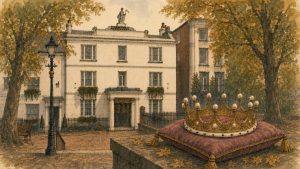
Stand on St Luke’s Road, TN4, on a Saturday morning. Look at the Victorian brick church on your left. Note the Church of England noticeboard. The familiar English parish signage. The entirely unremarkable, entirely ordinary appearance of a building that has stood here for over a century.
Nothing about it tells you what happens inside once a month. The Russian Orthodox Church in Tunbridge Wells holds a special place in its community.
The Eucharistic Community of St Luke — patron saint St Luke, Diocese of Sourozh, Moscow Patriarchate — worships at St Luke’s Church, St Luke’s Road, Tunbridge Wells, TN4 9JH, with Fr Vitalii Polishchuk as rector and Dennis Flower as churchwarden.
A Russian Orthodox congregation. In Tunbridge Wells. Currently active, currently meeting, currently unknown to the overwhelming majority of the town in which it gathers.
The revolution that sent Baroness Olga to walk these streets in her cloche hat and jade earrings in the 1920s, the same revolution that forced the Romanovs who might have found refuge in England to die instead in a cellar in the Urals — that revolution set in motion a long chain of Russian lives in Britain. One link is still here. It meets on St Luke’s Road. And almost nobody knows.
Three Hundred Years of Hiding in Plain Sight
The Russian Orthodox presence in Britain is far older and stranger than most people imagine.
The origins of the Diocese of Sourozh lie in the Parish of the Dormition in London, which, from 1716, served as the Russian Embassy Church and was relocated several times over its history. Three hundred years. Russian Orthodox Christians have been gathering in borrowed English buildings since the reign of George I — since before the Pantiles were properly paved, since before Beau Nash arrived to impose order on the promenade, since before almost anything in Tunbridge Wells’s modern history happened.
The Anglican Bishop of London agreed to allow Orthodox worship at the church, with the stipulation that the services remain private, that English people be excluded, and that singing not be loud “lest common crowds cause any harm.”
Services must remain private. English people excluded. Singing kept quiet.
Three hundred years later, on St Luke’s Road, the congregation still gathers in a building that belongs to the Church of England. They still keep themselves largely to themselves. The town still doesn’t know they’re there. Some things have a very long continuity.
The Man Who Built the Church That Reached Tunbridge Wells
To understand how a Russian Orthodox congregation ended up in TN4, you need to understand one extraordinary man.
Metropolitan Anthony of Sourozh — born Andrei Borisovich Bloom in Lausanne in 1914 — led the Diocese of Sourozh, the Russian Orthodox Church in Great Britain and Ireland, from 1962 until he died in 2003. His father had been a member of the Russian Imperial Diplomatic Corps. His mother was the sister of the composer Alexander Scriabin. He grew up in Russia and Persia, fled with his family to Paris after the revolution, took a medical doctorate from the Sorbonne, served as a surgeon in German-occupied France, and arrived in Britain in 1949.
From the difficulties of Russian émigré life that had conditioned him as a monk without a monastery, through the trials of war and revolution, he moved across changing landscapes, striving to take his bearings in prayer and contemplation.
He became one of the most beloved spiritual writers in Britain. In its initial decades, the diocese consisted mainly of upper-middle-class ex-Anglican converts and families from the first wave of emigration from Russia following the 1917 revolution. Metropolitan Anthony encouraged the development of a distinctive style, liturgical practice and ethos that reflected the fusion of Franco-Russian émigrés and Oxford-London ex-Anglicans.
Many Orthodox Christians in Great Britain and around the world consider Metropolitan Anthony a saint.
The congregation he built — from a London embassy church, through decades of quiet growth, through the Cold War years when the Moscow Patriarchate could exercise virtually no control over its British communities — eventually extended its reach to a quiet residential street in Tunbridge Wells. The grandson of a revolutionary disruption, still gathering, still praying, still entirely invisible from the outside.
What Happens Inside
Here is what you would find if you went in.
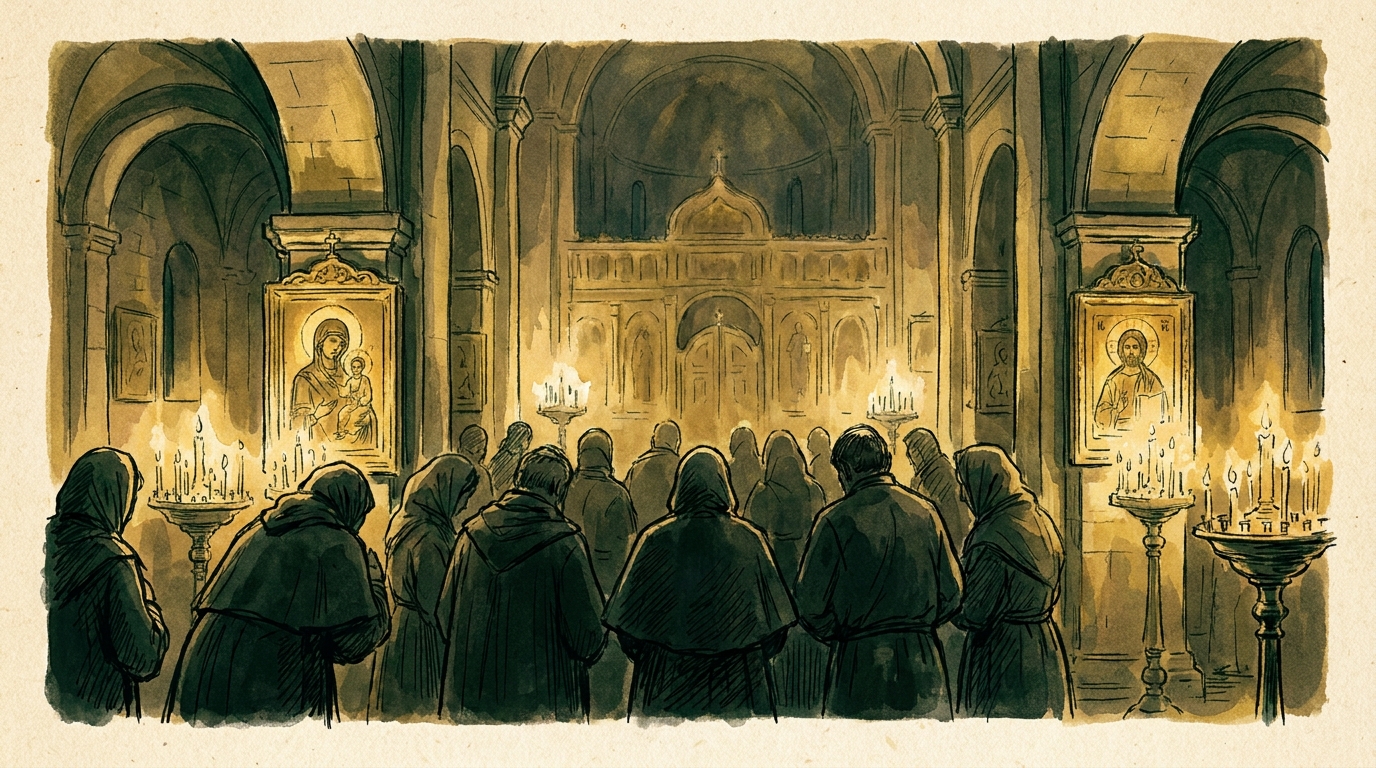
The building would look Anglican from the nave — Victorian proportions, familiar stonework, English light through English windows. But the space would be transformed. Icons — the gilded, luminous faces of Orthodox saints — arranged in the Eastern manner. Candles burning in the particular way of Orthodox worship, not placed in rows but clustered at focal points, filling the space with warm, uneven light. The smell of incense. The sound, when the liturgy begins, is of a tradition of sung worship that stretches back through Byzantium to the earliest centuries of Christianity.
The service would be in Church Slavonic — the ancient liturgical language of Orthodox Slavic worship — and in English. In the Orthodox tradition, the congregation would stand for most of the service. There would be no pews to retreat into.
It is, in every way, unlike anything else in Tunbridge Wells.
The Personal Thread
This trilogy began with a woman in a cloche hat and jade earrings on the streets of 1920s Tunbridge Wells — Baroness Olga, the town’s only acknowledged Russian Revolution refugee, noticed by a historian’s child and recorded in a prize-winning book that the town itself has never read.
It continued with the Romanovs, who almost found refuge in England, the cousins who called each other Georgie and Nicky, the Royal prefix granted in 1909 by a king who would shortly make the worst decision of his life.
It ends here. On St Luke’s Road. With a congregation that has been quietly gathering here since 2007 — a later chapter in the same long story, linking the revolution to the here and now, the jade earrings on a 1920s street to a monthly liturgy in a Victorian Church of England building that gives nothing away from outside.
There is a Russian in Tunbridge Wells who has lived here for seven years and never knew this congregation existed until a few weeks ago.
There are almost certainly others.
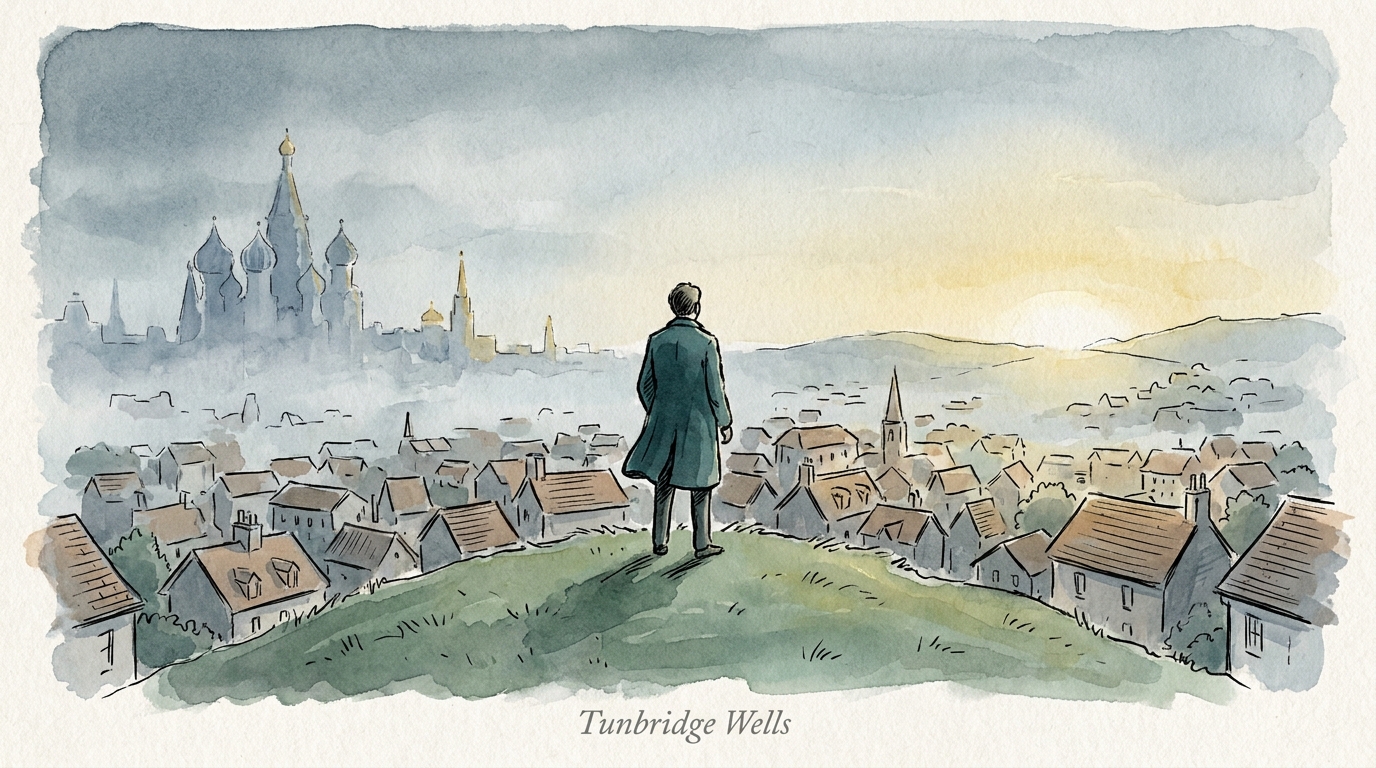
If you are Russian, or Orthodox, or simply curious, the contact is Dennis Flower, churchwarden, at [email protected]. The door is open. The candles are lit. The congregation is quietly growing, in a town that doesn’t know it’s there.
Now you know.
Go Find It Today
- The Spot: St Luke’s Church, St Luke’s Road, TN4 9JH, a Victorian brick church with ordinary Church of England signage.
- The Route: It is a short journey from the town centre. The Russian Orthodox community meets about once a month, so check its news page for dates first.
- The View or Challenge: Stand outside and look for any sign of what happens inside. You will find none, which is exactly the point of the story.
Fact or Fiction? The WalkTW Archive
- Does a Russian Orthodox congregation really meet in Tunbridge Wells? Yes. The Eucharistic Community of St Luke, part of the Diocese of Sourozh, worships at St Luke’s Church.
- Has Orthodox worship in Britain lasted about 300 years? Broadly yes. The diocese traces its roots to the Russian embassy church in London, dated from 1716.
- Did Metropolitan Anthony lead the diocese for decades? Yes. He led it from 1962 until his death in 2003.
- Was there an Orthodox group in Tunbridge Wells in the 1920s? Unknown. We have found no record either way.
Final Questions:
Three closing questions — one for each post in the series:
From Post 1: Who was Baroness Olga? Richard Cobb gives us her cloche hat, her jade earrings, and her title and nothing else. The WalkTW archive has been asking since the first post. Does anyone know her full name, her address, her story beyond Cobb’s single paragraph?
From Post 2: Did Grand Duke Michael Alexandrovich ever visit Kent during his months in England? He leased Knebworth House in Hertfordshire in 1913 and photographed the countryside. We have found no record of a visit to Kent. Could he have passed through Tunbridge Wells Central on a trip to the coast?
From Post 3: When did Russian Orthodox worship first reach Tunbridge Wells? The diocese dates the current parish to 2007, though the Diocese of Sourozh itself was formally constituted in 1962, with roots in the 1917 émigré wave. If Baroness Olga was in Tunbridge Wells in the 1920s, was there already a small Orthodox community gathering somewhere in this town — informally, invisibly, in someone’s drawing room — before there was ever a parish listing or a churchwarden’s email address?
The archive is listening. Drop what you know in the comments.
Read the whole Russian Tunbridge Wells trilogy
- Part 1: The Russians Who Came to Stay
- Part 2: The Russians Who Never Arrived
- Part 3: The Russians Who Never Left
Prefer to watch? The whole trilogy is also a four-minute film: watch “The Quiet Russians of Tunbridge Wells” on its film page.
Enjoyed this?