The Building That Straddled Two Counties
The Corn Exchange, 49 The Pantiles, Royal Tunbridge Wells, TN2 5TE.
Walk south along The Pantiles on any summer afternoon. Pass the Chalybeate Spring, pass the coffee shops and the collonaded walkway. Stop when you reach the building with the statue on the roof.
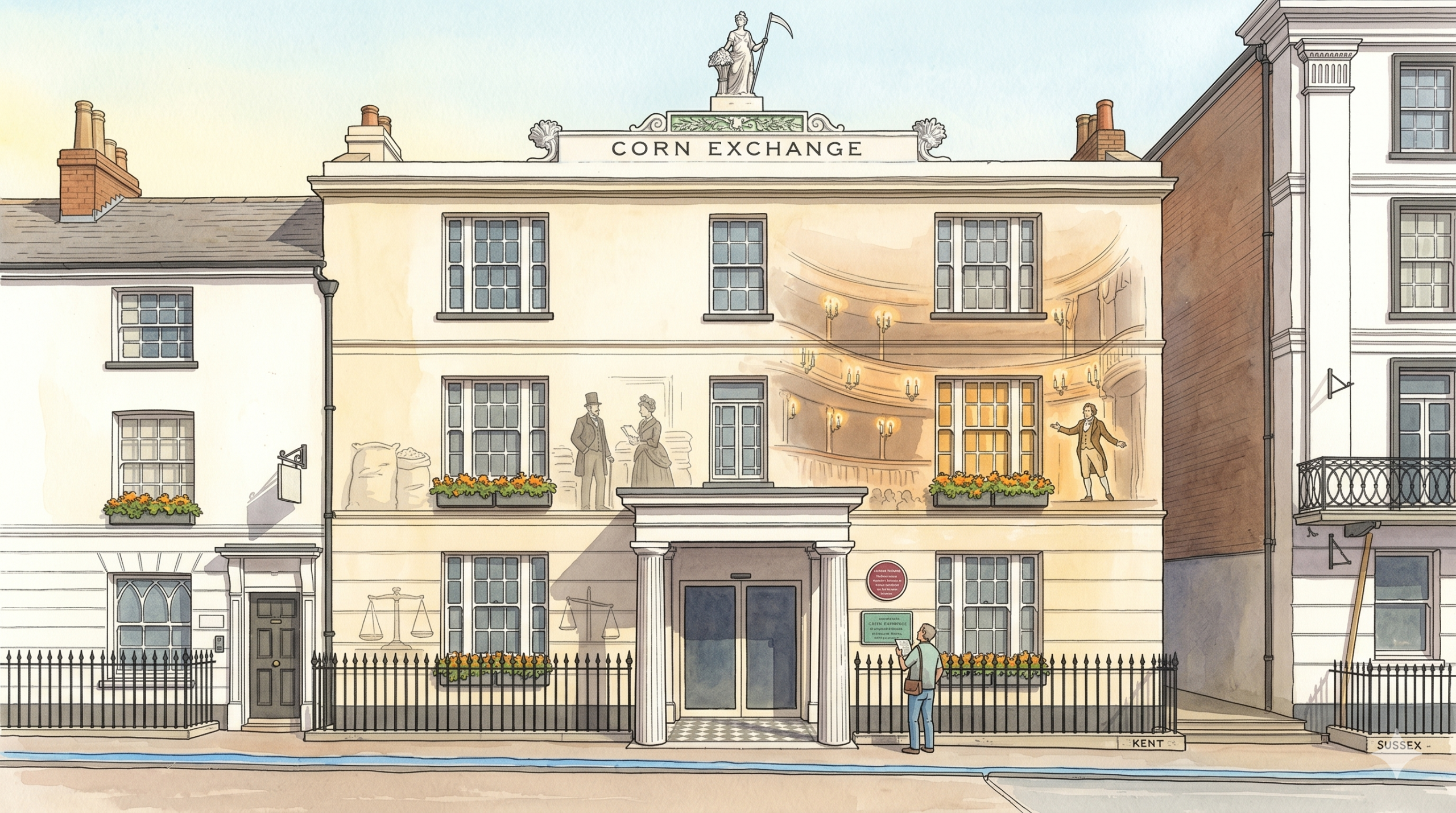
Look up. She’s been there since 1844 — Ceres, the Roman goddess of grain and harvest, standing on a parapet flanked by cornucopias, scythe in hand, looking out over The Pantiles with the expression of someone who has seen everything and is mildly amused by most of it.
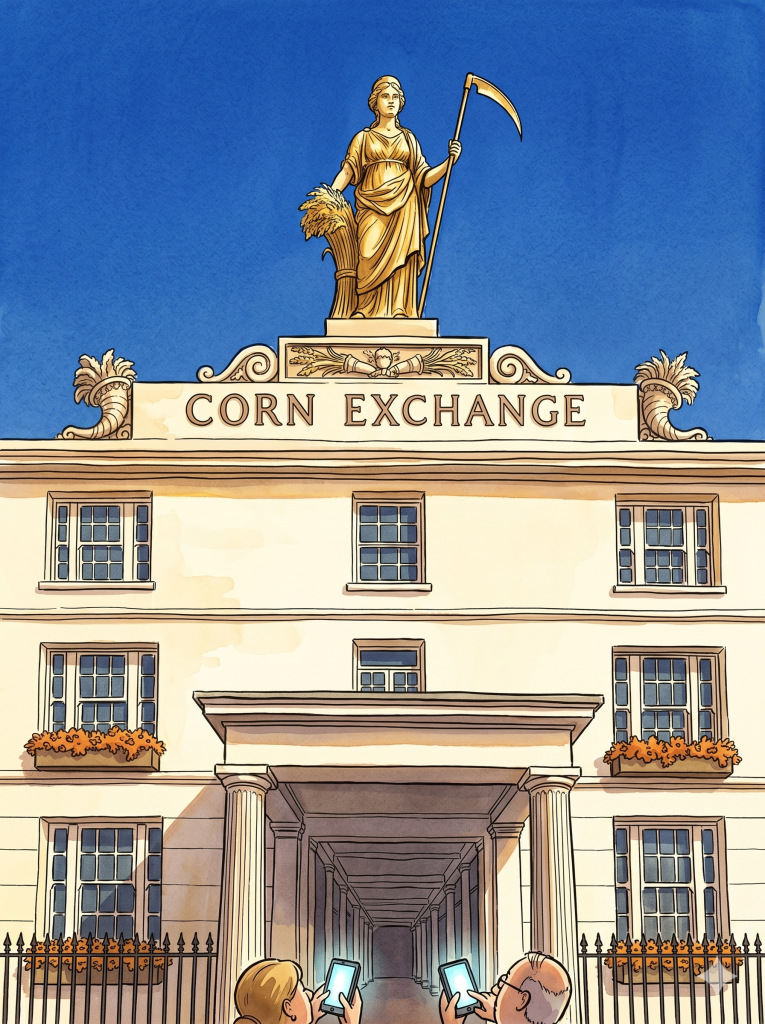
The Historic England listing describes her simply as “a statue of a female figure with scythe and sheaf of corn.” However, she is considerably more interesting than that. She is watching over a building that began its life as a theatre, hosted two of the greatest actors in British history, straddled a county border, and was — at one point — technically in two different counties simultaneously.
The Corn Exchange is not what it appears to be. In fact, it never has been.
How a Fairground Performer Built a Theatre on The Pantiles
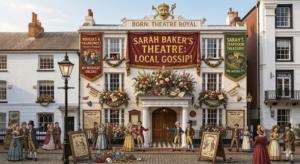
Sarah Baker was an illiterate fairground performer who became one of the most successful self-made women of her time. Born in 1737, she grew up travelling the country with her mother and younger sister, entertaining crowds at country fairs and race meetings. In the early 1770s, recently widowed and with three young children, she took over the small family troupe. Her story is told in full in The Theatre Queen of The Pantiles.
In the face of fierce opposition from male rivals, she began building a theatre empire across Kent. One rival, Mr Glassington, gets his own chapter in The Great Theatre Wars. It was not until 1789 that Sarah — well into her fifties by then — opened the first of what she described as her “great grand” Kentish theatres in Canterbury. She went on to build three more purpose-built theatres in the county: Rochester in 1791, Maidstone in 1798, and Tunbridge Wells in 1802.
All four were built to the same plan and similar dimensions, to allow for scenery to be easily moved between them. As a result, Sarah ran what was effectively a theatrical touring circuit across the entire county — moving actors, sets and costumes between four identical buildings, each playing to a different Kent audience.
The Tunbridge Wells theatre cost her approximately £1,600 to build. It officially opened on 8 July 1802, designed in the neoclassical style, built in brick with a stucco finish, and featuring a symmetrical main frontage of three bays facing onto The Pantiles.
That original frontage is still exactly what you’re looking at today.
The Stage in Sussex, The Audience in Kent
Here is the detail that belongs on every heritage trail in this town and is on none of them.
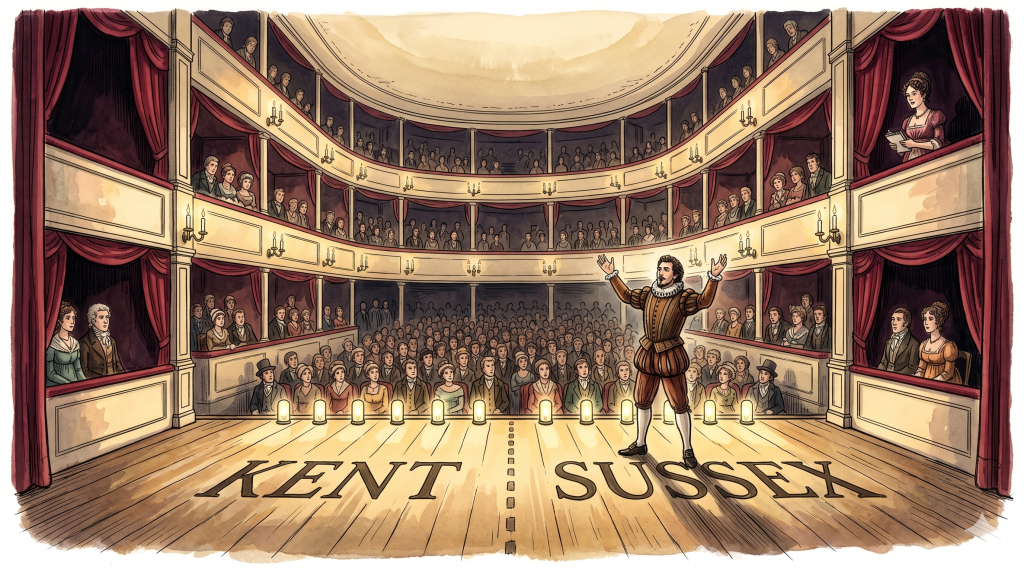
The Corn Exchange was built in 1802 over the Grom Brook, which carried the county boundary between Kent and Sussex. As a result, the actors on the stage would perform in Sussex while the audience watched from Kent.
Think about what that means in practice. Every actor who walked onto that stage stepped from Kent into Sussex. Every entrance was a county crossing. Every exit was a return to England’s garden county. The audience, meanwhile, sat in Kent and watched people perform in a different county entirely.
That is the plaque’s version, though one local history source reverses it. In 1894, however, the Local Government Act moved the administrative boundary between Kent and East Sussex two miles south, taking in the whole of the growing town.
Therefore, the county-straddling stage disappeared not because anything about the building changed, but because a government act moved the border. The theatre didn’t move. England simply redrew itself around it.
The Teenager Who Played the Fool
The actors Edmund Kean and Charles Kemble both performed on the stage in the building in the first half of the 19th century. In addition, the plaque on the wall outside confirms this plainly. However, the plaque does not mention what happened next.
Edmund Kean went on to become arguably the greatest Shakespearean actor of the 19th century. He was one of the greatest of English tragic actors — a turbulent genius noted as much for his megalomania and ungovernable behaviour as for his portrayals of villains in Shakespearean plays.
Before all of that, however, he was a teenager in Mrs Baker’s company at Tunbridge Wells. He joined in the autumn of 1806, aged 18, and stayed for around a year. According to the local historian Anne Carwardine, he played minor parts, sang comic songs between the acts and carried messages, all for 18 shillings a week. Eight years later, at Drury Lane, he played Shylock, Richard III, Hamlet and Othello in a single season.
The man whose acting Coleridge would later compare to “reading Shakespeare by flashes of lightning” was, in Tunbridge Wells, singing comic songs between the acts. He married the actress Mary Chambers in 1808 and eventually became the most celebrated actor in England. Biographers also tell of a time he left a company just ahead of a vengeful mob, after seducing a townsman’s wife. One account places that episode after he had left Tunbridge Wells, so we cannot place it here.
The building where all of this began now houses an antiques and fine art centre. However, the frontage is still the one he knew. Next time you walk past, note the three neoclassical bays, the fluted Doric columns at the porch, and the parapet above. That is what Edmund Kean saw when he arrived in 1806, aged eighteen.
From Theatre to Grain Market to Antiques
After Baker died in 1816, the theatre passed to her son-in-law, William Dowton. However, audiences dwindled, and the theatre closed in 1843.
In consequence, the building became a corn exchange — a market where grain was bought and sold. The corn exchange conversion was completed, and the building reopened in November 1844 by John Nevill, 3rd Earl of Abergavenny, whose seat was at Eridge Park. Furthermore, it was at this point that the Ceres statue appeared on the roof — the Roman goddess of grain, finally appropriate to the building’s new purpose.
For nearly sixty years, therefore, the building that Sarah Baker built as a theatre sold wheat, until the Corn Exchange Company went into liquidation in January 1902. Then came a Yeomanry drill hall in the First World War and an auction house. After a £1.1 million refurbishment in 1989, it became a tourist attraction called A Day at the Wells, which closed in 2004. Today it is the Pantiles Arcade, an antiques and fine art centre that opened in July 2021. The building has been Grade II listed since 20 May 1952.
However, the interior you see today is not original. When the theatre closed in 1843, the Corn Exchange was built behind its façade, and the 1989 refurbishment followed. The stage, the auditorium and the boxes where Georgian audiences watched performances in a different county are gone. What remains of the 1802 theatre is the frontage, still facing The Pantiles.
What the Plaque Doesn’t Tell You
There is a green plaque on the wall. It reads, accurately, that this was formerly the Tunbridge Wells Theatre, built in 1802 by Sarah Baker, that Edmund Kean and Charles Kemble performed here, and that the stage was in Sussex while the auditorium was in Kent.
However, it doesn’t mention that Sarah Baker was illiterate. She reputedly never learned to write more than her name, yet when she died at Rochester in February 1816, just months before her eightieth birthday, her estate was estimated at more than £20,000 — equivalent to well over £1.5 million today.
Furthermore, it doesn’t mention that Edmund Kean was a teenager on 18 shillings a week, singing comic songs between the acts. It doesn’t mention the Grom Brook that carried the county boundary beneath the stage. It doesn’t mention that the woman watching from the roof has been standing there since 1844, long before anyone now alive was born, watching everything that happens on The Pantiles with the patient attention of someone who has absolutely nowhere else to be.
Go Find It Today
The Corn Exchange is at 49 The Pantiles, TN2 5TE — on the south side of the Lower Walk, impossible to miss. Look for Ceres on the roof. The green plaque is on the wall to the right of the entrance.
The Pantiles Arcade inside is open Tuesday to Saturday, 10am to 5pm, according to its listing. Therefore, this is the one Building File entry where you can walk around inside the building freely, browsing antiques and fine art in a building whose theatre stage once stood in a different county.
Meanwhile, if you want the full Sarah Baker picture, the Theatre Wars post and the Theatre Queen of The Pantiles cover the remarkable story of how she built her empire in much more detail.
Walk it: The Corn Exchange is Stop 4 of Footsteps Tour 1: The Scandalous Mile, a 35-minute self-guided walk.
Watch it: One Foot in Kent, One in Sussex: The Border That Split Tunbridge Wells, a four-minute WalkTW film, follows the old county line from the chapel on the Pantiles to Broadwater Down, and says what is documented and what is only legend.
Fact or Fiction? The WalkTW Archive
- Was the stage in Sussex and the audience in Kent? According to the plaque on the wall, yes. One local history source says the reverse, so go and read the plaque yourself.
- Is the building still on a county border? Not administratively, since 1894. The Grom Brook still marks the old Kent and Sussex line, and Historic England records the building’s traditional county as Sussex.
- Did it sell grain for a century? No. The Corn Exchange Company went into liquidation in 1902, about 58 years after it opened.
- Did Edmund Kean flee Tunbridge Wells ahead of a mob? Not as far as we can tell. One biography tells that story but places it after he had left.
- Does the Grom Brook still flow under the Pantiles? Fact. It was enclosed in a barrel drain in 1853, and KCC says it is culverted beneath Nevill Street and Warwick Park.
- Does it run underground all the way to Groombridge? No. It emerges west of the town and flows as an open stream.
The Open Questions
Three things the WalkTW archive cannot yet answer:
Question 1: The Grom Brook. The county boundary ran along the Grom Brook, which flowed beneath the building. However, where exactly is the Grom Brook today? It has clearly been culverted — built over, diverted underground — at some point between 1802 and the present. Does it still flow beneath The Pantiles? Does anyone know where it goes?
So Where Did the Grom Brook Go?
We asked, and a long-time resident answered. Better still, the records back her up.
The little brook that carried the Kent–Sussex border did not vanish. By the 1850s, however, it had become something close to an open sewer behind the Lower Walk. So in 1853 the Local Board boxed it into a brick barrel drain, with the Earl of Abergavenny chipping in. Today Kent County Council describes the River Grom as culverted beneath Nevill Street and Warwick Park. In fact, rainwater from the Pantiles is now sent straight into it to stop the street flooding.
Once past the town, the Grom comes back into daylight. From there it runs west past High Rocks to Groombridge, and on to the Medway. So yes: Mrs Baker’s actors really did cross a river every night. They just never got their feet wet.
Urban explorers have filmed the culvert, and our reader remembers the videos. Please don’t follow them. Culverts flood fast, the air is poor, and the manholes are not doors.
Question 2: The Playbill. Kean arrived in autumn 1806 and stayed for about a year. However, we have not found a playbill, a diary entry or a newspaper notice naming him on the Tunbridge Wells stage. Does any local archive hold one?
Question 3: The Original Interior. The Corn Exchange was built behind the theatre’s façade in 1843 and 1844, so little of the Georgian interior may have survived. However, did anything remain by 1989, when the building was refurbished — original boxes, gallery ironwork, backstage machinery? Does anyone know what was lost?
Drop what you know in the comments. The Building Files are open.
The Corn Exchange stands on the Lower Pantiles, the Nevills’ end of the Walks; who owns the rest is in The Tunbridge Wells Jigsaw.
Next up: the hotel on The Pantiles where a young woman leapt from a window, a ghost has been throwing furniture in Room 16 since at least 1997, and the building itself has been watching the promenade since before Tunbridge Wells was Royal — until then, that story is told in full as “The Girl of Room 16” in Ten Ghosts of Tunbridge Wells.
Enjoyed this?