There’s a restaurant on London Road that looks slightly too good to be true. Odd angles, sloped ceilings, off-kilter stairways — it feels almost like something from a fantasy world. Locals walk past it every day without a second glance.
They really should glance. Actually, many are surprised to learn that William Makepeace Thackeray once called this place home.
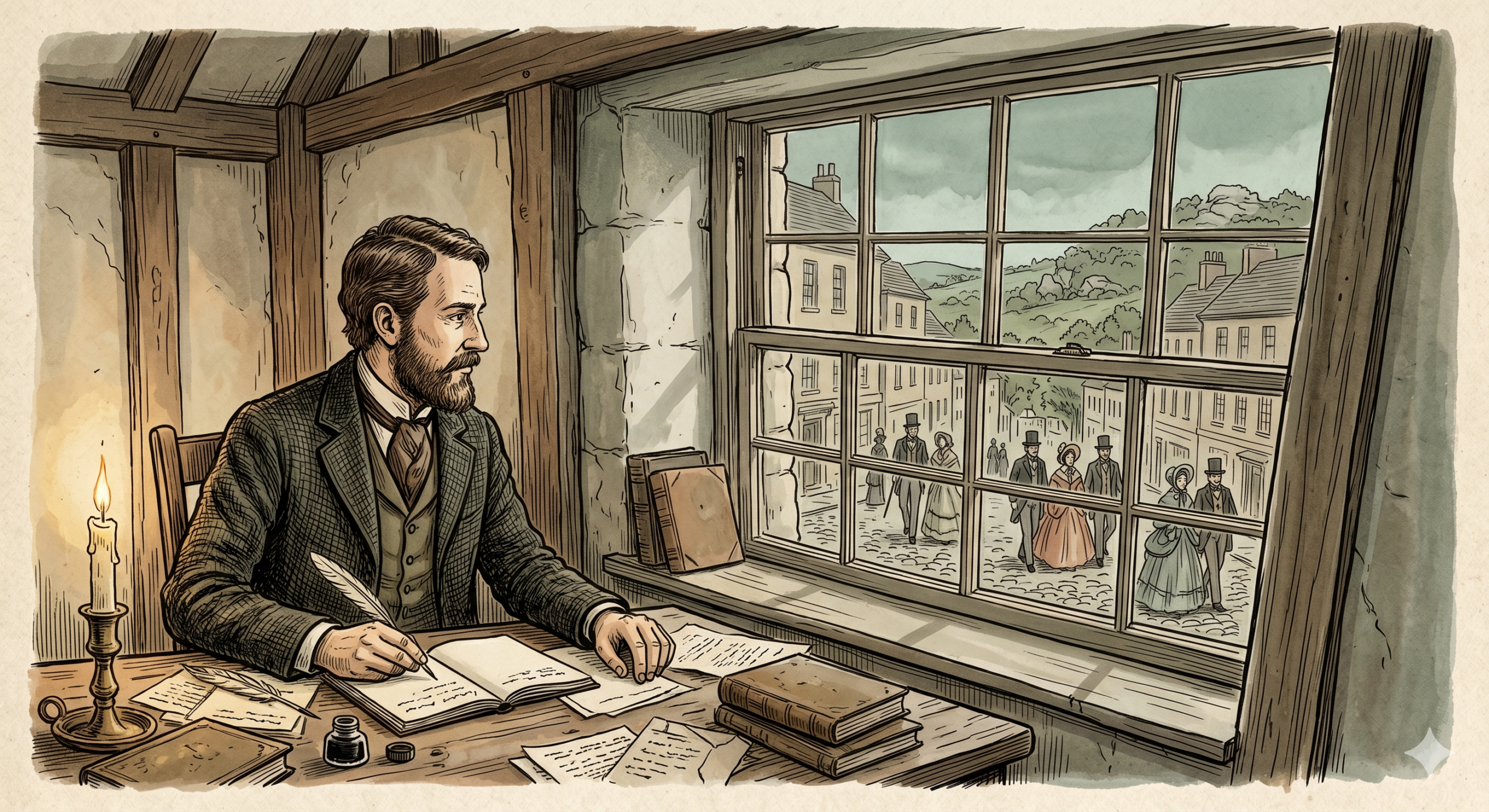
Because the man who lived here didn’t just enjoy the view over the Common. He watched Tunbridge Wells, took notes on everyone he saw, and turned it all into the most brutally funny portrait of English snobbery ever written.
His name was William Makepeace Thackeray. He wrote Vanity Fair there. And before he was famous, he was just a sharp, slightly bitter young writer sitting in a crooked house in our town, watching the social parade go past his window and thinking: these people are absolutely ridiculous. I’m going to write all of this down.
The Town That Built a Masterpiece
Here’s what made Tunbridge Wells so useful to him. The Pantiles gave him everything he needed — the aspirational aristocrats performing wealth they may or may not have actually had, the retired colonels competing over the quality of their carriages, the visiting families arriving for the “waters” with entirely different agendas from the ones they’d admit to in public. The setting was essential for Makepeace, William Thackeray’s observations about social climbing in England.
Thackeray saw society itself as a kind of “Vanity Fair” — a carnival where virtues are routinely compromised for social standing. He didn’t have to imagine that world. He could see it from his sitting room. In fact, inspiration for William Makepeace Thackeray overflowed from the everyday spectacle around him.
Having suffered bitterly himself due to what he considered societal constraints, he built his satire to blast the groups he felt had wronged him. Tunbridge Wells, with its magnificent parade of social climbers and status performers, handed him the raw material on a plate. A very polished, very expensive plate.
And here’s the detail that should genuinely stop you mid-coffee: Thackeray was such an expert at writing about snobs that he actually invented the modern use of the word. Before his The Book of Snobs, “snob” was just slang for a shoemaker. His knack for playful language is another William Makepeace Thackeray trademark.
He didn’t just satirise the snobs of Tunbridge Wells. He gave the entire category of human being a name that’s lasted nearly 200 years. You’re welcome, English language.
The Feud That Proves His Point
One small bonus story, because it’s too perfect to leave out. It perfectly captures the kind of literary drama William Makepeace Thackeray was never far from.
His great rival was Charles Dickens. They were friendly competitors for years — until Thackeray made the mistake of publicly discussing an affair Dickens was having. Dickens retaliated by having a journalist write that Thackeray’s work had no heart and that his white hair made him look old. Thackeray was furious because the article quoted private conversations from a social club, which was simply not done — and the two remained enemies until Thackeray died.
Two of the greatest writers in English history, destroyed by gossip, wounded pride, and the unspoken rules of social conduct. William Makepeace Thackeray was no stranger to drama, and it became part of his legacy.
If that doesn’t sound exactly like a subplot from Vanity Fair, nothing does.
Go Find It Today 🗺️
Thackeray’s Restaurant sits at 85 London Road, inside the novelist’s former home. The slanted floors, winding hallways, and grand fireplace in the main dining room are all original. The window still looks out over the same Common he watched every morning, just as William Makepeace Thackeray did centuries ago.
You can book dinner and sit in the exact rooms where Vanity Fair was written. Then walk down to The Pantiles afterwards and watch how people move — the subtle posturing, the sideways glances, the careful positioning near the right conversations.
Thackeray would recognise every single one of them. He’d probably have their names written down already. In short, Tunbridge Wells remains indelibly linked to the observations and humour of William Makepeace Thackeray.
🕵️ Fact or Fiction? You Decide
Three rumours for the WalkTW comment section. One involves William Makepeace Thackeray, of course:
Myth #1: Thackeray apparently drafted a dedication to “the good society of the Wells” for an early version of Vanity Fair — a pointed, sarcastic tip of the hat to the local promenade set who’d given him such rich material. His publisher reportedly killed it before print.
Myth #2: A pompous retired officer from Mount Ephraim — famous locally for his very loud opinions about his own carriage — is said to appear almost word for word as a character in The Book of Snobs. The man reportedly refused to read it. His wife read it three times. Imagine William Makepeace Thackeray overhearing these family debates.
Myth #3: Some literary historians believe the view from Thackeray’s window — the Common below, the grand ridge of Mount Ephraim above — directly inspired Vanity Fair‘s famous opening image of English society laid out like a fairground on a plain. Never proven. Never disproven, but that’s certainly something William Makepeace Thackeray would have enjoyed.
Have you ever eaten at Thackeray’s and felt vaguely observed? Drop your thoughts below. 👇
Next up: the child who played in the woods and tunnels around Tunbridge Wells and turned them into one of the most beloved books ever written. 🚂🌿
#TunbridgeWells #WalkTW #Thackeray #VanityFair #LocalHistory #BeforeTheyWereFamous #TheWritersWhoWatchedUs