There is a grave in Poets’ Corner, Westminster Abbey, that almost nobody visits.
It lies in the most literary postcode on earth — between Chaucer and Shakespeare and Dickens and Hardy, in the stone-flagged southern transept where Britain buries its writers. It belongs to playwright and novelist Richard Cumberland. He is best known as the Richard Cumberland playwright associated with Tunbridge Well. In addition, it sits next to the grave of actor John Henderson, near the grave of his closest friend Dr Samuel Johnson.
He died in Tunbridge Wells.
Not visited here, not merely connected here — he died here, in the house on this town’s streets that a subsequent owner named Cumberland House in his honour. He had arrived in 1785, when the town was in visible decline after Beau Nash’s era. His presence as a celebrity resident genuinely helped attract visitors back.
The most famous playwright in Georgian England retired to a spa town in need of saving. He wrote his most influential essays on its streets, and then died here. His house has been knocked down. His name means nothing to the town that named a building after him.
In Poets’ Corner, he lies near Samuel Johnson. In Tunbridge Wells, he is entirely forgotten.
The Man at the Top of Georgian Theatre
To understand what arrived in Tunbridge Wells in 1785, you need to understand what Richard Cumberland had been.
He was a prolific author and playwright best known for his highly successful sentimental comedies, including The Brothers (1769) and The West Indian (1771). He also wrote tragedies and historical novels. In addition, he wrote a history of Spanish painting and an autobiography which records his friendships with some of the greatest celebrities of the day, including the actor David Garrick and the writer and critic Samuel Johnson.
The West Indian, first produced by the great actor-manager David Garrick, enjoyed an extraordinary first run of twenty-eight nights and held the stage throughout the 18th century. Twelve thousand copies of the script were sold. When his third comedy, The Fashionable Lover, also succeeded in 1772, Cumberland was established as the leading dramatist of the sentimental school.
He moved in the circles that defined Georgian intellectual life. At the British Coffee House, he met Samuel Johnson, Sir Joshua Reynolds, Edmund Burke and Samuel Foote. He patronised the painter George Romney, whose portrait of Cumberland now hangs in the National Portrait Gallery. He was, for a decade, the most produced playwright in England.
And then things went somewhat sideways.
The Secret Mission That Ruined Everything
Here is the part of the story that nobody tells — because it is both deeply serious and faintly farcical, which is exactly the WalkTW register.
During the American War of Independence, Cumberland was sent by the government on a secret diplomatic mission to Madrid, with instructions to negotiate a separate peace with Spain and keep the Spanish out of the war. He spent months there. He spent £4,500 of his own money on the mission. He returned to England without the desired results and discovered the money would never be repaid. With the abolition of the Board of Trade soon after his return, and with but half his salary as compensation, he retired to Tunbridge Wells, where he remained until his death.
A failed secret agent. A government that wouldn’t cover his expenses. A job was abolished while he was abroad on its behalf. It is the kind of story that, in a different century, would make a very good television series.
He arrived in Tunbridge Wells in 1785: short, stout, red-faced, neatly dressed, and furious about Spain.
Sir Fretful Plagiary — The Most Famous Joke in Georgian London
There is one more thing he arrived carrying, invisible but heavy.
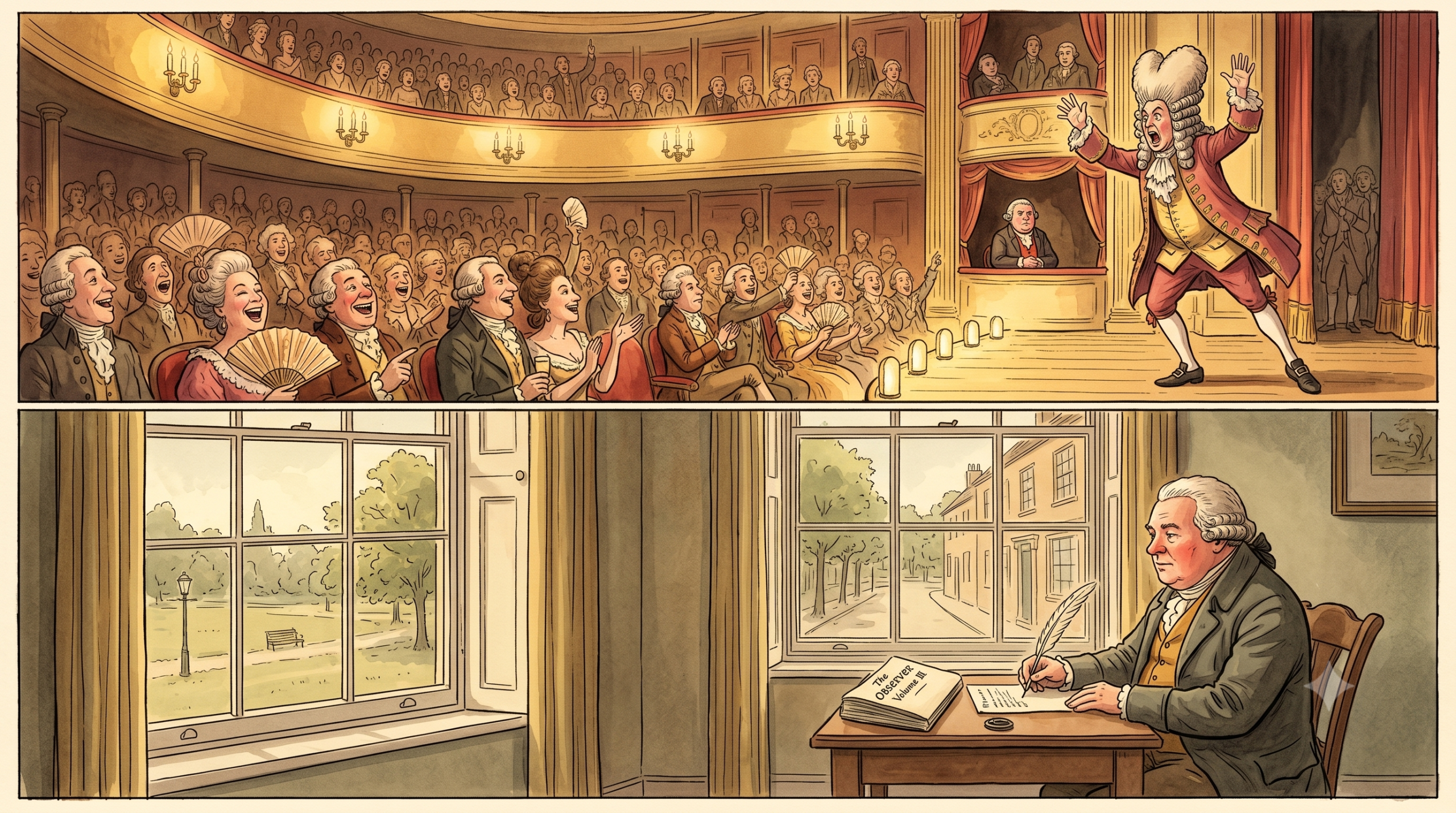
Six years before he came to Tunbridge Wells, Richard Brinsley Sheridan had written a play called The Critic. One of its major roles, Sir Fretful Plagiary, is a caricature of Richard Cumberland — a direct satirical portrait of the vanity of authors.
Sir Fretful Plagiary is thin-skinned, vain, obsessively sensitive to criticism, and incapable of hearing a negative word about his work without visible distress. He is, in Sheridan’s gleeful hands, everything a playwright should not be. He was immediately recognised by Georgian audiences as Cumberland. Garrick had already called Cumberland “a man without a skin” — meaning he had no protective layer against criticism, that every barb went straight in. Sheridan took that observation and turned it into one of the most memorable comic characters of the 18th century.
The most cutting satirical portrait in Georgian theatre was modelled on the man who would shortly retire to Tunbridge Wells. He knew it. London knew it. Everyone at the theatre knew it.
He came to this town carrying that knowledge. He sat in Cumberland House — wherever exactly it stood, on whichever street it occupied before being knocked down — and he wrote, and he kept writing, and he refused to stop.
What He Actually Did Here
His next prose work was a periodical paper called The Observer, which appeared in five volumes between 1786 and 1790 and contains 152 essays. The essays range across moral, literary and familiar subjects.
One hundred and fifty-two essays, written from this town, published over four years. Whatever the exact address of Cumberland House, 152 pieces of Georgian prose journalism were written somewhere on these streets — observations on literature, on morality, on the nature of comedy and tragedy, on the human condition as observed from a failing spa town in Kent by a man who had been to Madrid on a secret mission and come back with nothing but debt.
The essays were widely read. They were influential. In the late 18th century, Tunbridge Wells began to attract visitors once again, at least in part due to the presence of well-known residents such as Richard Cumberland.
He saved the town’s reputation simply by being here. The celebrity playwright in residence, writing his essays, receiving visitors, lending the place a cultural respectability it had been quietly losing since Beau Nash’s era ended. He was, without quite intending it, doing for Tunbridge Wells in the 1780s what Thackeray’s Restaurant does for the town today — giving it a reason to feel distinguished.
The Final Irony
Richard Cumberland is buried in Poets’ Corner, Westminster Abbey. His grave is near to the grave of his friend Dr Samuel Johnson.
He lies among Chaucer and Spenser, Dickens and Hardy, Johnson and Garrick. The Dean of Westminster decides who receives a place in Poets’ Corner based on merit. Cumberland was considered worthy of that company.
He had died in Tunbridge Wells. He had written his most enduring prose work here. The house that bore his name has been knocked down. There is no plaque, no commemorative bench, no reference on any heritage trail in the town.
In Westminster Abbey, he is remembered. In the town where he spent the last quarter of his life, he is invisible.
That is, come to think of it, the most Tunbridge Wells outcome imaginable.
🕵️ Fact or Fiction? The WalkTW Archive
Three questions for the comment section — and this time, one of them has a practical answer that someone in this town might actually know:
Question #1: Where Was Cumberland House? The house Richard Cumberland lived in was named Cumberland House in his honour by a subsequent owner and has since been demolished. It stood somewhere in Tunbridge Wells. Does anyone know which street it was on, or which building replaced it? The WalkTW archive would very much like to put a pin in the map.
Question #2: Did He Ever Watch Sarah Baker’s Theatre? Sarah Baker’s famous two-county theatre — the building now known as the Corn Exchange on The Pantiles — was operating throughout Cumberland’s years in Tunbridge Wells, from 1785 until his death. The most celebrated playwright in England was living in the same town as the most unconventional theatre manager in England. Did they ever meet? Did he ever sit in the audience? There is no record either way.
Question #3: Sir Fretful in Tunbridge Wells. Sheridan’s The Critic, which contains the Sir Fretful Plagiary caricature of Cumberland, was regularly performed in Georgian theatres throughout the period Cumberland was living here. Is it possible that Sarah Baker’s company ever staged The Critic in Tunbridge Wells while its subject was living in the town? The possibility alone is worth contemplating.
Drop what you know in the comments. 👇
The Writers Who Watched Us now has four parts: Thackeray, Defoe, Richard Cobb, and Richard Cumberland, the man they laughed at, who outlasted them all in Poets’ Corner.
#TunbridgeWells #WalkTW #RichardCumberland #TheObserver #GeorgianHistory #PoetsCorner #LocalHistory #TheWritersWhoWatchedUs #HiddenTunbridgeWells
Leave a Reply