We owe you this one.
Two posts in, the Writers Who Watched Us series has given you a satirist who used the town as target practice, a novelist who called it hopelessly behind the times, and a government spy who noted the gaming, intriguing fops and fools and moved on. But now, we turn our attention to The Man Who Actually Loved It Here. Every single one of them watched Tunbridge Wells and reached for their pen to skewer it.
So here, finally, is the writer who reached for his pen to celebrate it.
His name was Richard Cobb. He was one of the most respected historians in Britain. He was an Oxford Professor, a Legion d’Honneur recipient, a winner of the Wolfson Prize for History. He spent thirty years writing brilliant, acclaimed books about the French Revolution.
And in 1983, near the end of his life, he sat down and wrote a book about Tunbridge Wells instead.
He had grown up here. He had loved it completely. And almost nobody in the town he celebrated has ever heard of him.
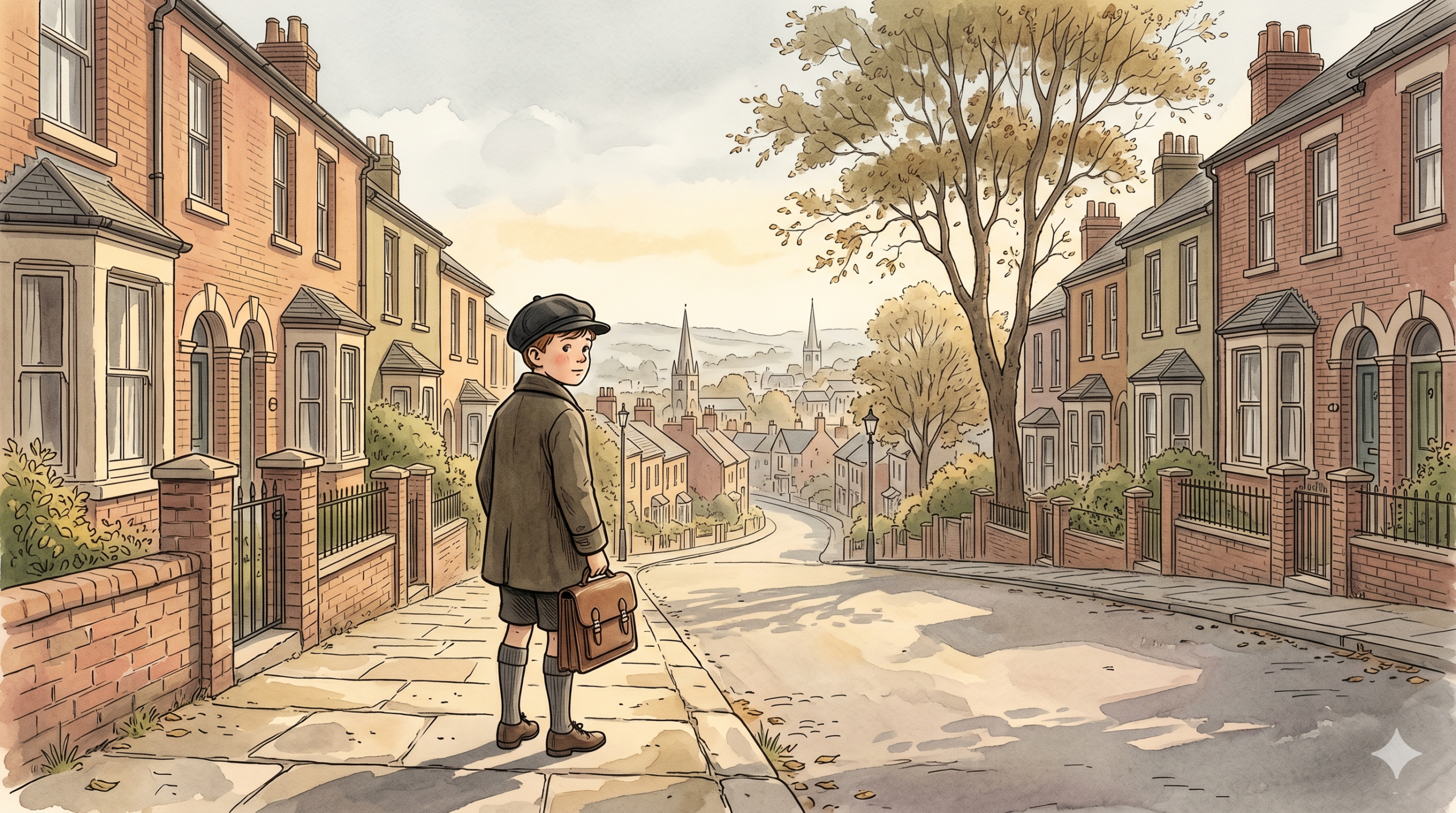
The Boy on Grove Hill Road
Richard moved to Tunbridge Wells at the age of four with his mother and sister; his father, who was in the Sudan Civil Service, was only an intermittent presence until his retirement. The family moved house a good deal, from one rented place to another, but managed to retain its status among the many gradations of middle-class society in a very middle-class town.
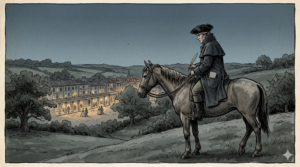
He grew up here through the 1920s and 1930s — walking the Common, catching the train from Central Station, learning the precise social hierarchies of the streets between Mount Sion and Mount Ephraim. He noticed everything. Down Poona Road, past the Grove Bowling Club, the young Richard Cobb conducted his reader through the streets of Tunbridge Wells in the twenties and thirties, taking us into cluttered drawing rooms and dining rooms set for tea — a chronicle of a south-eastern community, of the middle classes, their servants and an army of shopkeepers, of largely harmless snobbery, pretension and genteel scandal.
The keyword there is “harmless.” Unlike every other writer in this series, Cobb watched the town’s pretensions and found them not outrageous but quietly, deeply human. He was not contemptuous. He was fond.
The Book That Nobody Here Knows About
Still Life: Sketches from a Tunbridge Wells Childhood was first published in 1984. It won the J.R. Ackerley Prize for Literary Biography. It is a classic among middle-class memoirs.
A prize-winning literary classic. About this town. Written by someone who grew up on its streets.
And yet ask almost anyone in Tunbridge Wells if they’ve heard of it, and you’ll get a blank look.
The cast of characters Cobb assembled from his childhood would feel entirely at home in the WalkTW archives. Arriving at the Central Station, with its wooden staircase advertising “Carter’s Little Liver Pills,” he leads us through the town and into the lives of the characters among whom he grew up — from the mysterious Black Widow, seen always in deep yet unexplained mourning, to Baroness Olga, the town’s only victim of the Russian Revolution, with her tight-fitting cloche hat and jade earrings.
A Russian Baroness on the streets of Tunbridge Wells. We had a victim of the actual Russian Revolution living here, and this is somehow not on every heritage trail in town.
Then there were the Limbury-Buses. The mother never went outdoors, the son never spoke, and the whole family followed precisely the same routine each day. And Dr Footner, who made house calls in a horse-drawn carriage. And R. Septimus Gardiner, a taxidermist with a shop full of stuffed squirrels, fish, hummingbirds and badgers.
This is not a satirist’s invented gallery of grotesques. These were real people. On real streets. Right here.
What Made Him Different
Every other writer in this series used Tunbridge Wells as a mirror for something they wanted to criticise about England. Thackeray saw snobbery. Defoe saw vice and performance.
Cobb saw people. Actual people, in all their glorious, harmless, slightly peculiar ordinariness — and he loved them.
Richard may have been eccentric, irreverent and anarchical, but he was also someone who needed reassurance. He needed a place that would reassure him that life, however threatening it might be elsewhere, could carry on. For him, his childhood town was that place.
There’s something enormously touching about that. This man spent his academic career immersed in the violence and chaos of the French Revolution, surrounded by guillotines and mass graves and the wreckage of an entire social order. And when he finally turned to writing about himself, he went back to the steady, familiar streets of Tunbridge Wells — the Grove Bowling Club, the Wellington Rocks, the train coming in to Central Station — as the place that felt safe. The place that held still while the world turned.
As one reviewer put it: “Cobb has broken one of the strangest silences in English social commentary — on the missing history of the English bourgeoisie.”
He was the first person to take the ordinary, unremarkable daily life of this town completely seriously and say: This matters. These people matter. This place matters.
Go Find His Tunbridge Wells Today
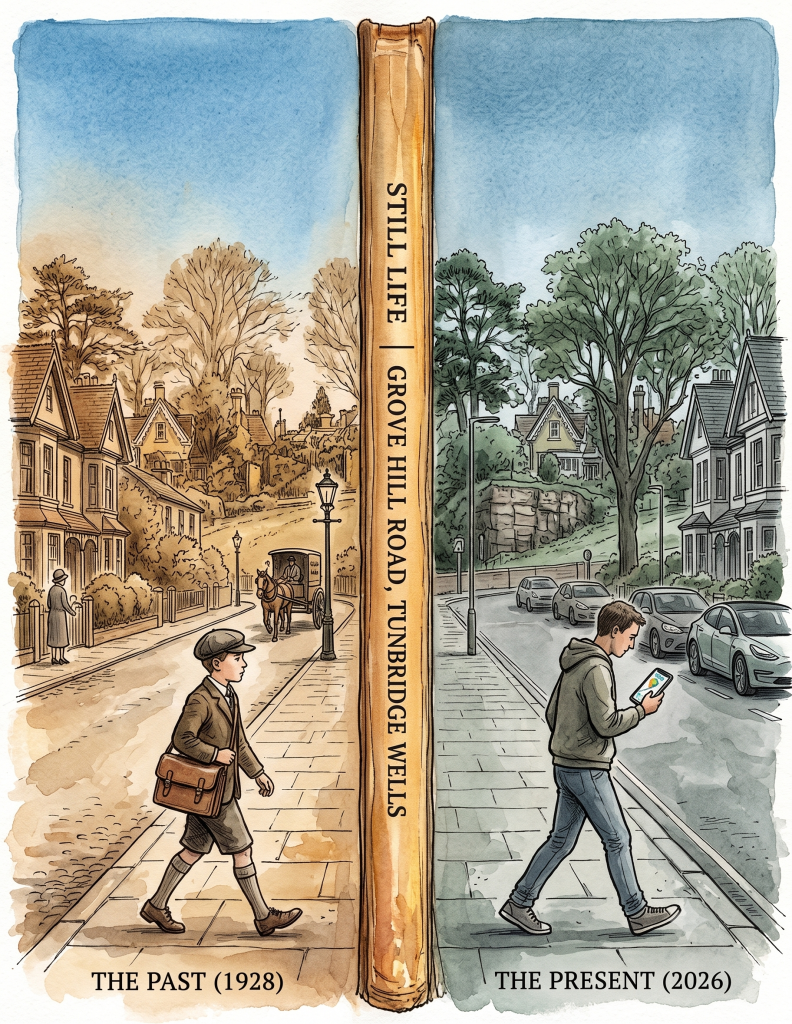
The remarkable thing about Still Life is how much of it is still here. The streets and houses Cobb describes are mostly still there — depicting the characters who inhabited them takes us into a world that, although gone, remains tangible. One Amazon reviewer noted: “Here is a tip that will enhance your enjoyment: have a computer screen with Google Street View loaded and ready to go as you begin reading.”
The Central Station — now Tunbridge Wells West, home of the Spa Valley Railway — is still there, minus the wooden staircase and Carter’s Little Liver Pills. The Wellington Rocks, where he played as a child, are still there. Grove Hill Road is still there. The Common is still there.
And here is perhaps the most WalkTW observation of all: the book is still in print, reissued by the wonderful Slightly Foxed quarterly as one of their most loved editions. You can buy it. You can walk the town with it. You can stand on the streets he wrote about and read his descriptions of the people who once lived there.
No other writer in this trilogy gives you that. Most of them watched the town and left. Cobb stayed in it, in memory at least, for the rest of his life.
🕵️ Fact or Fiction?
Three last questions for the comment section — and this time, unusually for this series, at least one of them is almost certainly true:
Myth #1: The Taxidermist’s Shop. R. Septimus Gardiner’s taxidermy shop, full of stuffed hummingbirds and badgers, is described in Still Life with such precision that local readers have spent decades trying to identify its exact location. Several candidates on the High Street and surrounding roads have been proposed. Nobody has definitively confirmed which building it was. Does anyone know?
Myth #2: The Unrecognised Professor. Cobb apparently returned to Tunbridge Wells regularly to visit his mother, who continued living there until the 1960s. There are suggestions that late in his life, having become one of the most celebrated historians in Britain, he would walk the streets of the town entirely unrecognised — past people living in houses he’d written about in an award-winning book they’d never read. He is said to have found this completely delightful.
Myth #3: The French Connection. Cobb’s passion for France was so consuming that French friends apparently found it baffling that this man, who had effectively become an honorary Frenchman — who wrote in French, who moved in Parisian literary circles, who received the Legion d’Honneur from the French government — had written his most personal book about a quiet English spa town in Kent. His response, reportedly, was simple: “France taught me how to look. Tunbridge Wells gave me something worth looking at.”
Have you read Still Life? Do you recognise any of the characters? Drop your thoughts below — and if anyone can identify the taxidermist’s shop, the WalkTW archive will be forever grateful. 👇
Also in this series · Writers Who Watched Us
Comments
4 responses to “The Man Who Actually Loved Tunbridge Wells”
I’d enjoy reading this… can one buy a copy from…? Or only in a library ?
Hi Ro, the book is available on Amazon and can be found as new or used.
Book details: “Still Life” by Richard Cobb, published in 1984, ISBN 0-7012-1920-3
I love this book and live in a house next door but two from his flat.
I’ve always been fascinated by the family who were brought lunch in bed and then played bridge the rest of the time.
My husband went to a lecture given by him at university.
He was a leading academic on the french revolution .
Hi Janice, thank you for your comments. It’s important that we can link our stories to real people’s experiences.
Let me know if you are interested in finding out any interesting facts, myths, or stories about TW and its people.