A book published in 1896 tells a short story set at Sevenoaks Station. Two gentlemen were chatting on the platform just before their train left. One asked why a large town like Tunbridge Wells had no theatre. The other had a ready answer: the town was “too religious” for one, so it would never pay.
He was wrong, of course. Sarah Baker had opened a theatre on the Pantiles back in 1801, as The Theatre Queen of the Pantiles and The Great Theatre Wars explain. The town went on to build a grand Opera House in 1902, as The Mystery of Mercury explains. However, the remark carries a sweeter irony today. The church at the heart of that religious reputation is now the town’s theatre.
A Town With a Spring but No Parish Church
Tunbridge Wells began as a spring, not a parish. The Chalybeate Spring sat where three ancient parishes met: Tonbridge, Frant and Speldhurst. As a result, the town that grew up around it had no parish church of its own.
By the 1820s, that was a real problem. Sea bathing had lured fashionable visitors away, as The Wave That Passed Us By explains, so more people chose to live in the town all year. They needed somewhere to marry, to christen their babies and to bury their dead. Yet the town had no cemetery, and the Church of King Charles the Martyr, then still a chapel, could hold only so many people.
Meanwhile, the Prince Regent had called for more churches in 1818. Parliament then passed a Church Building Act to pay for them.
A Committee, a Marquess and a 24-Year-Old
On 25 August 1824, the great and the good of the town held a public meeting and formed a Building Committee. Its members included the Marquess Camden and the Earl of Abergavenny, two names you can still read on street signs. If that rings a bell, A Fossilised Property Register explains how those two families came to share a wedding and a map.
The landowner John Ward, who owned the Calverley estate, sat beside them. Dr Thomas Thomson supplied the land. The committee collected subscriptions at the Pantiles libraries. Even so, the government’s church commissioners paid most of the bill: £8,059 of a £10,591 budget.
For architect, they chose Decimus Burton. He was barely 24, but his practice, begun in 1821, had already produced notable work. He had grown up near Tonbridge, and he had designed a mansion for John Ward the year before. Ward would soon commission him to plan Calverley Park.
The Tower Nobody Would Pay For
Burton chose a Gothic style, often called Georgian Gothic. Trinity’s own history notes that the sculpted heads and window arches closely resemble designs in Augustus Pugin’s 1822 pattern book. Burton probably had it open on his desk.
One feature nearly never happened. The Church Commission would allow a tower but refused to pay for it. Therefore, the committee asked builders for two prices, one with a tower and one without. The cross at the east end was an optional extra too. In the end, the money turned up, and the battlemented tower became a landmark.
Local people built the rest. The stone came from John Ward’s Calverley Quarry, where Quarry Road runs today. Henry and Aaron Barrett of Tunbridge Wells did the building, and Aaron led the work. Sadly, he later buried two of his children in the churchyard.
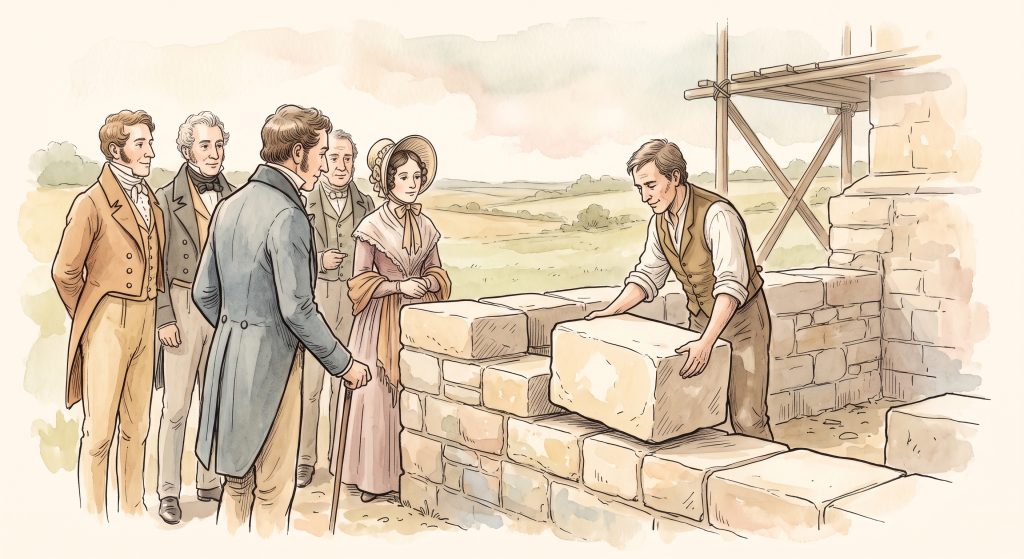
The foundation stone went down on 17 August 1827, the Duchess of Kent’s birthday. The Bishop of Rochester consecrated the church on 3 September 1829, and it seated 1,500 people. Victoria and her mother had visited the town before, as The Princess and the Donkey tells. In 1834 they came again and worshipped at Trinity several times.
Canon Hoare and the Queue
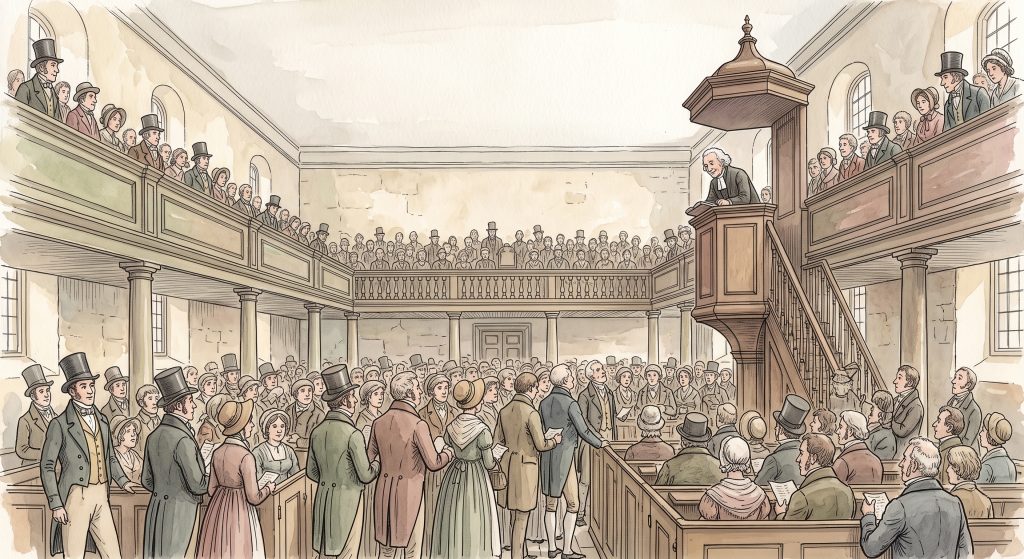
From 1853 to 1894, the pulpit belonged to Canon Edward Hoare. People queued for hours to hear him preach. Galleries ran along three sides of the church, holding about 600 people. A tall three-decker pulpit let Hoare see the whole congregation.
He was also a cricket lover, an abolitionist and a nephew of the prison reformer Elizabeth Fry. However, he does not lie at Trinity. The churchyard was already full by his death, so he rests in Woodbury Park Cemetery.
The Church That Ran Out of Congregation
The twentieth century changed the habit of churchgoing. Cinemas, music halls and theatres offered other evenings out. The welfare state also took over some of the church’s old work. Meanwhile, Tunbridge Wells had built more churches than it needed, partly thanks to Hoare himself. Holy Trinity, now surrounded by shops and offices, was the most at risk.
Even so, it still had big moments. Trinity’s history records that for the 1952 service for George VI, the church overflowed, and loudspeakers carried the hymns to the crowd outside. The last regular service came in 1972. Within two years, the diocese declared the building redundant.
Worse followed. In 1975, a redundancy scheme proposed demolishing the church and merging its parish with Christ Church. Plans to sell the land to residential developers were already on the table.
A Year to Save It
The Royal Tunbridge Wells Civic Society, formed in 1959, answered with a petition. As a result, the Church Commissioners granted a reprieve on 14 October 1975. The Society had until 1 November 1976 to find a public use. It also had to pay for it.
Next, the Society joined forces with the Tunbridge Wells Drama Club, founded in 1946. Together they formed an appeal committee. Trinity’s history names its chair as Lord Evans of Hungershall. Their plan was a community theatre and arts centre. The commissioners approved the idea in principle in January 1976. Then the fundraising began, and the appeal raised £50,000 in six months. In January 1977, the Diocese of Rochester granted a lease.
Bricklayers, Twice
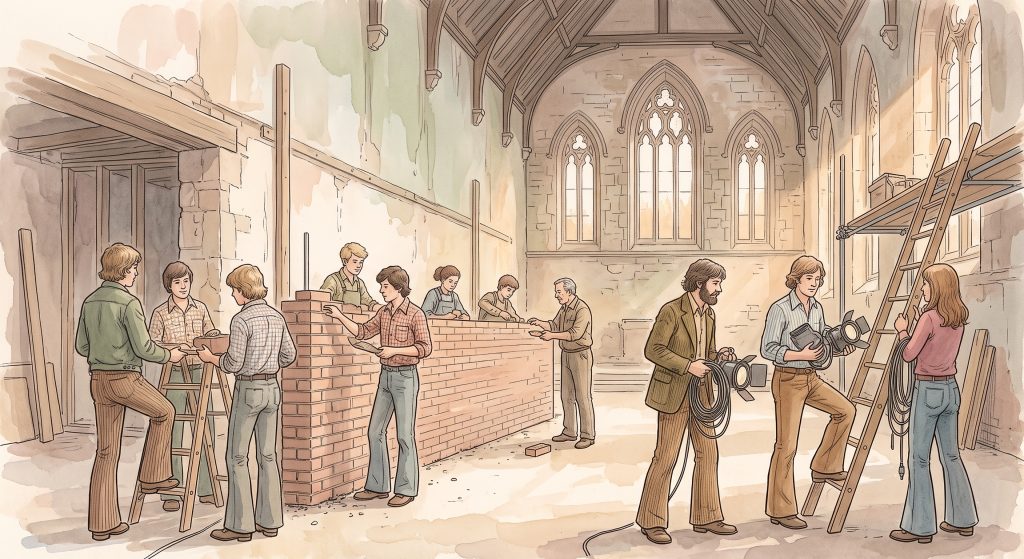
A lease was only the start. Inside lay a shell in poor repair. The new Trinity Theatre and Arts Association made Herbert Story its first general manager, and volunteers got to work. To save money, Trinity’s history says, Kent College bricklaying students built the auditorium while learning their trade. So a church raised by local builders in the 1820s was reborn through local builders-in-training. Tunbridge Wells has always relied on its bricklayers, as The Humble Bricklayer Who Made Tunbridge Wells “Posh” shows.
The first shows came in summer 1982. The borough council then gave a grant for heating, and a Youth Theatre followed in 1989. Today the building hosts hundreds of events every year. In 2024, the clock tower opened to visitors for the first time, with support from the National Lottery Heritage Fund.
So was Tunbridge Wells too religious for a theatre? Not quite. Residents wanted both. The town that built its church by public subscription saved it the same way, 150 years later. Time may change, but people don’t.
Fact or Fiction? The WalkTW Archive
- Was Holy Trinity the town’s first church? Partly. It was the first church built in the town in the nineteenth century. The Church of King Charles the Martyr was older, but it began as a chapel.
- Did the church cost about £10,600? That was the budget. A guide published in 1840 says it cost upwards of £12,000.
- Was the tower always part of the plan? No. The commissioners would not pay for it, so it began life as an optional extra.
- Did the Church save itself? No. Local residents did it, led by the Civic Society and the Drama Club.
Go Find It Today
- The Spot: Trinity Theatre, Church Road, Tunbridge Wells, TN1 1JP.
- The Route: Walk to Church Road from the town centre (about 7 minutes).
- Walk it: Trinity Churchyard is Stop 4 of Footsteps Tour 2: The Hidden Geniuses and Untamed Greens, a 40-minute self-guided walk. Trinity Theatre itself is Stop 1 of Footsteps Tour 9: Stage Fright, Theatres, Pianos & Playwrights, a walk of about 45 minutes.
- The View or Challenge: Look up at the battlemented tower. Then spot the sculpted heads and pointed window arches that echo Pugin’s pattern book. The clock tower is open from April to October, with 118 steps and requires a booking. Outside those months, an interactive kiosk in the foyer gives a step-free version.
Dr Thomas Thomson supplied Trinity’s land, but its neighbours, Calverley Park and Calverley Grounds, were John Ward’s; more in The Tunbridge Wells Jigsaw.
Related reading: The Explorer’s Wife Beside the Stage, Calverley Park and The Hall Built by Pennies.
Watch this story in under a minute →
Enjoyed this?