To wrap up our “Tunbridge Wells Hidden Geniuses” series, we have to look at the guy who actually built the town’s aesthetic identity. This post tells the story of The Humble Bricklayer Who Made Tunbridge Wells and why his legacy endures.
We all know Decimus Burton—his name is everywhere, and he gets all the credit for designing our stunning Calverley Park villas, the sweeping crescents, and that grand, upscale look that makes our town feel so distinct. But Burton was the architect drawing on paper. The guy who actually got his hands dirty, laid the bricks, managed the chaos, and literally constructed the town’s “posh” DNA was William Willicombe, who truly deserves to be called The Humble Bricklayer Who Made Tunbridge Wells.
And his story is the ultimate local rags-to-riches tale. It’s remarkable to think the transformation of Tunbridge Wells is thanks, in large part, to the humble bricklayer who made this town what it is today.
From Brickie to Master Builder
Willicombe didn’t start out with a fancy title or high-society connections. He began his career right here as a simple, ordinary bricklayer, the same humble man whose efforts made Tunbridge Wells famous.
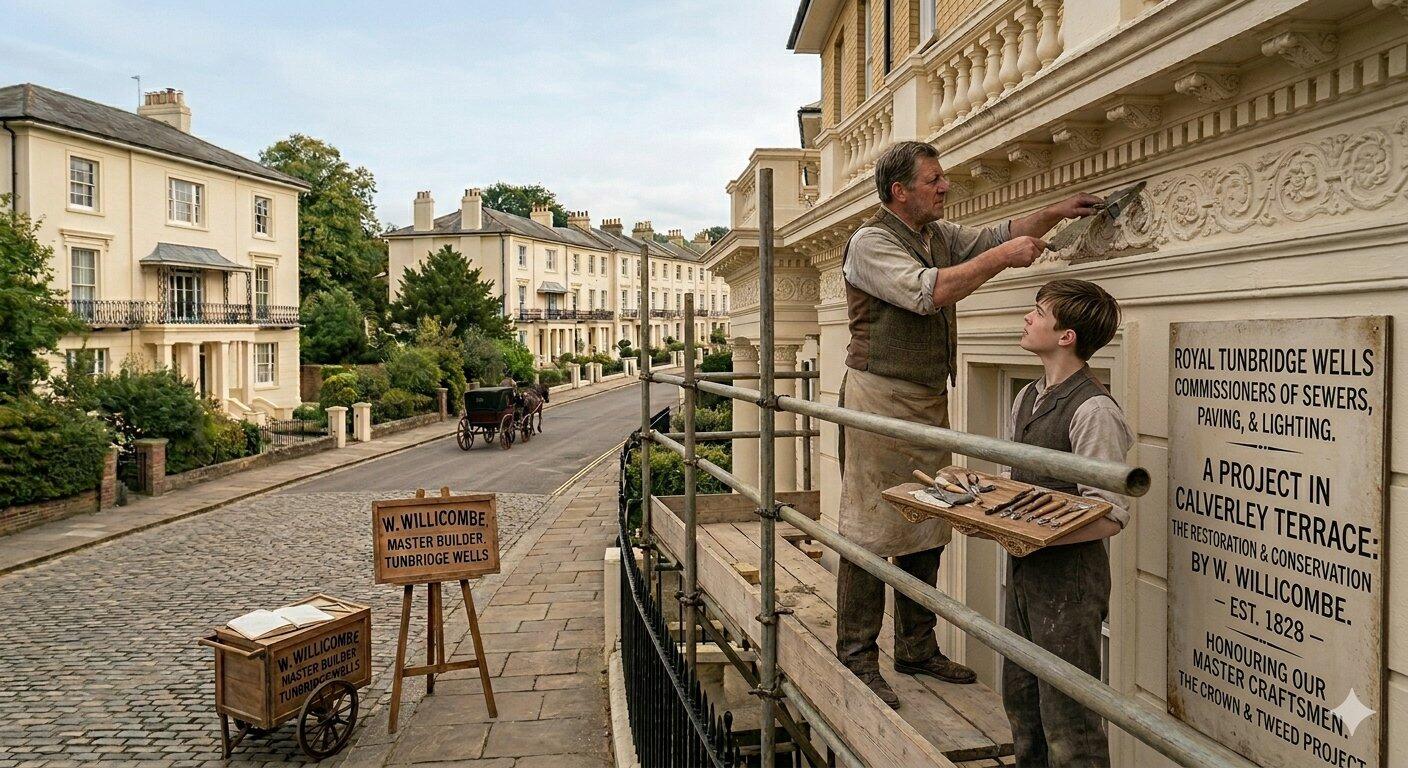
When Decimus Burton needed a reliable builder to turn his ambitious, high-end architectural dreams into actual stone and mortar, he hired Willicombe. It turned out the young bricklayer wasn’t just good with a trowel—he had a genius-level mind for engineering, project management, and structural design.
He quickly rose from the scaffolding to become Burton’s right-hand man and eventually the premier master builder of the entire Kentish Weald. In the end, his journey perfectly demonstrates why he’s celebrated as The Humble Bricklayer Who Made Tunbridge Wells.
Defining the Tunbridge Wells Skyline
If you’ve ever walked around the town centre, admired the stunning stucco villas, or felt fancy just strolling past the grand properties near the common, you are looking at Willicombe’s life’s work. Much of the unique style attributed to The Humble Bricklayer Who Made Tunbridge Wells remains visible to this day.
He took Burton’s complex ideas and figured out how to actually make them stand up.
He went on to build huge portions of the town independently, essentially inventing the local “curb appeal” that keeps our property market so lively today. His role as the humble bricklayer who made Tunbridge Wells the architectural gem it is cannot be overstated.
He became so successful and respected that he was eventually elected Town Commissioner, helping to run the place he spent his youth physically building.
Where to Find Him Today
Like our previous genius, Dr Golding Bird, Willicombe is buried right up the road in Woodbury Park Cemetery. He went from a working-class lad mixing mortar on a construction site to resting in a grand tomb in one of the town’s most historic spots. The legacy of The Humble Bricklayer Who Made Tunbridge Wells is still remembered here.
List of his projects preserved today:
- Calverley Terrace (The Surviving Remnant)
Willicombe worked closely with Burton on the massive Calverley Estate development from 1829 onwards. While much of Calverley Parade and Calverley Terrace was demolished to make way for the Civic Centre, one surviving fragment of Calverley Terrace still stands just beyond the Police Station. Willicombe’s building company was heavily involved in the physical erection of these landmarks, a testament to the humble bricklayer who made so much of Tunbridge Wells. - Lansdowne Road
If you walk down Lansdowne Road, you are walking through a neighbourhood entirely shaped by Willicombe in the 1850s. It is highly distinctive for its grand scale. Most of the massive, elegant buildings remaining here are his work—though today, many have been converted into flats, offices, or nurseries. Lansdowne Road stands as a proud reminder of the impact made by the humble bricklayer who transformed Tunbridge Wells. - The St. James’ Area & Sandrock Road
Willicombe was the primary driving force behind the residential expansion around the St. James’ area.
St. James’ Road: The upper, southern section features large, beautiful two- and three-storey paired villas designed and built in the manner of Willicombe. He evolved Burton’s look by using smooth stucco rather than bare sandstone, which gave them a very clean, grand finish.
Sandrock Road: On the north side of Sandrock Road, a number of Willicombe’s original, lower-density luxury villas and mansions still survive. Such streets are rich with the history and legacy of The Humble Bricklayer Who Made Tunbridge Wells. - Willicombe House (Clarence Road / Pembury Road area)
His legacy is literally preserved by name at Audley Willicombe Park (the luxury retirement village off Pembury Road). At the absolute heart of this estate sits Willicombe House, a grand, beautifully refurbished Victorian villa that originally formed part of his landmark developments in the area. Other surviving large houses of his from this specific expansion include Concord House, Chilston House, and St. Christopher’s. Willicombe’s construction here offers even more evidence of the humble bricklayer’s contribution to Tunbridge Wells. - Clarence Road & The Common Frontage
Just north of Church Road and along the edges of London Road overlooking the Common, Willicombe picked up where Burton left off, designing and building expansive, detached classical villas set in generous, mature green gardens, which can all be credited in large part to The Humble Bricklayer Who Made Tunbridge Wells.
🏰 Flagship Landmark: Willicombe House
His crowning personal achievement is Willicombe House, built in 1872 on the edge of Millionaires Row. He constructed it as his own grand statement of success—a sprawling Victorian villa that proved the bricklayer had officially conquered the town he helped build.
- The 2026 Reality: After surviving two separate fires over a century, being used as an evacuee home in WWII, and serving as a Barnardo’s baby nursery, the beautifully restored villa still stands today as the central clubhouse and heart of the Audley Willicombe Park village.
The Takeaway
Decimus Burton might have had the grand vision, but William Willicombe proved that the person who actually puts the pieces together is just as much of a genius. He’s the ultimate historical reminder that you don’t need a posh head start to completely reshape the world (or at least, a very beautiful corner of Kent). To sum up, The Humble Bricklayer Who Made Tunbridge Wells changed the town forever, leaving a legacy that continues to inspire.
So next time you pass the police station toward the remaining bit of Calverley Terrace, or take a stroll past the grand stucco villas near St. James, you’re looking directly at the engineering and craftsmanship of our local master bricklayer—the humble bricklayer responsible for making Tunbridge Wells truly unique. 🧱☕️
Thanks for following along with our local legends series! Who knew our quiet town had so many low-key revolutionaries hiding in its history?
🚶 Walk his buildings yourself: Footsteps Tour 2 — The Hidden Geniuses & Untamed Greens ends at Calverley Park — one of Willicombe’s finest construction projects — and traces the hidden geniuses and common-land fighters who built the town around him. Self-guided, free to download.