Building Files: The Opera House
The WalkTW Building Files | The Chronicles
Somewhere in Royal Tunbridge Wells, or possibly nowhere at all, there is a missing god.
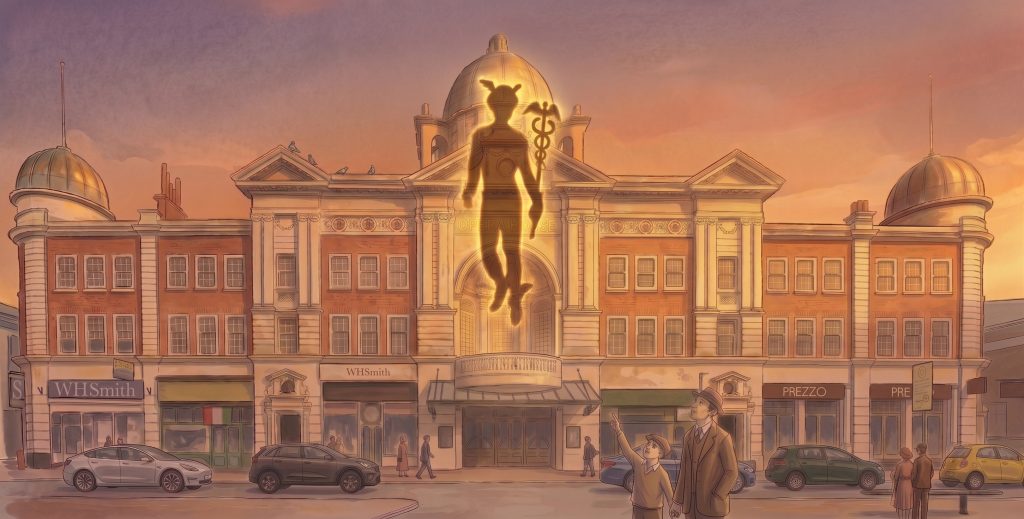
For eighteen years, a statue of Mercury stood atop the central dome of the town’s grandest theatre, looking down over Mount Pleasant Road — messenger of the gods, patron of trade, travel, and eloquence, watching over the comings and goings of the town below him like a quiet guardian of commerce. In 1920, he was taken down for safety reasons and stored in the basement. He stayed there, out of sight, for nearly half a century. Then, in 1968, he vanished. No record of where he went, who took him, or why. He has never been found.
The building he once stood on top of is still there. Today it sells £2 pints.
A Theatre Built to Impress
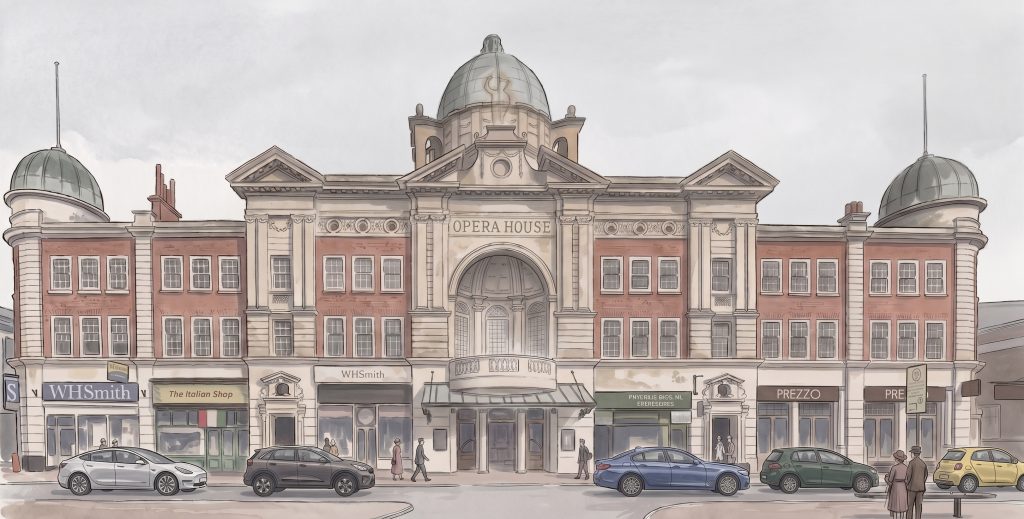
The Tunbridge Wells Opera House opened on 16 October 1902, on Mount Pleasant Road. It was designed by John Priestley Briggs, an architect who had trained under Frank Matcham — the most prolific theatre architect Britain has ever produced, responsible for dozens of grand Edwardian playhouses across the country. Briggs brought that pedigree to Tunbridge Wells: a fine Edwardian Baroque façade in brick and stone, three domes along the roofline, and a seating capacity of 1,100 — a striking scale for a town of this size.
The foundation stone was laid on 10 October 1901 by Herbert Beerbohm Tree, one of the most celebrated actor-managers of his generation. The building’s opening was, by every measure, a serious civic event.
Inside, the auditorium was surprisingly intimate given the scale of the frontage — Stalls, four boxes on either side, and two curved circles reaching seven rows deep, decorated in fine fibrous plaster with a large ceiling dome. Above it all, on the central dome outside, stood Mercury. A natural enough choice for a building devoted to performance and commerce alike — and, for eighteen years, a genuine landmark. Visitors arriving in Tunbridge Wells by train or carriage would have looked up Mount Pleasant Road and seen him there, presiding over the town’s grandest entrance to entertainment.
Bombed, Reopened, and Turned Into Bingo
The Opera House’s twentieth century was considerably rougher than its opening night promised.
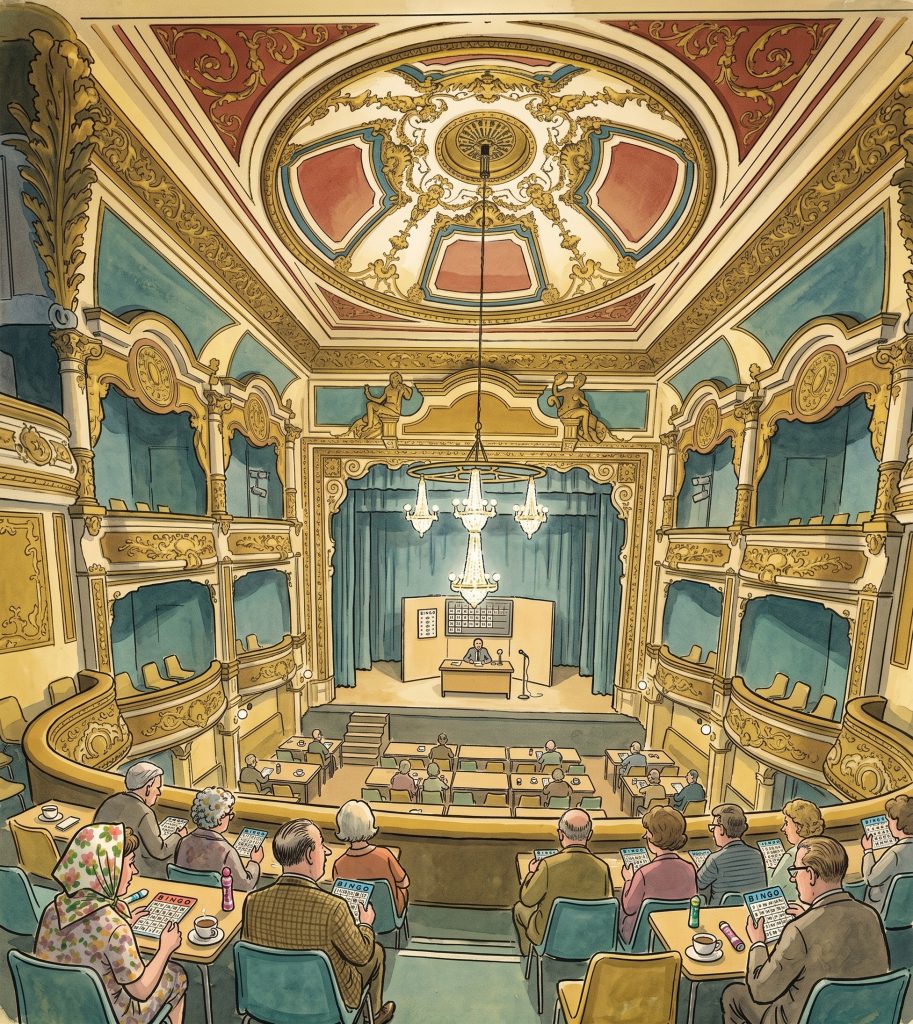
In 1931, it was converted into a cinema. During the Second World War, an unexploded bomb struck the building and started a fire — the venue was too badly damaged to reopen until 1949. It limped on as a cinema for another two decades before, in 1968, transitioning into an Essoldo Bingo & Social Club. Over the following decades it passed through several bingo operators — Ladbrokes’ Lucky Seven, the Rank Organisation, Cascade Bingo — closing its final bingo session on 18 June 1995.
In 1996, J.D. Wetherspoon bought the building. It reopened as a pub on 11 April 1997, with the original boxes, proscenium arch, circle, and balcony left in situ — one of the chain’s most ambitious historic conversions, and by most accounts its finest.
Where Mercury Went
Somewhere in this sequence of cinema, bomb, bingo hall, and pub conversion, the guardian on the roof simply disappeared.
The sequence of events is clear enough up to a point: Mercury was removed from the central dome in 1920, for reasons of structural safety rather than any change in fashion or ownership. He was stored in the basement of the building he’d once looked out from. And there he apparently stayed — through the cinema years, through the bomb and the fire, through the long stretch as a bingo hall — until 1968, when he disappeared without any surviving record of how or why.
Nobody claims to have destroyed him. Nobody claims to have sold him. He is not catalogued in any collection. Forty-eight years passed between his removal and his disappearance; another fifty-eight have passed since. Whatever became of him, the loss went entirely unrecorded at the time — which is, in its way, the strangest part of the whole story. A statue significant enough to crown a 1,100-seat theatre vanished from its own basement, and nobody thought to write down what happened.
Opera, Occasionally, Again
The building’s theatrical history hasn’t been entirely extinguished by pints and quiz nights.
Since 2006, the Wetherspoons pub has hosted an annual opera performance inside the original auditorium — the Merry Opera Company staging full productions, including Handel’s Tamerlano and Mozart’s Don Giovanni, beneath the same decorative plaster dome that has watched over the room since 1902. For one or two days a year, the Opera House briefly becomes an opera house again, chandeliers and all, before returning to its more regular business of cheap breakfasts and match-day pints.
Mercury, wherever he ended up, misses it. But this town has a habit of proving that “missing” isn’t always the same as “gone forever.”
The Spring That Came Back
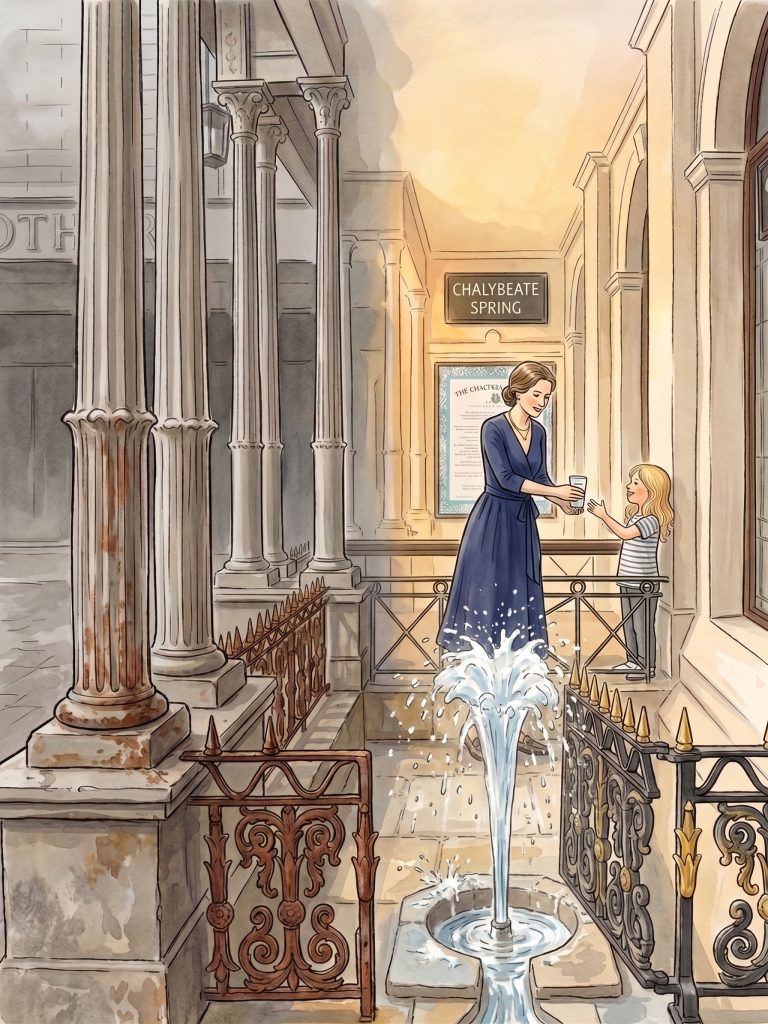
For most of the twenty-first century, the Chalybeate Spring — the reason this entire town exists, the spring Dudley North stumbled on in 1606, the one that gave Royal Tunbridge Wells its name, its royal visitors, and eventually its royal title — sat locked, neglected, and quietly forgotten. One account from someone who eventually restored it describes finding it “suffering from a serious case of being unloved,” with litter floating in the water below the railings where generations of visitors once queued.
It came back to life anyway. Not through some grand civic masterplan, but through one determined local tradesman who looked at the spring, decided the town’s own founding symbol deserved better, and spent two years working patiently with the council, planners, heritage officers, the landowner, and local history groups to get the water flowing again. Today, visitors can once more taste the very thing that put this town on the map four centuries ago.
It’s a small, quietly wonderful story. And it’s proof of something worth holding onto: things this town loses are not always lost for good. Sometimes all it takes is one person deciding that a piece of Tunbridge Wells’s history is worth bringing home.
What Else Might Be Waiting
Mercury has now been missing for considerably longer than the spring sat neglected. Realistically, the odds of him turning up in an attic or a reclamation yard somewhere are not high. But this town has shown, more than once, that its lost and half-forgotten treasures have a way of finding their champions eventually.
There’s something rather lovely about that thought. A statue of the god of trade and travel, once watching over the busiest corner of town, might one day be found again — and if he is, there would be something genuinely fitting about seeing him restored to his old post above Mount Pleasant Road, looking out over a town that never quite stopped hoping he’d come home.
Stories like this are, in a way, exactly why WalkTW exists. Not just to record what Tunbridge Wells used to be, but to notice what’s still quietly waiting to be rediscovered — the buildings, the statues, the springs, the little pieces of civic pride that get overlooked simply because nobody has stopped to ask what happened to them. Every one of these small revivals adds something back: not just to the skyline or the street corner, but to the sense that this is a town worth being proud of. A town with real depth beneath its familiar streets, the kind of place residents can point to and say — that’s ours, that’s been here for centuries, that’s part of why we love raising our families here.
The Opera House is still standing. The dome is still there. And once a year, for a night or two, it still remembers exactly what it was built to be.
Perhaps Mercury will too, one day.
Building Files: The Facts
Address: Mount Pleasant Road, Royal Tunbridge Wells, TN1 1RT
Opened: 16 October 1902 (foundation stone laid 10 October 1901 by Herbert Beerbohm Tree
Architect: John Priestley Briggs (former Clerk of Works to Frank Matcham)
Capacity: 1,100
Status today: Grade II listed, operating as a J.D. Wetherspoon pub since 1997
Notable feature: A statue of Mercury once stood on the central dome — removed in 1920, missing since 1968
If you’re wondering what else this town has quietly lost and might yet find again, Tunbridge Ware — a royal-warranted craft that hasn’t been made here since 1927 — is very much in the same category.
Leave a Reply