On Camden Road, two elephant heads flank a door that many shoppers walk straight past. Camden Road takes its name from the Pratt family, whose story we told in Two Families, One Wedding. Behind the door, a hall holds the Victoria Snooker Centre. However, the building was never meant for snooker. Working people built it in 1877 to look after each other. As of October 2026, its interior is due to be demolished, and the club has accepted it will leave by 28 February 2027. Therefore this seems the right moment to record how the hall began and what it became.
Insurance Against a Bad Week
Victorian Tunbridge Wells ran on the labour of laundresses, builders and servants. Their wages were low and uncertain. A single illness could end a family’s income, and the workhouse waited at the end of that road.
Friendly societies offered a way out. Members paid a few pence a week, perhaps 4d. In return they received help with sickness, funeral costs and sometimes unemployment. The members ran the schemes themselves.
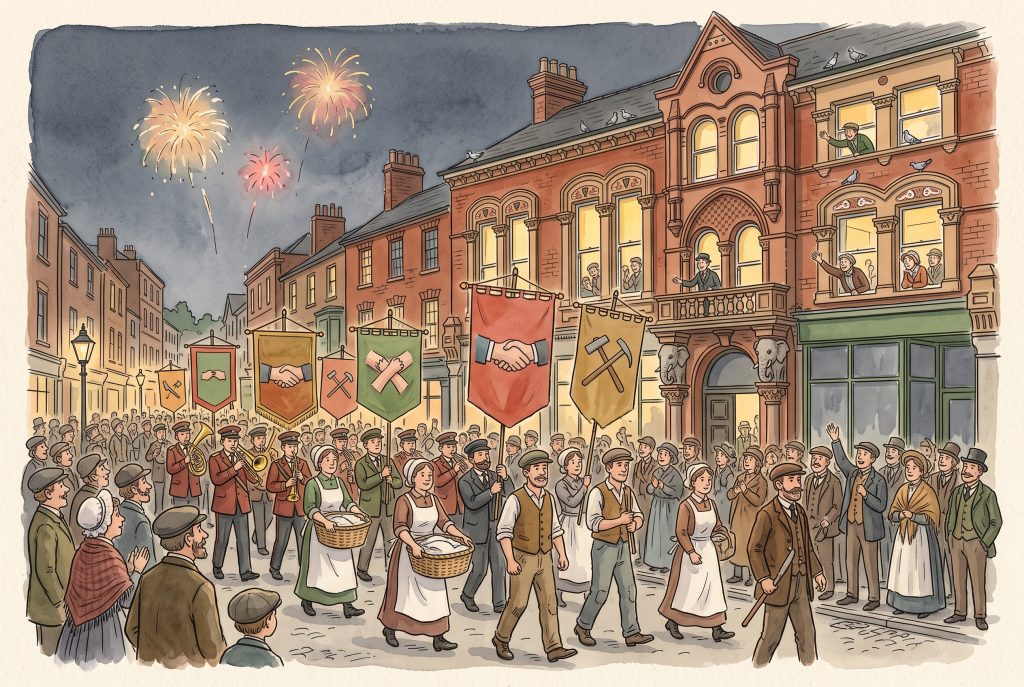
By the 1840s, the town had at least two such groups: the United Brothers and the Mechanics & Artisans. By 1864 there were 19. Meanwhile, they began to act together. Each year, they held a fete with a procession, bands, and banners. The evening ended with fireworks that carried the motto of unity.
A Princess Lays the Stone
In the 1870s the societies wanted a home of their own. First they formed a company and sold shares. Next they took out a mortgage and bought a site on Camden Road.
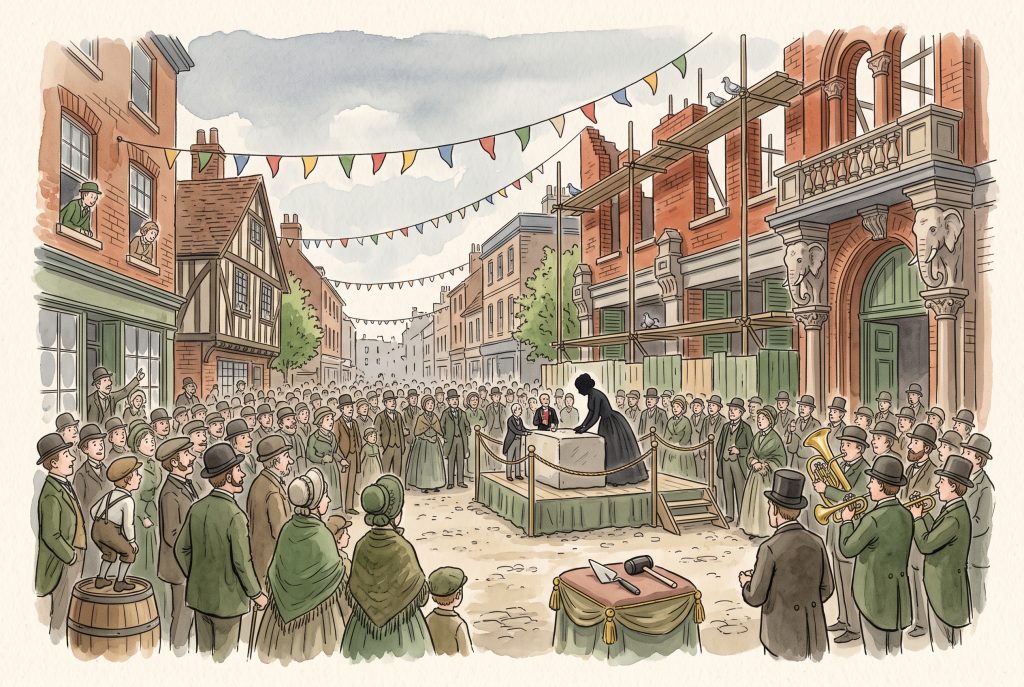
On 30 June 1877, Princess Louise, a daughter of Queen Victoria, laid the memorial stone. She was staying nearby at the time. According to the Kent & Sussex Courier, the town came to a standstill. The paper gave the day a full page.
The details were rather grand. Local craftsmen made the mallet from ebony and ivory. They made the trowel from silver with an ivory handle. The Courier reported that the princess admired the stone and mallet aloud.
The plans promised a hall for 400 people and a reading room. The paper hoped for a self-supporting club that working men could afford.
What They Built
William Barnsley Hughes designed the hall. He also designed Kentish Mansions and the Wellington Hotel, now a Travelodge. Henry Elwig was the builder.
The building came in two parts. The left side had two storeys and the right had three, and both had basements. Shops filled the ground floor at the front. A coal merchant, a tobacconist and a Ceylon tea merchant took the first tenants.
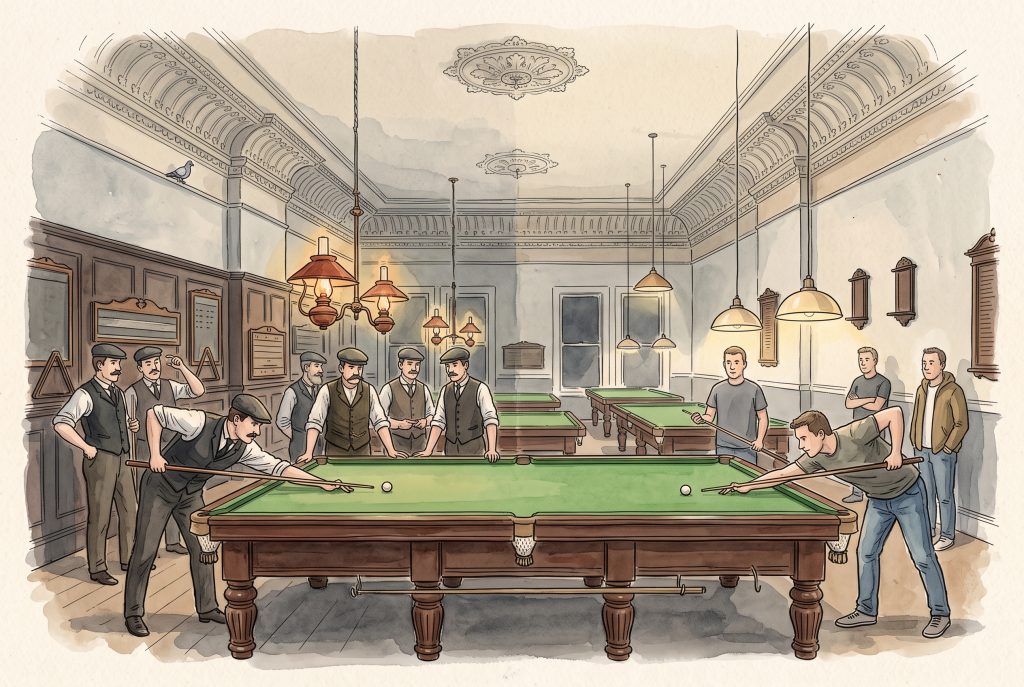
On the left, a full-length club room ran across the first floor. It had a high ceiling and ornate mouldings. Today it is the snooker room. The right side held the staircase, a bar and a committee room. The kitchen sat in the basement. The first floor had a billiard room, and a shipowner named William Tindall donated the table. In other words, cue sports were part of the plan from day one.
Behind the shops, the plans included a cookery school. The idea was self-improvement: learn a skill, then help your neighbour.
When the Money Ran Out
The finances did not work. By 1889 the owners decided to sell. The new borough council showed some interest at one point. However, the hall failed to reach its reserve at auction.
A new grouping of friendly societies then bought it. As a result, the hall reopened in 1890 as the Friendly Societies Hall Club & Institute. Building societies and trade unions joined the list of users.
Concerts, Clubs and a Famous Guest
The hall served the whole town. In 1882, children from the Ragged School performed Pilgrim’s Progress there. In 1901 the hall hosted a lunch for the actor Herbert Beerbohm Tree. He had just laid the foundation stone of the Opera House. You can read that story in The Mystery of Mercury.
That same year the trustees bought the freehold from the Ward family. They also extended the building at the back. The old cookery room became a billiard room with three tables. The first-floor billiard room became another club room.
The hall stayed open to everyone. In 1936 the Conservatives held a Christmas whist drive there. In 1937, striking bus workers used it as a base in their fight for an extra 2d an hour. That same year, they added a stage and dressing rooms behind the concert hall.
From Mutual Aid to Snooker
The state slowly took over the societies’ work. The 1911 National Insurance Act began the shift, and the NHS arrived in 1948. In the 1950s, the hall hosted a Rent Advice Bureau. However, its financial role was fading, and it became mainly a social club.
In 1994, the trustees of the three societies that owned the hall announced they would sell. The Victoria Snooker Club followed in 1995, according to the club’s supporters. Since then it has hosted exhibitions with players such as Ronnie O’Sullivan, Steve Davis, Jimmy White and John Higgins. In 2026, it has 431 members, according to its owner, Graham Martin.
The Last Chapter, For Now
In 2025, Tunbridge Wells Borough Council set out plans to redevelop Royal Victoria Place. The plans include a proposed three-screen boutique cinema, a leisure hub, and five restaurant units. The council says it will keep and restore the Camden Road frontage. However, it plans to demolish the interior.
A petition to save the club gathered more than 6,000 signatures. The Civic Society applied for the hall to be listed, arguing that it matters nationally as well as locally. Historic England advised against listing, and the government agreed. Historic England also recommended a certificate of immunity from listing, which would block listing for five years. The council says the proposed cinema needs this site and that the club would have had to move even if the building were listed.
As of 8 October, the club says it will leave on 28 February 2027. The council has promised help to find new premises. The council’s forward plan shows a decision on the full scheme planned for April 2027.
In 1877, working people pooled pennies to build a place of their own. In 2026, members signed their names to keep one. Time may change, but people don’t.
Fact or Fiction?
“The hall was built in 1861.” Fiction. Some campaign material gives this date. However, the foundation stone was laid on 30 June 1877, and the Courier covered the ceremony.
“The elephant heads come from the Camden family’s coat of arms.” Probably a fact. Southborough News reports it, and Camden Road takes its name from that family, as we explored in A Fossilised Property Register. We found no second source, so treat it as reported.
Go Find It Today
Where to find it: 7 Camden Rd, Tunbridge Wells TN1 2QY (view on Google Maps).
Walk it: The hall is Stop 6, the last stop, of Footsteps Tour 7: Calverley, The Town Within the Town, a 40-minute self-guided walk.
Walk to the Camden Road frontage and look up at the elephant heads beside the door. Then picture the shops that once filled the ground floor. The Victoria Snooker Centre says it is not a private members’ club and that all guests are welcome, so you can step inside and see the hall for yourself until it closes on 28 February 2027. Under the council’s current plans, that frontage will remain.
Those elephant heads probably point to the Camdens, the family behind nearby Camden Park; meet them in The Tunbridge Wells Jigsaw.
Related reading: Too Religious for a Theatre, about a landmark the town’s residents saved, and The Corn Exchange, from the same Building Files series.
Watch this story in under a minute →
Enjoyed this?