If you’ve been following our town-planning rivalries, you already know that Royal Tunbridge Wells didn’t become a premium destination by playing nice. It was forged in the fires of pettiness. And if you think modern business competition in 2026 is brutal, let me introduce you to the ultimate theatrical heavyweight match of the early 1800s: Sarah Baker vs. Mr. Glassington. Not many local legends loom as large in Tunbridge Wells as Sarah Baker.
The Battle of the Theatres (Crushing the Competition)
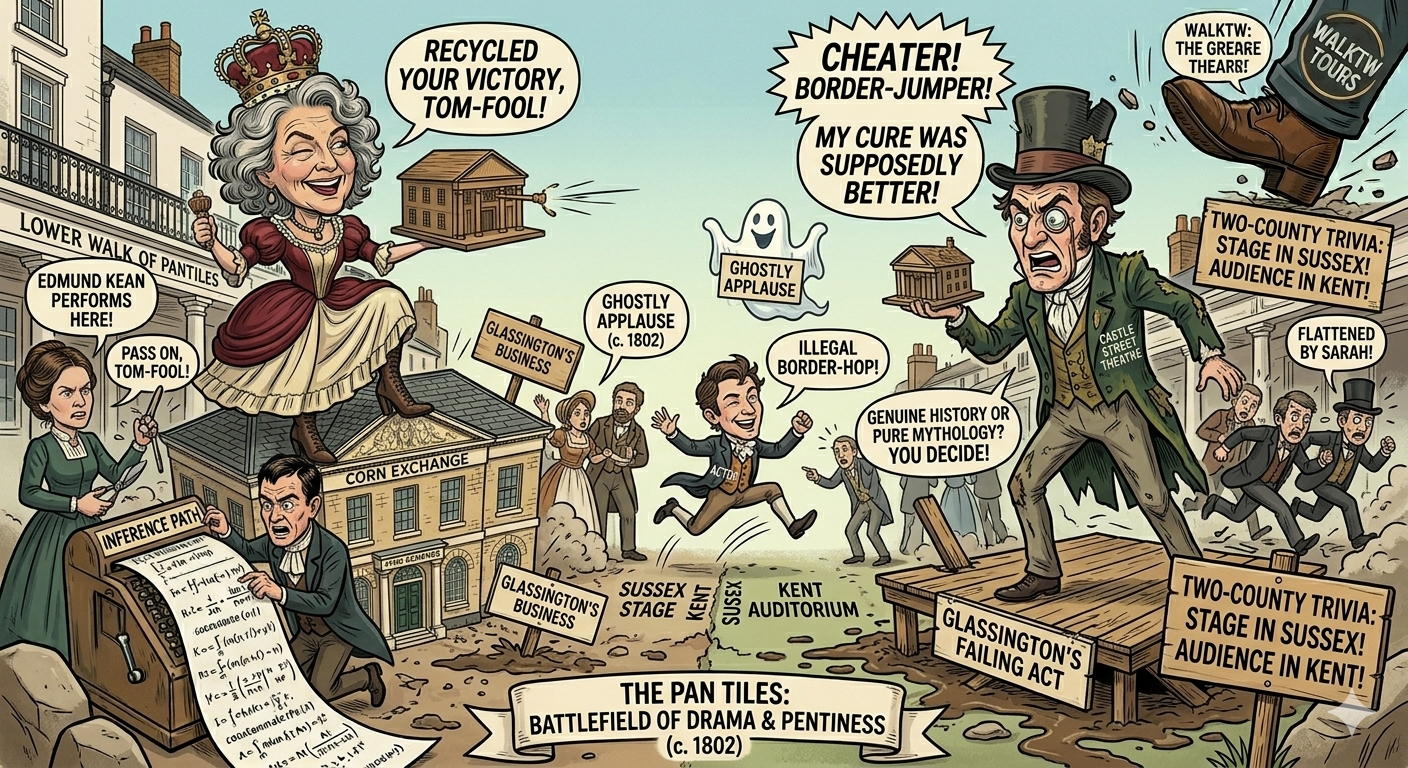
When Sarah first rolled her theater carts into Tunbridge Wells, she didn’t have the market cornered. A rival manager, a rather dignified gentleman named Mr. Glassington, ran a competing theatre over on Castle Street.
For a brief, high-stakes period, they went head-to-head. They scheduled plays on the exact same nights, actively trying to steal the same small pool of wealthy, water-sipping aristocrats. Glassington thought he could out-class Sarah Baker. He was wrong.
Sarah didn’t just out-market him; she completely crushed his business. Once Glassington was safely driven out of town, Sarah pulled off the ultimate power move: she reportedly demolished her own old, out-of-the-way theatre (“The Temple of the Muses” up on Mount Sion) and used its actual physical timber and bricks to fortify her brand-new, unstoppable stronghold on The Pantiles. Talk about recycling your victories.
The Legend of the Split Counties
Once the theatre opened in 1802, it instantly generated the best geographic trivia the town had ever heard. Because Sarah Baker had built the venue directly on the historic boundary line between Kent and Sussex, a wild rumour took hold of the public imagination:
- The Legend: It was widely whispered that the stage sat squarely in Sussex, while the audience’s seats were anchored in Kent.
- The Gossip: Locals loved the idea that actors literally “crossed the border” every time they made a dramatic entrance, meaning the audience was sitting in one county, paying Kentish ticket prices, to watch a show happening in an entirely different county.
The “Tom-Fool” at the Box Office
By 1806, Sarah Baker was one of the wealthiest self-made women in the south of England. She could have hired an army of staff. Instead, she chose to remain a chaotic spectacle at her own front door.
Every single night, Sarah sat at the box office entrance herself. To flaunt her immense wealth, she surrounded herself with blazing silver candlesticks and a massive, heavy silver inkstand. Spread right in front of her were her grand account books. The hilarious catch? She couldn’t actually read or write. But what she lacked in literacy, she made up for in volume. Sarah Baker had absolutely zero patience for dallying theatregoers. If a wealthy lord or an upper-class dandy fumbled with their coins or moved too slowly through the queue, the illiterate “Governess General” of Kent would loudly scold them in front of the entire street, shouting:“Pass on, Tom-Fool!”
A Brush with Legend: The Superstar Incubator
Despite her terrifying box-office etiquette, Sarah had an unmatched eye for raw talent. Her Pantiles stage became the ultimate testing ground for actors who would go on to become national legends.
Before he became a household name and arguably the greatest British actor of the nineteenth century, a young, unknown Edmund Kean trod the boards right here in Tunbridge Wells, taking notes from an illiterate fairground dancer who knew exactly how to hook an audience. Unsurprisingly, Sarah Baker stories are woven through the history of British theatre.
🕵️♂️ Fact or Fiction: Help Us Untangle the Rumors!
Our comment section is the official 2026 WalkTW archive office. Let’s look at the latest rumours swirling around Sarah and Glassington—which ones do you think hold water? Also, if you know any surprising Sarah Baker facts, please add them below.
- Myth #1: The Ghost of the Ruined Rival. Local legend says that Mr. Glassington was so heartbroken by Sarah destroying his business that his ghost cursed the bricks she stole from Mount Sion. Some say that if a performance went too well, a brick would mysteriously fall from the rafters—Glassington’s final, petty critique from beyond the grave.
- Myth #2: The Illegal Border-Hop. Rumour has it that local smugglers used the “Two-County” layout to outsmart the law. If Kent constables raided the auditorium to catch a thief, the suspect would simply jump onto the stage into “Sussex,” leaving the officers legally stranded without a cross-county warrant.
- Myth #3: The Coded Books. Some believe Sarah’s unreadable account books weren’t a sign of illiteracy at all, but a highly sophisticated, secret code she invented to hide her true earnings from the tax collectors and corrupt town managers.
Next time you walk past the Corn Exchange and look up at the statue of Ceres on the roof, just picture Sarah Baker sitting below it, surrounded by silver, calling someone a Tom-Fool. What’s your take on the border-jumping theatre? Let’s argue about it below! 👇
Next up in the trilogy: The Great Paving Scandal—how a royal slip-and-slide in the mud and a pair of corrupt local managers accidentally gave The Pantiles its iconic name. Stay tuned! 👑🧱