Alright, by popular demand, here is part three of our “Tunbridge Wells Hidden Geniuses” series. If you thought math and birds were cool, wait until you meet Dr. Golding Bird—a man who was basically living in the year 3000 while the rest of the Victorians were still figuring out indoor plumbing.
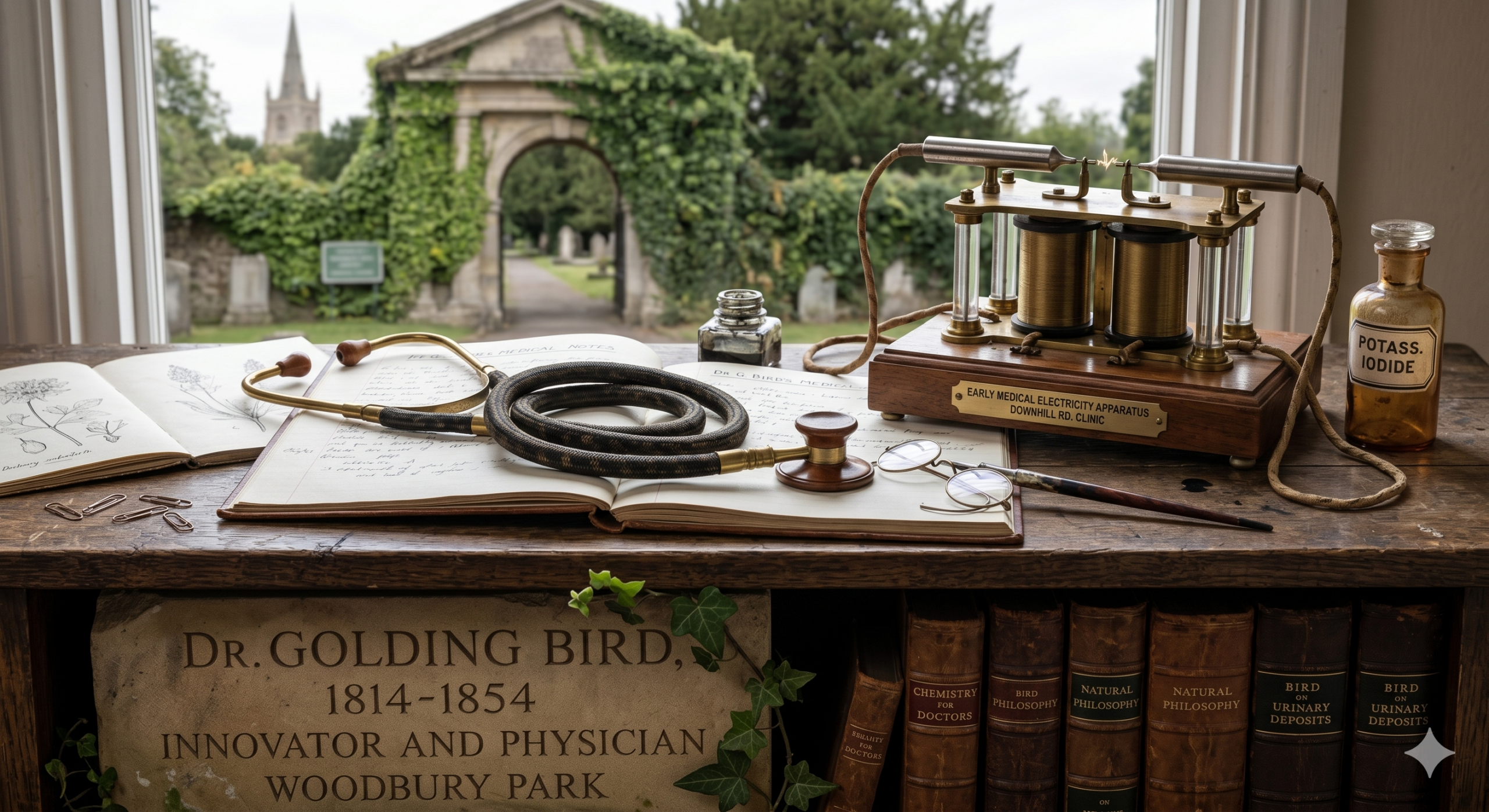
He’s currently resting peacefully right up the road in Woodbury Park Cemetery, but during the 1840s and 50s, this guy was a medical absolute machine. It’s remarkable how Dr. Golding Bird contributed so much to medicine in such a short life.
The Problem with the Old “Stethoscope”
Before Golding Bird came along, if a doctor wanted to listen to your heart or lungs, they used a rigid, solid wooden tube. It was awkward, uncomfortable, and required the doctor to lean completely over you at a very weird angle. Interestingly, Dr. Golding Bird considered new ways to improve such essential tools.
Bird looked at this and thought, “We can do better.” He went ahead and invented the flexible stethoscope—using a tube made of woven silk and wire. It changed medicine forever because doctors could finally sit comfortably next to a patient and actually move around. If you’ve ever had a checkup, you owe this guy a thank you.
The Original “Mad Scientist” (But in a good way)
But he didn’t stop at stethoscopes. Bird was obsessed with “medical electricity.” Long before modern physical therapy or neurological treatments, he was building custom electrical machines to send tiny, controlled currents into patients paralyzed by strokes or suffering from nervous disorders. He was essentially a Victorian bio-hacker, trying to restart the human body’s hard drive using static electricity, and the work of Dr. Golding Bird in this area was ahead of its time.
The Ultimate “Side Hustle” Warning
Here’s the catch: Golding Bird was a textbook overachiever. While running a massive medical practice, he was also:
- Writing best-selling textbooks on physics and chemistry.
- Researching kidney stones under a microscope.
- Studying botany.
He was so deeply addicted to his work that he quite literally worked himself to death, passing away in his late 30s. To sum up, Dr. Golding Bird stands as proof that relentless dedication may come at a cost.
The Takeaway
We walk past Woodbury Park all the time, completely unaware that a literal medical revolutionary is right there. Next time you see a stethoscope—or feel guilty for working late on a Tuesday—think of Dr. Golding Bird. Another brilliant mind who called our little corner of Kent home!
What do we think? Update: we did — meet William Willicombe, the bricklayer who built the town’s posh villas.
🚶 Visit the grave yourself: Footsteps Tour 2 — The Hidden Geniuses & Untamed Greens starts at Woodbury Park Cemetery, at Dr Bird’s resting place, and continues to the other hidden geniuses who shaped the town. Self-guided, free to download.

Comments
2 responses to “The Victorian “Bio-Hacker” buried in Woodbury Park Cemetery”
What about his friend, buried next to him, Jacob Bell. Founder of the Royal Pharmaceutical Society and patron of the arts. FWPC has a booklet about him.
Hi Elinor, thank you for the heads up. I will look at it for certain.