How a Former Public Toilet on Tunbridge Wells Common Became Britain’s Best Small Venue
Made in Tunbridge Wells | Before They Were Famous | The Chronicles
In 2012, the NME voted The Forum in Royal Tunbridge Wells as Britain’s Best Small Venue. The Forum has a standing capacity of 250 people. It is located on Tunbridge Wells Common. It was, before any of this happened, a public toilet.
This is not a detail that gets buried. It is, in fact, the whole story.
The Building Before the Music
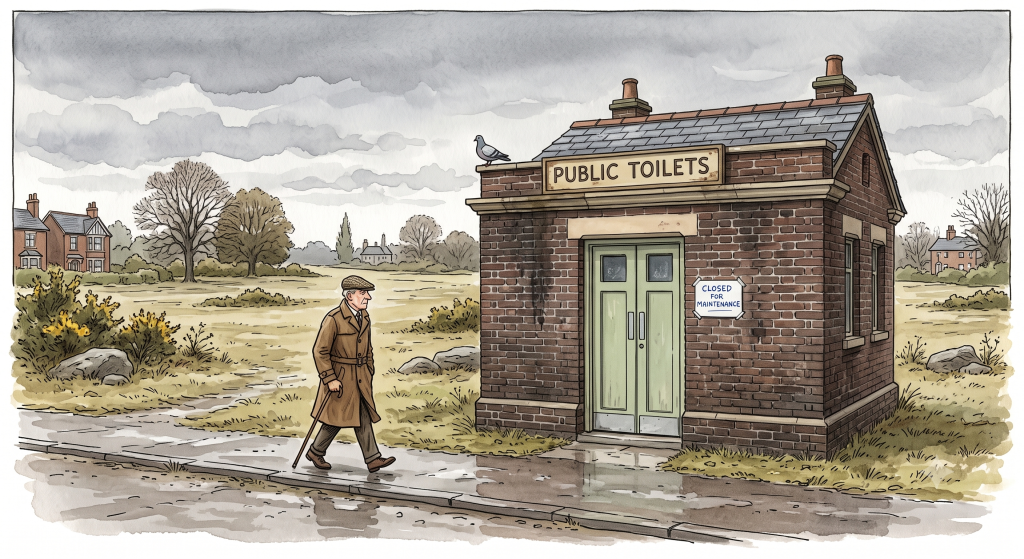
The structure that stands on the Common at the junction of London Road and Frant Road has had four lives. In order: a public cold bath, a public toilet, a brass rubbing centre, and a music venue that launched some of the most significant British bands of the past thirty years.
The cold bath came first — a Victorian civic amenity, the kind of thing the nineteenth century built on commons and in parks with a confidence about public hygiene that has since largely evaporated. In due course, the cold bath became a public convenience, which is a gentler way of saying what it was. Then, in the way of things, the toilet closed, and someone decided the building should become a brass rubbing centre instead.
The brass rubbing centre did not last.
The building sat. The Common carried on around it. And eventually, four friends in Tunbridge Wells looked at it and saw something nobody else had.
The Rumble Club
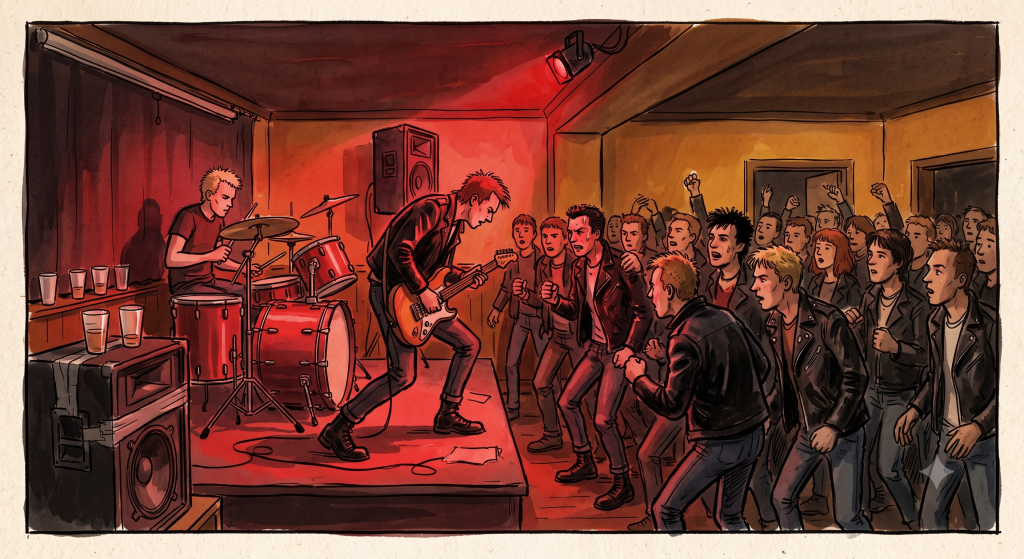
Before The Forum, there was The Rumble Club.
Between 1988 and 1992, two of the four future Forum founders ran an irregular music event that moved between venues across Tunbridge Wells — wherever they could get a space, for however long they could keep it. The Rumble Club brought in bands at the early stages of their careers that would later mean considerably more. Among them: The Boo Radleys, Lush, and a young American punk band called Green Day, who were then entirely unknown outside their home state of California.
The Rumble Club was not a business. It was a passion project run on enthusiasm and logistical improvisation. However, it was successful enough to prove something important: there was an audience for this in Tunbridge Wells. A real one, showing up in numbers, for bands that the town’s official cultural calendar would never have booked.
The four friends — Michael Oyarzabal, Peter Hoare, Jason Dormon, and Mark Davyd — decided they needed somewhere permanent.
January 1993
The former brass rubbing centre on the Common became available. The four founders took it on, converted it into a standing music venue with a capacity of 250, and opened The Forum in January 1993.
The location was, on the face of it, improbable. The venue stood directly opposite the Church of King Charles the Martyr — the oldest building in Tunbridge Wells, dating from 1684, whose founding story is told in our One Spring, Five Villages, One Town post. Five minutes’ walk away was The Pantiles, where Georgian aristocrats had once promenaded, and the town’s reputation for conservative propriety had been quietly accumulating for three centuries.
Between those two anchors of Tunbridge Wells’s official identity, in a building that had most recently been used to reproduce medieval tomb inscriptions on paper, a 250-capacity punk-and-indie venue opened its doors.
The Names That Passed Through
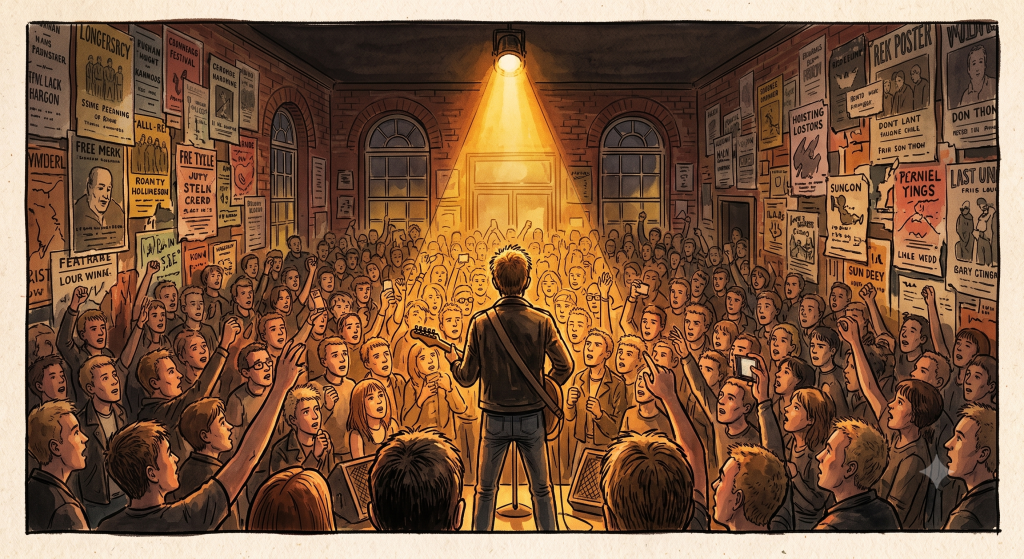
What happened next is, by any measure, extraordinary.
The Forum began booking emerging bands at the start of their careers, when nobody could yet predict their success. Over the years that followed, the list of acts that played the 250-capacity room before becoming significant grew into something that reads less like a venue booking history and more like the index of British popular music history.
Adele, Biffy Clyro, Coldplay, Ellie Goulding, Green Day, IDLES, The Libertines, Mumford & Sons, Muse, Oasis, Royal Blood, The Vaccines, and Wolf Alice all appeared at The Forum towards the beginning of their careers, which went on to global significance.
In 2007, The Forum produced a parody of the cover of Sgt. Pepper’s Lonely Hearts Club Band, filling the famous grid with famous faces who had played the room. The joke only works because the list is so implausibly long. In 2010, founder Jason Dormon was featured in The Independent’s Happy List, which profiles people who make Britain a better place to live. In 2012, the NME made it official: Britain’s Best Small Venue.
In Tunbridge Wells. In a building that used to be a toilet.
What One Founder Did Next
Mark Davyd, one of the four original founders, remained a co-owner of The Forum. However, he also went further — considerably further — with what he had learned from running it.
In 2014, Davyd founded the Music Venue Trust, a UK registered charity whose purpose is to protect, secure, and improve grassroots music venues across the country. He became its CEO. In 2016, the Music Venue Trust changed UK law — a landmark amendment to the Town and Country Planning Act. In 2018, the National Planning Policy Framework was updated to formally protect music venues from development pressure. The Music Venues Alliance now has over 500 member venues.
Davyd speaks regularly at international conferences — SXSW, Eurosonic, Primavera Sound. He is a Fellow of the Royal Society of Arts. He started in a converted toilet on Tunbridge Wells Common in January 1993.
The Music Venue Trust’s own website carries a quote from a musician who grew up in Tunbridge Wells: “Were it not for the presence of the Tunbridge Wells Forum while I was growing up, I very much doubt that I would be a professional musician now.”
The Reputation and the Reality
There is a persistent image of Royal Tunbridge Wells as a town that disapproves of things. We have written about it in detail — its origins, its contested history, and the considerable gap between the stereotype and the reality — in our Disgusted of Tunbridge Wells post.
The Forum is the single most powerful argument against that image.
The town most associated with conservative Middle England disapproval produced a 250-capacity music venue in a former public convenience that launched Oasis, Coldplay, Muse, and Adele — and whose founder went on to change UK planning law to protect the kind of place he had built. This is not an asterisk in Tunbridge Wells’s history. It is the history.
The brass rubbing centre did not last. The music has been going for thirty-two years.
This is the second post in the Made in Tunbridge Wells series — stories of things created, invented, and performed here that went on to mean something to the rest of the world. Read the first: The World Cup Started Here — Subbuteo, Langton Green, 1947. Next: a Christmas baby from Pembury who became one of the most distinctive voices in British music.
The Forum is at Tunbridge Wells Common, TN1 1XL. It is still open. Shows are listed at twforum.co.uk.