Shane MacGowan, Holmewood House, and the Question of Where You’re Actually From
This edition features the story of Shane MacGowan and his time at Holmewood House.
Every Christmas, in pubs across Britain and Ireland, a song plays that begins with a man in a drunk tank remembering better days. “Fairytale of New York” is, by most serious critical accounts, the greatest Christmas song ever written. It was co-written by a man born in Pembury, Kent, on Christmas Day itself, who spent six formative years at a preparatory school in Langton Green before Westminster, drug expulsion, punk, and a career that made him one of the most significant songwriters of his generation.
He spent most of his life trying very hard to make people forget the Kent part.
Christmas Day, 1957
Shane Patrick Lysaght MacGowan was born on 25 December 1957 in Pembury, just outside Tunbridge Wells, to Maurice MacGowan, a wages clerk at C&A, and Therese MacGowan, a traditional Irish dancer and singer. Both parents were Irish. The family had been living in County Tipperary during Shane’s earliest childhood, and moved back to England when he was six and a half.
What followed was, by his own later account, an obstinately English education. Between the ages of seven and thirteen, MacGowan attended Holmewood House — a fee-paying preparatory school set in thirty acres of rolling countryside at Langton Green, on the edge of Tunbridge Wells, the same village where Peter Adolph had invented Subbuteo a decade earlier, a story we’ve told in The World Cup Started Here.
MacGowan was, even as a child, formidably literary. By age eleven, he was reading Dostoevsky, Steinbeck, and James Joyce. At thirteen, he won a literature competition sponsored by the Daily Mirror. In 1971, aged thirteen, he left Holmewood with a literature scholarship to Westminster School — one of the most prestigious schools in the country, a place whose alumni fill entire pages of the Oxford Dictionary of National Biography.
He was expelled in his second year for possession of drugs.
The Breakdown Nobody Talks About
What happened next is rarely mentioned in the mythology, but it matters. At seventeen, MacGowan spent six months in psychiatric care at Bethlem Royal Hospital in London, struggling with drug and alcohol dependency that had already taken hold with alarming speed for someone barely out of school. He briefly enrolled at St Martin’s School of Art, worked at Rocks Off record shop in central London, and started a punk fanzine called Bondage under the alias Shane O’Hooligan.
The trajectory from Kent prep school to the London punk scene unfolded astonishingly fast, and it did so through genuine crisis, not simply rebellion. This detail tends to get smoothed over in the retelling, in favour of the more romantic version where an angry young punk simply chose his own path. The reality, as with most things about MacGowan, was messier and more human than the legend allows.
From The Nips to The Pogues
In 1977, MacGowan co-founded his first band, The Nipple Erectors — soon shortened to The Nips — with his then-girlfriend Shanne Bradley. It was a punk and rockabilly outfit that built a following on London’s independent circuit before disbanding in the early 1980s.
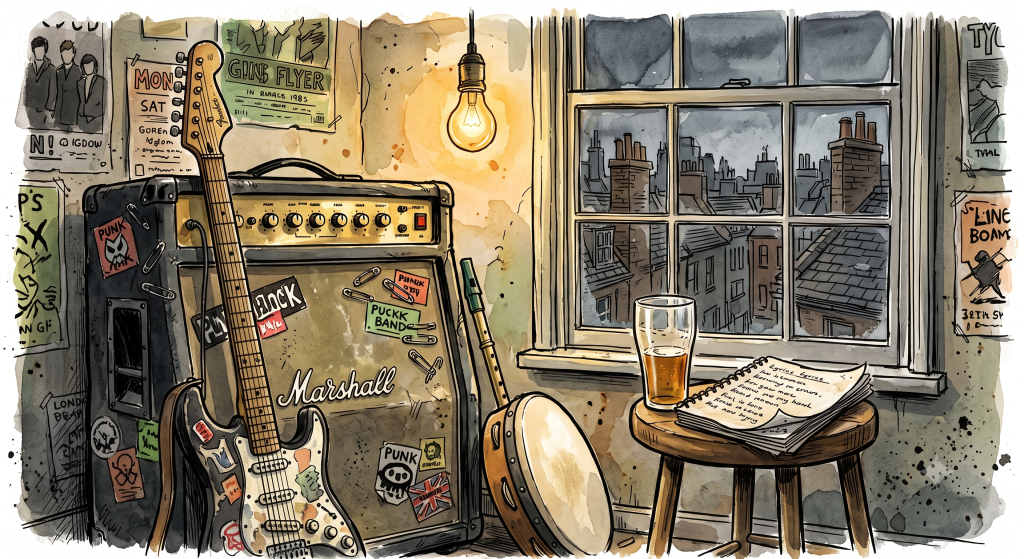
What came next changed British and Irish music permanently. In 1982, MacGowan formed Pogue Mahone — later renamed The Pogues — with Spider Stacy and Jem Finer. The band fused punk energy with traditional Irish folk music in a way nobody had quite attempted before, and MacGowan’s songwriting drew on literature, mythology, Irish history, and the lived experience of the Irish diaspora in London.
The Pogues released Red Roses for Me in 1984, Rum Sodomy & the Lash in 1985 — produced by Elvis Costello — and If I Should Fall from Grace with God in 1988, widely regarded as their creative and commercial peak. MacGowan wrote or co-wrote the majority of the material across all five albums he fronted.
The Song
Between 1985 and 1987, MacGowan and Jem Finer co-wrote “Fairytale of New York.” MacGowan recorded it as a duet with Kirsty MacColl. It reached number two in the UK charts in 1987, was voted the favourite Christmas song in the UK on multiple occasions in the following decades, and was certified sextuple platinum in the UK in 2023 — thirty-six years after its release.
It remains, every December, inescapable. Written, in part, by a boy who once sat in a classroom in Langton Green.
The Question That Followed Him
Here is where the story gets genuinely complicated, and where a WalkTW post can do something more interesting than simple celebration.
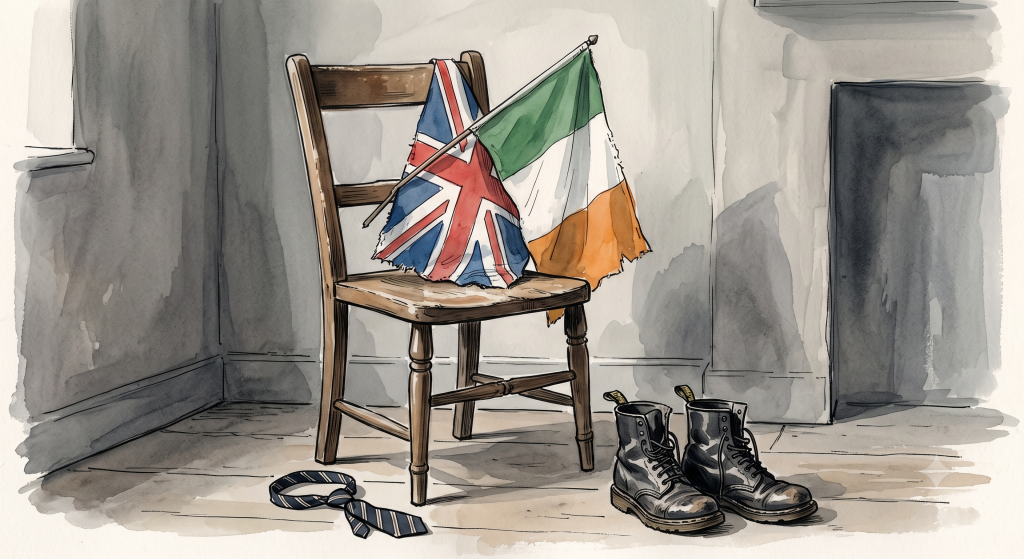
MacGowan spent much of his career being questioned about the authenticity of his Irish identity — precisely because of the Kent upbringing this post has just described. Fellow punk musician John Lydon, born to Irish parents himself, was among those who suggested MacGowan’s Irishness was performed rather than lived — pointing out that MacGowan wore Union Jack clothing on the early London punk scene before switching to the Irish tricolour once the Pogues took shape.
The biography A Furious Devotion, by Richard Balls, examines this directly. It notes that MacGowan did not walk through the gates of a state primary school on his first day — he walked through the gates of Holmewood, a fee-paying school set in thirty acres of Kent countryside, about as far from a rural Tipperary childhood as an upbringing in England could be.
MacGowan himself was, by most accounts, uncomfortable with this part of his story. His 2001 autobiography describes his time at Holmewood as “boring” and “depressing,” in contrast to the warmth he remembered about summers in Tipperary and the comfort of a Catholic preschool where he “didn’t feel cut off from Ireland.” He was, in the words of one biographer, inclined to delete Holmewood from the record entirely.
What This Actually Means
There is a version of this story that treats MacGowan’s English prep school years as a kind of inconvenient secret — proof that his Irish identity was manufactured, that the accent and the tricolour and the songs about the diaspora were, in Lydon’s phrase, “plastic paddy” performance.
That reading is too simple, and it misses something more interesting.
MacGowan was born in Kent to Irish parents. He spent his earliest years in Tipperary, then six formative years in Langton Green, then adolescence bouncing between London and the home counties. He was, in the most literal sense, a child of the Irish diaspora his songs would later document — someone who grew up between two identities, belonging fully to neither, and spent his creative life trying to reconcile the gap.
That is not inauthenticity. That is exactly the experience “Fairytale of New York” and the rest of the Pogues catalogue describe — the immigrant condition, the sense of a home that exists more in memory and song than in any single place you can point to on a map.
MacGowan didn’t fake his connection to Irish identity. He lived the diaspora experience from the English side, at a Kent prep school, he spent his adult life trying to forget, while writing some of the most powerful songs about Irish identity ever recorded.
What Remains
Shane MacGowan died of pneumonia at his home in Dublin on 30 November 2023. He was sixty-five. Tributes arrived from across the worlds of music, literature, and Irish public life — the President of Ireland had personally presented him with a lifetime achievement award at a gala concert marking his sixtieth birthday five years earlier.
Holmewood House still operates today, in the same thirty acres of Langton Green countryside where an eleven-year-old was reading Dostoevsky before anyone had heard of the Pogues. There is no plaque. No mention of the school’s public history. The connection exists mostly in biographies, brainstorm essays, and the occasional obituary that couldn’t resist juxtaposing the “Garden of England” with the raucous, brilliant, self-destructive genius the boy became.
Every Christmas, in pubs across two countries, a song plays that begins in a drunk tank and ends somewhere more forgiving. It was written, in part, by a boy from Pembury who spent his whole life trying to convince everyone — including himself — that he belonged somewhere else entirely.
This post is in the Made in Tunbridge Wells series — stories of things created, invented, and performed here that went on to mean something to the rest of the world. Read the others: The World Cup Started Here — Subbuteo and From Cold Bath to Coldplay — The Forum.
Also in this series · Made in Tunbridge Wells