On fate, hidden histories, and the unexpected geography of belonging
The Founder Story
There is a fact about Royal Tunbridge Wells that most people who live here don’t know.
The town is built on seven hills.
This is not a marketing claim or a piece of tourist board optimism. It comes from Richard Cobb — historian, Oxford professor, and the most attentive reader this town has ever had — who mapped its topography in the kind of detail that only someone who loved a place completely would bother with. Mount Ephraim. Mount Sion. Mount Pleasant. Grove Hill. Rose Hill. Camden Hill. The western ridge above Rusthall. Seven hills, in a small English spa town in Kent.
Most people who walk these streets every day have no idea. The hills are simply the reason certain roads are steep, certain views are unexpectedly long, and certain mornings feel like you’ve earned your coffee.
But for the person behind WalkTW, that number meant something else entirely.
The City That Started Everything
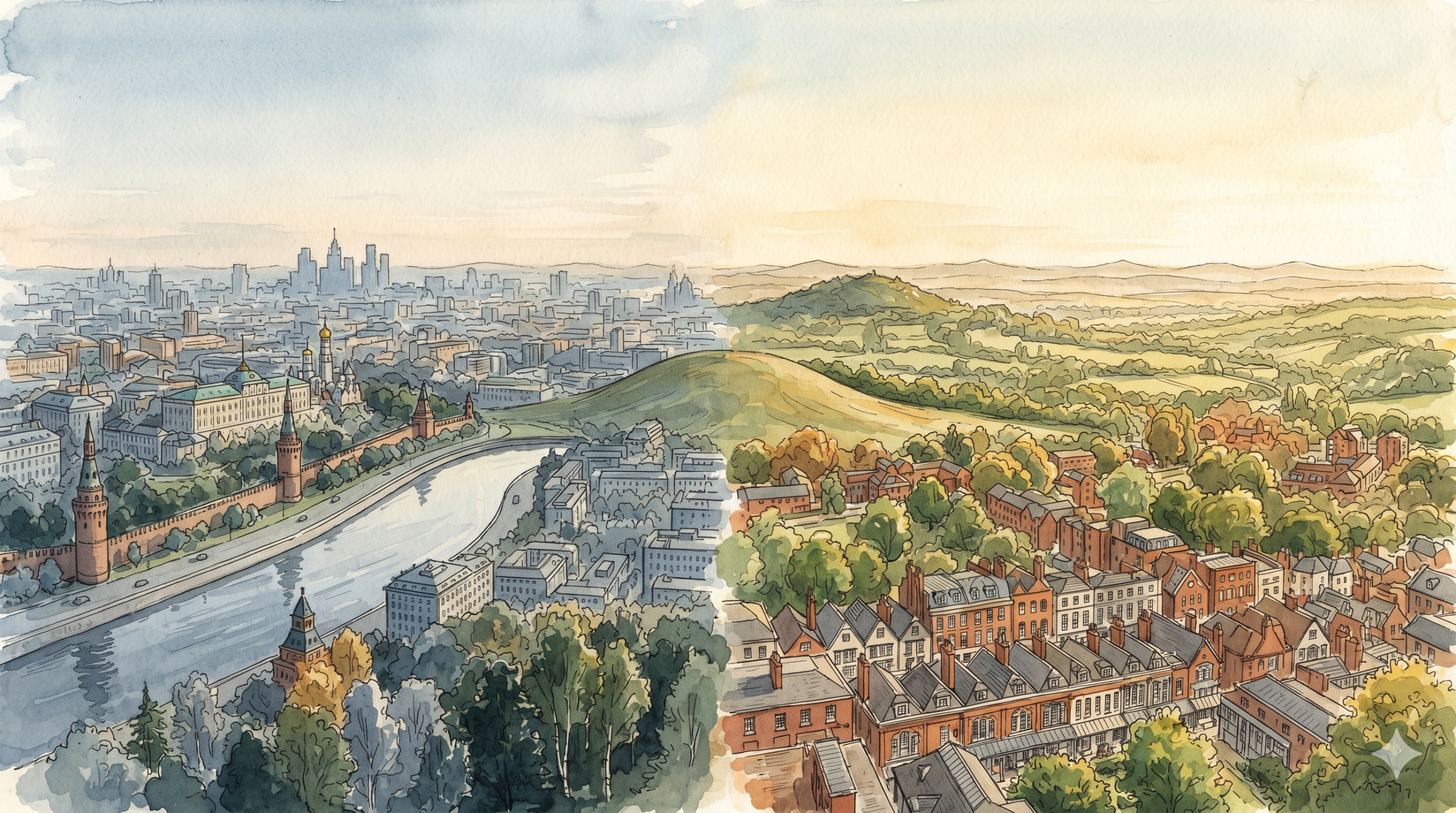
Moscow is called the City of Seven Hills.
The legend dates from the fifteenth and sixteenth centuries, when the city was positioning itself as the successor to Rome — politically, spiritually, geographically. If Rome was built on seven hills, then Moscow, the Third Rome, would be too. The specific hills were counted, named, debated, and eventually mythologised. Lomonosov made a list. Historians argued about it for centuries. Britannica notes diplomatically that the claim is something of an exaggeration.
But the idea persisted. Moscow is a city of hills — of slopes and ravines and unexpected elevations, of streets that rise and fall in ways the map doesn’t quite prepare you for. Growing up there, you don’t think about the hills. They are simply the city. The topography is the air.
The Journey That Wasn’t Planned
The path from Moscow to Tunbridge Wells was not direct. It was not planned. It was, as with most significant journeys, a series of practical decisions that added up to something nobody intended.
London first — Greenwich, specifically, with the meridian line running through it and the sense of standing at the exact centre of measured time. Then Brentwood in Essex, which is a perfectly decent place to live and about which history has relatively little to say. Then something unexpected: a work opportunity in Belfast, a city that every British colleague of everyone involved received with barely concealed alarm.
This requires a moment of explanation.
Most British people’s understanding of Belfast in 2016 was formed by images from a conflict that had ended nearly twenty years earlier. The Troubles were real — the bombs, the barricades, the decades of violence that left marks on streets and families and the collective imagination. However, 2016 Belfast was not 1985 Belfast. What the WalkTW family found there was a modern, vibrant, genuinely surprising city — full of young people, full of energy, shaped by a university culture that had grown into the space left by history.
The perception was wrong. The place was something else entirely.
This would turn out to be a pattern.
What Belfast Taught Without Knowing It
The Emerald Island leaves marks on everyone who spends time there. The landscape is saturated with myth — every hill has a story, every stone has a name, every view carries the weight of something that happened before anyone now living was born. Northern Ireland is perhaps the most historically layered landscape in the British Isles, and living inside that density changes the way you read places afterwards.
You start to look underneath.
You start to notice the gap between what a place appears to be and what it actually contains. You start to understand that reputation and reality are almost never the same thing, and that the most interesting version of any place is almost always the one that isn’t written on the front of the tourist brochure.
Nobody sat down and decided to learn this. It was simply what happened when you lived somewhere whose surface didn’t match its depth.
The Practical Decision
The move to Tunbridge Wells was made, as most moves with children are made, for entirely rational reasons.
The children were approaching secondary school age. The family was back in London and looking at the same calculation that thousands of families make every year: which town within commutable distance of the city has the concentration of good secondary schools that justifies uprooting everything and starting again? Tunbridge Wells scored well on that calculation. The schools are good. The town is manageable. The commute to London is real but not punishing.
Nobody moved here because of the seven hills. Nobody moved here because of the Georgian Pantiles, the Victorian railway war, the Russian Orthodox congregation on St Luke’s Road, or the preservation society called TWERPS. Nobody moved here because a man called Henry Reed walked 120 miles across Tasmania and eventually built Dunorlan Park. Nobody moved here because the town’s most famous resident is anonymous, fictional, and wrong about almost everything.
The decision was about schools.
What the Project Found
WalkTW began as a curiosity and became an archive.
The further the research went, the more the town revealed itself to be something quite different from its reputation. Underneath the tweedy, conservative, Disgusted-of-Tunbridge-Wells surface — a surface that is real enough, and has been earned over centuries — was a place of extraordinary density. Georgian scandal. Hidden geniuses. Russian exiles are building an Orthodox church in a Victorian Anglican building. A piano was banned by the Council. A Victorian merchant whose life spanned three continents and whose park is now walked by everyone who has never heard his name.
The same gap that Belfast had taught the importance of noticing.
The same depth that had always been there, waiting for someone to look.
Seven Hills
And then, reading Cobb’s Still Life — the memoir by the Oxford historian who grew up in Tunbridge Wells in the 1920s and loved it with the particular thoroughness of someone who understood that ordinary places contain extraordinary things — the number appeared.
Seven hills.
There is probably a rational explanation for why a person from Moscow ends up in a town built on seven hills. Something about the High Weald geology, about the sandstone formations that create exactly the kind of rolling, multi-ridged terrain that human settlements have always found hospitable. Something about how the same geological logic that produces a seven-hilled Moscow produces a seven-hilled Tunbridge Wells, and how the fact that both numbers are the same is simply arithmetic rather than fate.
Probably.
However, there is another way to read it. The one that admits that we don’t fully understand why we end up where we do. That the reasons we give for our decisions — schools, opportunities, practicalities — may be accurate as far as they go, but not the whole story. That the places we are drawn to, repeatedly and without quite knowing why, may be telling us something about ourselves that the rational account leaves out.
A city of seven hills produces, perhaps, a person who is simply more comfortable on uneven ground.
The Question Worth Asking
How many other things are there — about the places we live, the towns we chose without really choosing, the histories we walk through without knowing it — that are quietly shaping decisions we think we’re making for entirely different reasons?
WalkTW exists, in part, to answer that question for anyone who lives in or loves Royal Tunbridge Wells. Not because the history changes the present, but because knowing it changes the way you inhabit the present. The town looks different when you know what Dunorlan Park cost its builder. The Pantiles sounds different when you know what went on there. The railway feels different when you know about the peace tunnel bored through Grove Hill in 1876 as the price of a grudging truce between two companies that despised each other.
And the streets feel different — slightly, in a way that’s hard to explain — when you know you’re walking on seven hills.
The same seven hills you started on, thousands of miles away, without ever knowing it would matter.
The WalkTW archive is an ongoing excavation of Royal Tunbridge Wells — its hidden histories, overlooked people, and the stories that most residents walk past without knowing they’re there. It began, like most things worth doing, with a practical decision that turned out to have fewer practical reasons than it first appeared.
Richard Cobb’s memoir of Tunbridge Wells — Still Life — is published by Slightly Foxed Editions and is available from their website at foxedquarterly.com. It is the best book ever written about this town, and it is not close.