Tag: spa town

Stories tied to the spa town identity of Royal Tunbridge Wells — the chalybeate spring, the “taking the waters” culture, and the fashionable society it attracted.

  • THE TOWN THAT DIDN’T KNOW ITSELF

    THE TOWN THAT DIDN’T KNOW ITSELF

    An Introduction to Three Stories About Royal Tunbridge Wells and Its Queer History

    The Chronicles


    There is a version of Royal Tunbridge Wells that everyone knows. It is tweedy, it is conservative, it is faintly outraged by most things, and it almost certainly writes letters. It is the town of the mythic Disgusted of Tunbridge Wells — a place that stands, in the national imagination, as shorthand for a very particular kind of English disapproval.

    That version is not entirely wrong. However, it is spectacularly incomplete.

    Royal Tunbridge Wells has a queer history. It runs from the Georgian Pantiles — where fluid identity and theatrical self-presentation were, for a brief and glittering century, practically the entry requirement — all the way to a man who returned here from Birmingham in 2021, looked around, found no LGBT+ community infrastructure whatsoever, and quietly built one from scratch.

    In between, there is a Council ban on a piano recital. There is a campaigning group so dedicated it operated for decades in a town that mostly pretended it didn’t exist. There is, in short, a story that Tunbridge Wells has never quite told itself.

    It is time to tell it.


    Why This Town, Why This History

    Every place has a version of itself it prefers to project. Tunbridge Wells projects elegance, history, and a certain studied propriety. The Pantiles. The chalybeate spring. The Victorian villas. The commuter trains to London Bridge.

    What it projects, rather less enthusiastically, is complexity — the messy, contradictory, thoroughly human reality beneath the curated surface. However, complexity is precisely what makes a town interesting. Furthermore, it is precisely what WalkTW exists to excavate.

    Queer history is, in most English market towns, hidden history. Not because it didn’t happen — it always happened — but because it happened quietly, in spite of opposition, and without the institutional support that would have made it visible. As a result, it tends to vanish from the official record. The Assembly Rooms get a heritage plaque. The gay campaigners who were banned from the Assembly Rooms do not.

    Therefore, this series exists. Not as a political statement — or not only as one — but as an act of historical accuracy. Tunbridge Wells is more interesting than its reputation. Its LGBT history is part of that.


    Three Stories, Three Eras

    The trilogy ahead covers three very different chapters of the same long story.,
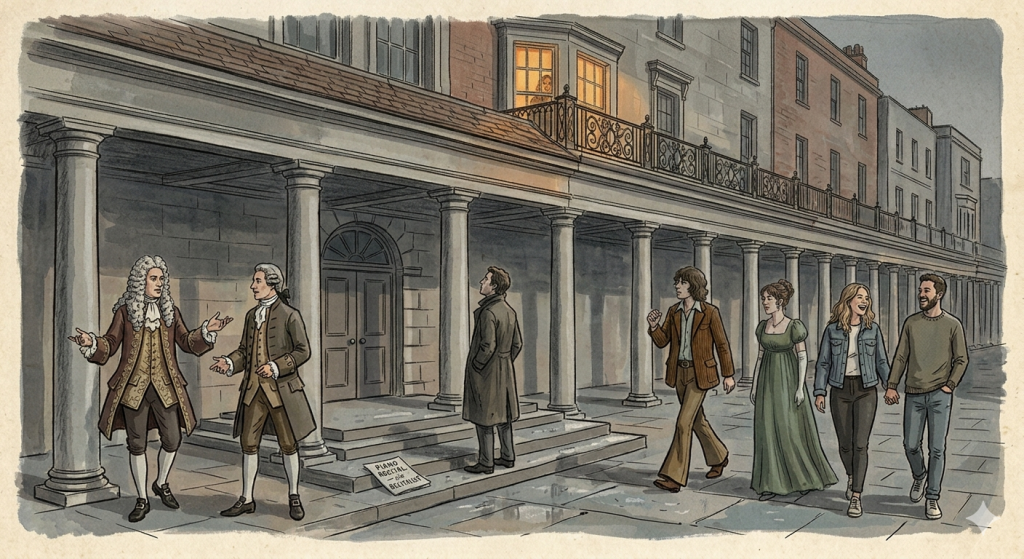
    A quietly dramatic editorial illustration of the exterior of a grand civic building — stone-faced, Edwardian, authoritative — on a grey evening in 1974. The arched double doors are firmly closed. A concert programme lies on the steps, slightly rain-dampened, reading "Peter Katin — Piano Recital." A single figure stands at the base of the steps in a long coat, hands in pockets, looking up at the closed doors. He does not look defeated — he looks patient. The atmosphere is one of dignified, unhurried resistance. Pencil-and-wash illustration style. Palette of charcoal, stone grey, and one small warm amber light in a window above.

    Part One begins in 1972, when a man called Ross Burgess moved to Tunbridge Wells, looked around, and decided to do something about the fact that there was nowhere for gay people to meet. What followed — a campaigning group, a Council ban on a charity piano concert, and an acronym even better than TWERPS — is one of the most quietly extraordinary episodes in the town’s modern history. It is also almost entirely unknown.

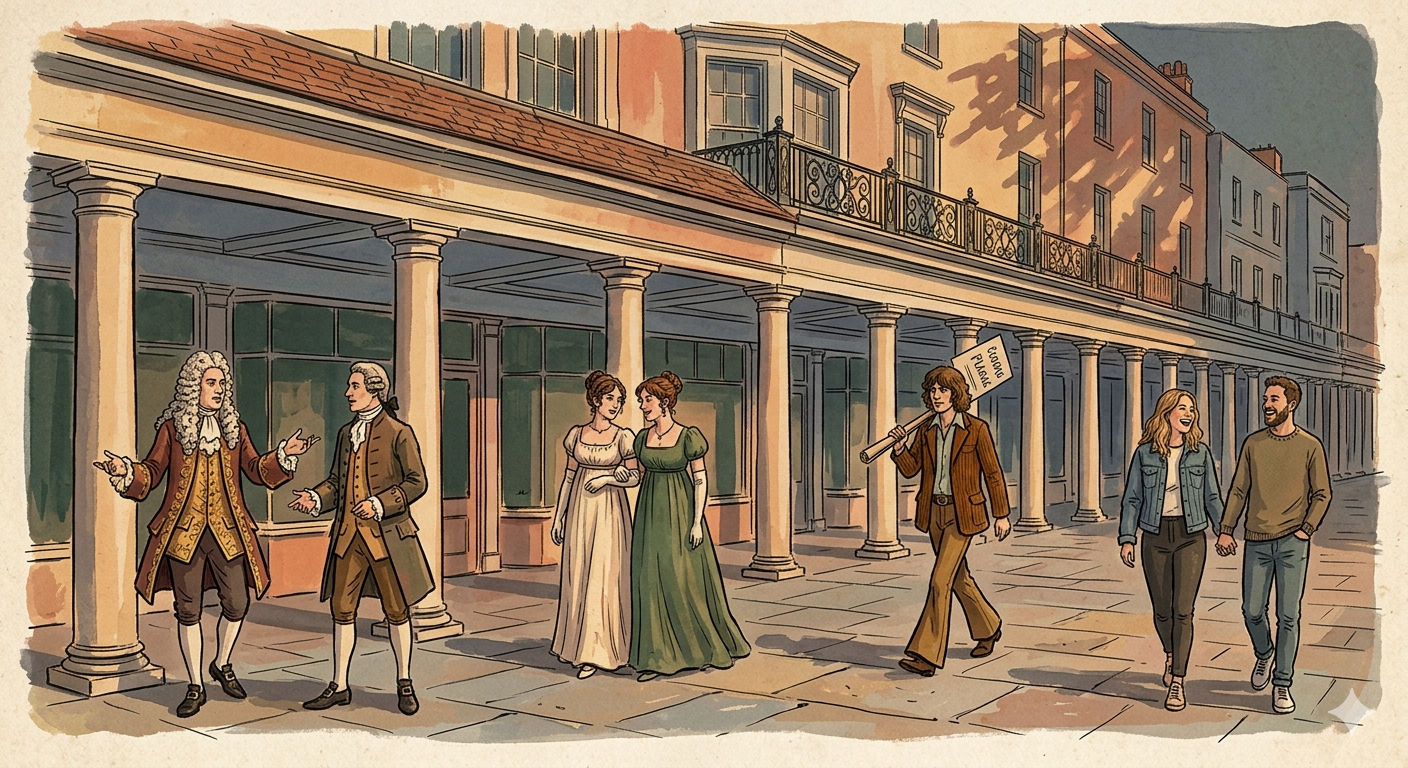
    Part Two goes further back — much further. The Georgian spa town of the 17th and 18th centuries was not the conservative retirement destination of modern imagination. It was a place of performance, transgression, and deliberate social theatre, where the usual rules of English life were, for the season at least, suspended. The Pantiles was not simply a place to take the waters. It was a stage. And, historically, stages have always attracted people who needed one.

    Part Three arrives in the present. Tunbridge Wells in 2024 has no gay bar, no Pride parade, and no LGBT+ venue of any kind. It also has a growing community, a social group built by one determined man with a Facebook page, and a question worth asking: what does a queer life in a town like this actually look like — and what does it say about how much has, and hasn’t, changed?


    What We Owe the Full Picture

    The Disgusted of Tunbridge Wells myth is, in its way, a comfort. It is easy to understand, easy to repeat, and requires nothing of anyone. However, the real town — the one with three centuries of complicated, interesting, frequently surprising human history — requires a little more from us.
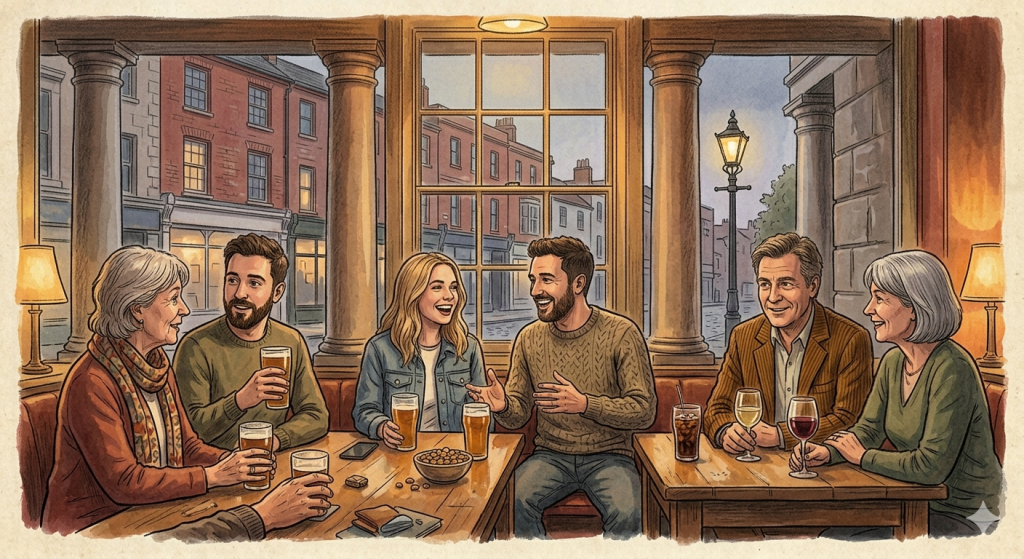
    A warm editorial illustration of a small informal social gathering in a pub in Royal Tunbridge Wells, contemporary. Six or seven people of different ages sit around two pushed-together tables — drinks in hand, mid-conversation, relaxed. Through the window behind them, the familiar red brick of a Tunbridge Wells high street is visible. There are no flags, no banners, no signage of any kind. The image's entire argument is in the warmth of the scene — people who found each other in a town that gave them no infrastructure to do so. Painterly, intimate illustration style. Golden pub light, warm amber and brick-red palette.

    It requires us to look at the Assembly Rooms and remember not just the concerts that happened there, but the ones that didn’t. It requires us to walk The Pantiles and consider who else walked it before us, and why. It requires us to acknowledge that a community need not be visible from the outside to be real.

    Royal Tunbridge Wells has always been more than its reputation. This series is, among other things, a small argument for noticing that.

    Hashtags: #TunbridgeWells #LGBTHistory #RoyalTunbridgeWells #HiddenHistory #WalkTW #TheChronicles #QueerHistory #KentHistory
  • The Russians Who Never Arrived: Tunbridge Wells and the Romanovs 👑🚂

    The Russians Who Never Arrived: Tunbridge Wells and the Romanovs 👑🚂

    Some came to stay. Some never arrived. Some never left. The hidden Russian history of Royal Tunbridge Wells.

    On 8 April 1909, King Edward VII signed a royal warrant. From that day forward, the spa town in Kent would be known as Royal Tunbridge Wells — one of only three towns in England ever to receive the honour. The story of the Romanovs in England — the Royal connection to Tunbridge Wells is a fascinating part of the town’s unique history.

    The original proposal was to rename it “Royal Kentish Spa,” but the King preferred “Royal Tunbridge Wells,” and this was the name formally granted. The prefix recognised the town’s long history of royal and aristocratic visitors, stretching back to the earliest days of its fame as a spa.

    It was a moment of quiet civic triumph. The town had been trying to modernise, to compete, to position itself as something more than a faded Georgian resort. The Royal prefix was its reward.

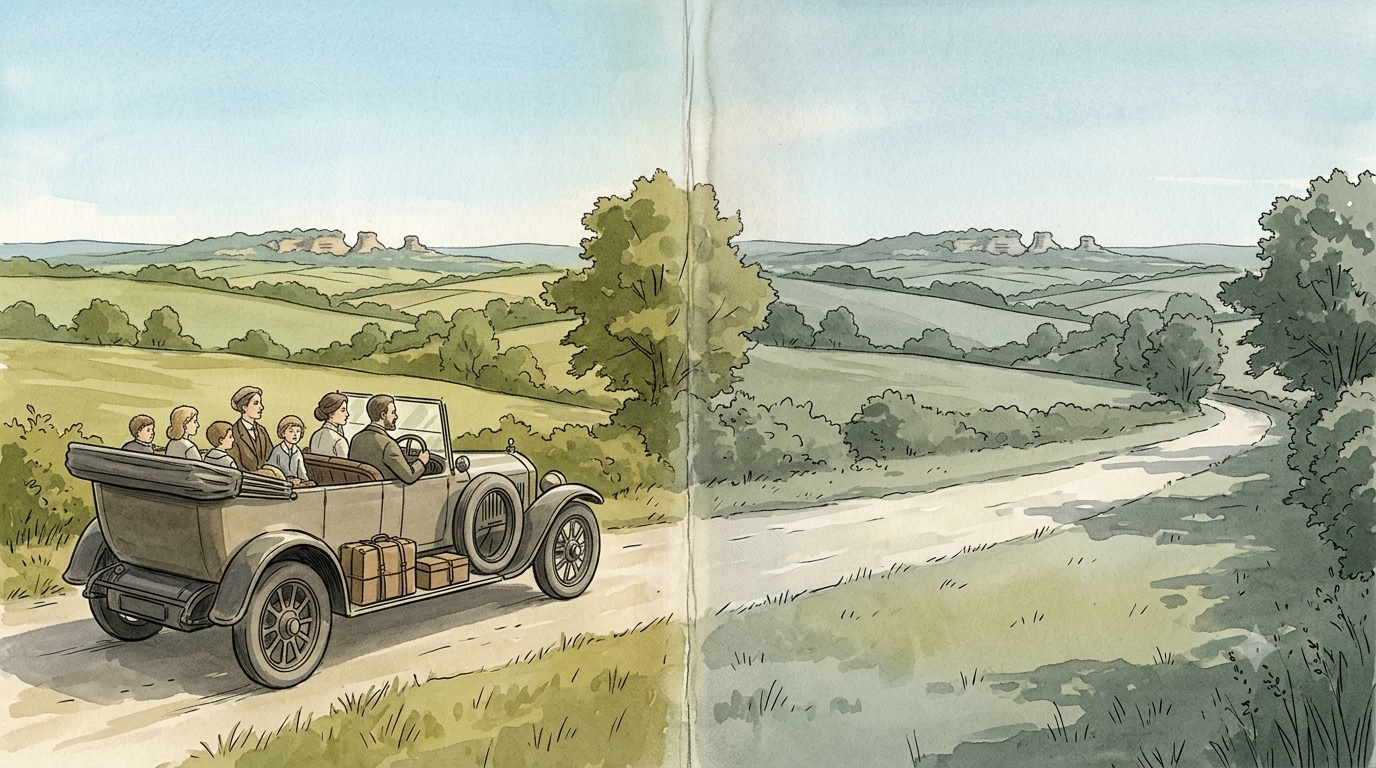
    What nobody in Tunbridge Wells could have known was that the King who signed that warrant had less than thirteen months left to live. That his son George, who would inherit both the throne and the family’s Russian connections, would within eight years face one of the most agonising decisions in the history of the British monarchy. And that the Russian cousins who might, in a different history, have found their way to this corner of Kent would instead end their lives in a cellar in the Ural mountains.

    The year Tunbridge Wells became Royal was also, almost exactly, the last year things were still going to be fine.


    Georgie and Nicky: The Cousins Who Looked Like Twins

    To understand what was lost, you need to understand what existed.

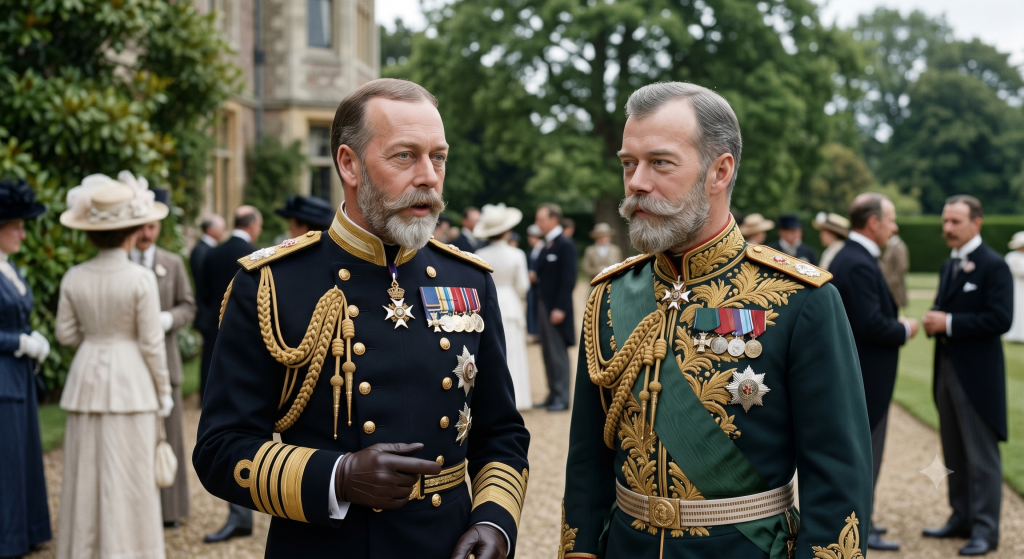
    A realistic historical photograph depicting King George V of Great Britain and Tsar Nicholas II of Russia standing side-by-side at an outdoor garden party. Both men possess striking physical similarities, including neatly trimmed, greying beards and prominent moustaches. They wear ornate, highly detailed military uniforms adorned with gold epaulets, sashes, and numerous medals. In the blurred background, other Edwardian-era guests mingle on the grounds of an estate.

    Tsar Nicholas II of Russia and King George V of Great Britain were first cousins and bore a striking resemblance to each other — the same blue eyes, the same beard, similar in size and build. They often wrote to each other using the nicknames “Nicky” and “Georgie.” Their own relatives sometimes mistook them for one another from behind.

    By all accounts, the relationship was warm and affectionate — cousins who seemed almost as close as siblings. They holidayed together with their families. Although George and Nicholas shared a close bond when young, the weight of the monarchy and political unrest in Russia would gradually impose distance between them.

    They were cousins in the deepest Victorian sense — products of Queen Victoria’s extraordinary habit of marrying her children into every royal house in Europe. George and Nicholas were grandchildren of Queen Victoria, bound to one another by history even as history would ultimately tear them apart.

    In the summer of 1909 — the same year Tunbridge Wells received its Royal prefix — the Romanov and Windsor families met at Cowes for Regatta Week. Three generations. The last entirely happy family photograph. Four years later, in 1913, they gathered again in Berlin for a cousin’s wedding. It would be the final meeting of the great European royal families before the start of the First World War — and perhaps the last amiable occasion before the Romanov dynasty’s collapse.


    The Romanov Who Actually Lived in England

    Here is something most people don’t know. A member of the immediate Romanov family didn’t just visit England in the years leading up to the revolution. He lived here.

    Grand Duke Michael Alexandrovich — tall, handsome, younger brother of Tsar Nicholas II — ended up in England in 1913, taking up residence at Knebworth House in Hertfordshire on a one-year lease. He had been exiled from Russia by his own brother for entering into a morganatic marriage — marrying beneath his station — with a twice-divorced commoner named Natasha. The couple had been forced to live a peripatetic existence in Switzerland, on the French Riviera and finally in England.

    He walked English lanes. He photographed the English countryside. A photo album of some 200 photographs he took during his time at Knebworth sold at auction for the equivalent of $34,000. He was, in every practical sense, a Russian Grand Duke living an English country life — attended by an English governess for his children, watched by Russian secret police who had followed him across Europe, excluded from English high society because his wife was divorced.

    When Russia mobilised its troops in 1914, Michael sought permission to return to Russia and fight for his country. He went back. He need not have.

    In 1917, after Nicholas abdicated, Michael was named in the abdication manifesto as potential Tsar — he deferred acceptance until ratification by an elected assembly and was never confirmed as Emperor. Grand Duke Michael and Countess Brasova were kept under house arrest on the Gatchina estate. They used diplomatic channels to request permission to leave Russia and live in exile on their Sussex estates.

    Sussex. He had property in England. He wanted to come back. The permission was not granted.

    Grand Duke Michael Alexandrovich was murdered on 13 June 1918 in Perm, Russia, aged 39. He was the first of the Romanovs to be killed. His brother Nicholas and the rest of the imperial family followed in Yekaterinburg one month later.

    The Sussex estates waited empty. The English countryside he had photographed from Knebworth continued quietly without him.


    The Refusal That Changed Everything

    In March 1917, the British Foreign Office wrote to the British Ambassador in Petrograd to offer “asylum to the Emperor and Empress in England, which it is hoped they will take advantage of during the war.” Later, owing to fears of growing anti-monarchical sentiment and possible revolution at home, King George V and Parliament opposed the idea.

    There are grounds to believe it was George V himself who blocked the plan — though he later tried to cover up the fact. The political calculation was cold and clear: bringing “Bloody Nicholas” and his German Empress to England would look bad. Britain was a constitutional monarchy where a king’s power was at the mercy of the people. Nicholas was radioactive, and George needed to protect himself. He wasn’t “Georgie” anymore.

    It was unfortunately not considered acceptable to offer asylum to the Tsar or any male members of the Russian Imperial family. The British government needed to keep Russia in the war as an ally and did not want to upset the Provisional Government, which they had already recognised as the legitimate rulers of Russia.

    George V wrote to Nicholas after his abdication: “I shall always remain your true friend.”

    He did not save him.

    After the murder, he wrote in his diary that it was a foul murder, and that he had been devoted to Nicky, who was the kindest of men and a thorough gentleman. The diary entry has the particular quality of a man who knew exactly what he had done and could not say so.


    What Tunbridge Wells Might Have Contained

    This is the counter-history. The paths that nearly crossed. The houses that might have had different occupants.

    Grand Duke Michael owned property in Sussex and wanted to return to it. His sister Xenia — Nicholas’s favourite sibling — was George V’s favourite cousin. He gave her Frogmore Cottage as a grace-and-favour home in 1925, and she used to go to Windsor Castle to see the King and Queen. She lived in England until she died in 1960 at Hampton Court Palace. The Tsar’s sister died in Hampton Court Palace. His nephew, Prince Andrei Alexandrovich, was born in the Winter Palace, St Petersburg, and died at Provender House, Faversham, Kent, on 8 May 1981.

    The Tsar’s family — the ones who survived — ended up in Kent anyway. One branch of the Romanovs has been in this county for over a century. They just arrived as exiles rather than as royalty, by a longer and more terrible route than anyone intended.

    And in Tunbridge Wells, in the 1920s, a woman in a cloche hat and jade earrings walked the streets — the town’s only acknowledged Russian Revolution refugee, remembered by a historian’s child who happened to be watching.

    The Royal prefix the town received in 1909 came from a king who would shortly face a choice between family and politics, and choose politics. The word “Royal” on our street signs is, among other things, a small monument to a friendship that couldn’t hold when it mattered most.


    🕵️ Fact or Fiction? The WalkTW Archive Weighs In

    Three questions for the comment section:

    Question #1: The Sussex Estates. Grand Duke Michael Alexandrovich owned property in Sussex and formally requested its return in 1917. Nobody has yet identified exactly which Sussex estates these were, or how close they came to Tunbridge Wells’s borders. Does anyone know? The WalkTW archive would very much like to find out.

    Question #2: The Photograph Album. Grand Duke Michael took 200 photographs of English country life during his time at Knebworth in 1913-14. They sold at a Russian auction. Has anyone ever seen them? Given that he was exploring English landscapes just a short distance from Kent, some of those photographs may show the Wealden countryside visible from the hills of Tunbridge Wells.

    Question #3: Did They Pass Through? The railway line from London to the Sussex coast — the same route a Russian Grand Duke with Sussex property would most naturally have taken — runs through Royal Tunbridge Wells. The station exists. The timetables existed. Is it possible that a Romanov passed through Tunbridge Wells Central on their way to or from their English estates and never left a record of it? We cannot prove it. We cannot disprove it either.

    Drop your thoughts below. The archive is listening. 👇

    #TunbridgeWells #WalkTW #Romanovs #RussianHistory #TheRussiansWhoNeverArrived #GeorgeV #NicholasII #LocalHistory #HiddenHistory


    More in this series: Russian Tunbridge Wells

  • The Writers Who Watched Us — Part 2: The Spy Who Came to Take the Waters ☕🕵️

    The Writers Who Watched Us — Part 2: The Spy Who Came to Take the Waters ☕🕵️

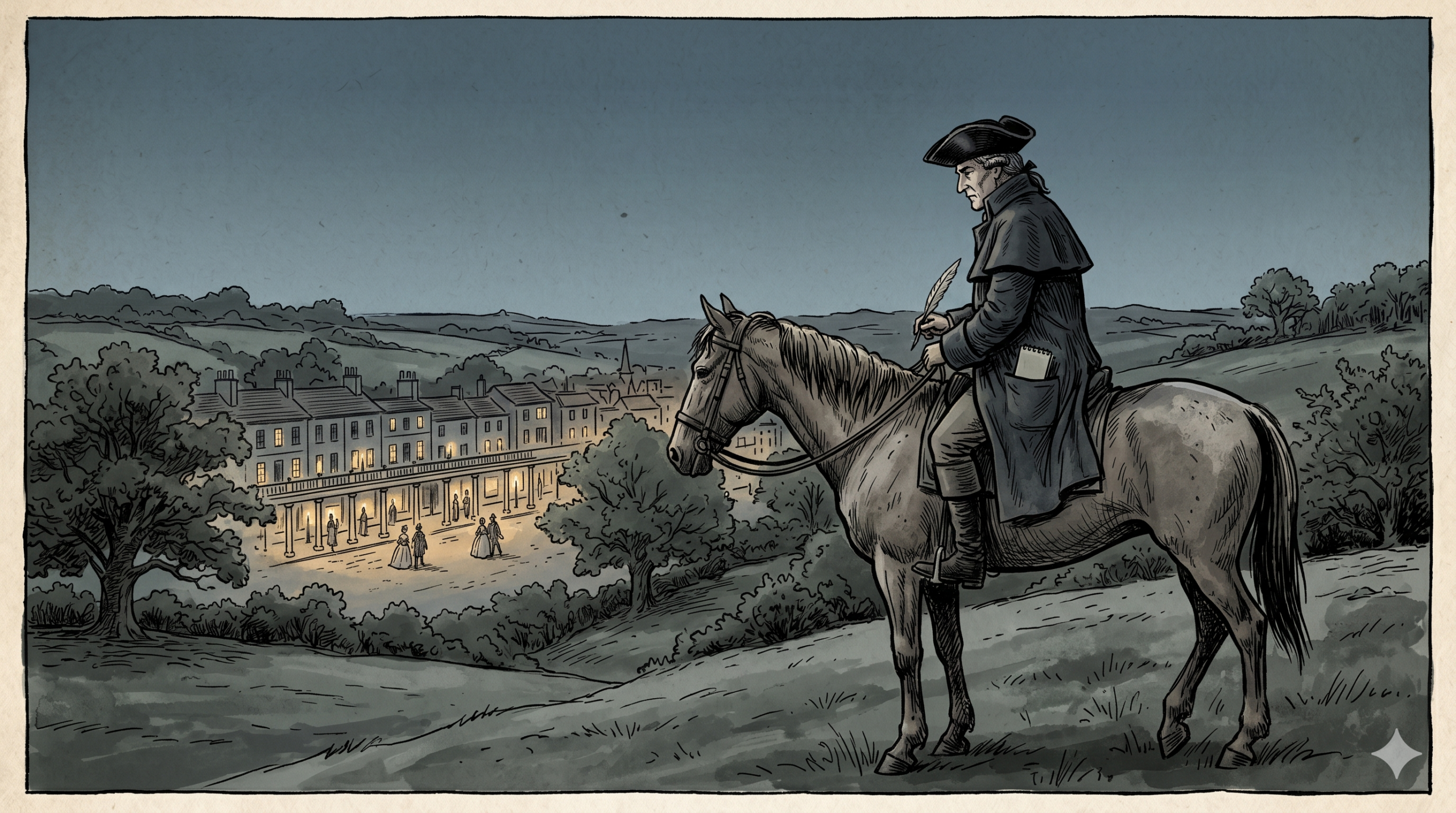
    Let’s set the scene. The year is 1722. Daniel Defoe’s original ambition had been to be a businessman — but following bankruptcy, imprisonment, and the pillory, he had transformed into a lonely and secretive writer of pamphlets, novels, and a government spy.

    He had already written Robinson Crusoe. Moll Flanders had come out that same year. At this point, Daniel Defoe in Tunbridge Wells was sixty-two years old, perpetually in debt, almost certainly still working as a government intelligence agent on the side, and very probably in no mood to be impressed by anyone’s pretensions.

    He rode into Tunbridge Wells on horseback. He watched. He formed some extremely sharp opinions. And then he wrote them all down in a book that is still in print three hundred years later.

    If Thackeray took notes from a window and Nesbit took memories from a field, Defoe walked straight into the middle of the promenade, looked everyone directly in the face, and told them exactly what he thought of them.


    The Man Who Invented Modern Journalism

    Before we get to what he said about us, it’s worth understanding who was saying it.

    A well-educated London merchant, Defoe became an acute economic theorist and began to write eloquent, witty, and often audacious tracts on public affairs. A satire he published resulted in his being imprisoned in 1703, and his business collapsed. He travelled as a government secret agent while continuing to write prolifically.

    When prosecuted for a pamphlet, Defoe had spirit enough, while awaiting his ordeal, to write the audacious “Hymn to the Pillory” — and this helped to turn the occasion into a triumph, with the pillory garlanded, the mob drinking his health, and the poem on sale in the streets.

    This is the man who arrived in Tunbridge Wells. A convicted pamphleteer, a former bankrupt, a government spy travelling under cover, and the author of Robinson Crusoe and Moll Flanders — two books that had both been published that same extraordinary year of 1722. He had spent his whole career writing about fraudsters, social climbers, shipwrecked men, and women forced to reinvent themselves through sheer nerve.

    Tunbridge Wells must have felt like coming home.


    What He Actually Found Here

    Defoe arrived during an unusually busy season. When he came to the Wells, he found a great deal of good company — and what was more particular, it happened to be at the time when His Royal Highness the Prince of Wales was there with an abundance of the nobility and gentry of the country, who thronged to that place; so that at first he found it very difficult to get a lodging.

    He watched the Prince do his royal rounds, and he watched the town snap back to its ordinary self the moment the entourage left. In two or three days, things returned all to their ancient channel, and Tunbridge was just what it used to be.

    What it used to be, in Defoe’s assessment, was a place running almost entirely on performance, appetite, and the management of appearances. He described the morning ritual on the Upper Walk with the cool detachment of a man who had seen every variety of human hustle:

    The ladies that appear here are indeed the glory of the place; coming to the Wells to drink the water is a mere matter of custom; some drink, more do not, and few drink physically. But company and diversion are, in short, the main business of the place; and those people who have nothing to do anywhere else seem to be the only people who have anything to do at Tunbridge.

    Three hundred years before anyone invented the phrase, Defoe had identified the entire town as a place where people came to be seen rather than to do anything useful. He would have been absolutely lethal on social media.


    The Bit That Reads Like a WalkTW Post

    Here is where Defoe, the ex-convict government spy and author of Moll Flanders, turns unexpectedly into a social commentator of quite startling precision. Having watched the promenade for a few days, he delivered this verdict:

    As for gaming, sharpening, intriguing, as also fops, fools, beaus, and the like, Tunbridge is as full of these as can be desired, and it takes off much of the diversion of those persons of honour and virtue, who go there to be innocently recreated.

    “Gaming, sharpening, intriguing.” He named our three defining pastimes in a single sentence and barely paused for breath.

    But then he added something even better. Having noted that a lady could easily damage her reputation at the Wells, he immediately turned the blame around:

    I must own I look just the other way; and if I may be allowed to use my own sex so coarsely, it is really among the men that the ladies’ characters first and oftenest receive unjust wounds. The malice, the reflections, the busy meddling, the censuring, the tattling from place to place, and the making havoc of the characters of innocent women, are found among the men’s gossips more than among their own sex, and at the coffee-houses more than at the tea-table.

    A man. In 1722. Telling the entire assembled company of Tunbridge Wells that the real gossip was the men, not the women. At the coffee houses. Not the tea tables.

    The man had nerve, you have to give him that.


    The Final Verdict

    After all the sharp observations, Defoe landed on a conclusion that could serve as the town’s unofficial motto to this day:

    In a word, Tunbridge wants nothing that can add to the felicities of life, or that can make a man or woman completely happy — always provided they have money; for without money a man is nobody at Tunbridge, any more than at any other place; and when any man finds his pockets low, he has nothing left to think of but to be gone, for he will have no diversion in staying there any longer.

    Lovely place. Bring cash.


    Find His Tunbridge Wells Today

    The Upper Walk Defoe described — where ladies paraded in their finest and gentlemen intrigued at the coffee houses — is The Pantiles. You can walk it this afternoon. After the appearance at the Wells, you are surprised to see the walks covered with ladies completely dressed and gay to profusion, where rich clothes, jewels, and beauty dazzled the eyes from one end of the range to the other.

    The Chalybeate Spring, he dismissed as mostly a social excuse, still flows at the north end of The Pantiles, where a costumed Dipper serves the waters on summer afternoons. The Church of King Charles the Martyr, which he would have passed on his way in, still stands at the end of the walk.

    Stand there on a Saturday morning, watch the coffee shop queue, notice who is watching who, count the number of people performing casualness while very carefully being seen, and think of a sixty-two-year-old ex-convict spy sitting at a window nearby, notebook open, smiling to himself.

    He called it correctly three centuries ago. Nothing has fundamentally changed.


    🕵️ Fact or Fiction? Last Call for the WalkTW Archive

    Three rumours to close out the trilogy:

    Myth #1: The Coded Notes. Given that Defoe was actively working as a government intelligence agent during his 1722 tour, some historians have suggested that his descriptions of spa-town society contained coded reports on the political sympathies of specific noble visitors. The “fops, fools, and beaus” he mentioned may not have been random observations — they may have been specific people whose names were recorded elsewhere. Nobody has proven this. Nobody has disproven it either.

    Myth #2: The Unpublished Chapter. Word in certain literary circles suggests Defoe wrote a far more explicit account of Tunbridge Wells that his publisher refused to print — a full catalogue of specific scandals, named assignations, and identified gamblers that would have caused a legal catastrophe. The cleaned-up version is what we have. The original, if it existed, has never surfaced.

    Myth #3: The Return Visit. Defoe reportedly told a friend that of all the places he had visited on his great Tour, Tunbridge Wells was the one he most wanted to see again — not for the company, but because it was the only place in England where everyone was exactly what they appeared to be, with no pretence at anything else. The gambling was open gambling. The intrigue was open and intriguing. The performance was acknowledged. He found it, apparently, refreshing.

    Whether that’s a compliment or the sharpest insult in Georgian literature, we leave entirely to you. Drop your verdict in the comments. 👇


    And that wraps up The Writers Who Watched Us — three writers, three centuries, one town that kept giving them material. Thackeray invented the word “snob” from a window on London Road. Nesbit turned Kent’s railway cuttings into a children’s classic. And Defoe rode in on horseback, took one long look at The Pantiles, and told everyone exactly what they were doing there.

    The WalkTW Chronicles continue. Next up: we open the archive boxes. 📦

    #TunbridgeWells #WalkTW #DanielDefoe #LocalHistory #ThePantiles #BeforeTheyWereFamous #TheWritersWhoWatchedUs #GeorgianHistory


    More in this series: The Writers Who Watched Us

  • The Writers Who Watched Us — Part 1: The Man Who Invented the Word “Snob” 🍽️📓

    The Writers Who Watched Us — Part 1: The Man Who Invented the Word “Snob” 🍽️📓

    There’s a restaurant on London Road that looks slightly too good to be true. Odd angles, sloped ceilings, off-kilter stairways — it feels almost like something from a fantasy world. Locals walk past it every day without a second glance.

    They really should glance. Actually, many are surprised to learn that William Makepeace Thackeray once called this place home.

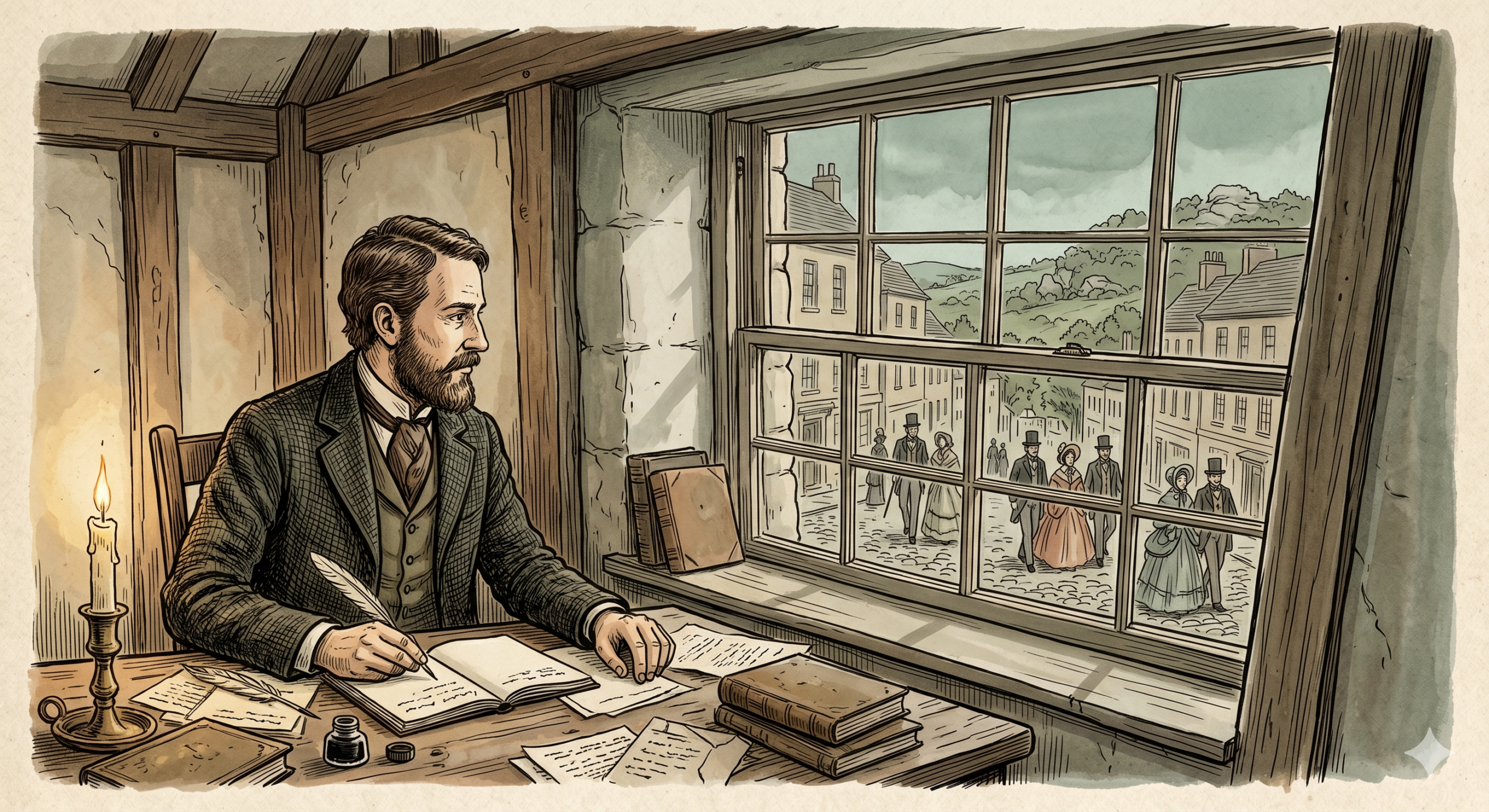
    Because the man who lived here didn’t just enjoy the view over the Common. He watched Tunbridge Wells, took notes on everyone he saw, and turned it all into the most brutally funny portrait of English snobbery ever written.

    His name was William Makepeace Thackeray. He wrote Vanity Fair there. And before he was famous, he was just a sharp, slightly bitter young writer sitting in a crooked house in our town, watching the social parade go past his window and thinking: these people are absolutely ridiculous. I’m going to write all of this down.


    The Town That Built a Masterpiece

    Here’s what made Tunbridge Wells so useful to him. The Pantiles gave him everything he needed — the aspirational aristocrats performing wealth they may or may not have actually had, the retired colonels competing over the quality of their carriages, the visiting families arriving for the “waters” with entirely different agendas from the ones they’d admit to in public. The setting was essential for Makepeace, William Thackeray’s observations about social climbing in England.

    Thackeray saw society itself as a kind of “Vanity Fair” — a carnival where virtues are routinely compromised for social standing. He didn’t have to imagine that world. He could see it from his sitting room. In fact, inspiration for William Makepeace Thackeray overflowed from the everyday spectacle around him.

    Having suffered bitterly himself due to what he considered societal constraints, he built his satire to blast the groups he felt had wronged him. Tunbridge Wells, with its magnificent parade of social climbers and status performers, handed him the raw material on a plate. A very polished, very expensive plate.

    And here’s the detail that should genuinely stop you mid-coffee: Thackeray was such an expert at writing about snobs that he actually invented the modern use of the word. Before his The Book of Snobs, “snob” was just slang for a shoemaker. His knack for playful language is another William Makepeace Thackeray trademark.

    He didn’t just satirise the snobs of Tunbridge Wells. He gave the entire category of human being a name that’s lasted nearly 200 years. You’re welcome, English language.


    The Feud That Proves His Point

    One small bonus story, because it’s too perfect to leave out. It perfectly captures the kind of literary drama William Makepeace Thackeray was never far from.

    His great rival was Charles Dickens. They were friendly competitors for years — until Thackeray made the mistake of publicly discussing an affair Dickens was having. Dickens retaliated by having a journalist write that Thackeray’s work had no heart and that his white hair made him look old. Thackeray was furious because the article quoted private conversations from a social club, which was simply not done — and the two remained enemies until Thackeray died.

    Two of the greatest writers in English history, destroyed by gossip, wounded pride, and the unspoken rules of social conduct. William Makepeace Thackeray was no stranger to drama, and it became part of his legacy.

    If that doesn’t sound exactly like a subplot from Vanity Fair, nothing does.


    Go Find It Today 🗺️

    Thackeray’s Restaurant sits at 85 London Road, inside the novelist’s former home. The slanted floors, winding hallways, and grand fireplace in the main dining room are all original. The window still looks out over the same Common he watched every morning, just as William Makepeace Thackeray did centuries ago.

    You can book dinner and sit in the exact rooms where Vanity Fair was written. Then walk down to The Pantiles afterwards and watch how people move — the subtle posturing, the sideways glances, the careful positioning near the right conversations.

    Thackeray would recognise every single one of them. He’d probably have their names written down already. In short, Tunbridge Wells remains indelibly linked to the observations and humour of William Makepeace Thackeray.


    🕵️ Fact or Fiction? You Decide

    Three rumours for the WalkTW comment section. One involves William Makepeace Thackeray, of course:

    Myth #1: Thackeray apparently drafted a dedication to “the good society of the Wells” for an early version of Vanity Fair — a pointed, sarcastic tip of the hat to the local promenade set who’d given him such rich material. His publisher reportedly killed it before print.

    Myth #2: A pompous retired officer from Mount Ephraim — famous locally for his very loud opinions about his own carriage — is said to appear almost word for word as a character in The Book of Snobs. The man reportedly refused to read it. His wife read it three times. Imagine William Makepeace Thackeray overhearing these family debates.

    Myth #3: Some literary historians believe the view from Thackeray’s window — the Common below, the grand ridge of Mount Ephraim above — directly inspired Vanity Fair‘s famous opening image of English society laid out like a fairground on a plain. Never proven. Never disproven, but that’s certainly something William Makepeace Thackeray would have enjoyed.

    Have you ever eaten at Thackeray’s and felt vaguely observed? Drop your thoughts below. 👇

    Next up: the child who played in the woods and tunnels around Tunbridge Wells and turned them into one of the most beloved books ever written. 🚂🌿

    #TunbridgeWells #WalkTW #Thackeray #VanityFair #LocalHistory #BeforeTheyWereFamous #TheWritersWhoWatchedUs


    More in this series: The Writers Who Watched Us

  • Capital of Infidelity, Part 3: The “Grand Tour” of Heartbreak 💔🎩

    Capital of Infidelity, Part 3: The “Grand Tour” of Heartbreak 💔🎩

    If Part 1 taught us anything, it’s that the Georgian elite didn’t just visit Royal Tunbridge Wells to “take the waters”—they came to completely rewrite the rules of romance. Enterprising builders gave them double-staircases and overlapping balconies to hide their late-night visitors, but as the town’s popularity exploded, the scandal outgrew individual lodging houses.

    It spilled out across the entire landscape. The consequences of infidelity can touch every aspect of life.

    Welcome to Part 3, where we look at the logistical nightmare of the “Grand Tour” of Heartbreak. This wasn’t a tour of Europe; it was the high-stakes, frantic daily commute of aristocratic husbands trying to manage a wife, a mistress, and a judgmental town gossip mill all within a one-mile radius. Clearly, infidelity played a major role in Tunbridge Wells society.

    1. The Ridge-Line Divide: High-Stakes Geography 🗺️

    By the mid-1700s, the wealthiest lords running away from London for the summer season faced a unique dilemma. They wanted to bring their families for a wholesome countryside holiday, but they also couldn’t bear to leave their secret lives behind. It’s fascinating how infidelity could weave itself so seamlessly into the fabric of their summer escapes.

    The solution? They weaponised the town’s geography.

    A lord would rent a grand, respectable townhouse up on the breezy heights of Mount Ephraim or Calverley Park for his official wife, children, and an army of servants. Then, he would quietly lease a completely separate, discreet cottage tucked away down in the valley of Mount Sion or along the edge of the Common for his mistress.

    The massive, rocky expanse of the Tunbridge Wells Common became a strategic buffer zone. Husbands would literally spend their days “hiking” across the rocks, ostensibly for their health, but actually migrating between completely separate domestic realities. Infidelity, for many, dictated every step between those two addresses.

    2. The Great Promenade Minefield 💣

    While the geography worked beautifully at night, the entire system collapsed every morning at 11:00 AM. Why? Because everyone, regardless of which hill they slept on, was socially obligated to converge on The Pantiles to drink the chalybeate water, listen to the orchestra, and parade. Avoiding public proof of infidelity became an art in itself.

    This turned the morning promenade into a literal psychological minefield. Imagine strolling down the Upper Walk with your wife on your arm, only to turn the corner by the doughnut stall (or the Georgian equivalent) and come face-to-face with your mistress wearing the exact silk ribbon you bought her the night before.

    The level of frantic social dodging, sudden “coughing fits” to look away, and panicked fan-fluttering was legendary. Tales of infidelity circulated among the onlookers as entertainment almost as much as the music.

    3. Myths, Legends, and Awkward Standoffs: The Crowborough Coach Panic 🐎

    To understand just how tense this high-society chess game could get, we have to look at the folklore and questionable rumours that local historians still chuckle over. Stories of infidelity often grew into elaborate myths told for generations in Tunbridge Wells.

    The Legend of the False Appendix (1782): > Lord Harrington allegedly holds the record for the most dramatic logistical failure in local history. Rumor has it he accidentally sent two identical, highly passionate love letters detailing an “assignation at the sandstone rocks”—one to his mistress on Mount Sion, and one, via a very confused servant, directly to his wife up on Mount Ephraim.

    Realizing his fatal error just as the letters were delivered, Harrington didn’t run. Instead, he staged a massive, theatrical “medical emergency” right in the middle of the Upper Walk. He collapsed onto the paving stones, feigning a sudden, agonizing illness that required him to be immediately loaded into a coach and driven back to London for “urgent surgery.” Both women rushed down to the promenade only to find an empty carriage track and a very confused local apothecary. The marriage was saved, the affair survived, and Harrington spent a month in London hiding from a completely fictitious disease.

    4. The Modern Parallel: Location Sharing vs. The Common Rocks 📱

    Fast forward to 2026. Today, we worry about getting caught because of a leaked DM, an accidental “Find My” location-sharing slip, or a notification popping up on a shared iPad screen. Unsurprisingly, infidelity is as much of a risk for the modern relationship as it was for the Georgians.

    The Georgians didn’t have smartphones, but they had something arguably worse: The Assembly Room Letter Rack.

    All mail arriving in Tunbridge Wells was publicly displayed on a massive wooden grid in the social rooms for people to collect. If a suspicious wife decided to browse the rack before her husband woke up, the game was instantly over. The digital apps that earned us our modern “Cheating Capital” crown haven’t actually changed the human heart—they’ve just replaced the terrifying walk to the public letter rack with a face-ID lock. Infidelity just found new ways to make its presence felt.

    🕵️‍♂️ WalkTW Archive Meeting: What’s Your Strategy?

    The logistics of the Grand Tour of Heartbreak sound exhausting. If you were an 18th-century lord or lady trying to navigate a secret romance on The Pantiles, how would you manage it? For those who lived with infidelity as a daily reality, the calculations were endless.

    • Would you trust the “hiking across the Common rocks” excuse, or is the risk of bumping into someone at the Chalybeate Spring too high?
    • Do you think modern technology makes it easier or harder to live a double life compared to the rigours of early Tunbridge Wells?

    Let’s hear your theories, local gossip, or thoughts on Lord Harrington’s fake illness in the comments below! 👇

    #TunbridgeWells #ThePantiles #GrandTourOfHeartbreak #WalkTW #LocalHistory #GeorgianScandals #CheatingHotspot


    More in this series: Capital of Infidelity

  • Capital of Infidelity, Part 1: The Modern Crown vs. The Georgian Reality 🤫📱

    Capital of Infidelity, Part 1: The Modern Crown vs. The Georgian Reality 🤫📱

    When a notorious modern dating website looked at its user metrics and officially crowned Royal Tunbridge Wells the “Cheating Capital of the UK,” the national press had a field day. As a result, it’s no wonder some now refer to Royal Tunbridge Wells as the capital of infidelity. Journalists mocked the irony of a deeply affluent, seemingly polite, and conservative Kentish town topping the charts for marital betrayal. Importantly, naming the town the capital of infidelity sparked debates throughout the UK.

    But if you know anything about the true DNA of this town, you know that the algorithm didn’t corrupt us. Instead, it just exposed a centuries-old tradition of making Tunbridge Wells the infidelity capital at heart. This is a place where secret affairs have long thrived.

    The internet didn’t invent the local appetite for scandal; it just modernised it. If you trace the layout of our historic streets back to the 1700s, you realise the entire town was practically engineered by the Georgians. They made it a giant, high-society playground for extramarital liaisons. Moreover, they helped Tunbridge Wells earn its reputation as the foremost capital for infidelity in the country.

    The Chalybeate Spring: The Ultimate Cover Story ⛲️

    In the 18th century, high society flooded down from London to Tunbridge Wells under the noble guise of “taking the waters.” Physicians published dense, serious tracts praising the iron-rich Chalybeate Spring for curing everything from bad nerves to digestive complaints. Because of this, the destination became a magnet for those seeking, and some say deserving, the lively reputation associated with Britain’s infidelity capital.

    Let’s be completely honest: the health benefits were mostly a highly convenient cover story. This excuse covered what would become the capital’s infidelity-driven undercurrent.

    The genius of the spa town setup was that it provided a socially bulletproof excuse to leave town. Wealthy aristocrats, bored lords, and neglected wives traveled down to the Wells—crucially—in separate carriages, often weeks apart. Also, they came with entirely different social entourages. Once you arrived at the promenade, the rigid, suffocating chaperoning rules of London society completely evaporated. You were on holiday, you were “convalescing,” and the rules of engagement were entirely different. In fact, this social sphere helped solidify the town’s notoriety as a budding capital of infidelity during the Georgian era.

    A Tale of Two Hills: Pleasures vs. Prayers ⛰️

    As the seasonal crowds grew, a fascinating, geographic ideological war broke out across the town’s landscape. Consequently, this underscored its double life as one of England’s most enduring capitals of infidelity.

    Up on Mount Ephraim, the strict, deeply religious Puritans watched the developing spa town with absolute horror. They built their lodging houses on the high ridge to literally look down upon the sins of the valley. Accordingly, they saw these as characteristics befitting a true capital of infidelity.

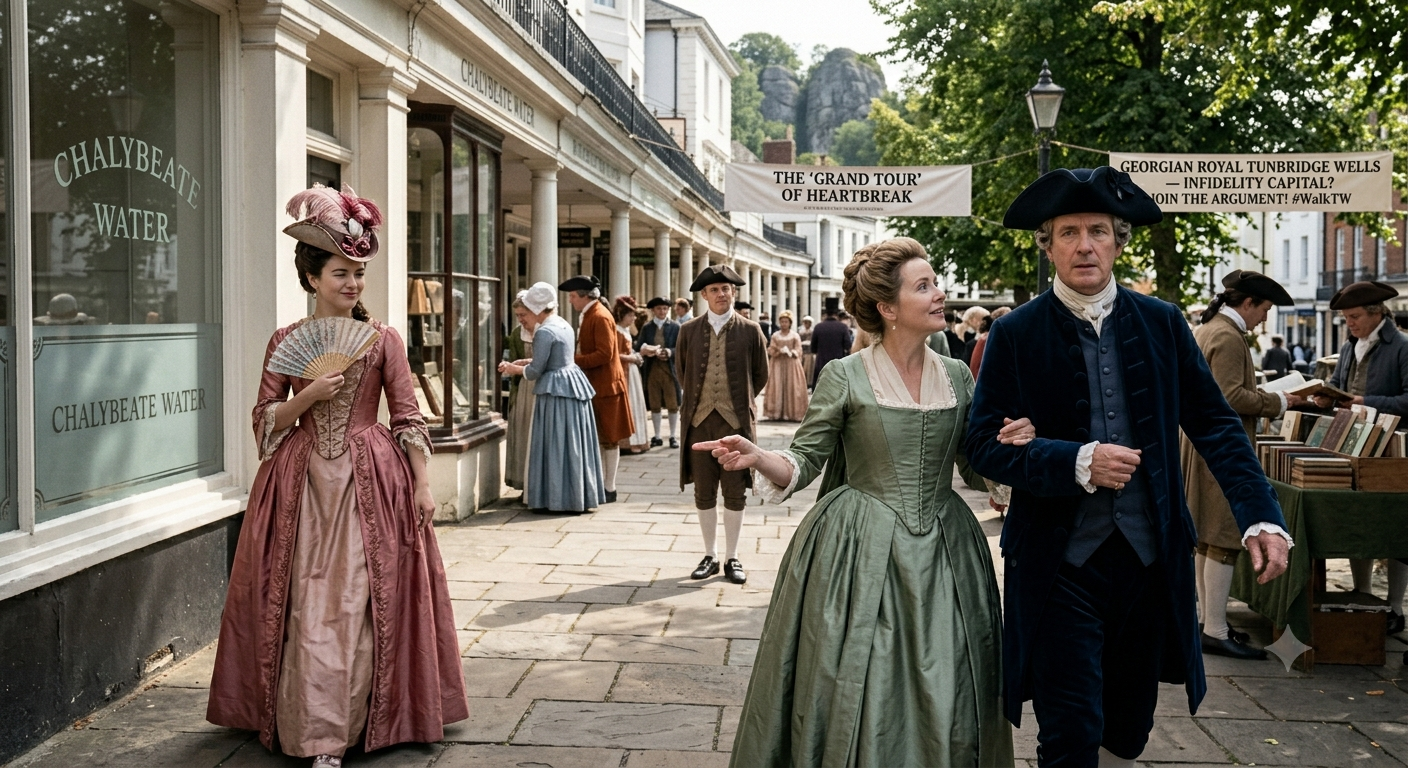
    Down on the Upper Walk (what we now call The Pantiles), the atmosphere was a high-stakes hunting ground for secret romance. Under the shade of the trees, aristocrats engaged in a continuous, stylised parade of eye contact, dropped handkerchiefs, and coded fan-fluttering. It was an open-air marketplace for attraction. Meanwhile, while the band played music from the gallery, secret notes were slipped into gloved hands. Also, assignations were booked right under the noses of the local chaperones, which naturally contributed to the lasting reputation as the capital for local infidelity.

    Architecture of a Midnight Flit: Back-Stairs and False Balconies 🏛️🚪

    The real magic of the Georgian infidelity machine, however, was hidden inside the local architecture. Enterprising local builders quickly realised that if they wanted to make a fortune renting lodging houses to the elite, they needed to cater to their clients’ true priorities. Those priorities included absolute discretion—essential to maintaining the capital city’s reputation for unescapades.

    If you look closely at the surviving historic blueprints of the town’s oldest lodging houses, the structural layout tells a very specific story:

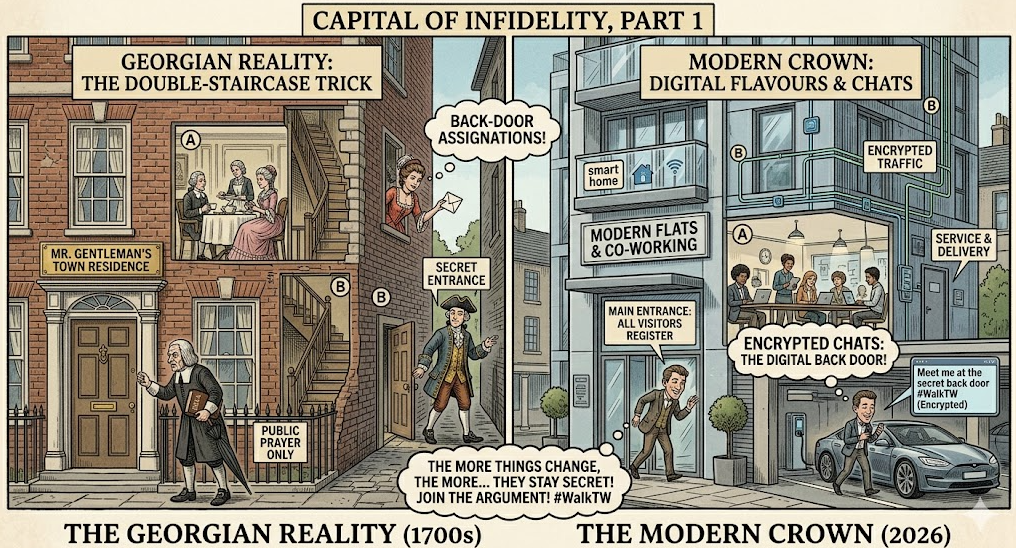
    • The Double-Staircase Trick: Grand townhouses were intentionally built with entirely separate back staircases. While the main sweeping staircase was for show, the secondary, unlit back stairs allowed “unannounced late-night guests” to slip between floors and into master bedrooms. In this way, it was all completely undetected by the household servants—a design that perhaps only the true capital of infidelity would inspire.
    • Overlapping Balconies: Row cottages and adjacent lodging rooms were often designed with shared or easily accessible wooden balconies. If a nosy neighbour or a surprise visitor knocked on the front door, a lover could simply step out the sash window. Then they could hop the low balcony partition and vanish into the next room before the maid could even light a candle.

    The town’s very bricks and mortar were designed to keep secrets. The digital apps of today haven’t changed our behaviour; they’ve just replaced the secret back-staircases with encrypted chat threads. This seamless evolution cements Tunbridge Wells’s place as the modern capital for infidelity in Britain.

    🕵️‍♂️ WalkTW Archive Meeting: Join the Investigation!

    Now that Part 1 of the Capital of Infidelity is out in the wild, the floor is open to our WalkTW detectives in the comments.

    • Have you ever noticed the bizarre, labyrinthine layouts, dual entryways, or odd staircases inside the historic buildings on Mount Sion or The Pantiles? These are clues that further cement Tunbridge Wells’s notoriety as a capital for infidelity.
    • Do you think the Georgians were actually much better at hiding their tracks than the modern locals getting caught on dating apps?

    Drop your thoughts, architectural spots, and theories below! Let’s untangle the gossip about this infamous infidelity capital. 👇

    #TunbridgeWells #ThePantiles #CheatingCapital #TheDandyChronicles #WalkTW #LocalHistory #GeorgianScandals #InfidelityCapital


    More in this series: Capital of Infidelity

  • Capital of Infidelity, Part 2: Lord Maiden and the Camp Culture of 1703 🎭💅

    Capital of Infidelity, Part 2: Lord Maiden and the Camp Culture of 1703 🎭💅

    If you thought 18th-century “sledge-cottages” moving mistresses through the woods at midnight was peak drama, brace yourselves. We are wrapping up our Capital of Infidelity trilogy. This time, we are stepping directly into the spotlight of a completely overlooked, glittering piece of local history connected to Lord Maiden.

    But first, let’s address the elephant on the promenade: the modern data. When people find out that Royal Tunbridge Wells has frequently been crowned the “Cheating Capital of the UK” by major dating websites specialising in extramarital affairs, they assume it’s a modern glitch in the local Wi-Fi. The statistics show a massive per-capita surge in local registrations, making our affluent town the official hub for secret digital rendezvous.

    But here is the real twist: the internet didn’t make Tunbridge Wells scandalous. The town was literally built for it. Long before modern society began open conversations about fluid relationships, gender expression, and secret lives, Royal Tunbridge Wells was already serving them up as mainstream entertainment. It did this with colourful characters like Lord Maiden, both on and off stage.

    Turn the clock back to 1703. While the strict, ultra-religious Puritans up on Mount Ephraim were busy clutching their prayer books, the social scene on the Upper Walk was so wildly uninhibited, fluid, and delightfully chaotic that it inspired a smash-hit London stage play.

    The play was called Tunbridge-Walks; or, The Yeoman of Kent, written by Thomas Baker. And its breakout star? A character that would give modern reality TV stars a run for their money: Mr Maiden, perhaps loosely based on the legendary Lord Maiden of Tunbridge Wells society.

    The Ultra-Camp Sensation of the 18th Century

    Tunbridge-Walks was written specifically to satirise the scandalous, zero-consequences love lives of the high-society crowd visiting the Kent spa. In the 1700s, coming to the Wells wasn’t about the water; it was an excuse to reinvent yourself away from the judging eyes of London completely.

    The undisputed centrepiece of the show was Maiden. He wasn’t your standard, gruff Georgian gentleman. Maiden was a fiercely flamboyant, cross-dressing dandy who proudly marched to the beat of his own drum. On stage, he openly bragged about his favourite hobby: slipping into gorgeous women’s gowns so he could sit with the high-society ladies, drink tea, and absorb the absolute best gossip firsthand. Remarkably, audiences saw traces of Lord Maiden in this iconic, camp performance.

    Even better? Maiden used his camp, fluid lifestyle as a brilliant tactical shield to completely evade traditional marriage. While every other character in the play was stressing over arranged marriages, dowries, and societal expectations, Maiden was living his best life. He was utterly unbothered by the patriarchy.

    The Real-Life Caricature That Shook the Town

    Now, if this had just been a fictional character, London audiences would have laughed and moved on. But Tunbridge-Walks caused an absolute thunderstorm of gossip because everyone knew Maiden was based on a real person.

    The playwright had spent the previous summers people-watching on the promenade, taking direct, highly provocative notes on a real-life regular visitor to Tunbridge Wells. When the curtain went up, locals immediately recognised the walk, the voice, the clothes, and the exact mannerisms of a prominent society figure. This person frequently graced our tree-lined avenues.

    The town’s rumour mill went into overdrive. People would literally sit in the assembly rooms scanning the crowd, trying to spot the “Real Mr Maiden”, grabbing a morning coffee or strolling past the Chalybeate Spring.

    A 2026 Reality Check: Are We Actually Less Modern?

    This brings us to a fascinating, slightly mind-bending question for us to ponder here in 2026: Could you write and debut a character like Maiden today without starting a massive cultural war? Of course, Lord Maiden’s legacy makes that question even more intriguing.

    On the surface, we like to think 21st-century society is the pinnacle of free expression and progress. After all, we have the apps to prove that we have an active underground dating scene! But there’s a compelling argument that 1703 Tunbridge Wells was, in some ways, much more relaxed about the absurdities of human nature.

    If a playwright introduced a character like Maiden in a mainstream theatre today, it would instantly be swallowed by the modern internet outrage machine. It wouldn’t just be viewed as a fun, chaotic satire. Instead, political commentators, social media factions, and cultural gatekeepers would dissect it from every angle. They would slap labels on it, and argue over whether it’s “appropriate” or “offensive.”

    Humans haven’t fundamentally changed since 1703—we still love gossip, drama, and breaking the rules (as our “Cheating Capital” crown reminds us every year). But our modern moral borders and ideological rigidness often prevent the kind of unfiltered, breezy, free-spirited expression that the Georgians laughed along with over 300 years ago. Back then, high society looked at a cross-dressing, gossip-loving dandy and said, “Brilliant, let’s put him on a poster.” Today, we’d probably start a petition to cancel the show. Ultimately, the legend of Lord Maiden continues to provoke debate today.

    🕵️‍♂️ WalkTW Archive Meeting: Join the Argument!

    Our Capital of Infidelity series is officially in the books, and the floor is open to our WalkTW detectives.

    • Do you think 1703 Tunbridge Wells was genuinely more progressive than we are today, or were they just too distracted by gambling and affairs to care about enforcing moral borders?
    • Does knowing our history of “sledge-cottages” and cross-dressing stage stars make our modern title as the UK’s cheating capital feel a bit more like a historical tradition?

    Drop your thoughts, theories, and cultural hot-takes in the comments below! Let’s argue about it. 👇

    #TunbridgeWells #ThePantiles #LordMaiden #CampCulture #TheDandyChronicles #WalkTW #LocalHistory #TheatreHistory


    More in this series: Capital of Infidelity

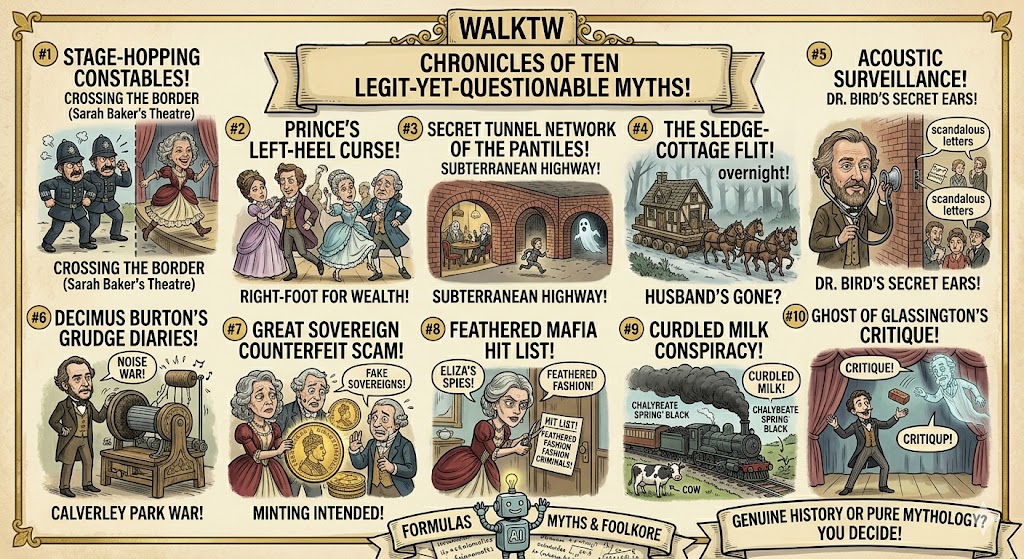
  • Top 10 Myths, Rumours, and Questionable Truths of Royal Tunbridge Wells 🕵️‍♂️✨

    Top 10 Myths, Rumours, and Questionable Truths of Royal Tunbridge Wells 🕵️‍♂️✨

    Every local history book will tell you about the discovery of the Chalybeate Spring, the grand visits of Queen Victoria, and the elegant architecture of Decimus Burton. But let’s be honest: towns aren’t built on polite tea parties. They are built on whispers, eccentric characters, and centuries of high-society gossip.

    If you peel back the polished layers of our classic spa town, you find an alternate history—one filled with bizarre landscape feuds, subterranean highways, and questionable local legends. Many of these stories are what make up the fascinating collection of Tunbridge Wells myths.

    Here are the top 10 myths and rumours floating around Royal Tunbridge Wells. Some are absolute historical fact, some are beautifully embroidered fiction, and others sit in that glorious, murky middle ground. We’ll let you decide where the truth lies.

    1. The Stage-Hopping Constables (The Two-County Theatre)

    • The Legend: When the legendary “Theatre Queen” Sarah Baker built her permanent theater on The Pantiles in 1802 (now the Corn Exchange), it was erected directly over the boundary line separating Kent and Sussex. Rumor has it that local smugglers and thieves exploited this layout for decades. If the Kent constables rushed the auditorium to make an arrest, the suspect would simply leap onto the stage into “Sussex,” legally trapping the officers who didn’t possess a cross-county warrant.

    2. The Prince’s Left-Heel Curse

    • The Legend: We all know the story of young Prince William slipping in the mud in 1698, prompting a furious Princess Anne to demand the promenade be paved with “pan-tiles.” But highly superstitious Georgian visitors took it a step further. It was widely whispered that the Prince fell specifically on his left heel. For decades, anxious aristocrats would only step onto the Upper Walk with their right foot first, genuinely believing that leading with the left would invite immediate financial ruin at the local gaming tables.

    3. The Secret Tunnel Network of The Pantiles

    • The Legend: For centuries, building contractors excavating cellars along the Upper and Lower Walks have whispered about hitting bricked-up structural arches that appear on no official town maps. The prevailing local myth is that during the height of the 18th-century gambling craze, a massive subterranean highway system connected the major taverns. This allegedly allowed high-rolling lords, cheating politicians, and illicit lovers to vanish underground the moment the local watchmen conducted a late-night raid.

    4. The Sledge-Cottage Flit

    • The Legend: In the early days of the spa, enterprising locals actually constructed several small lodging houses on massive wooden sledges or wheels. The official historical reason was “to suit the changing preferences of seasonal tenants,” but the local rumour mill always insisted on a much more scandalous purpose. If a suspicious, wealthy husband unexpectedly announced he was riding down from London, a mistress’s entire cottage could literally be hooked up to a team of horses and dragged deep into the Common woods overnight, leaving nothing but tire tracks.

    5. Dr Golding Bird’s Acoustic Surveillance

    • The Legend: Dr Golding Bird, buried in Woodbury Park Cemetery, was a brilliant Victorian medical pioneer who helped invent the flexible stethoscope. However, the town’s elite whispered that his interest in the physics of sound wasn’t purely medical. Rumour has it he modified his early stethoscopes and acoustic tubes to listen through the thick walls of neighbouring lodging houses, turning his medical rounds into a highly sophisticated information-gathering mission.

    6. The Decimus Burton Grudge Diaries

    • The Legend: The incredibly wealthy, famously irritable retired officers who moved into the exclusive Calverley Park estate expected absolute serenity. When the railway whistle and street musicians began infiltrating the area, an intense noise war broke out. Local lore claims one particularly grumpy colonel built a completely soundproof “crying room” lined entirely with horsehair mattress padding just so he could scream out his frustrations about his neighbours without breaking his polite upper-class composure.

    7. The Great Sovereign Counterfeit Scam

    • The Legend: The gambling dens operating behind the Lower Walk were notoriously cutthroat, but in the late 1700s, a ring of bankrupt aristocrats allegedly kept their high-flying lifestyles afloat using highly sophisticated fake currency. Because the local tradesmen and tavern keepers were far too intimidated to question or inspect money handed to them by a Duke or a Lord, a secret mint operating out of a Mount Sion mansion successfully flooded the local economy with counterfeit gold sovereigns for years.

    8. The Feathered Mafia Hit List

    • The Legend: Long before Eliza Phillips officially co-founded what became the RSPB, she waged a fierce war against the Victorian obsession with taxidermy fashion (where women wore entire stuffed birds on their hats). Local gossip tells us Eliza ran a militant network of “high-tea spies.” If an elite lady stepped onto the promenade wearing an endangered plume, her name, address, and social crimes were secretly slipped under the doors of the town’s assembly rooms, leading to immediate, devastating social boycotts over afternoon tea.

    9. The Curdled Milk Conspiracy

    • The Legend: When railway planners proposed extending the tracks into the center of town in the 1840s, a secret alliance of wealthy hotel owners and traditional horse-coach operators fought it tooth and nail. To terrify the public, they funded a bizarre propaganda campaign, spreading the rumour that the sulfurous smoke from locomotive engines would permanently turn the water of the Chalybeate Spring black and cause the milk to instantly curdle inside the local dairy cows.

    10. The Ghost of Mr Glassington’s Critique

    • The Legend: After Sarah Baker completely crushed her theatrical rival, Mr Glassington, and drove him out of business on Castle Street, she allegedly dismantled his old theatre and used the timber to fortify her own. Ever since, actors performing on that site have blamed “The Ghost of Glassington” for any bad reviews. The rumour is that if an actor’s performance was particularly terrible or lacked artistic class, a single, structural brick would mysteriously dislodge and drop from the rafters—Glassington’s final, petty critique from beyond the grave.

    🕵️‍♂️ WalkTW Archive Meeting: What’s Your Verdict?

    Every great myth has a kernel of truth hidden inside it. Which of these 10 stories do you think is genuine history, and which one is pure, unfiltered local mythology? Have you ever stumbled upon a bricked-up arch or walked the Common looking for sledge tracks?

    Drop your theories, corrections, or your own family rumoursen in the comments below! Let’s untangle the gossip together. 👇

    #TunbridgeWells #ThePantiles #LocalMyths #WalkTW #HistoryGossip #KentHistory

  • The Great Paving Scandal (The Royal Slip-and-Slide) 👑🧱

    The Great Paving Scandal (The Royal Slip-and-Slide) 👑🧱

    If you’ve ever walked down the elegant, sunlit promenade of The Pantiles, dodging dog walkers and tracking down a morning flat white, you’re stepping on the results of a massive, 17th-century royal temper tantrum.

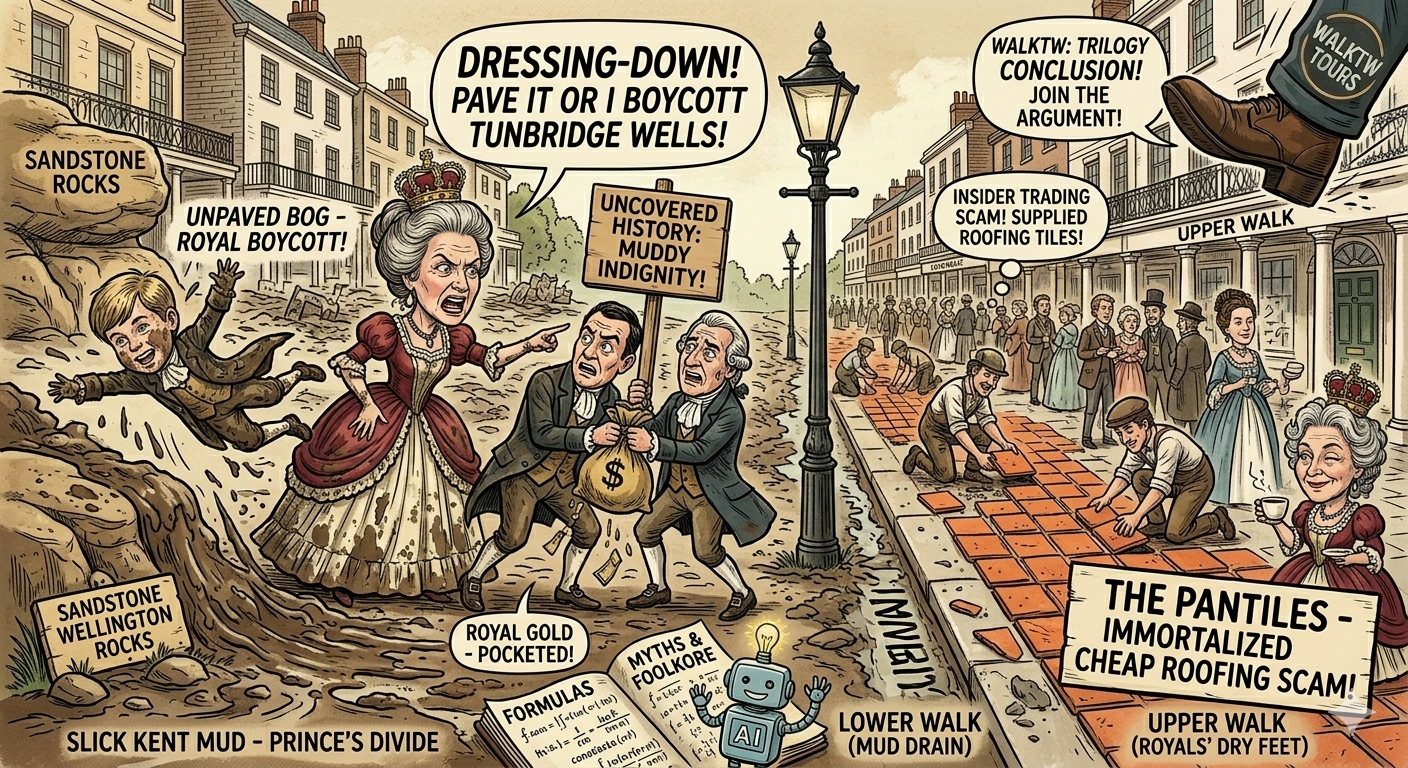
    Today, it’s one of the most beautiful avenues in Kent. But back in 1698, it was a total mud bath. The entire identity of our town—and its most famous landmark—was accidentally decided because a future king lost his footing. Additionally, a furious queen lost her patience, and a pair of corrupt local lords tried to pocket the development cash. This is just one of the curious stories you’ll discover when exploring Pantiles history. In fact, Pantile’s history is filled with colourful incidents and memorable characters.

    The Day the Prince Ate Dirt

    Our story begins with an adorable, five-year-old boy named Prince William, Duke of Gloucester. He was the only surviving child of Princess Anne (who would later become Queen Anne). In addition, he was the absolute obsession of high society. Because the young prince was a bit sickly, his mother brought him down to Tunbridge Wells for the summer to drink the iron-rich spring waters. Furthermore, understanding Pantiles’ history helps us appreciate the significance of this royal visit.

    On a particularly damp afternoon, the young prince was charging along the Upper Walk when he hit a patch of classic, slick Kent mud.

    Before his royal handlers could intervene, the heir to the British throne went flying, wiping out spectacularly in the dirt. Princess Anne was absolutely horrified. Muddy, furious, and fiercely protective, she rounded on the local town managers and gave them an absolute dressing-down.

    She demanded that the promenade be paved immediately so her son would never have to brave the muddy indignity again. To make sure it happened, she handed over a massive sum of cash. Then she told them she’d be back next year, and swept out of town.

    2. The Rogue Managers and the Missing Cash

    Enter our villains: a pair of local, smooth-talking lords who were in charge of the town’s upkeep.

    Instead of immediately hiring stonemasons, they looked at the heavy sack of royal gold and thought, “Well, the Princess won’t be back for twelve whole months…” They pocketed the cash, spent the winter living the high life, and completely ignored the promenade. The road remained a treacherous, muddy bog. Consequently, this episode of Pantiles history adds intrigue to the town’s legacy.

    Summer 1699 rolled around, and Princess Anne’s carriage rattled back into Tunbridge Wells. She stepped out, looked down, and saw that the Upper Walk was just as filthy and unpaved as the day her son had taken his royal dive.

    Anne was utterly dynamic in her rage. She didn’t just write a strongly worded letter; she effectively boycotted the entire town. She hopped back into her carriage, swore she would never return to Tunbridge Wells until the place was properly paved, and took her massive, high-spending royal entourage down to rival spa towns instead.

    The Pan-Tiling Panic

    The local business owners went into an absolute meltdown. The town’s economy was heavily reliant on royal favour, and the corrupt managers had just starved them of their best customers.

    In a desperate, frantic rush to win back the future Queen, the local authorities fired the managers and bought the cheapest, fastest-available paving materials on short notice: baked clay tiles called “pan-tiles.” They weren’t smooth, elegant flagstones; they were rough, orange-red, square earthenware tiles usually used for roofing. Workers laid them down in a record-breaking scramble. As a result, they created a bizarre, brightly coloured, heavily textured walkway that became central to Pantiles’ history.

    The emergency rebrand worked. The walkway became known across the country as “The Pantiles.” Even though those cheap clay tiles were eventually stripped up and replaced with grander stone in the 1790s, the name stuck for centuries. Therefore, a corrupt local scam and a royal slip-and-slide were immortalised.

    What to Spot in 2026

    You don’t need to look hard to see the echoes of the great paving panic today:

    • The Topographical Dip: Notice how the Lower Walk sits significantly lower than the Upper Walk. That structural split was emphasised during the frantic paving scramble to ensure water drained away from the main promenade. As a result, the royals would always have dry feet.
    • The Surviving Tiles: While the orange clay pan-tiles were largely replaced with stone, look closely at the threshold steps of some of the oldest, untouched shop entrances along the Upper Walk. You can still spot a few heavily weathered, deep-red clay inserts hidden in the brickwork.

    🕵️‍♂️ Fact or Fiction? Join the Investigation!

    Our trilogy is wrapping up, which means it’s time for the final WalkTW detective meeting in the comments. What do you think is historical truth, and what is pure local folklore? Without a doubt, there are still mysteries to be uncovered in Pantiles history.

    • Myth #1: The Cursed Left Foot. An old legend says the young Prince slipped specifically on his left heel. For decades, highly superstitious Georgian visitors would only step onto the Upper Walk with their right foot first. This was done to avoid “the Prince’s bad luck.”
    • Myth #2: The Hidden Royal Cache. A rumour persists that the corrupt managers didn’t actually spend all of Princess Anne’s gold—they buried a portion of it in a lead box right beneath the foundations of the walk to keep it hidden when she returned in a rage.
    • Myth #3: The Roofing Conspiracy. Some historians joke that the local tile-maker who supplied the emergency pan-tiles was actually the brother-in-law of one of the town managers. Therefore, the entire “emergency rush” was just a highly orchestrated insider trading scam to clear out excess warehouse stock.

    What’s your verdict? Have you ever taken a clumsy trip on the stones after a rainy Kent afternoon? Let us know your thoughts in the comments! 👇

    And that concludes our opening trilogy! A massive thank you to everyone who has read, shared, and argued over these stories. We are just getting started.

    #TunbridgeWells #ThePantiles #PavingScandal #QueenAnne #LocalHistory #WalkTW #RoyalGossip

  • The Hidden History of Royal Tunbridge Wells: Exploring Its Lesser-Known Stories

    The Hidden History of Royal Tunbridge Wells: Exploring Its Lesser-Known Stories

    The Origins of Royal Tunbridge Wells

    • The Fact: In 1606, a hungover young aristocrat named Lord North stumbled upon a strange, rust-coloured, bubbling spring in a muddy valley. He drank it and claimed it cured his ailments. As a result, he accidentally birthed a booming spa destination. The history of Royal Tunbridge Wells truly began with this discovery. Because the valley was prone to flooding and lacked infrastructure, early entrepreneurs had to build lodging on the surrounding hills. Consequently, this created two distinct, hyper-rival communities facing off across the valley:
      • Mount Ephraim (The Rebels): Settled heavily by pious Puritans who named their hill after a biblical mountain. They kept things strict, sober, and business-focused.
      • Mount Sion (The Royals): Settled by the high-flying royalists, Anglicans, and courtiers who wanted luxury, gambling, and high fashion.
    • The Fiction: Local folklore long insisted that the Chalybeate Spring’s strange iron taste was caused by Saint Dunstan catching the Devil by the nose with a pair of red-hot tongs and discarding him into the local waters. While the Puritans loved a good “devil-defeating” origin story to justify their presence, the truth is just pure, unadulterated Wealden geology. In fact, if you study the history of Royal Tunbridge Wells, you’ll find it holds as many myths as documented facts.

    Hidden Gems and Stories

    • The Fact: For decades, a literal hilltop cold war played out across the Common. Touts from Mount Sion and Mount Ephraim would practically fight in the mud to drag wealthy tourists stepping off the London coaches up to their respective lodging houses. If you stayed on Ephraim, you were branded a boring prude. Conversely, if you stayed in Sion, you were a corrupt sinner. In conclusion, this rivalry has become one of the most fascinating episodes in the history of Royal Tunbridge Wells.
    • The Fiction: A lingering urban legend suggests that secret underground tunnels run directly from the cellars of Mount Ephraim’s Puritan houses all the way under the Common to the taverns of Mount Sion. These tunnels were allegedly built so the strict Puritans could sneak over for a covert drink and a game of dice away from watchful eyes. While our sandstone terrain is riddled with caves and fissures, these “hypocrite tunnels” are entirely a myth invented by Royalist gossip to ruin their rivals’ spotless reputations.

    Influences of Victorian Society

    • The Fact: Eventually, the valley grew enough to force the two hills to play nice. This was largely thanks to the iron fist of 18th-century “forum moderator” Beau Nash and the architectural boom under Master Builder William Willicombe. As the town expanded into the Victorian era, the architectural styling of the hills evolved. The strict, exposed timber-and-brick structures gave way to grand, smooth-stuccoed classical villas designed to project wealth, elegance, and an extreme sense of social order. Clearly, the history of Royal Tunbridge Wells is reflected in these shifting styles and the town’s physical landscape.
    • The Fiction: Victorian high-society guidebooks subtly hinted that the steep incline of Mount Sion Road was intentionally engineered as a moral filter for the town. The running joke among visitors was that the hill was deliberately made exhausting. This way, anyone lacking “fortitude and upright character” would give up and turn back before reaching the respectable estates at the top.

    The Modern-Day Perspective

    • The Fact: You can still experience this 350-year-old feud through your feet today. Because the massive, open green space of the Tunbridge Wells Common only exists as the literal, legally protected “No Man’s Land”, it kept the two warring factions apart. If you walk along the Mount Ephraim ridge today, you’ll notice the oldest mansions face straight out over the grass like watchtowers. In fact, they were deliberately built so the early landlords could spy on whatever antics their rival neighbours were up to.
    • The Fiction: Locals today joke that the ideological divide never truly died; it just transformed into a modern property war. Ask anyone living on Mount Ephraim, and they’ll claim the air is crisper and the views are superior. On the other hand, ask a Mount Sion resident, and they’ll argue they possess the true, creative soul of the town. We might complain about local parking and council potholes today, but at least we aren’t waging a holy war over who has the better hilltop bowling green! Finally, it’s worth noting that the history of Royal Tunbridge Wells continues to shape the town even today.

    #TunbridgeWells #LocalHistory #TownPlanningWars #MountEphraim #MountSion #RoyalTunbridgeWells #WalkTW