Before Bath Was Bath
Ask most people when Tunbridge Wells became fashionable, and they picture wigs, sedan chairs, and Georgian ballrooms. That’s true, but it starts the story a century too late. This corner of Kent had already picked a fight with the rest of Europe before Bath had properly woken up.
The word “spa” itself comes from a small town in Belgium, where wealthy visitors had been drinking iron-rich water since the 1300s. By the time Lord North stumbled on a rusty spring in the Kentish woods in 1606, “taking the waters” was already a Continental habit. England was the late arrival here, not the inventor.
The Choice Nobody Made Her Make
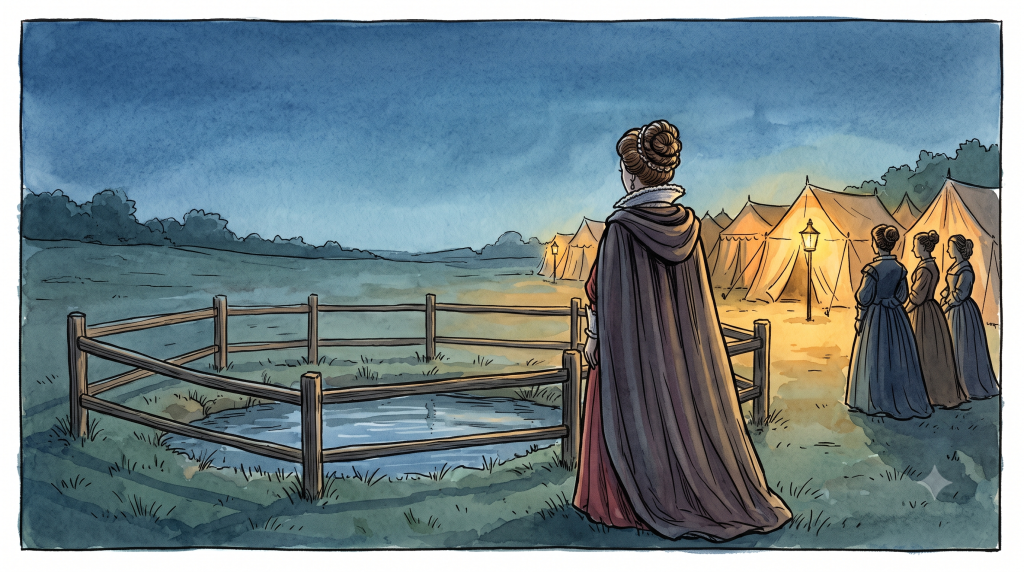
In 1630, Queen Henrietta Maria proved the point. As The Queen Who Slept In a Tent tells it, she pitched her entire royal court on a muddy Common because the town she’d chosen didn’t have so much as an inn. No war had closed the Continent that year. No emergency forced her hand. Spa and Aachen, the two grandest Continental resorts of the age, were both still very much open for business.
She picked Kent anyway. The reason, as that post records, was simple: the spring was closer to London than Bath, and considerably closer than any French spa. Convenience beat glamour. It’s a small detail, but it carries the whole argument — Tunbridge Wells was never a fallback option. From day one, it was a deliberate rival.
The King Who Brought the Fashion Home
Her son returned the favour, in his own way. When Charles II and Catherine of Braganza visited in 1663, the fashionable Continental influence didn’t vanish — it simply moved in alongside them. At that very same court, the French exile Charles de Saint-Évremond was busy making Champagne the drink of choice in London, a story The Soil That Never Left France tells in full. Kent wasn’t shutting the Continent out. It was importing the best of it, while keeping the crown’s own holiday business firmly at home.
The Man Who Made It Official

The clearest proof came a century later. When Richard “Beau” Nash took over as Master of Ceremonies in 1735, he was already running the identical job in Bath, and had been since the early 1700s. He simply exported his own playbook eastward — the same balls, the same strict etiquette, the same social machine that had made Bath the most talked-about town in England.
For twenty-six years, until his death in 1761, one man ran both towns’ social calendars at once. As a result, this was never a spa town living in another’s shadow. It was a spa town competing on level terms with the biggest name in the business — the same high-society world the Capital of Infidelity series explores from a very different angle.
A Rival, Not a Refuge
None of this fits the story you might expect. Tunbridge Wells didn’t become fashionable because a war shut off access to France. It became fashionable a hundred and seventy years before Napoleon, on its own merits, by choice rather than necessity.
That timing matters, because a war did eventually arrive — one that would hand every English spa town the biggest opportunity of the century. Tunbridge Wells got there first. Next time, we’ll find out what happened when it actually counted.
Also in this series · The Rival That Went First