Part 1 of “The Royal Visitors“
The Dandy Chronicles | The Chronicles
In the summer of 1630, the Queen of England arrived at a spring in Kent to recover her health. She came with her full court — ladies-in-waiting, physicians, servants, the entire travelling apparatus of Stuart royalty.
There was nowhere for any of them to stay.
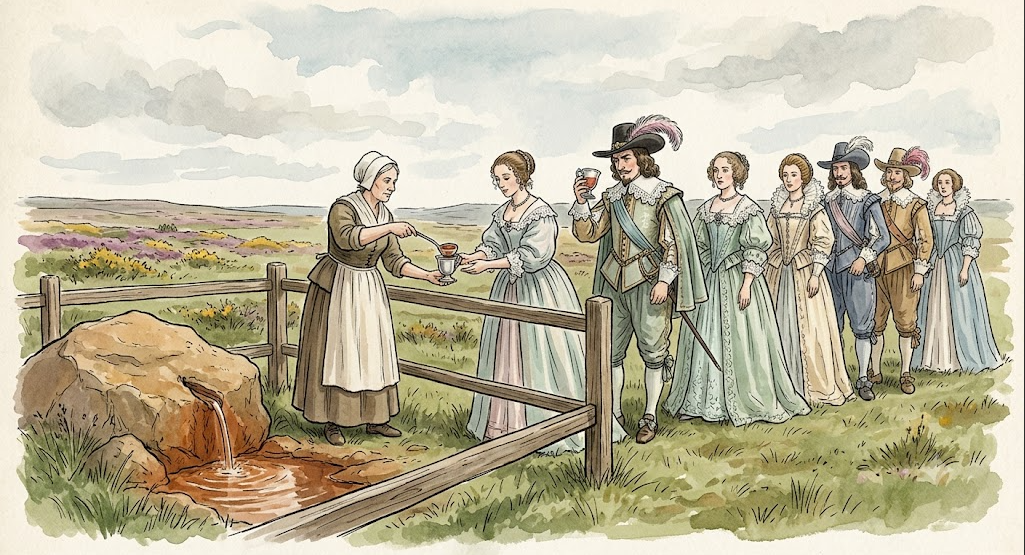
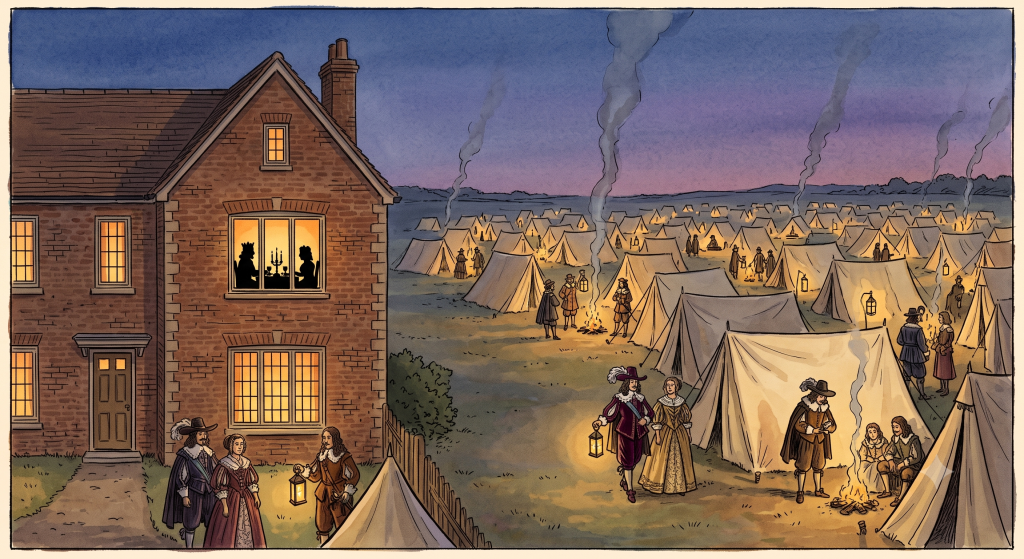
Not a substandard inn. Not a modest lodging. Nothing. The place that would become Royal Tunbridge Wells was, in 1630, a spring with a fence around it. So the Queen of England and her entire entourage pitched tents on the Common and camped there for six weeks.
It remains, by some distance, the most glamorous camping trip in Kent’s history.
Why She Came
Henrietta Maria was twenty years old, French, Catholic, and married to King Charles I. Her father was Henry IV of France, assassinated six months after her birth; her childhood had been spent surrounded by political intrigue, and her marriage — at fifteen — began badly and improved dramatically after 1628, when Charles fell properly in love with his wife.
In May 1630 she gave birth to a son: the future Charles II. Her physicians, following the standard prescription of the age, sent her to take the waters to re-establish her health. The chalybeate spring in Kent — discovered by accident just twenty-four years earlier, as told in One Spring, Five Villages, One Town — was the fashionable new destination, closer to London than Bath and considerably closer than any French spa.
A brief note for the record: a few accounts date the visit to 1629, following the loss of her first child. Most sources, however, place the six-week stay in 1630, after Charles’s birth. Either way, the essential facts are undisputed: the Queen came, the court came with her, and the tents went up on the Common.
The Town That Wasn’t There
It is difficult, walking through Royal Tunbridge Wells today, to grasp just how little existed in 1630.
The spring had been enclosed with wooden rails in 1619. That was, more or less, the extent of the infrastructure. Visitors who wanted to take the waters camped on the downs or lodged miles away — in Southborough, or as far as Tonbridge, which is how the Wells got the name of a town five miles distant. For seventy years after the spring’s discovery, nobody built anything to sleep in.
The Queen’s visit did not immediately change that. However, it changed something more valuable: the address’s reputation. For a time afterwards, the spring was known as “Queen Mary’s Wells” — a name that didn’t stick, but the royal seal of approval did. In 1632, the Ashford physician Lodwick Rowzee published a treatise on the spring’s medicinal virtues titled The Queenes Wells, with an endorsement from the King’s own chief physician. The marketing wrote itself.
Within a generation, the first permanent lodging houses were going up on Mount Sion. The camping era was ending. The spa town was beginning.
The Sequel: 1663
The royal family, evidently, did not hold the accommodation against the place.
In 1663, Henrietta Maria’s son — now King Charles II, restored to the throne after the Civil War and his long exile — came to the Wells with his wife, Queen Catherine of Braganza. This time there was a house: the King and Queen stayed on Mount Ephraim, in a residence built by Sir Edmund King, the royal physician.
The royal retinue, however, slept in tents. Thirty-three years after Henrietta Maria’s visit, the town still could not accommodate a full court indoors. Some traditions take longer to break than others.
The visits kept coming. James II is said to have visited in 1670, while still Duke of York. His daughter Anne — the future Queen Anne — came in the 1680s. By the end of the century, the scattered hilltop settlement had a season, a social calendar, and a clientele that included most of fashionable London, as the Capital of Infidelity series records in detail.
The Church and the Queen
There is one more connection worth standing still for.
Henrietta Maria’s husband, Charles I, was executed in 1649 — tried by Parliament, beheaded outside the Banqueting House in Whitehall. She was in France by then and never saw him again. To Royalists, he became a martyr.
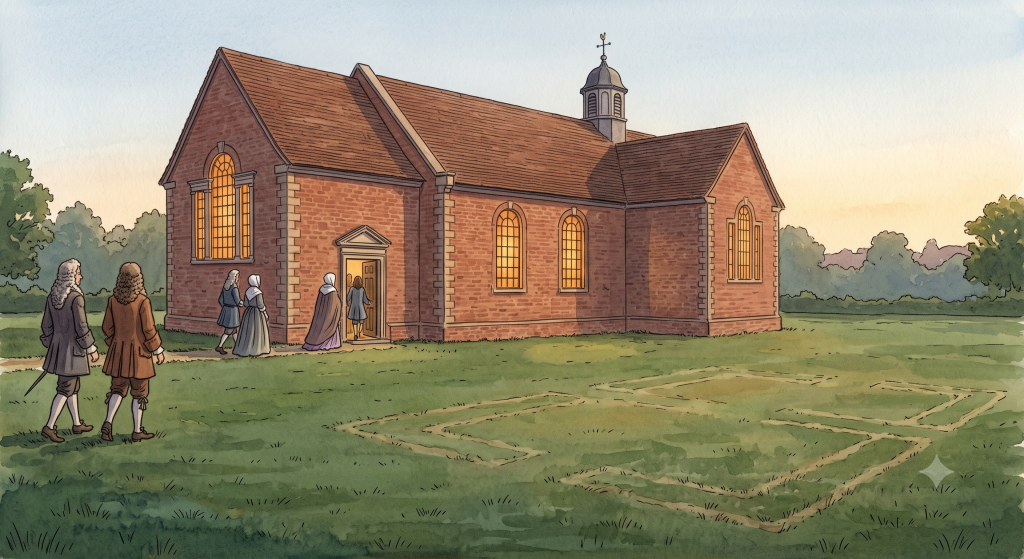
Which is why the oldest building in Royal Tunbridge Wells — completed in 1684, the anchor around which the town finally organised itself — is called the Church of King Charles the Martyr. The town’s first permanent civic building is named for the executed husband of its first royal visitor. Her camping trip and his memorial bookend the town’s founding half-century.
She never returned to see any of it. She died near Paris in 1669, fifteen years before the church was finished. But every WalkTW tour that starts at that church — and Tour 1 does — starts, in a sense, with her.
Part 2 of The Royal Visitors follows the royal thread into the nineteenth century — and a young princess whose visits helped shape the town’s Victorian identity: The Princess and the Donkey →
Read the full trilogy: Part 2 — The Princess and the Donkey · Part 3 — The Letter That Made Us Royal