Why the Ground Beneath Royal Tunbridge Wells Is Champagne’s Long-Lost Twin
Weald and Woods Folklore | The Chronicles
Every glass of proper Champagne and every bottle of the best English sparkling wine is, geologically speaking, made from the same rock.
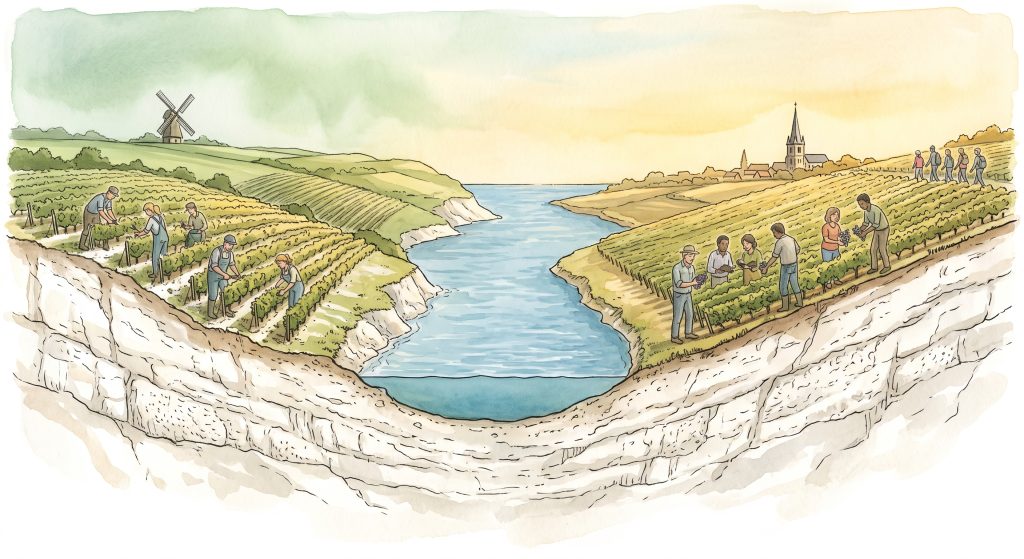
Not a similar rock. Not comparable rock. The same rock — a single vast chalk formation laid down between 100 and 61 million years ago, when a shallow sea covered what would eventually become southern England and northern France. That sea deposited the same white, porous, mineral-rich chalk across the whole region. Millions of years later, the ground buckled upward along a ridge geologists call the Weald-Artois Anticline, arching the chalk into hills on both sides of what is now the English Channel. The Channel itself didn’t exist yet. Kent and Champagne were, quite literally, the same ground.
They still are. The Channel just happens to run through the middle of it now.
What’s Actually Under Your Feet
Royal Tunbridge Wells doesn’t sit directly on Champagne’s exact chalk seam — the town’s own footing is a mix of Wealden sandstone and clay, the same warm, iron-rich geology that gave the chalybeate spring its colour and the Common its distinctive rock outcrops. But travel a short distance in almost any direction from the Pantiles, and you’re standing on the wider Wealden geology that does share its chalk directly with Champagne: the North Downs above Maidstone, the greensand ridges around Sissinghurst, the chalk exposures toward the coast.
Kent, as a whole, now holds the same chalk classification — Kimmeridgian limestone, deposited in the same Upper Cretaceous period — as the vineyards of the Champagne region. It’s separated from its French twin by roughly 100 million years of geological time and 21 miles of seawater, and effectively nothing else.
The County That Noticed First
Kent has quietly become the largest wine-producing county in England — over fifty vineyards, more than 350 acres under vine, and roughly a quarter of the entire country’s plantings. Biddenden, established in 1969, was the first commercial vineyard in the county. Carr Taylor produced Kent’s first traditional-method sparkling wine in 1984. Since then, names like Chapel Down, Gusbourne, Balfour, and Squerryes have built genuine international reputations for wines made using exactly the same method, and increasingly the same soil, as Champagne itself.
The clearest possible validation of the whole theory arrived in 2015, when Taittinger — a genuine Grande Marque Champagne house, one of the handful of names that actually define the category — became the first French Champagne producer ever to plant vines in England. They chose Kent specifically, purchasing land near Chilham, on the strength of its chalk soil, its south-facing slopes, and its altitude, all of which the Taittinger family judged to closely mirror their own Côte des Blancs back home. The estate is named Domaine Evremond after Charles de Saint-Évremond — a French exile who spent the second half of the seventeenth century at the court of Charles II in London and is widely credited with introducing fashionable English society to Champagne. The timing is a pleasing coincidence worth noting: while Saint-Évremond was making Champagne fashionable at Charles II’s London court in the 1660s and 70s, that same King and his Queen, Catherine of Braganza, were making their own separate visits to Tunbridge Wells — camping, like his mother Henrietta Maria before him, on Mount Ephraim.
If a company that has spent three centuries perfecting Champagne looked at a map of southern England and chose Kent, that’s about as strong an endorsement of the terroir theory as exists.
The Nearest Glass to Home
You don’t need to travel to Chilham to taste the theory for yourself. Birchden Vineyards sits just four miles from The Pantiles, on the edge of Groombridge — close enough to walk to from Tunbridge Wells if you’re feeling ambitious, and considerably closer than Champagne itself. They produce a sparkling rosé Pinot Noir from vines growing on the same broad Wealden geology that runs beneath the whole town.
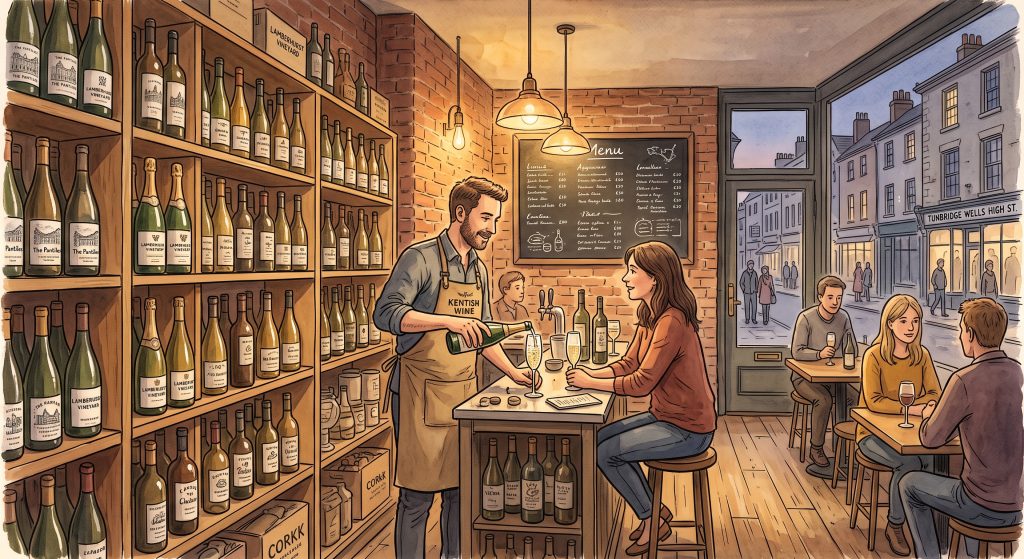
If you’d rather not leave town at all, Corkk, on the High Street, has built an entire business around this exact geology — a dedicated wine shop and bar stocking over 120 wines from Kent, Sussex, and across England, curated by a Master of Wine. It is, in effect, a tasting room for the theory this whole post is built on. Chapel Place, on Chapel Place itself, pours directly from Chapel Down’s own vineyard, one of the county’s most decorated sparkling wine producers. Between the two, you can taste your way through Kent’s Champagne-adjacent chalk without ever crossing the Common.
It is, in the most literal sense, local wine — grown on ground that was, in the very deep past, the same ground as Épernay.
What the Ground Remembers
There’s something quietly satisfying about the shape of this story, sitting as it does alongside everything else in the WalkTW archive. Royal Tunbridge Wells has spent four centuries being visited by the French, married into France, twinned with a German town, and — as we wrote from the Riviera itself in The English Riviera That Was Never on the Coast — essentially functioning as a domestic substitute for the Continent for anyone who couldn’t make the crossing.
The soil got there first. Long before Henrietta Maria pitched her tents, long before the Pantiles were paved, long before anyone had discovered the spring at all, the ground beneath this corner of Kent was already, geologically, part of the same landscape as Champagne. It took until 2015, and a French company with three centuries of expertise, to notice properly.
Next time you’re on The Pantiles with a glass of good English sparkling wine, you’re not drinking something that merely resembles Champagne. You’re drinking something made from the same rock — separated only by a channel of water that, geologically speaking, is a fairly recent inconvenience.
This post sits in Weald and Woods Folklore, alongside our other pieces on the geology, myths, and quirks of the ground beneath Tunbridge Wells.
Leave a Reply