Every town has its landmarks. Tunbridge Wells has a 130-million-year-old rock shaped like a giant toad, real dinosaur bones under the grass, and a modern Bigfoot legend that made national news. All three sit on the same slab of sandstone — and none of them are quite what they first appear.
The Rock That Looks Like a Toad
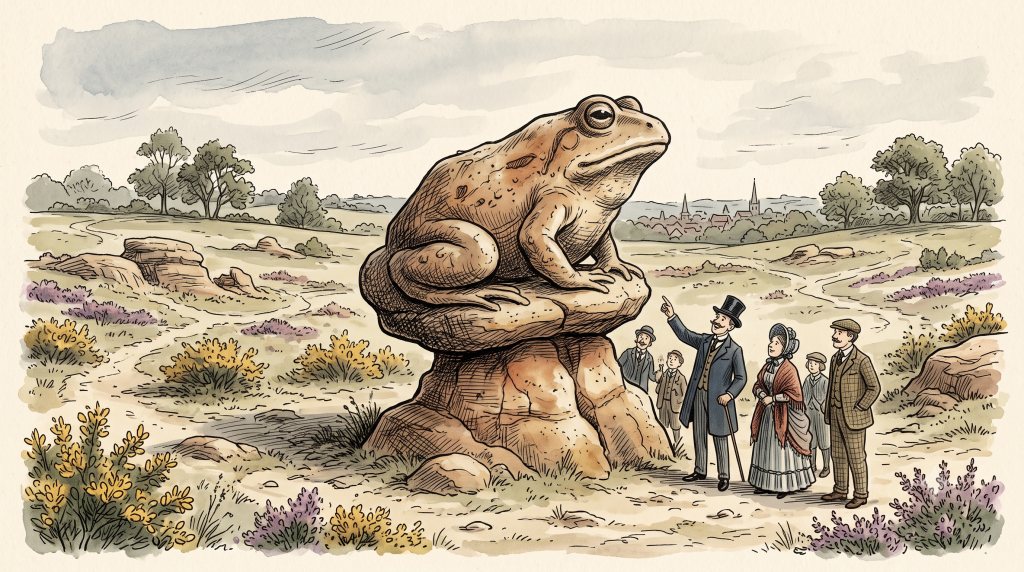
Walk out to Rusthall Common, a mile west of the town centre, and you’ll find a boulder that stops visitors in their tracks. It’s called Toad Rock, and the resemblance isn’t a stretch of the imagination — it genuinely looks like a giant toad, hunched and watchful, sitting above the common.
The rock formed roughly 130 million years ago, laid down as sediment in what geologists call the Wealden Lake, then slowly carved into its current shape by millions of years of wind and rain. Victorians loved it. Guidebooks from 1810 already sent visitors out to see it, and by the mid-1800s, charabancs full of day-trippers were arriving specifically for the view. Some archaeologists believe the site may once have hosted a Mesolithic or Bronze Age ritual gathering, based on flint finds discovered nearby — though, in keeping with WalkTW’s usual caution, that theory remains unproven rather than settled fact.
There’s a lighter story attached to the rock too. A satirical 1832 newspaper piece joked that it was secretly named after a notorious local “toad-eater” — Georgian slang for a professional flatterer who cosies up to the grieving and the wealthy for personal gain. It’s a joke, not a genuine origin story, but it’s a nice reminder that even a 130-million-year-old rock couldn’t escape Tunbridge Wells’s appetite for gossip.
The Monsters That Were Real
Long before Toad Rock had a name, actual monsters walked this ground — and Tunbridge Wells played a small part in proving it.
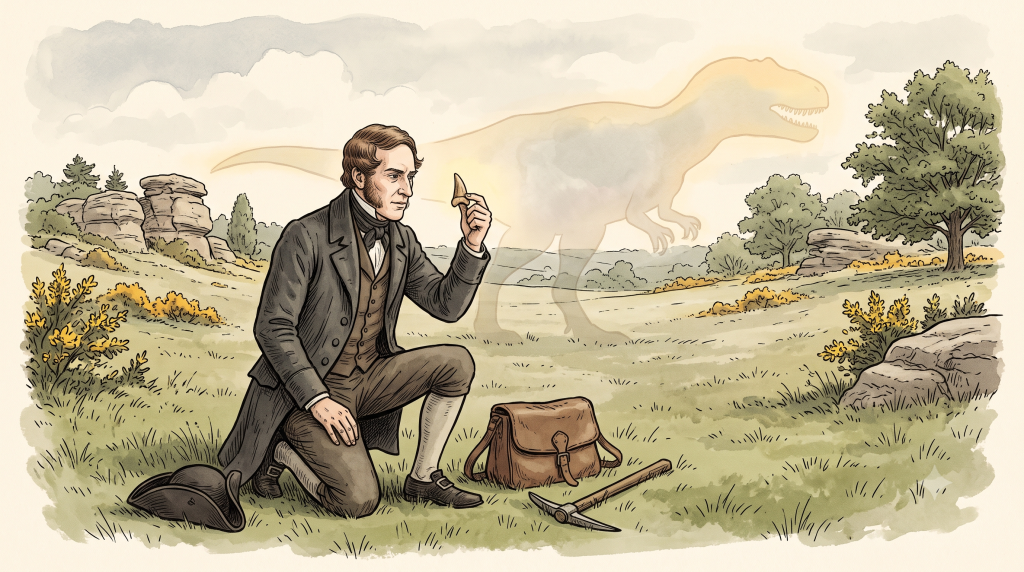
In the 1820s, the pioneering geologist Gideon Mantell identified fossil teeth found right on Tunbridge Wells Common as belonging to Megalosaurus, a predator roughly the length of a London bus. Around the same period, Iguanodon remains turned up nearby at High Brooms, part of the same discoveries that helped establish dinosaurs as a distinct group of animals in the first place. The Weald, in other words, wasn’t just scenery for the dinosaurs. It was one of the places scientists first learned they had existed at all.
These aren’t legends or local colour. They’re catalogued fossils tied to one of the founding figures of palaeontology, and they were found here.
The Monster Nobody Can Prove
Which brings us to the one monster on this list that almost certainly isn’t real — though plenty of people would swear otherwise.
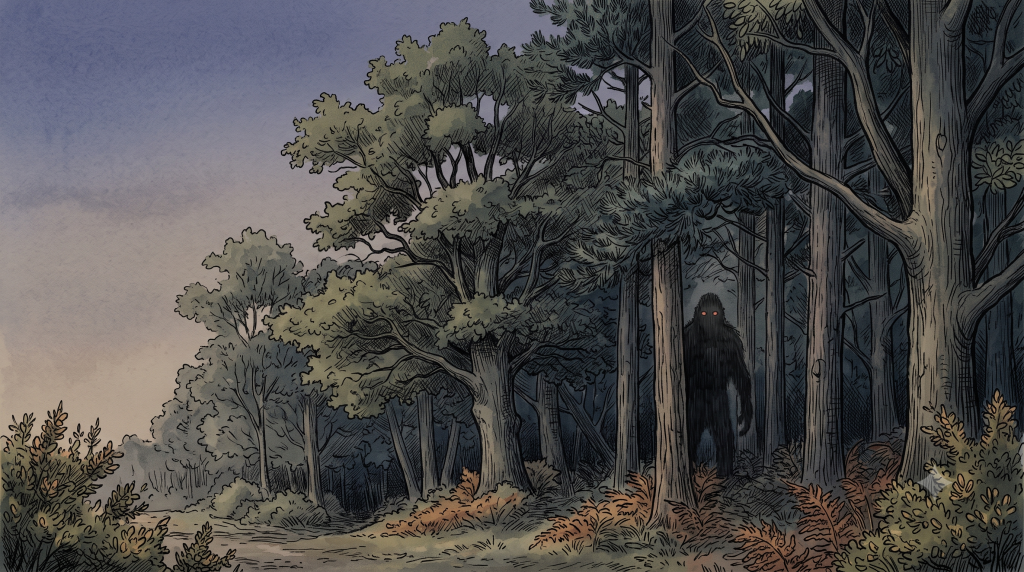
In 2012, a walker near the Common reported an encounter with an eight-foot-tall, ape-like creature with glowing red eyes that allegedly roared at him before he fled. The story ran in national tabloids within days, and locals dubbed it the “Kentish Apeman.” According to online folklore, the legend actually predates that sighting by seventy years: a story claims an elderly couple saw the same creature on a bench on the Common back in 1942, during the Second World War.
Sceptics were quick to investigate. The London Cryptozoology Club sent a team to look into the 2012 sighting, and their conclusion was blunt: no solid evidence, and quite possibly a prankster in costume. Whether that fully explains every account is, naturally, a matter of local debate — the kind that resurfaces in the pub every few years whenever someone claims to have heard something moving in the woods after dark.
Same Rock, Different Centuries
Toad Rock, the Megalosaurus teeth, and the Kentish Apeman couldn’t be more different in kind — one is geology, one is science, one is folklore. But they share the same physical ground: the sandstone bed that runs beneath the Common and out toward Rusthall, the same rock that has already done quiet work elsewhere in this town’s history, from the smugglers’ routes to the WWII tunnels beneath Broadwater Down.
Tunbridge Wells didn’t need a coastline or a battlefield to end up with monsters. It just needed a few hundred million years of geology, one sharp-eyed Georgian scientist, and a town with an enduring taste for a good story — proven or not.
Sources include Natural England’s SSSI designation for Rusthall Common, contemporary and historical guidebook references to Toad Rock, palaeontological records of Gideon Mantell’s Wealden discoveries, and national press coverage of the 2012 “Tunbridge Wells Bigfoot” sighting.