Drive anywhere in Kent, and you’ll see it. Rearing on the county flag. Stamped on council letterheads. Painted on pub signs β at least eight pubs in the county are named The White Horse.
Worn on the badges of police officers and firefighters. The white horse of Kent, motto Invicta β unconquered β is one of the oldest and proudest county emblems in England. The story of The Horse That Had to Share is closely tied to this iconic symbol.
Except in Tunbridge Wells, where something strange happens to it.
In this town β and, as far as we can tell, only in this town β the unconquered horse of Kent is never allowed to appear alone. Wherever it turns up, it has company. It shares a mace. It shares a hospital. It once shared a theatre, in the most literal way imaginable.
This is the story of Kent’s proudest symbol, the legends behind it, the awkward facts underneath it β and why Tunbridge Wells is the one place in the county where the horse learned to split the bill.
The Legend: Two Brothers and a Banner
Let’s start with the story as Kent has told it for centuries. Fair warning: this section is legend, not history β but it’s a magnificent legend, so it’s staying in.
In the year 449 AD, so the tale goes, two brothers landed on the Kent coast: Hengist and Horsa, warrior chieftains invited by Vortigern, ruler of the Britons, to fight as mercenaries in exchange for the Isle of Thanet. The brothers fought, won, looked around, sensed weakness β and turned on their employer, taking the whole of Kent for themselves. Hengist became the founder of the Kingdom of Kent, and on his battle banner, the story says, flew a rearing white horse.
It’s a perfect origin myth. Even the names cooperate: hengst and horsa are old Germanic words for stallion and horse. Two men named Horse, conquering a kingdom under a horse banner. History is rarely this tidy β which, as we’ll see, is precisely the problem.

The Second Legend: The Moving Wood of Swanscombe
The horse’s famous motto has its own myth, and it’s even better.
The year is 1067. William the Conqueror has won at Hastings, King Harold is dead, and the Norman army is marching through Kent toward London. Near the village of Swanscombe, on the old Roman road of Watling Street, something extraordinary blocks his path: a forest. A moving forest, advancing toward the Norman lines.
At a signal, the branches are thrown down β and William finds himself facing the assembled men of Kent, armed, ready, and led by no less than the Archbishop of Canterbury and the Abbot of St Augustine’s. Their offer is simple: peace, if William grants Kent its ancient rights and liberties. Otherwise, in the words carved on the monument that still stands at Swanscombe, “war and that most deadly.”
William β the man who had just conquered England β granted the request. And from that day, says the legend, Kent’s motto has been Invicta. The county that was never conquered merely came to terms.
Is it true? Almost certainly not in that form β no contemporary source records a forest ambush, and the real Kentish Revolt of 1067 ended in rapid defeat at Dover. But here’s the genuinely interesting part, the kernel of fact inside the myth: Kent really did keep something nobody else kept. The county’s ancient system of gavelkind β land inherited equally by all sons, rather than the Norman rule of everything to the eldest β survived in Kent, and essentially only in Kent, into the twentieth century. For more than 800 years after the Conquest, Kentish land law remained stubbornly, measurably different. Something happened in 1067. The moving wood is the story Kent told about it.
The Awkward Facts (Historians, Look Away Now… Actually, No, Look Closely)
Now for the part where modern scholarship walks in and quietly ruins the party.
The historian James Lloyd has examined the white horse with the kind of attention legends rarely survive. His findings, in brief: the actual emblem associated with the Saxons in the brothers’ era was the dragon, not the horse. Kent wasn’t even a Saxon kingdom β it was settled by the Jutes. And the “Saxon Steed” motif itself appears to have been invented in the fourteenth century as a deliberately faux-ancient symbol, retrofitted onto the Hengist and Horsa story centuries after the fact.
As for the flag β the white stallion rearing on its red field β the Flag Institute dates it to the seventeenth century.
Pause on that date, because for Tunbridge Wells, it produces something delicious.
The chalybeate spring β the iron-rich water that created this entire town, and the starting point of every hidden history WalkTW has told since β was discovered in 1606. Which means that the “1,500-year-old” white horse of Kent and brand-new, upstart, did n’t-even-exist-before-the-Stuarts Tunbridge Wells are, in flag terms, roughly the same age. The ancient county emblem and the newest town in Kent grew up together. Neither of them is quite as old as it pretends to be.
There’s one more twist. The same prancing white horse appears today on the coat of arms of Lower Saxony in Germany β a parallel emblem from the continent. Whether the two horses share a common ancestor or were invented separately is still debated. But a Kent Police officer once reported, with some astonishment, seeing what looked exactly like the Invicta badge on the uniforms of German colleagues. The horse, it turns out, has family abroad.
The Horse Arrives in Tunbridge Wells β and Learns to Share
So how does the proud, unconquered, possibly-invented stallion fare when it reaches our corner of the county? It runs straight into the one thing Tunbridge Wells has that almost no other Kent town does: a border running through the middle of everything.
Tunbridge Wells sits directly on the KentβSussex boundary β a line that predates the town itself by a thousand years. And the town’s symbols have had to acknowledge this ever since.
Exhibit one: the civic mace. The ceremonial mace of Tunbridge Wells carries a shield with the white horse of Kent on one side, and a shield with the six golden martlets of Sussex on the other. One mace, two counties. The unconquered horse, formally and permanently, shares the silverware.

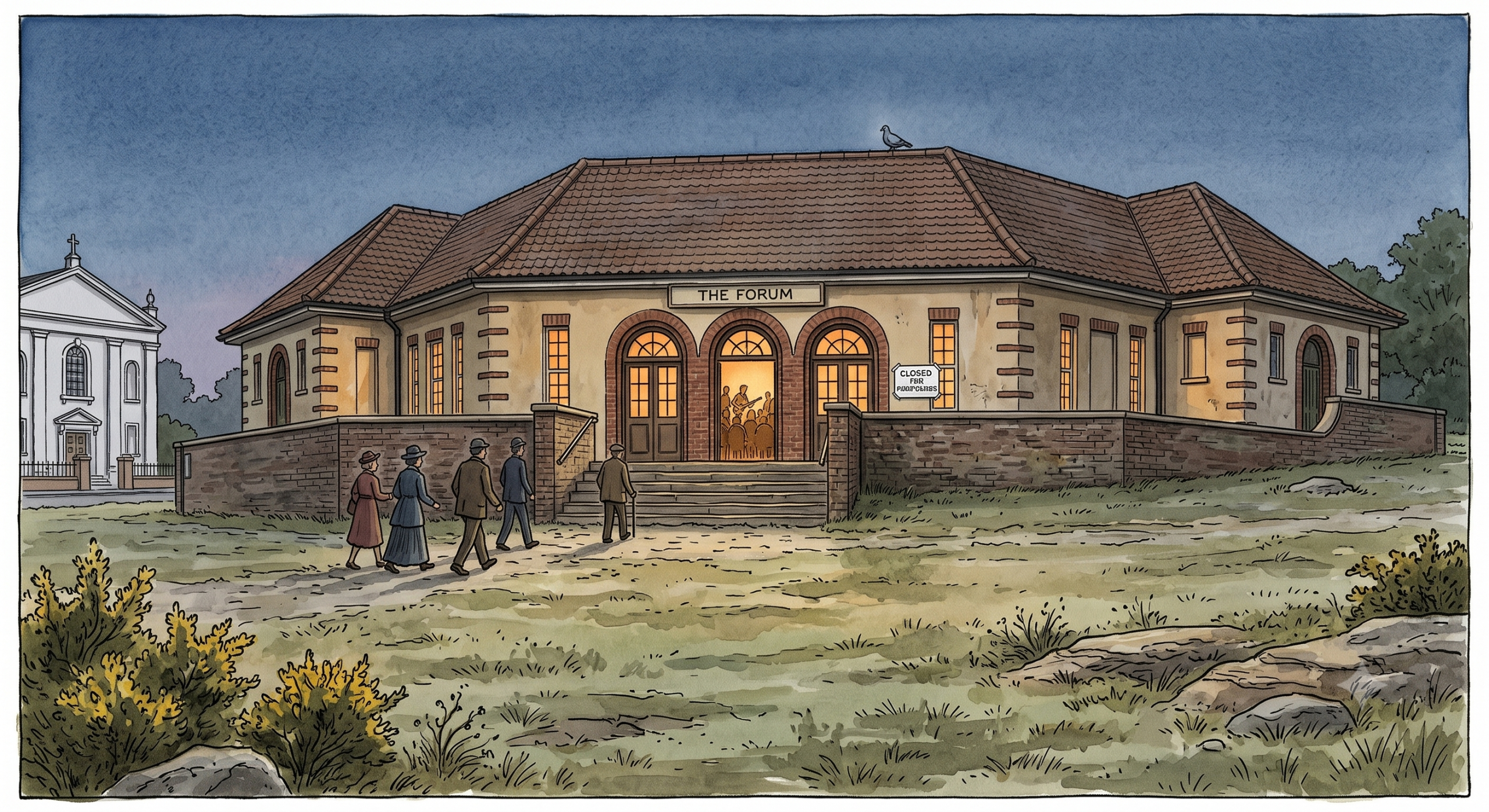
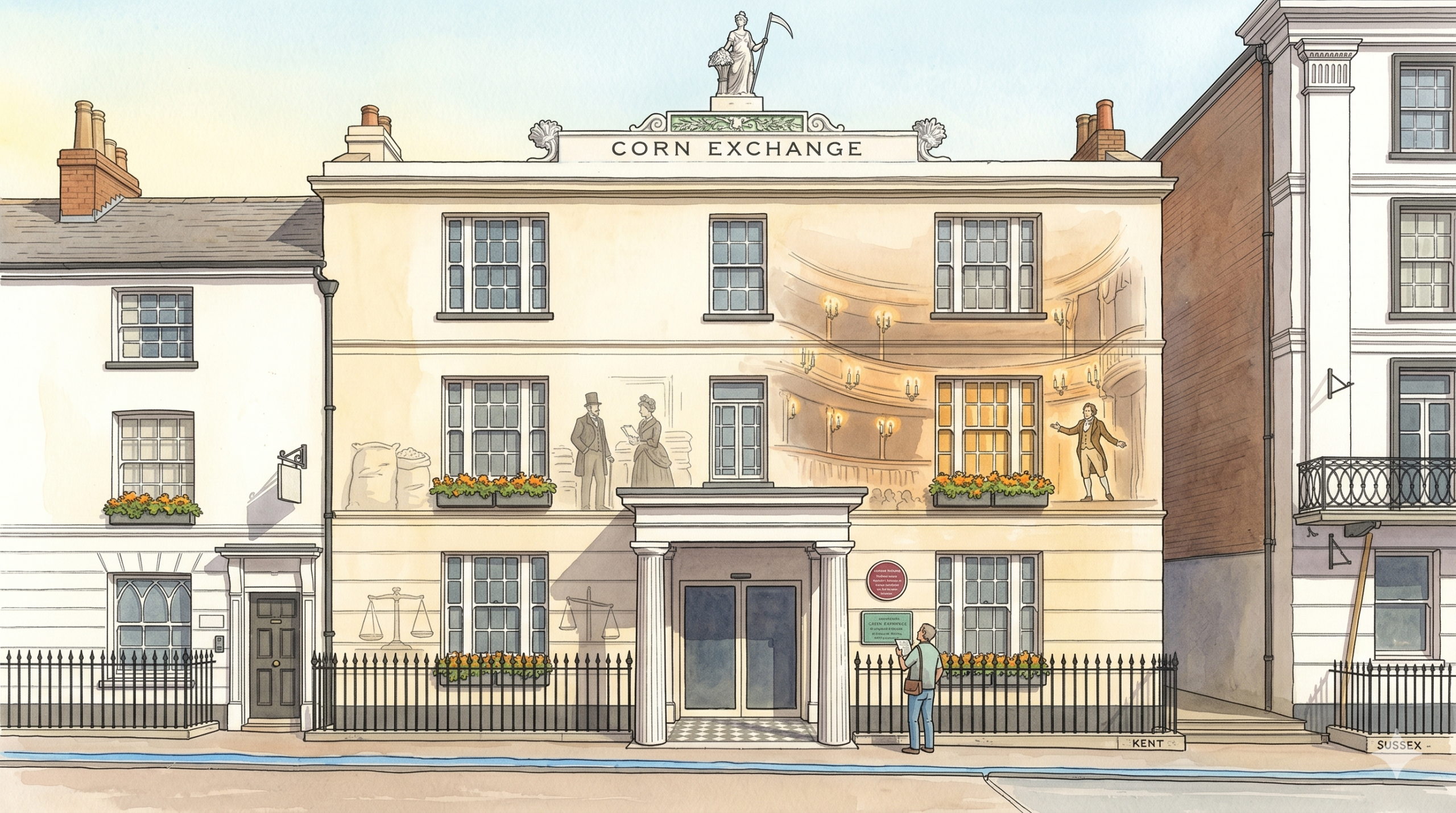
Exhibit two: the theatre where the audience sat in a different county from the actors. The Corn Exchange on the south side of The Pantiles β a few steps from the stops on the WalkTW Hidden History Tour β was built in 1802 over the Grom Brook, and began life as the Tunbridge Wells Theatre. The brook was the county boundary. The stage stood in Sussex; the seats were in Kent. Every night, the audience watched a performance taking place in another county, a few feet away. No other theatre in England could make that claim.

Exhibit three: the hospital with two coats of arms. When the Kent and Sussex Hospital opened on Mount Ephraim in 1934, its foundation stone was laid by the future Queen Mother, and it served both counties, as stated. Two plaques went up: the white horse of Kent beside the martlets of Sussex. Staff wore a badge carrying both emblems. The hospital closed in 2011 and was demolished, but the plaques survived the wrecking ball β they now sit, largely unnoticed, on the wall of the school that occupies the site. The horse quietly changed jobs and went into education.

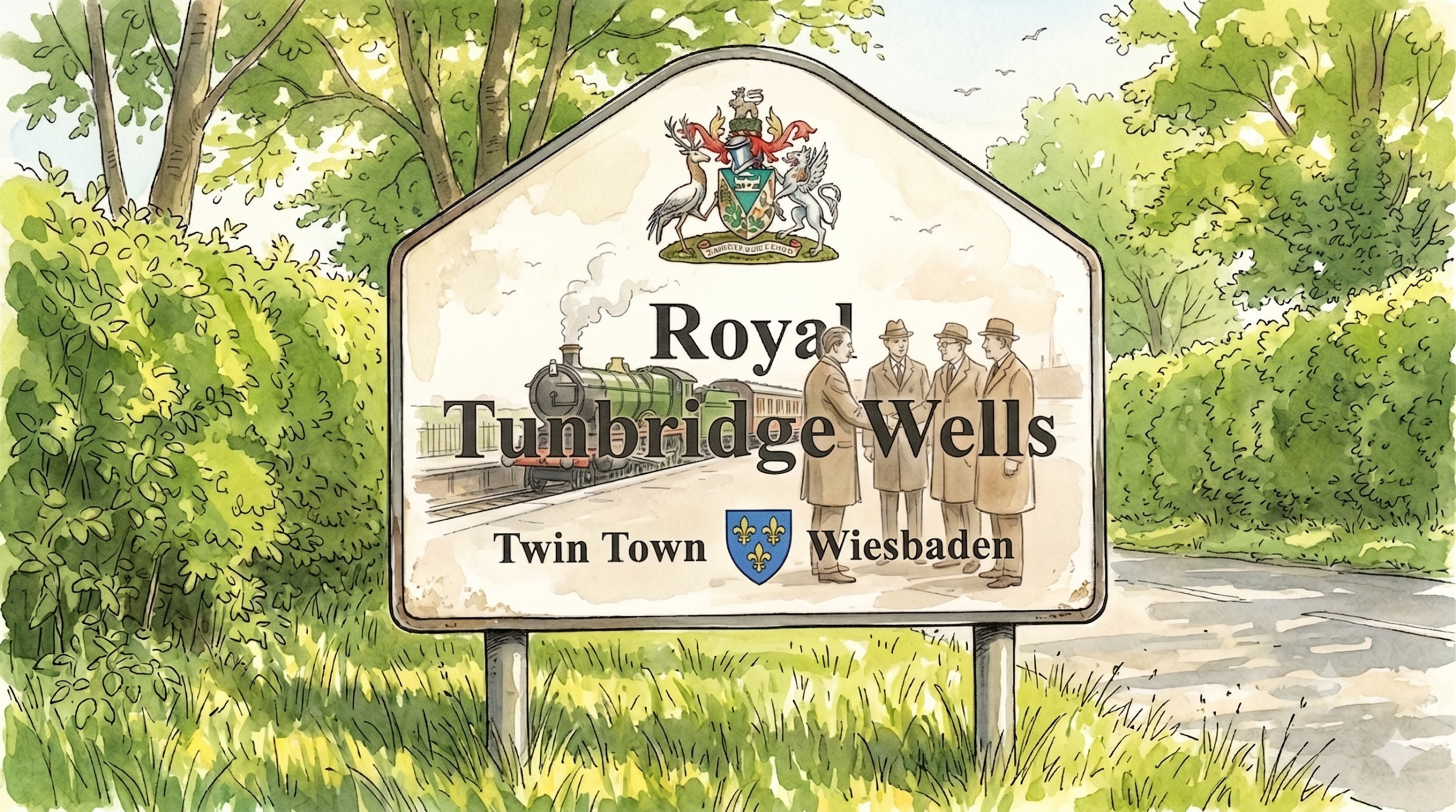
Exhibit four β the best one: the horse standing on our rocks. When the modern Borough of Tunbridge Wells received its coat of arms on 2 April 1976, the white horse of Kent was given the role of sinister supporter β the figure holding up the left side of the shield. And the heralds specified exactly what it stands on: “a Compartment of Sandstone Rocks proper.”
Sandstone rocks. The same High Weald sandstone as Wellington Rocks on the Common, the same stone every Tunbridge Wells child has climbed for three centuries. Somewhere in the College of Arms in 1976, someone decided that when the ancient horse of Kent came to Tunbridge Wells, it would be depicted standing on the town’s own geology. The unconquered stallion of Hengist, perched on our rocks β and on the other side of the shield, keeping it company as ever, a crane representing Cranbrook. Even on its own coat of arms, the horse doesn’t get to stand alone.
And one final detail, which may be the most Tunbridge Wells fact of all. Kent has a registered flag β the white horse rearing on red, flown from County Hall, recognised by the Flag Institute. Sussex has one too. Tunbridge Wells, sitting precisely between them, has never had a flag of its own. There are the arms, the mace, the motto β Do Well and Doubt Not β but no banner has ever flown for the town itself. The place where two proud county flags meet decided, with perfect quiet logic, not to make a fuss by adding a third.
What You Can See Today
- The borough coat of arms β horse, rocks and all β appears on civic buildings and council documents around town. Once you know the horse is standing on Wellington Rocks, you can’t unsee it.
- The Corn Exchange still stands on the Lower Walk of The Pantiles, crowned by a figure of Ceres. Stand in front of it, and you’re in Kent; the back of the building reaches toward old Sussex. The county boundary plaques on The Pantiles mark the line.
- The hospital plaques β the horse and the martlets, side by side β survive on the wall of the school on the old Kent and Sussex Hospital site on Mount Ephraim.
- The Swanscombe monument, for the dedicated pilgrim, stands in the churchyard of St Peter and St Paul, Swanscombe β sculpted by Hilary Stratton, unveiled in 1958, and moved in the early 1960s when the A2 was built. Even the monument to the unconquered county had to give way to a dual carriageway.
Invicta means unconquered. And perhaps that’s the real Tunbridge Wells version of the story: the horse was never conquered here. It just had to learn the most Tunbridge Wells skill of all β sharing politely with the neighbours, and never making a fuss about it. The town that waited three centuries for its Royal prefix knows a thing or two about patience.
Have you spotted the white horse anywhere else in town β on a building, a badge, a gatepost? The WalkTW archive wants to know. Drop your sightings below. π
#TunbridgeWells #WalkTW #WhiteHorseOfKent #Invicta #KentHistory #SussexBorder #ThePantiles #HiddenHistory #LocalHistory