How a Button, a Blanket, and a Bird of Prey Gave the Beautiful Game to Every Living Room on Earth
Made in Tunbridge Wells | Before They Were Famous | The Chronicles
Right now, forty-eight nations are playing football in stadiums across the United States, Canada, and Mexico. Billions of people are watching. The players are wearing GPS vests. The ball charges itself. The VAR system reviews decisions in milliseconds. The 2026 FIFA World Cup is the largest and most technologically sophisticated football tournament in history.
It has nothing to do with Tunbridge Wells.
Except that the game which gave millions of children their first experience of World Cup football — the one played on a bedroom floor, on a blanket marked out in chalk, with tiny plastic figures flicked by the fingertip — was invented in a back garden in Langton Green. And the man who invented it couldn’t even trademark the name he wanted because the Patents Office told him it was too ordinary a word.
His name was Peter Adolph. He was a birdwatcher. He is buried with a falcon engraved on his headstone.
The Man Who Needed Something to Do
Peter Adolph was born in 1916. He served in the Royal Air Force during the Second World War as a stores manager, and when the war ended, he was demobilised, returned to England, and went to live with his widowed mother at Upper Birchetts in Langton Green, near Tunbridge Wells.
He was, by any measure, restless. He took a bookkeeping job at the Pensions Office and walked out after a row with a superior. He then earned money by dealing in rare bird eggs — legal at the time and suited to his passion for ornithology. However, this was not a long-term plan. He needed something to build.
What he built was Subbuteo. However, in August 1946, when he first advertised the idea in The Boy’s Own Paper, it didn’t have that name yet.
A Button and a Blanket
The game Adolph was developing was a table football game, adapted and improved from an earlier game called Newfooty, invented in Liverpool in 1929. His central innovation was making the player figures lighter and more manoeuvrable — replacing the heavy lead bases with something more responsive to the fingertip flick that the game required.
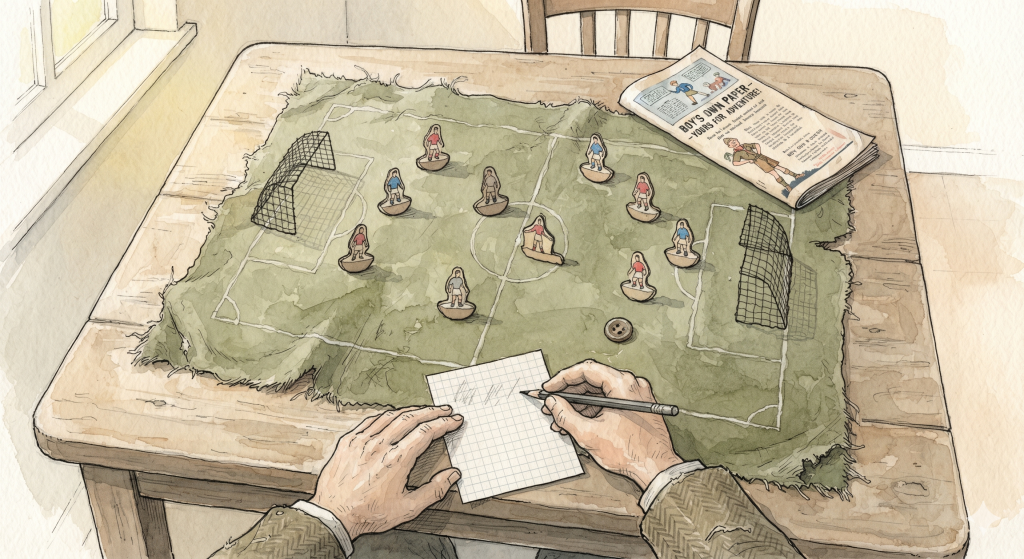
For the very first prototype, he used a button from his mother’s coat.
The 1946 advertisement in The Boy’s Own Paper offered to send details of the game to anyone who wrote in. Adolph then went to America on a business trip. While he was away, a telegram arrived from his mother. Orders totalling approximately £4,000 had flooded in from readers who had seen the advertisement.
He came home and got to work.
The first sets became available in March 1947. They were strikingly minimal by any standard, but the standard was post-war Britain, and post-war Britain was used to minimal. The set contained two cardboard team sheets of flat players waiting to be cut out, two wire-frame goals with card netting, and a piece of chalk. No pitch was included. The instructions recommended an old army blanket as a playing surface, on which the lines could be drawn in chalk.
He had wanted to call the game The Hobby — a reference to his favourite bird of prey and a nod to the game being a hobby in itself. The Patents Office refused to register it, on the grounds that “hobby” was too generic a word to trademark. Adolph reached instead for his ornithological training. The Eurasian Hobby’s scientific name was Falco Subbuteo. The game became Subbuteo.
The Housewives of Tunbridge Wells
In the early years, every Subbuteo player figure was hand-painted. As demand grew and the figures evolved from flat cardboard to moulded plastic, the painting work was farmed out to home-based workers across the Tunbridge Wells area. Drivers would drop off bags of unpainted moulded plastic and collect the finished figures later.
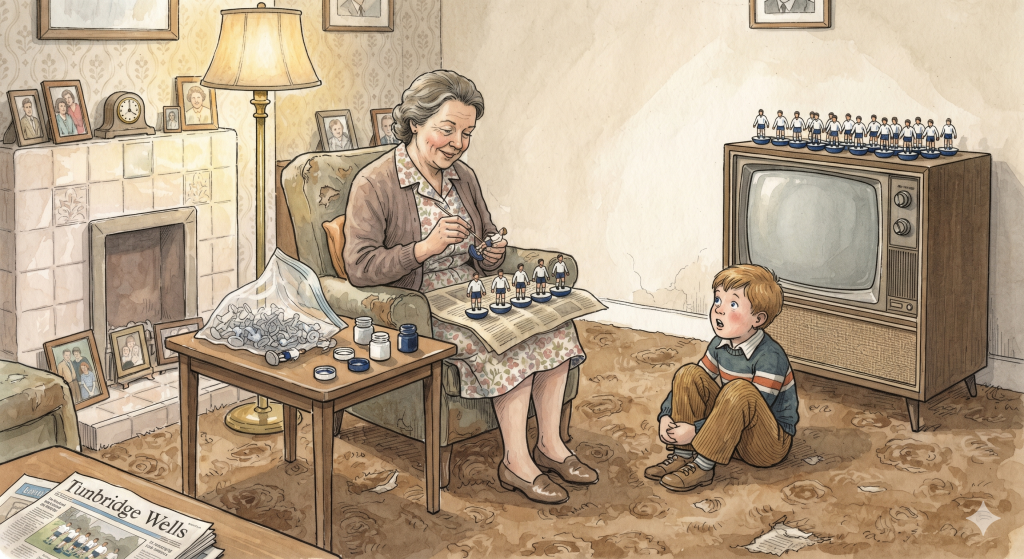
Most local people either knew someone who did this piecework for Subbuteo, or were involved themselves. It was a particular source of income for home-based women, who would often rope in their families to help too. A common sight in Tunbridge Wells homes was a crowd of tiny figures drying on top of the TV.
This was not a small operation. At its peak, Subbuteo employed hundreds of people across sites in Langton Green, Paddock Wood, Chiddingstone Causeway, Wadhurst, and Tunbridge Wells itself. The game that began with a button and a blanket had become a significant local industry — and the people who made it possible were, in large part, the residents of this town, painting two-centimetre footballers at their kitchen tables.
1966 and Everything After
Subbuteo had been growing steadily through the 1950s. However, nothing in its first two decades prepared it for what happened on 30 July 1966, when England beat West Germany 4–2 at Wembley and won the FIFA World Cup.
Subbuteo became a very popular game, particularly after England won the World Cup in 1966. The timing was exact. A generation of children who had grown up watching football wanted to play it, and Subbuteo — with its World Cup figure sets, its miniature stadiums, its replica kits for teams from every competing nation — was perfectly positioned to be the answer. The game was exported to over fifty countries. International tournaments were established. The Subbuteo World Cup, a competition in its own right, was first held in 1970.
In 1969, Peter Adolph sold Subbuteo to the toy manufacturer John Waddington for £250,000 — approximately £3.2 million in today’s terms. He stayed on as brand director, but the corporate culture of a large toy company was not a natural environment for a man who had built his business from a button and a back garden in Langton Green. He left.
Production and headquarters remained at Warwick Park in Tunbridge Wells until 1982, when Waddingtons moved the operation to County Durham. The move resulted in the loss of 70 local jobs.
What Remains in Tunbridge Wells
The building in Warwick Park is now a hotel, and a Royal Tunbridge Wells Civic Society plaque commemorates the Subbuteo factory. The hotel is One Warwick Park. The plaque is on the wall by the entrance. Most people walking past it have no idea what it marks.
At the Amelia Scott — the town’s museum and cultural centre on Crescent Road — there is a display dedicated to Subbuteo, including original sets and a stuffed Eurasian Hobby, the bird whose Latin name became one of the most recognised brand names in British toy history.
Peter Adolph died in 1994. Waddingtons sent a three-foot high floral tribute to the funeral in the shape of a Subbuteo player wearing the kit of Queen’s Park Rangers — the football club he had supported his whole life. On his headstone there is an engraving of the hobby falcon, Falco Subbuteo.
In 2024, Royal Tunbridge Wells hosted the FISTF World Cup — the international Subbuteo championship — at the Amelia Scott. Players came from across Europe and beyond to compete in the town where the game was born.
The World Cup, Then and Now
Tonight, somewhere in a stadium in North America, a footballer wearing a GPS vest and a self-charging smart ball will score a goal that will be reviewed by VAR and watched by hundreds of millions of people.
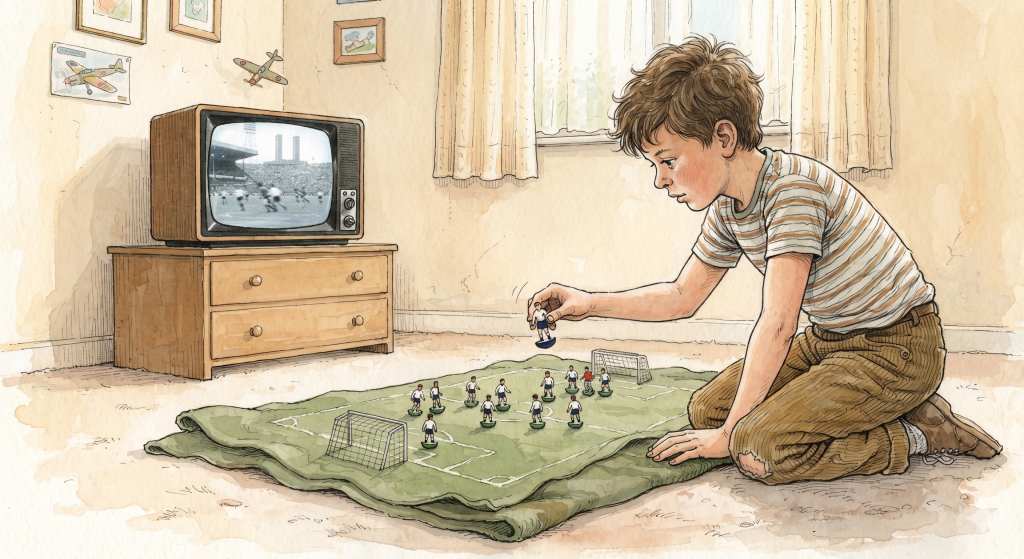
Meanwhile, in a loft somewhere in Tunbridge Wells, there is almost certainly a box of Subbuteo. The figures inside were probably hand-painted by someone’s grandmother at a kitchen table in the 1960s. The cardboard box has gone soft at the corners. The wire goals still work.
The game itself is still available to buy in 2026 — not as a museum piece, but as a living product, in its ninth decade of production, with sets on shelves and international tournaments still being held in competitive leagues across Europe and beyond. It came within a few hundred sales of disappearing entirely in the early 2000s. It didn’t. A global community of players and collectors refused to let it.
In 2022, Subbuteo marked its 75th anniversary. In 2047, it will reach its centenary — a hundred years since a demobbed RAF stores manager in Langton Green cut two cardboard teams out of a sheet, borrowed his mother’s coat button, and invited the readers of The Boy’s Own Paper to write in if they were interested.
The World Cup has been going to America. For seventy-nine years, it has also been going to bedroom floors everywhere — courtesy of a birdwatcher in Langton Green, his mother’s coat, and an old army blanket.
This is the first post in the Made in Tunbridge Wells series — stories of things created, invented, and performed here that went on to mean something to the rest of the world. Next: a Christmas baby from Pembury who became one of the most distinctive voices in British music.
Comments
2 responses to “The Birdwatcher Who Invented Subbuteo — And Why the Housewives of Tunbridge Wells Built His Empire for Him”
Super
Thank you Peter. Our readers feedback is very important to us. Please visit us back for more Tunbridge Wells stories.