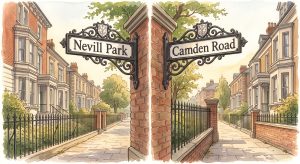
What Happened to the Aristocrats Whose Names Are Still on Your Street Signs
In our last Chronicles piece, A Fossilised Property Register, we told you that Camden Park and Nevill Park are named after in-laws — the Marquess Camden’s family married into the Marquess of Abergavenny’s family, and Tunbridge Wells ended up with two grand aristocratic estates sitting side by side, permanently bound together by a Georgian wedding.
What we didn’t tell you is what happened to either family next. Two centuries on, their stories have gone in almost opposite directions — and only one of them is still around to tell it.
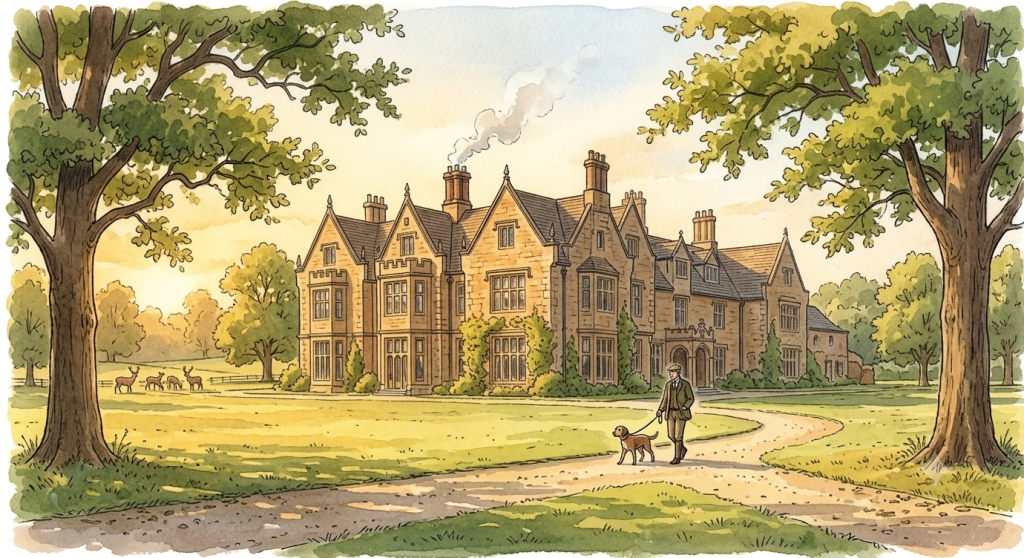
The Nevills: Still Here
The Marquesses of Abergavenny have held Eridge Park, a few miles from Tunbridge Wells, since 1448. That is not a typo, and it bears repeating: this family was established in this corner of Kent more than 150 years before anyone had even discovered the chalybeate spring that the whole town grew up around.
They are still there today. The current head of the family, Christopher Nevill, 6th Marquess of Abergavenny, was born in 1955 and currently resides at Eridge Park. He is the current head of the House of Neville — a noble family whose origins trace back to the medieval period and whose earlier generations played a central role in the Wars of the Roses.
The line very nearly didn’t reach him. In 1965, the direct heir — Henry, Earl of Lewes, just 17 years old — died of acute anaemia. The title passed sideways rather than downward, eventually reaching Christopher’s father as heir presumptive, and then to Christopher himself in 2000, upon his uncle’s death.
There’s a pleasing detail buried in the family’s own history, too. The Marquessate of Abergavenny was created in 1876 by Queen Victoria — the same queen who, as a girl, rode her donkey Flower through Tunbridge Wells’s streets, and who personally granted the town’s Tunbridge Ware craft a Royal Warrant in 1842. She didn’t just visit this town. She elevated the very family whose name is stamped across half of it.
The family motto, carried for centuries: Ne vile velis — “Wish not wickedly.” A fitting line for a family whose surname literally comes from the Norman French for “new town,” now permanently welded to an English spa town they never actually lived in, but comprehensively shaped.
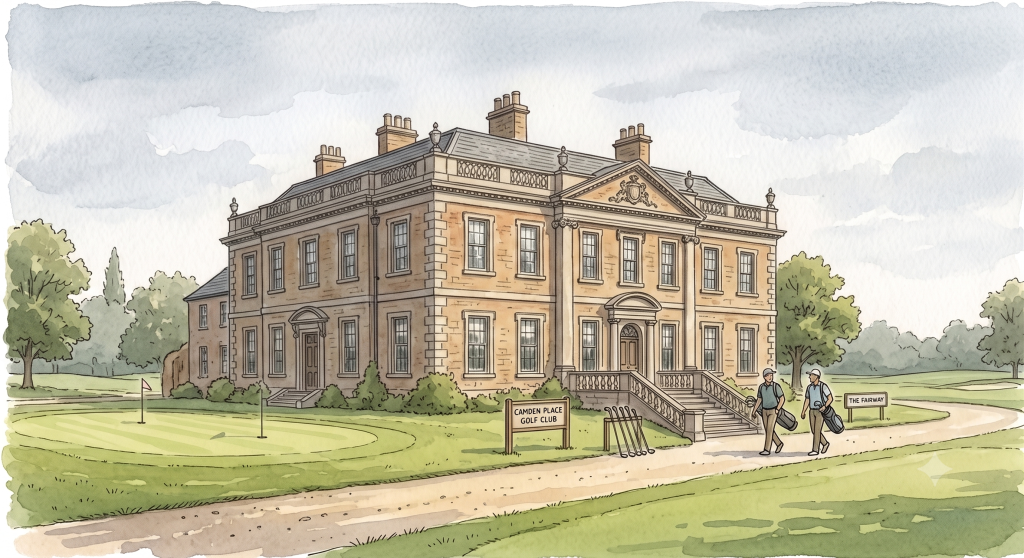
The Camdens: Not Anymore
The Pratt family’s story runs the opposite way entirely.
David Pratt, 6th Marquess Camden, is also alive today — born in 1930. But where the Nevills remained rooted, the Camdens drifted. Following the 1999 reforms that removed most hereditary peers from the House of Lords, the Marquess lost his seat. By the early 2000s, records place him living at Wherwell House — in Hampshire, nowhere near Kent at all.
The family’s grander legacy has faded further still — and it turns out it began fading almost immediately. The Pratt title itself doesn’t even come from Kent. It comes from a modest house in Chislehurst called Camden Place, named after the Elizabethan scholar William Camden, who’d lived there a century and a half earlier. When Sir Charles Pratt was ennobled in 1765, he took his title from that house. He’d already sold it by 1805. Camden Place went on to briefly shelter the exiled French Emperor Napoleon III in the 1870s, and since 1894 it has been the clubhouse of Chislehurst Golf Club — which it still is today.
The family’s fortune also grew through property in Camden Town, the London district that still carries their name and remains one of the most recognisable market areas in the country. But the family’s own last properties there were sold off around 1946. The Pratts gave their name to two places in England — a Chislehurst golf club and a London market district — and by the mid-twentieth century owned neither.
Their peak local involvement in Kent was real and significant, though. John Pratt, 4th Marquess Camden, served as Lord-Lieutenant of Kent for 38 years, from 1905 to 1943 — the King’s own representative for the entire county, through two world wars and four different monarchs. His father, the 2nd Marquess, died at Bayham Abbey “near Tunbridge Wells” in 1866, days after chairing the Kent Archaeological Society’s annual meeting — a family embedded in local heritage right up to the end.
That embeddedness didn’t survive. Today, Camden Road and Camden Park may be the last physical trace the Pratt family has left in this part of England at all.
What the Streets Still Remember
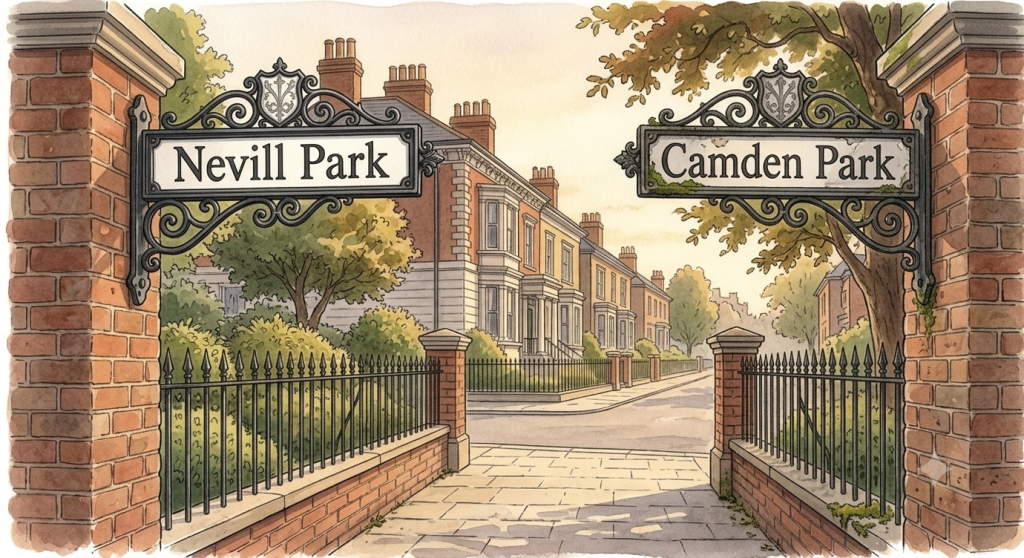
Walk between Nevill Park and Camden Park today, and you’re crossing between two very different kinds of history. One name belongs to a family who are still, right now, living a few miles from the streets that bear it — a living connection, unbroken since before the town existed. The other belongs to a family that gave its name to places in London, Kent, and Chislehurst, and then quietly left each of them behind.
The streets don’t know the difference. They just carry the names forward regardless — Camden Road, Camden Park, Nevill Street, Nevill Park — long after the wedding that joined them, and long after the fortunes of the two families who once celebrated it went their separate ways.
This post follows on from A Fossilised Property Register, our earlier piece on how Tunbridge Wells’s grandest streets came to carry the names of the families who built them.
Also in this series · TW Street Names