Every era has its version of the same trick: find the rule, then find the gap in it. Today it’s tax loopholes and grey-market imports. In the 1700s, it was tea, brandy, silk and tobacco — and Kent turned smuggling into something closer to a regional trade than a crime.
Kent, Smugglers Paradise
Georgian Britain taxed luxury goods so heavily that the price of legal tea could run four times higher than the same leaf landed quietly on a beach at midnight. Kent and Sussex sat directly opposite the Continent, with a short Channel crossing and a coastline made for the job — quiet coves, marsh creeks, and villages willing to look the other way. Whole communities got involved. Farmhands moved contraband inland by night. Innkeepers stored it. Even a few customs men took a cut to stay blind. Historians later nicknamed the trade “the Free Trade,” which tells you how normal it had become.
Tunbridge Wells wasn’t on the coast, so it never became a smugglers’ landing point. But it sat inland on the routes that moved goods from the beaches to London, and that was enough to pull the town into the story — not as a backdrop, but through one of its own.
Enter Gabriel Tomkins, Bricklayer Turned Rogue
Gabriel Tomkins started out laying bricks in Tunbridge Wells, an unremarkable trade in an unremarkable Georgian town. By his early twenties, however, he was leading the Mayfield Gang, one of the two dominant smuggling operations in South East England. His men ran tea, brandy and tobacco up from the coast in organised, disciplined convoys — and when two of them were caught and jailed, Tomkins didn’t negotiate. He stormed the prison, guns drawn, and freed them himself, taking a wound in the process.
That alone would make a decent story. Tomkins made it a better one.
Riding for the King (and Himself)
In a plot twist that would embarrass most fiction writers, Tomkins later took a job as a Riding Officer — a mounted customs official whose entire purpose was catching smugglers. He kept smuggling on the side. Historians suspect the arrangement worked out rather neatly for him: as the law’s own man on the ground, he could seize a rival gang’s goods while waving his own convoys through. It’s the 18th-century version of hiring the fox to count the hens, and somehow nobody noticed until it was far too late.
Tomkins’s career didn’t end quietly. He later rode with the far more violent Hawkhurst Gang, turned King’s evidence when it suited him, and was eventually hanged in 1750 — not for smuggling, in the end, but for highway robbery. A Tunbridge Wells bricklayer had spent thirty years playing every side of the law at once.
Gibbet Lane, Horsmonden: The Cost of the Game
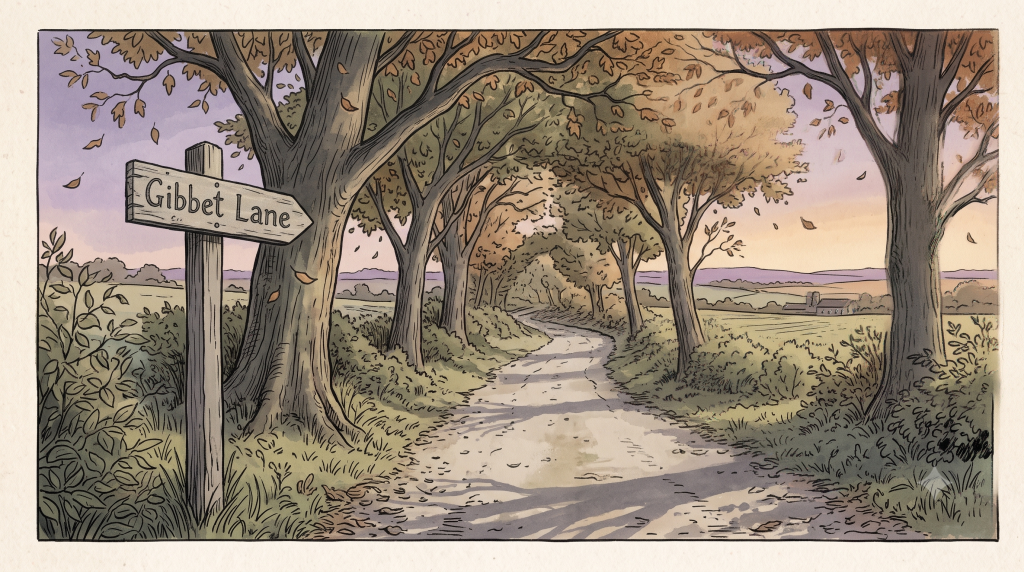
Not every smuggler’s story ended in a memoir-worthy escape. A few miles from the town centre, in Horsmonden — still within the Borough of Tunbridge Wells today — stands Gibbet Lane, named for exactly what it sounds like. William Fairall, a member of the Hawkhurst Gang, was gibbeted there: hanged, then displayed in chains as a public warning to anyone tempted to follow his trade. The lane still carries the name. It’s a blunt reminder that “the Free Trade” wasn’t always the roguish caper Tomkins made it look like — it could turn brutal fast, and often did.
The Legends the Woods Still Tell
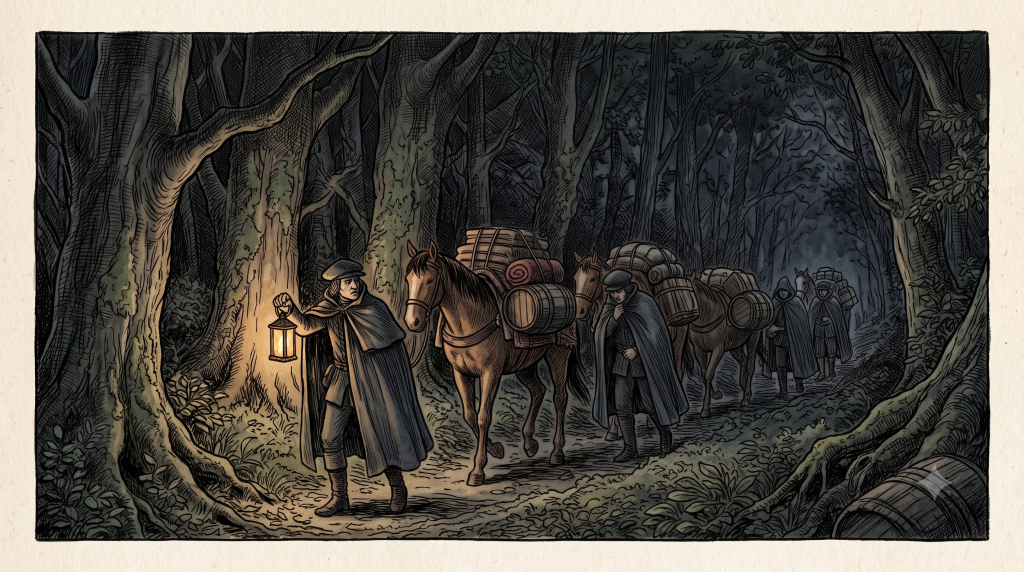
Local folklore adds one more layer, though it comes with a caveat: it’s tradition, not documented fact. Storytellers have long claimed that smugglers used the dense woods around Tunbridge Wells to move goods inland under cover of darkness, and that a ghostly highwayman still waits near Broomhill Road for an unsuspecting traveller. No records back this up directly — but the fact that the legend took root here at all says something about how deeply the smuggling era soaked into the town’s memory.
Same Game, Different Rules
Strip away the tricorn hats and the brandy kegs, and Tomkins’s story is a familiar one: someone finds the seam between the rules and the enforcement of them, and exploits it for as long as the run lasts. Tunbridge Wells never had a smugglers’ cove or a hidden landing beach. What it had was a bricklayer clever — or reckless — enough to work both sides of the law at once, and a lane a few miles out of town that still remembers how that game usually ends.
The Trade Never Really Stopped
Three centuries on, Tunbridge Wells produced another name for the smuggling ledger. Andrew Kinnaird, of High Brooms Road, was convicted in 2011 as part of a smuggling operation that moved more than eight million cigarettes into the country, dodging over £1.2 million in duty. Different goods, same instinct: find where the tax bites hardest, and find a way around it. Tomkins would probably have recognised the logic immediately — he just would have wanted a cut.
Part 2 of Subterranean Secrets and Sandstone Sins goes underground properly, into a WWII tunnel network with its own tangle of myth and record: The Tunnels Nobody Can Quite Explain →
Also in this series · Subterranean Secrets
Comments
3 responses to “The Bricklayer Who Rode With Both Gangs”
If you ever publish a book of short stories about RTW, please let me know👍
Thank you so much, Alex — that really made my day! I hadn’t thought about a book seriously, but comments like this make me want to consider it. For now I’ll keep the stories coming on the blog, but I’ll definitely keep it in mind. 👍
You need to turn these stories into a book. Love hearing about the history of the town and surrounding villages.