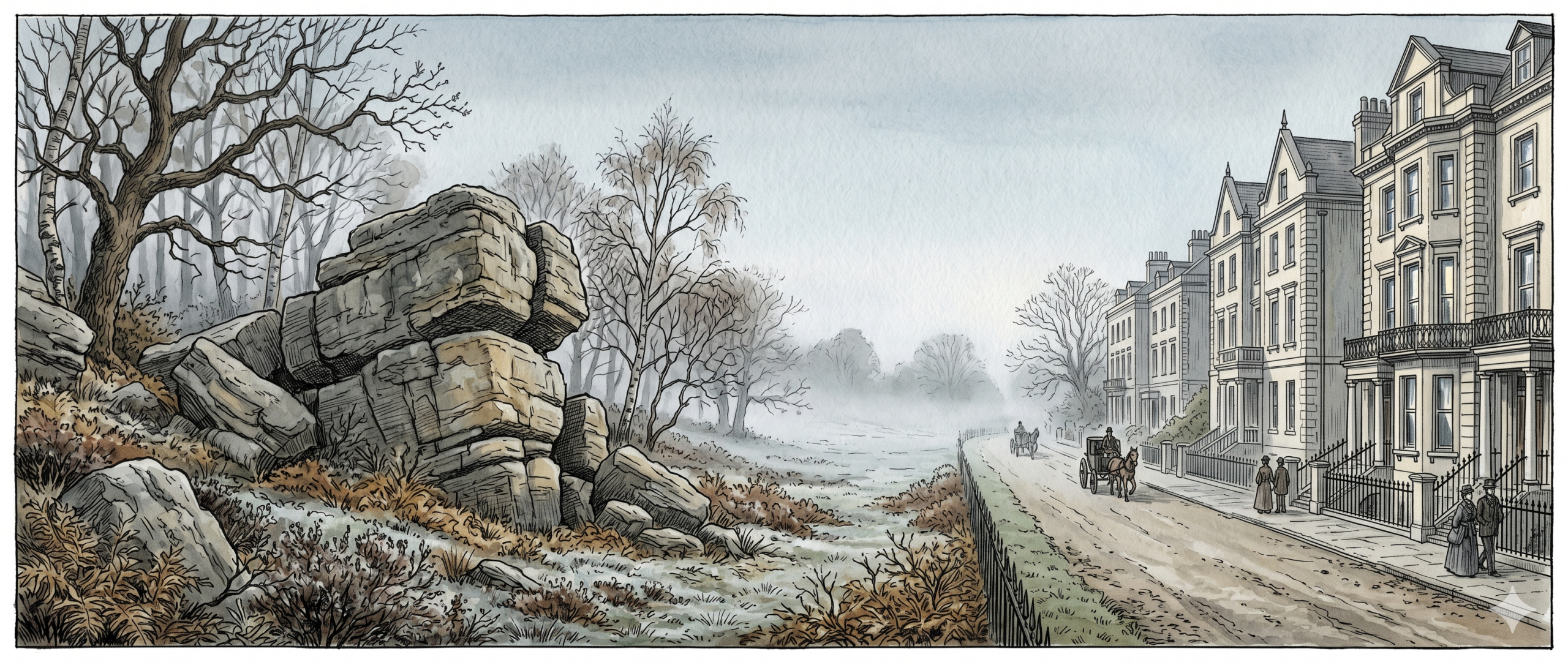
If you’ve ever kicked a football across the grass, scrambled up the Wellington Rocks, or watched the morning mist settle into the bracken on a crisp autumn stroll, you are standing on a multi-century battlefield.
The Common looks peaceful enough today, but historically, Tunbridge Wells Common has been the patch of land that simply refused to be tamed. Back in the 1700s and 1800s, local lords of the manor and greedy developers saw this sprawling green space as a massive pile of unmonetised money. They tried everything to fence it off, build luxury villa estates on it, and pave over our iconic sandstone. In fact, the history of Tunbridge Wells Common is full of such determined resistance and attempts at control.
But they catastrophically under-calculated the absolute fury of the “Free Tenants”—the regular local working folk who legally held ancient commoners’ rights to graze cattle and gather wood.
⚔️ The Midnight War of the Fences

Every time a wealthy developer erected an illegal fence, dug a boundary trench, or tried to claim a corner of the grass for a private garden, the local resistance mobilised. A mob of angry residents would march out well after dark, chop the wooden boundary posts to splinters, and hurl them straight into the bushes. These events transformed Tunbridge Wells Common into a genuine battleground for community rights.
It was a relentless, messy game of midnight Whack-A-Mole that went on for generations. It didn’t matter how high-society or legally intimidating the landowners tried to be; the regular people of the Wells refused to surrender an inch. This continuous rebellion ultimately secured the legally protected, beautifully untamed “No Man’s Land” we walk our dogs on today, an area better known as Tunbridge Wells Common.
🕵️♂️ Go Spot It Today!
- The Invisible Boundary Line: Walk along the edges of Mount Ephraim or London Road. Notice how the grand houses press right up against the green perimeter but never cross onto it. You are looking at the exact structural line where the developers’ money and lawyers ran out of legal permission. This invisible line is a defining characteristic of Tunbridge Wells Common.
- The Watchtower Architecture: Look closely at the oldest grand mansions facing the Common. They weren’t just designed for the views; they were built like surveillance platforms so early residents could keep a sharp eye out for illegal land grabs or midnight fence-builders.
💬 Fact or Fiction? You Decide!
- The Smuggler’s Filing Cabinet: Local lore insists that the deep, jagged fissures inside Wellington Rocks weren’t just a playground for Victorian tourists—they were an active, midnight distribution hub for the notorious Hawkhurst Gang to hide illegal gin and tea. The rumour mill claims half the respectable town managers up on Mount Ephraim were on the smugglers’ payroll, conveniently looking the other way.

- The Sovereign of the Sandstone: Word on the street is that during the height of the enclosure battles, the Free Tenants buried a localised “charter” detailing their rights inside an iron box deep beneath one of the massive rocks, vowing that as long as the box stayed buried, the land belonged to the people.
🥾 WalkTW Archive Meeting
The Common survived the developers, but how do you prefer to enjoy it today? Scrambling the rocks, or sticking to the paths? Let us know your favourite hidden corners in the comments below! 👇 Today, Tunbridge Wells Common is enjoyed by everyone and remains at the heart of local history.
Next up in the trilogy: Dunorlan Park—the spectacular story of a colossally wealthy merchant banker who went spectacularly bust, and the Victorian pleasure lake that survived by the skin of its teeth. Stay tuned!
#TunbridgeWells #LocalHistory #TWCommon #TheSecretLifeOfTheGreens #WalkTW #KentHistory