On the origin, the myth, and the considerable inconvenience of being Disgusted of Tunbridge Wells
The Dandy Chronicles | The Chronicles
This edition features reflections inspired by the legendary Disgusted of Tunbridge Wells.
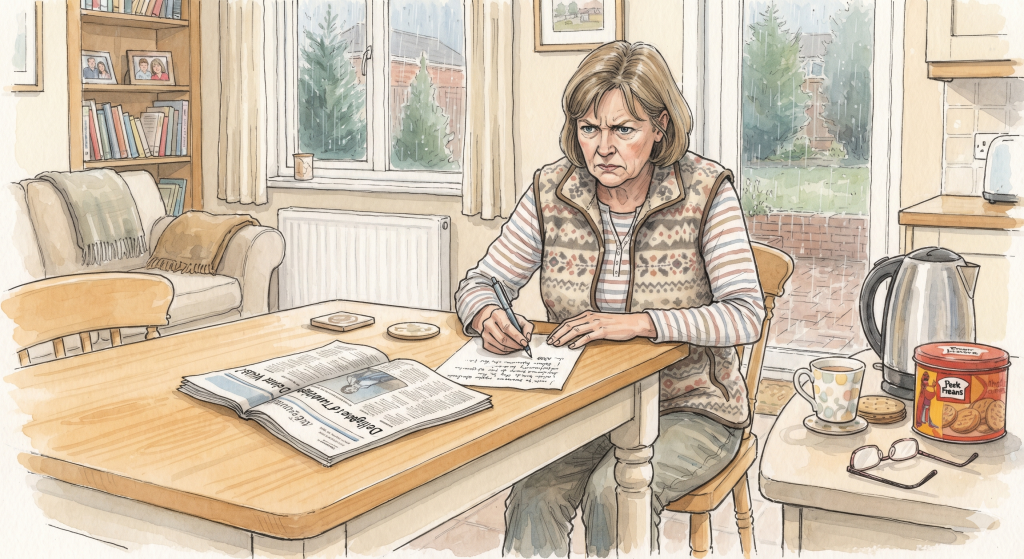
Somewhere in the national imagination, there is a person sitting at a writing desk in Royal Tunbridge Wells. He is retired. He is a colonel, almost certainly. He served in India, probably. He is deeply, personally, and specifically outraged about something — the state of the BBC, the behaviour of young people, the direction of the country, the volume of a brass band on a Sunday afternoon. He is writing a letter. He will sign it “Disgusted of Tunbridge Wells.” He has been doing this since at least the 1920s.
He does not exist. He has never existed. And the town he is supposed to represent has spent the better part of a century trying — with limited success — to explain this to everyone.
How the Phrase Works
The phrase “Disgusted of Tunbridge Wells” is a pseudonym. It is the name of no specific person and the letter of no specific complaint. Instead, it is shorthand for an archetype: the conservative, outraged, middle-class letter-writer who believes things were better before and is not afraid to say so in writing.
It appears in newspapers whenever a complaint needs to be labelled retrograde. It appears in political commentary whenever a party needs to signal that its critics are out of touch. It appears in casual conversation whenever anyone wants to describe the particular kind of indignation that comes from having standards. Michael Caine once deployed it. Private Eye ran it for years. The BBC named an entire radio programme after it.
The town, meanwhile, has simply had to live with it.
The Letters Were Real
Before we reach the question of who invented the phrase, it is worth establishing something important: the letters that gave rise to it were entirely genuine.
In September 1928, a correspondent wrote to the Tunbridge Wells Advertiser about the town’s traffic problem. The council had granted over a hundred licences for heavy passenger-carrying buses. The speed limit had been set too high. The noise was intolerable. The letter writer thanked the editor for his coverage and requested that he keep up the agitation. They signed off as “Disgusted, London Road, Tunbridge Wells.”
However, this was not even the earliest. The Kent and Sussex Courier carried a letter signed simply “Disgusted” in December 1914. Another appeared in June 1933. Furthermore, in 1924, a letter to the Advertiser complained about attendees at a Pantiles ceremony who had declined to remove their hats during the National Anthem. The letter writer asked whether such people were Communists.
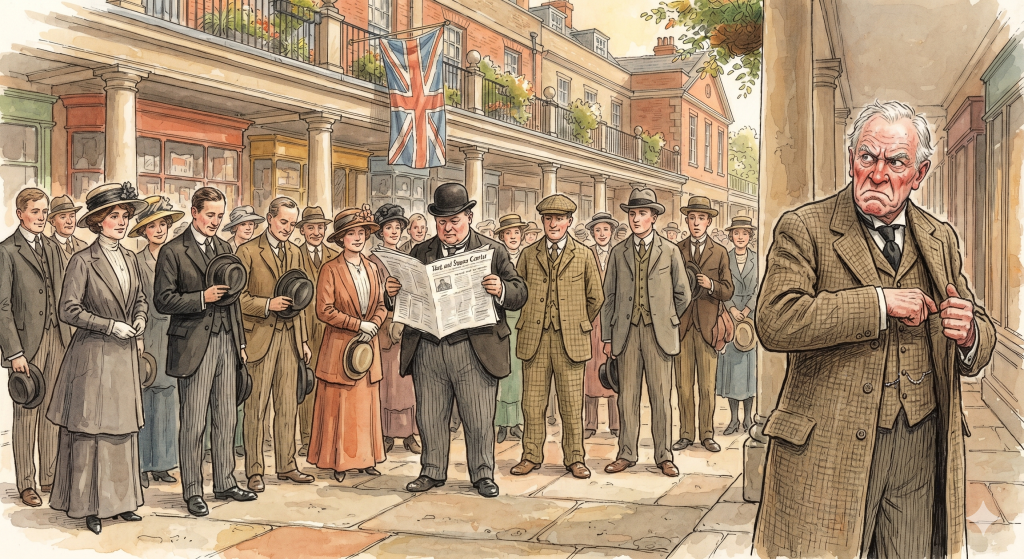
The archetype, in other words, did not need to be invented. It was already there, writing letters about buses and hat etiquette, long before anyone decided to make a national joke of it.
The Origin Nobody Can Agree On
This has not, however, prevented several competing claims about who first popularised the phrase on a national scale.
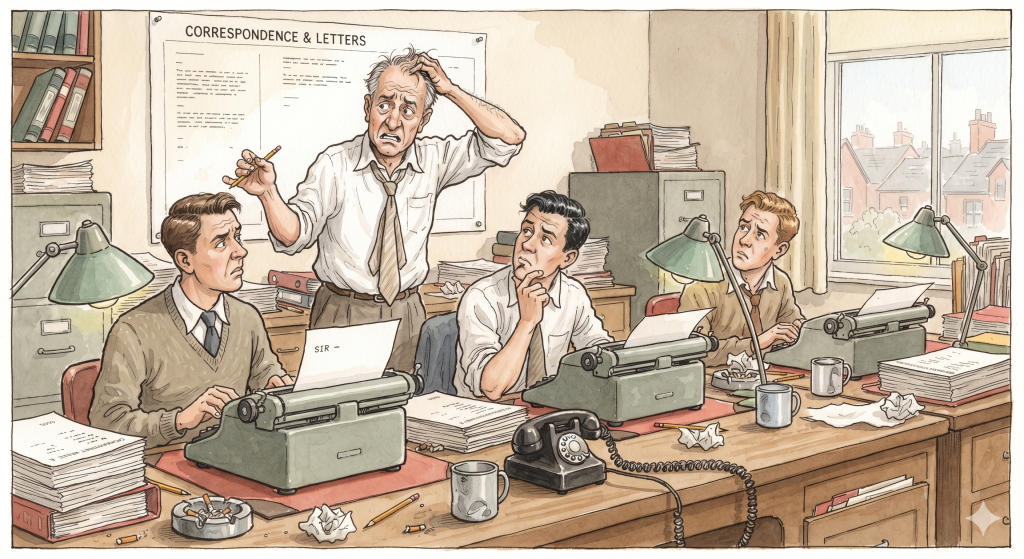
Claim one places the origin with the BBC wartime radio comedy Much-Binding-in-the-Marsh in 1944. This claim appears regularly in newspaper reports and is repeated in reference works. The documentary evidence for it is, charitably, thin.
Claim two involves an anonymous regular contributor to The Times in the early twentieth century — a man who identified himself only as “Disgusted of Tunbridge Wells” and was described by editors as the quintessential Englishman. His real identity was never established. Popular rumour made him a retired colonel of the British Indian Army. In 2014, the Kent and Sussex Courier suggested he was Colonel George Thomas Howe, who had developed his skill for indignant prose while observing apartheid in South Africa. This identification has not been independently confirmed.
Claim three comes from local historian and former newspaper editor Frank Chapman, whose account is the most specific and the most persuasively local. During the final months of the Tunbridge Wells Advertiser in the early 1950s, editor Nigel Chapman — alarmed at a shortage of reader letters — instructed his staff to write some themselves to fill space. One signed his simply “Disgusted, Tunbridge Wells.” The phrase was adopted by all subsequent staff letters until the paper ceased publication in 1954.
Claim four is the most documented. In April 1954, the BBC radio comedy Take It From Here broadcast a sketch called “Disgusted of Tunbridge Wells.” The character, played by Wallas Eaton, would deliver a ludicrous protest to cue a sketch from Jimmy Edwards and Dick Bentley. This is almost certainly the moment the phrase entered mainstream British vocabulary. Everything before it was local colour. Everything after it was national mythology.
What Happened Next
The mythology, once established, proved extremely durable. In 1978, BBC Radio 4 named its new listener feedback programme Disgusted, Tunbridge Wells — a title that lasted exactly one year before the BBC lost its nerve and renamed it Feedback. Private Eye ran the pseudonym regularly throughout the 1970s and 1980s. The phrase became, as it remains today, the default shorthand for a certain kind of English conservatism.
In 2009, some residents of Royal Tunbridge Wells decided they had had enough. The tag was “inappropriate,” they said. It was “stereotypical.” They launched a campaign to rebrand the town as “Delighted of Tunbridge Wells.”
The campaign failed.
It failed partly because tourists at the local information centre were buying twice as many “Disgusted” goods as “Delighted” ones. It failed partly because “Delighted of Tunbridge Wells” has, as one local commentator noted, considerably less ring to it. However, it failed most memorably because residents who opposed the rebrand wrote letters to newspapers saying so — in the tone, the register, and the precise indignant spirit of “Disgusted of Tunbridge Wells.”
They were disgusted about being called disgusted. They said so in writing.
The Town the Phrase Forgot
In 2016, the New York Times used Royal Tunbridge Wells as its base for covering the Brexit referendum. The town was chosen because it was, the paper explained, the quintessentially English place — the spiritual home of the conservative instinct, the place the phrase had always implied.
Tunbridge Wells voted Remain. It was the only council area in the whole of Kent to do so.
This detail is worth sitting with. The most famous symbol of Middle English conservatism voted to stay in the European Union. Furthermore, in the years since, the town has returned a Liberal Democrat MP, organised civic campaigns against water companies’ failures, and produced a political culture considerably more complicated than the archetype allows.
However, the phrase has not been updated. It does not, in the nature of phrases, care about the evidence. “Disgusted of Tunbridge Wells” still means what it meant in 1954 — and probably what it meant in 1928, on London Road, when someone sat down to write about buses.
What the Phrase Gets Wrong
Every post in this archive makes the same argument: Royal Tunbridge Wells is more interesting than its reputation.
The Georgian Pantiles — where the aristocracy came specifically to escape the rules of London life — contradicts the stereotype entirely. The Russian exiles who built an Orthodox congregation in a Victorian church on St Luke’s Road are not Disgusted of Tunbridge Wells. The piano that the Council banned in 1974 suggests an institution considerably more repressed than its famous letter-writing suggests. The man who walked 120 miles across Tasmania before building Dunorlan Park was not, by any available measure, a retired colonel in a cardigan.
None of these people are the archetype. They are the town underneath it — the one that existed before the phrase, alongside it, and in spite of it.
The most famous resident of Royal Tunbridge Wells is anonymous, fictional, and wrong about the town he is supposed to represent. He has been writing letters about it for over a century.
The town has been considerably more interesting than his letters suggest.
Disgusted of Tunbridge Wells appears across The Chronicles in various forms. Start with the Capital of Infidelity for the Georgian town that contradicts him most directly. Or read The Lives They Didn’t List for the histories his archetype helped to erase.