Dunorlan Park is probably the most underwritten story in all of Royal Tunbridge Wells.
Back in the 1850s, a colossally wealthy merchant-banker named Henry Reed decided to build a private home and garden that would make the rest of high society in Kent look completely ordinary. He had the cash, he had the ambition, and he wanted a billionaire’s playground.
Most people discover Dunorlan Park on a Sunday morning. They come for the lake, the ducks, the coffee from the café by the water, the children’s playground, and the long grass slopes in summer. What they are walking through, without necessarily knowing it, is one of the most carefully designed Victorian landscapes in the south of England — built as the private pleasure grounds of a single family, nearly lost to development on multiple occasions, rescued by the Council during the Second World War, and now enjoyed by everyone.
The story of how it got from there to here involves an extraordinary man, a landscape architect at the peak of his powers, wartime soldiers with very poor taste in recreational activities, and a fountain that was exhibited at the Great Exhibition before it was ever installed in Tunbridge Wells.
The Man Behind the Park
In the 1850s, a wealthy merchant named Henry Reed purchased a farmhouse and lands on the eastern edge of Tunbridge Wells. He demolished the farmhouse and commissioned an imposing new mansion in its place — built in the Italian style from Normandy stone, completed in 1862, and named Dunorlan. Over the entrance, his family motto read: nothing without the cross.
Reed’s life before Tunbridge Wells was, by any standard, remarkable — from Doncaster to Tasmania by steerage at twenty, a whaling empire, land grants, a friendship with the co-founder of Melbourne, and evangelical work across three continents. The full story of who he was and what brought him here is in our dedicated post: Henry Reed — Nothing Without The Cross.
What he did with the Dunorlan estate is the subject of this one.
What Robert Marnock Built
To design the grounds surrounding his new mansion, Reed engaged Robert Marnock — one of the foremost landscape designers of the Victorian era, whose work on the Sheffield Botanical Gardens and the Royal Botanic Society’s garden in Regent’s Park’s Inner Circle had established him as a leading figure in his field.
Marnock’s guiding principle was what he called “harmony with nature.” At Dunorlan, he had 78 acres to work with and a client with both serious ambitions and a serious budget.
The result was extraordinary. Marnock dammed the River Teise — a tributary of the Medway — twice, to create a six-acre ornamental lake at the heart of the grounds. He laid out a grand avenue of deodar cedars leading from a Grecian temple at the top of the slope down to a fountain at the base. The fountain itself was a commission from the Pulham family — specialists in ornamental stonework and the inventors of Pulhamite, an artificial stone — who built it in terracotta and Pulhamite with dolphin figures, water nymphs, and classical figures around the base. The upper section of the fountain had been exhibited at the Great Exhibition of 1862 before it arrived at Dunorlan. Between the lake and the fountain, a terraced cascade water garden connected the two levels of the grounds.
The large deodar cedars Marnock planted along the original drive to the house still stand today at the Pembury Road entrance. The cascade has changed little since the 19th century. The fountain was restored in the 2000s and won a Civic Trust Award for the quality of the work. During the grounds’ open-air evangelical services, Reed sent over five hundred invitations to local residents to attend — local ministers preaching under the beech trees on the lawn, while the grounds served both as a private pleasure garden and a public mission.
Why He Left
Reed moved out of Dunorlan in 1870. The reason, as his widow recorded in her memoir, was that fellow Christians had found fault with him for the scale and grandeur of his house. A man of his evangelical commitments, they felt, had no business living in a Normandy stone Italian mansion with a fountain from the Great Exhibition. Reed moved to Harrogate. Dunorlan was put up for sale.
Two auction attempts — 1871 and 1872 — failed to find a buyer. A servant’s account of the house, preserved in the Tunbridge Wells Museum records, describes it as “an architectural monstrosity which represented everything one might expect from a man with too much money and too little taste.” The sales brochure, which survives in the museum today, took a rather different view — describing the mansion as “most elegant and substantial, finished throughout in the most perfect manner, and in every way adapted for the comfort and enjoyment of a nobleman or gentleman of fortune.”
Eventually, the estate was sold to Brenton Halliburton Collins, a banker from Halifax, Nova Scotia. On his death, it passed to his son, Carteret Fitzgerald Collins, who died in 1941.
The War Years
The house was requisitioned for the war effort on 15 May 1941. Troops were billeted there, and, according to the park’s records, used the statues lining the Marnock avenue from the Grecian temple to the fountain for target practice. The War Damage Commission took up residence in 1943 and remained until 31 July 1957.
A fire broke out in the house in 1946. Restorative work was undertaken but proved insufficient. When the Commission surrendered the building back to the Council, it was beyond economic repair. In September 1957, it was sold for development and demolished the following year. Eight houses now occupy the site of the mansion.
The Council had purchased the estate from the Collins family during the war years for £42,000. By 1947, thirty acres were opened to the public — initially on a temporary basis that quickly became permanent. Footpaths, fences, and seats were installed. Boating on the lake began in April 1949 and has continued every year since. In 1950, King George VI awarded two swans to the park.
What Remains
The dancing Girl — a Victorian bronze sculpted by William Theed, gifted to the park in 1951 and valued at £50,000 — was stolen from the Grecian temple on the night of 23 October 2006. Whoever took it drove in through the Pembury Road entrance, removed the statue from its plinth, and left. Its whereabouts remain unknown.
Everything else Marnock designed is still here. The lake. The cascade. The fountain — restored, re-topped with a new terracotta Hebe, fully operational. The Grecian temple. The deodar cedars. The long grass slopes where Reed once held open-air sermons for five hundred guests.
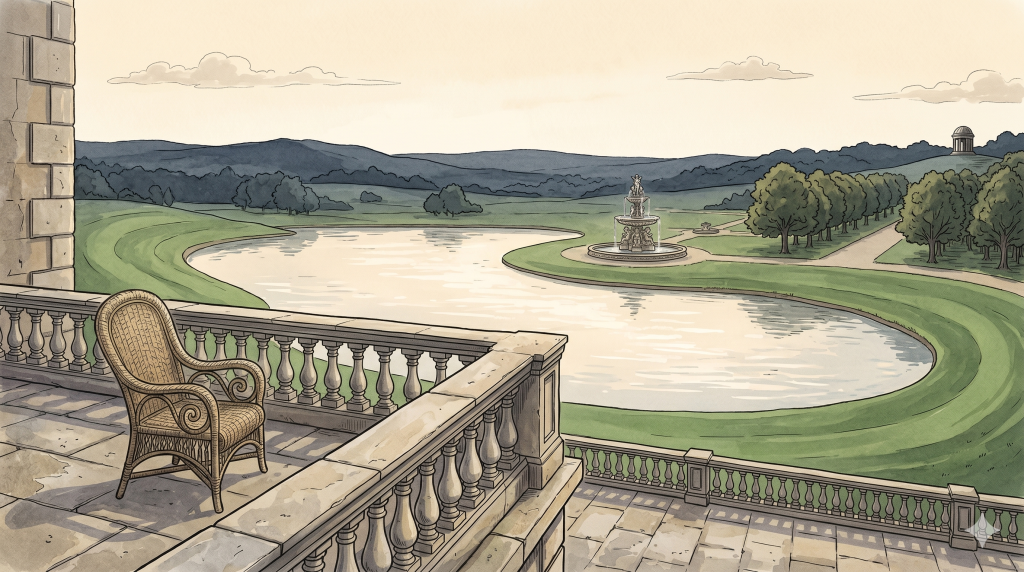
The mansion is gone. Marnock’s landscape, created for a private family to enjoy from a private terrace, is walked by hundreds of people every weekend, none of whom need a key.
That, in the end, is a better outcome than the alternative.
To read the full story of the man who built all this — the whaler, the evangelist, the restless philanthropist whose life spanned Doncaster, Tasmania, New Guinea, and Tunbridge Wells — read our dedicated post: Henry Reed — Nothing Without The Cross
🕵️♂️ Go Spot It Today!
- The Tycoon’s Terrace: Next time you are walking past the boating lake, take a closer look at the grand stone cascade and fountain. Notice how it doesn’t quite align with the modern park’s footpaths; it was designed specifically to be viewed from the vantage point of Reed’s long-demolished private mansion terrace, built to show off his wealth to visiting aristocrats in Dunorlan Park, Tunbridge Wells.
- The Marnock Standard: Look at the way the trees frame the water. If you’ve ever been to Crystal Palace Park or Regent’s Park in London, you will recognise the exact same sweeping, cinematic design philosophy that Marnock used to give urban escapees a sense of infinite nature.
💬 Fact or Fiction? You Decide!
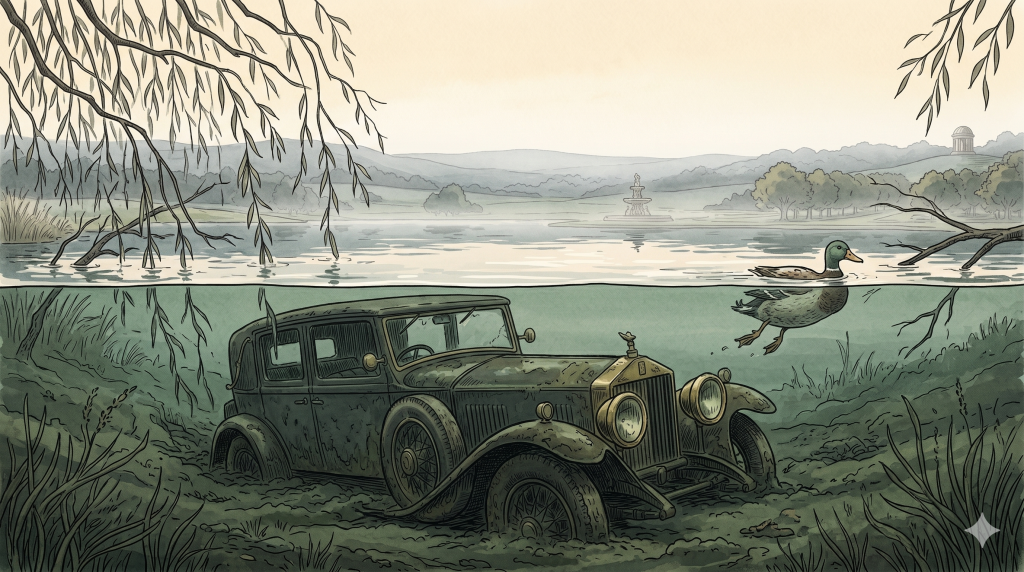
- The Submerged Luxury Coach: A lingering, highly popular rumour from the 1920s claims that during a particularly raucous, illegal jazz-age party held at the old estate, a wealthy guest had a few too many glasses of champagne, lost control of his luxury motor car, and drove it straight down the grass bank and into the centre of the lake. Local lore says the car was so deep, and the mud so thick, that it was simply abandoned and still sits buried in the silt today.
- The Chalybeate Backup: Rumour has it that when Henry Reed first dug the lake, he accidentally tapped into a secondary branch of the town’s famous iron-rich Chalybeate spring. The myth goes that if you swim to the absolute deepest point of the lake, the water turns a deep rusty orange, holding enough mineral power to turn your hair completely grey.
🥾 WalkTW Archive Meeting
Did you know the dramatic story behind your favourite weekend stroll? Next time you’re sitting by the lake, remember the banker who went bust building it! Above all, this is what makes Dunorlan Park in Tunbridge Wells so fascinating to history lovers.
Next up in our Secret Life of the Greens trilogy: Calverley Park—Decimus Burton’s hyper-exclusive, gated utopia that was so wildly ambitious it was never actually finished, leaving behind a private paradise that requires a physical key to enter. Stay tuned!
🚶 Explore it on foot: Footsteps Tour 4 — Dunorlan Park is a self-guided trail through Marnock’s Victorian landscape — the cascade, the fountain, the cedars, and the stories behind them. Free to download.
#TunbridgeWells #LocalHistory #DunorlanPark #TheSecretLifeOfTheGreens #WalkTW #KentHistory #RobertMarnock