About This Tour
A WalkTW Walking Tour of Royal Tunbridge Wells
This route follows the WalkTw Walking Tour of Royal Tunbridge Wells, offering an easy way to explore the town’s highlights.
Distance: 0.8 miles / 1.3 km
Time: 35 minutes at a relaxed pace
Difficulty: Easy — mostly flat, one gentle descent toward Linden Park Road
Start point: Tunbridge Wells Railway Station, TN1 1BT
End point: Spa Valley Railway, TN2 5QY — trains run Saturdays and Sundays, 10am–4pm
Best time: Any day for the walk. Visit on a weekend if you want to continue the story by steam train.
Two rival Victorian railway companies. One town. Eighty years of spectacular mutual hostility. This tour follows the route of the railway war from the station that won to the station that refused to disappear — through the hill where a peace tunnel was bored as the price of a grudging truce. The full story is in The Chronicles. This tour gives you the ground.
Route Map
Stop 1 — Tunbridge Wells Central Station
Station Approach, TN1 1BT
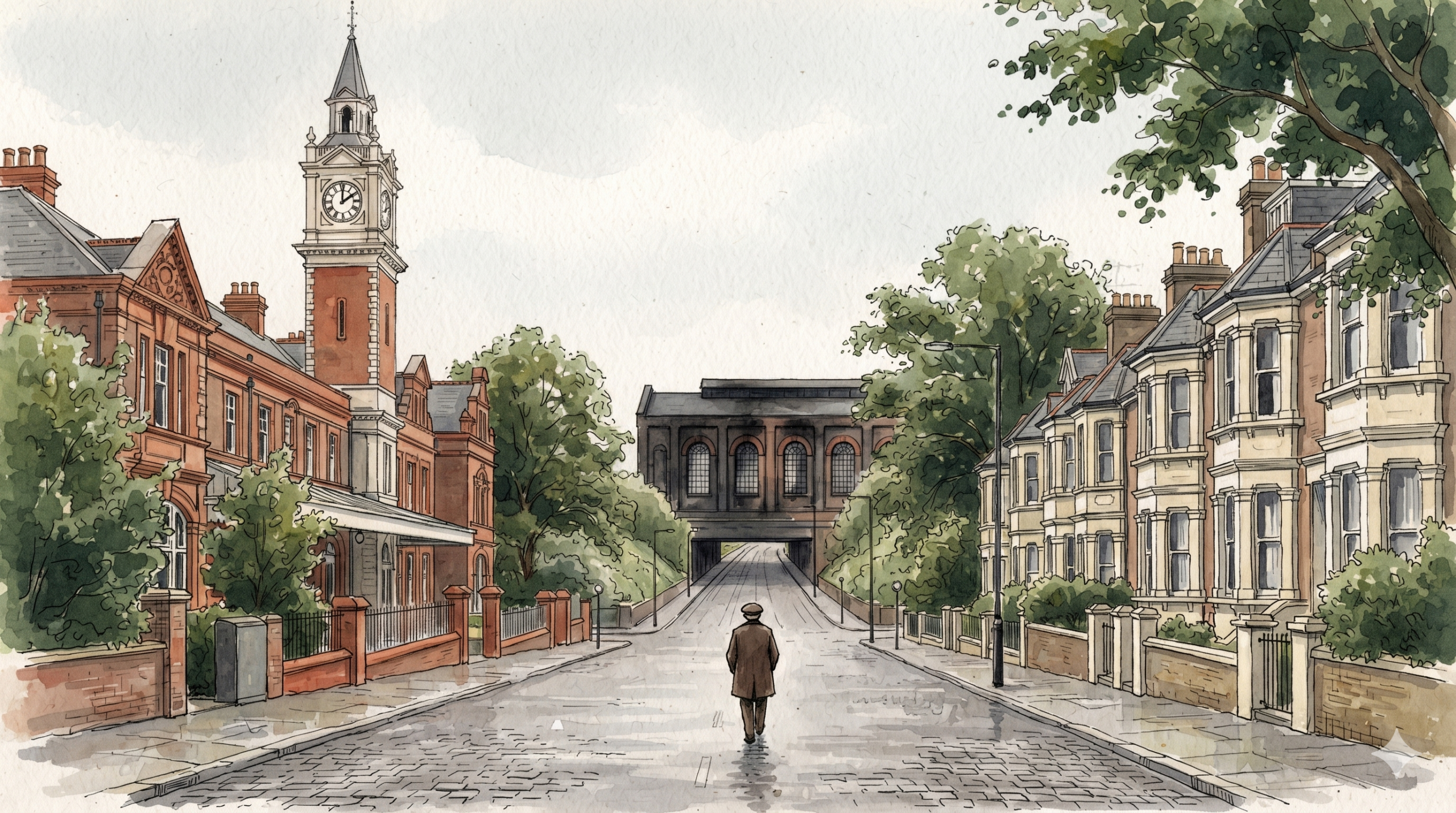
Stand on the pavement outside the station and look up at the clock tower. The white stone and red brick facade above you was built in 1912 — a confident Edwardian statement from a company that knew, by that point, it had won.
The South Eastern Railway arrived in Tunbridge Wells in 1845. It was the first. For over twenty years, it had this town entirely to itself — and it had no intention of sharing. The arrival of a rival company in 1866 changed that calculation permanently. What followed was one of the longest and most expensive corporate feuds in the history of Victorian England, conducted entirely through Parliamentary bills, competing timetables, and the strategic deployment of tunnel-boring equipment.
The clock tower still looks down Station Approach with the particular serenity of an institution that outlasted its enemies.
🔍 Which company built this station — and why did its rival insist on building a completely separate one half a mile away?
📖 Read: The Railway War Part 1 — Two Companies, One Town, Zero Diplomacy
Stop 2 — Grove Hill Road
Grove Hill Road, TN1
Walk south from the station along Grove Hill Road and stop roughly halfway along, where the road curves through the cutting. Look at the hill rising to your left.
Beneath the ground under your feet runs one of the more unusual pieces of Victorian infrastructure in Kent. The tunnel bored through this hill was not built because neither railway company wanted to. It was built because Parliament insisted, as the price of a territorial compromise — a single-track connection between the two rival networks, bored through solid rock as a gesture of forced cooperation between companies that regarded each other as enemy combatants.
It opened in 1876. Through it ran trains connecting routes that the two companies had spent a decade trying to keep separate. It was, in the most literal sense, peace underground.
The tunnel is still there. Sealed, but structurally sound, its Victorian brickwork intact beneath the hill.
🔍 What did one company have to give the other in exchange for this tunnel — and why did neither side actually want to build it?
📖 Read: The Railway War Part 1
Stop 3 — The Old West Station (Smith & Western)
1 Linden Park Road, TN2 5QL
Continue south and west along the road until the Victorian facade comes into view on your left. Stop and look at the building.
The red brick station in front of you was the rival company’s answer to the clock tower you started at. Built in 1866 as the London, Brighton and South Coast Railway’s Tunbridge Wells terminus, it was designed by an architect whose credits included the ornamental masonry of the Thames Embankment. It was listed Grade II in 1986 — roughly ten months after the last scheduled passenger train departed from its platforms.
Today it is a Wild West steakhouse. The booking hall where passengers once queued for tickets to Brighton and Lewes now contains saddle stools, bourbon, and a decorative jail available for private hire. The engine shed directly behind the building — four roads of Victorian engineering brick, arched windows, iron railings — survived a German bomb, a wartime requisition, and the arrival of a Sainsbury’s next door. It is still standing.
The planning permission for the Sainsbury’s development came with a legal condition so specific it deserves its own entry in local history. Read the full story to find out what it was.
🔍 What legally binding clause was attached to the Sainsbury’s planning permission — and what small structure nearly blocked an entire railway corridor?
📖 Read: The Railway War Part 2 — Bombs, Bureaucrats, and a Toilet Block with a Removal Clause | The Old West Station
Stop 4 — Spa Valley Railway Platform
West Station, TN2 5QY
Walk around the left side of the building and step onto the platform behind it.
The last scheduled passenger service departed from this platform on 6 July 1985. By the following morning, the track had been lifted. The line was closed. The building was converted into a Beefeater restaurant.
Six weeks later, a group of people met in a village hall in Groombridge and decided to reopen it. They called themselves the Tunbridge Wells and Eridge Railway Preservation Society. The acronym was TWERPS. They chose it without apparent awareness of the consequences.
Eleven years after closure, the first heritage train departed from this platform heading south toward Groombridge, hauled by a steam locomotive. Services now run to Eridge through the High Weald — the same countryside the LBSCR carved its route through in 1866.
Stand at the end of the platform and look south along the track. The railway war ended in 1923 when both companies were absorbed into the Southern Railway. The railway, however, did not.
🔍 What happened to the junction that once connected the two stations — and what does a £1 land sale have to do with the future of this line?
📖 Read: The Railway War Part 2
Tour ends here. The Spa Valley Railway runs heritage steam and diesel services to Eridge on weekends and selected weekdays — tickets at the platform. The Smith & Western restaurant is open from 7am Monday to Friday, 9am weekends. The town centre is a 12-minute walk north.
Want the full story at every stop — the confirmed facts, the contested claims, and the details that don’t make it onto the free route?
The WalkTW guided Footsteps tours go deeper. Join the waitlist