Part 2 of The Lives They Didn’t List
The Chronicles
This series: The Lives They Didn’t List
- Introduction: The Town That Didn’t Know Itself
- Part 1: The Town That Banned a Piano
- Part 2: The Waters Were Always Queer (you are here)
- Part 3: Quietly, On Our Terms
The word “queer” is older than its current meaning.
Before it became a term of identity — reclaimed, debated, eventually claimed — it simply meant sideways. Odd. Not quite fitting the expected shape of things. It described anything that resisted a tidy category.
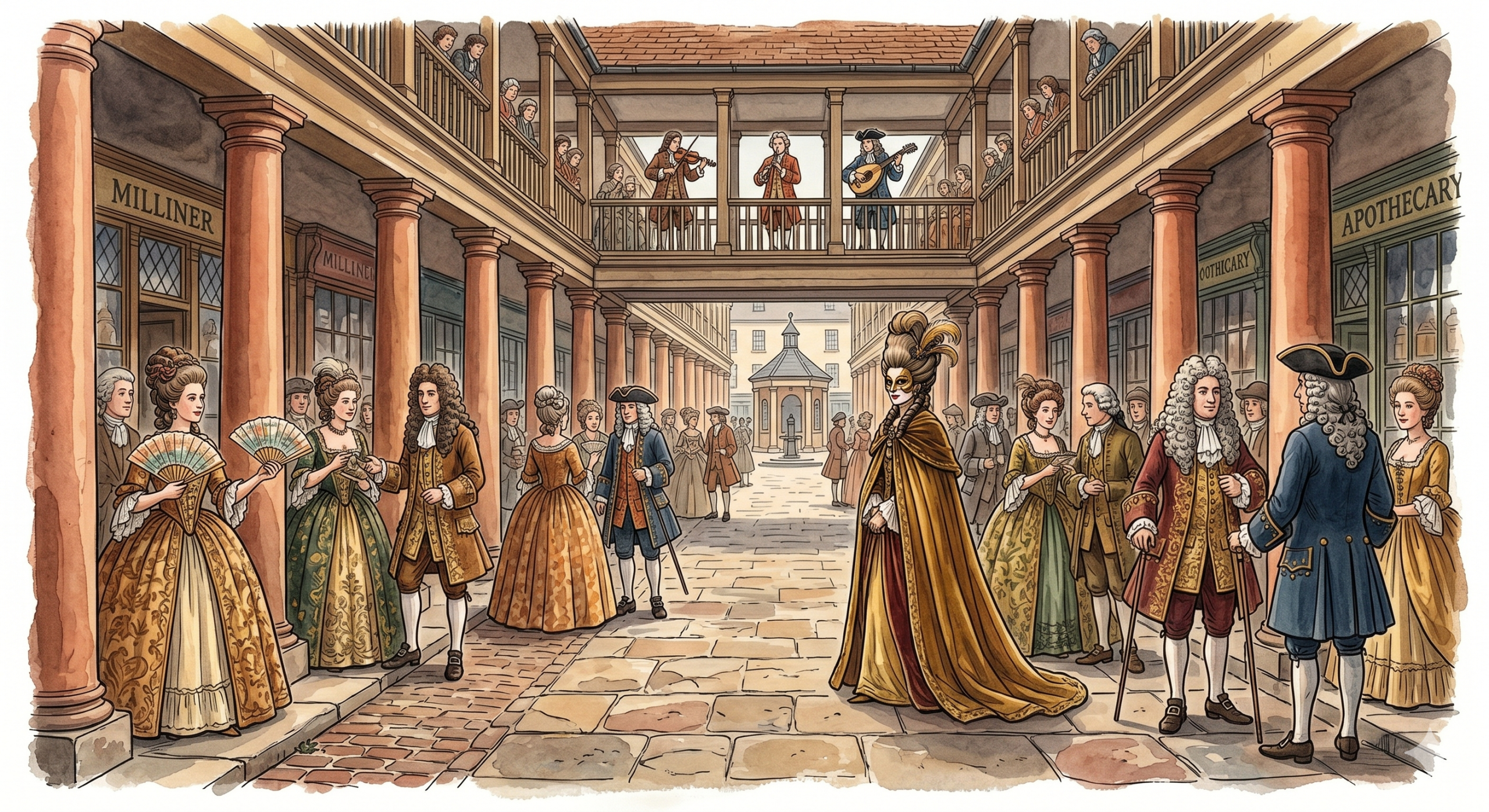
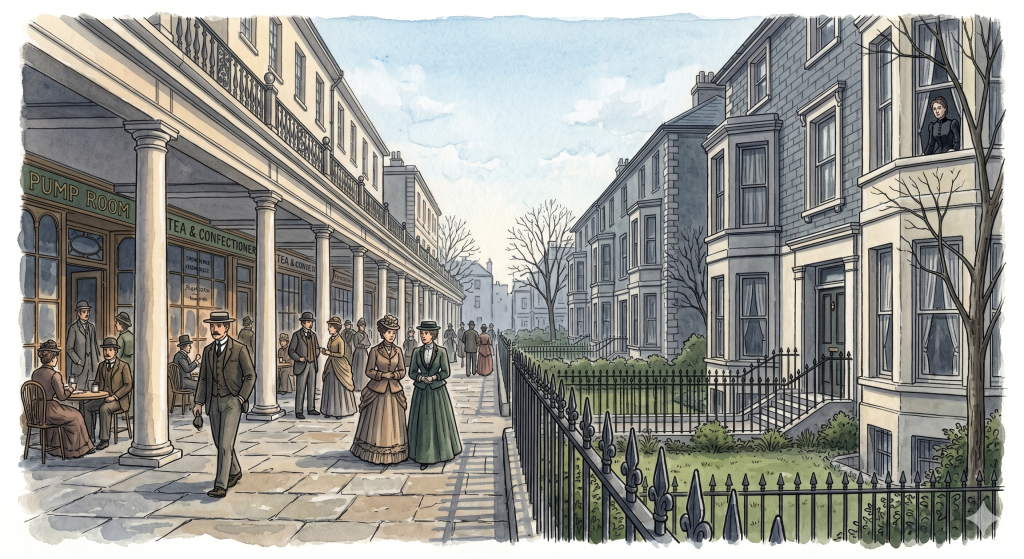
In that older sense, Royal Tunbridge Wells was queer from the beginning. It was a town that existed specifically to offer people a temporary release from who they were supposed to be. The Georgian spa town was built on social suspension. For the duration of the season, you arrived, you promenaded, you performed, and — crucially — you were whoever you chose to present yourself as on The Pantiles.
What the Spa Town Actually Was
Let us start with what is documented.
The chalybeate spring was discovered in 1606. Within a generation, a seasonal resort had formed around it — built on the premise that iron-rich water cured nervous complaints, digestive disorders, and a considerable variety of ailments that wealthy Londoners preferred not to specify too precisely. The medical framing was, as we have covered elsewhere in The Chronicles, largely a convenience. People came to the Wells to escape.
However, what they were escaping was specific. Georgian London operated through dense, overlapping networks of surveillance: neighbours, servants, parish officers, social connections accumulated over decades. The spa town replaced these with a transient, seasonal community of strangers who had no fixed relationships with one another and no particular investment in each other’s long-term reputations. People arrived in the summer and left in the autumn. What happened at the Wells, therefore, existed in a different social register from what happened at home.
This was not a designed feature of the spa town. It was a structural one — a consequence of seasonality and transience rather than any deliberate policy. However, its effects were real. The gap between London life and Wells life was wide enough that people used it. Some used it for the affairs we covered in the Capital of Infidelity series. Others used it for other things.
Mr Maiden, Revisited
In 1703, playwright Thomas Baker wrote Tunbridge-Walks; or, The Yeoman of Kent — a comedy based on the social scene at Wells, featuring a character called Mr Maiden. Maiden was a flamboyant, cross-dressing dandy who wore women’s clothes to navigate female social spaces and gather gossip. Audiences immediately recognised him as based on a real, regularly visible person on the Pantiles promenade.
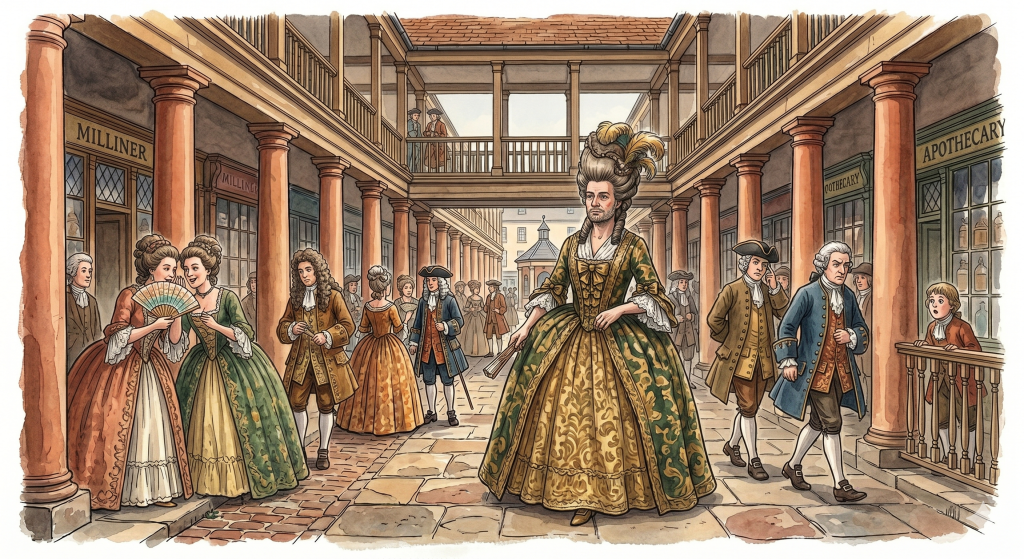
We told this story in detail in our Capital of Infidelity Part 2. However, what that post was not designed to explore is what Maiden’s existence actually represented in legal and social terms.
Cross-dressing itself was not a criminal offence. However, Maiden’s behaviour — moving through women’s spaces, cultivating an explicitly feminine persona, rejecting the social expectations attached to his apparent sex — was the kind of non-conformity that, in most English social contexts, attracted serious consequences. At the Wells, he was a public figure. Known by sight. A recurring seasonal presence visible enough to inspire a hit London comedy.
He was not hidden. He was, in some sense, the entertainment.
That is not the same as saying Tunbridge Wells was tolerant in any meaningful modern sense. The play is a comedy, and Maiden is the joke. Furthermore, what made his visibility possible was almost certainly the specific conditions of the spa town — its transience, its theatrical culture, its distance from fixed community — rather than any particular social progressiveness.
In 1703 in England, a man who presented himself this way and was not imprisoned or prosecuted was, at a minimum, navigating his circumstances carefully. At best, he had found a place where the usual rules had a slightly looser grip. That is worth noting.
The Legal Reality
To understand what the spa town offered, it helps to understand what the alternative looked like.
Sodomy was a capital offence in England from 1533. The last two men executed for it in England, James Pratt and John Smith, were hanged outside Newgate Prison in November 1835. The death penalty for the offence was abolished in 1861, replaced by life imprisonment as the maximum sentence.
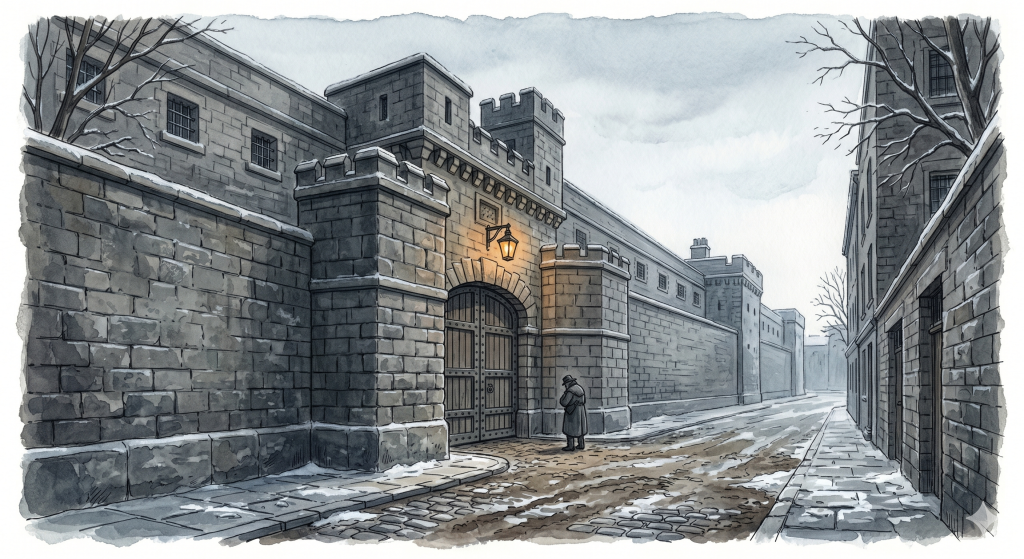
However, prosecution under the sodomy laws required the courts to prove penetration had actually occurred. The burden of proof was high, successful prosecutions were therefore relatively rare, and the legal reality for most people navigating same-sex desire in Georgian England was one of constant risk management rather than routine prosecution.
The spa town, with its transient community, its seasonal anonymity, and its theatrical culture of performed identity, reduced — marginally, not entirely — some of the conditions under which that risk was highest. Permanent community, fixed surveillance, and known social relationships are the conditions in which private behaviour becomes visible. The spa town temporarily removed all three.
This is not a claim that Tunbridge Wells was a Georgian sanctuary for non-conforming desire. The evidence does not support that. It is claimed that the specific structure of the seasonal spa town created an environment distinct from that of the permanent communities surrounding it. For people for whom difference was dangerous, different environments mattered.
The Wall That Went Up
The Georgian spa town’s relative fluidity did not survive the 19th century intact.
As Tunbridge Wells transformed from a seasonal resort into a prosperous permanent town — as the grand villas of Mount Ephraim and Calverley Park filled with retired officers, commuters, and professional families — the seasonal social suspension ended. People were no longer visitors. They were neighbours. The fixed networks returned.
In 1885, the Labouchère Amendment criminalised all sexual acts between men — not only sodomy, but any act of “gross indecency,” in public or private. The prosecution no longer needed to prove penetration. It needed only to establish intimacy. The effect was swift and significant. Oscar Wilde was convicted under this law in 1895 and sentenced to two years’ hard labour. Alan Turing was convicted under it in 1952 and subjected to chemical castration. The law remained on the statute book until 1967.
The Victorian Tunbridge Wells that emerged alongside this legal shift was, therefore, not simply the Georgian spa town that had grown up and settled down. It was a different kind of place — more permanent, more surveilled, more rigidly conformist — shaped partly by the same cultural forces that produced the Labouchère Amendment itself. The temporary freedoms of the seasonal spa, such as they were, had been replaced by the permanent respectability of the Victorian commuter town.
The town that Ross Burgess arrived in during 1972 was partly the product of that transformation. The Georgian Pantiles had offered, for a season at a time, a slightly looser grip. The Victorian town had tightened it considerably — and kept it tight for the better part of a century.
What Remains
Walk The Pantiles today, and the Georgian stage is intact — the colonnade, the spring, the building lines that would have been familiar to Baker’s Maiden. The performances have changed. However, the instinct that drew people here — the desire for somewhere the usual categories apply with slightly less force — has not entirely gone away.
It simply found fewer places to express itself in a town that had definitively decided what it was. Until, in 1972, someone decided to build something new instead.
Part 1 of this series — the story of what Ross Burgess built, and the Council that tried to stop it — is here. The final chapter — what Tunbridge Wells’s LGBT community looks like in 2024 — follows in Part 3.