Tag: scandal

The gossip, intrigue, and outright scandal that has followed Royal Tunbridge Wells throughout its history — despite (or because of) its respectable reputation.

  • The Battle of Little Mount Sion: Two Pubs, One Title, No Resolution 🍺👻

    The Battle of Little Mount Sion: Two Pubs, One Title, No Resolution 🍺👻


    The WalkTW Building Files🏛️🔍

    A Note Before We Begin

    Every WalkTW story so far has followed a person — a writer, a mathematician, a Russian baroness, a playwright — and used the buildings of this town as their backdrop (Thackeray’s window. Cumberland’s playwright. Defoe’s promenade.). In this piece, however, we’ll turn our attention to an event: The Battle of Little Mount Sion. The buildings were always there, waiting patiently in the margins.

    This is the series where the buildings get their turn.

    Tunbridge Wells is 400 years old. That is 400 years of people living, arguing, dying, drinking, conspiring and occasionally dropping dead of shock inside the same walls. Some of those walls are still standing. Some of them are on streets you walked past this morning without a second glance.

    The WalkTW Building Files is a new series — one building per post, investigated properly. Confirmed history, contested claims, rumours that won’t go away, and at least one question that nobody has yet managed to answer. Each post comes with directions, because the whole point is that you can go and stand in front of the building yourself and see what history has left behind.

    We start where Tunbridge Wells itself started — on the hill above the Chalybeate Spring, in the oldest streets in town, where two pubs have been arguing about the same thing for four hundred years.


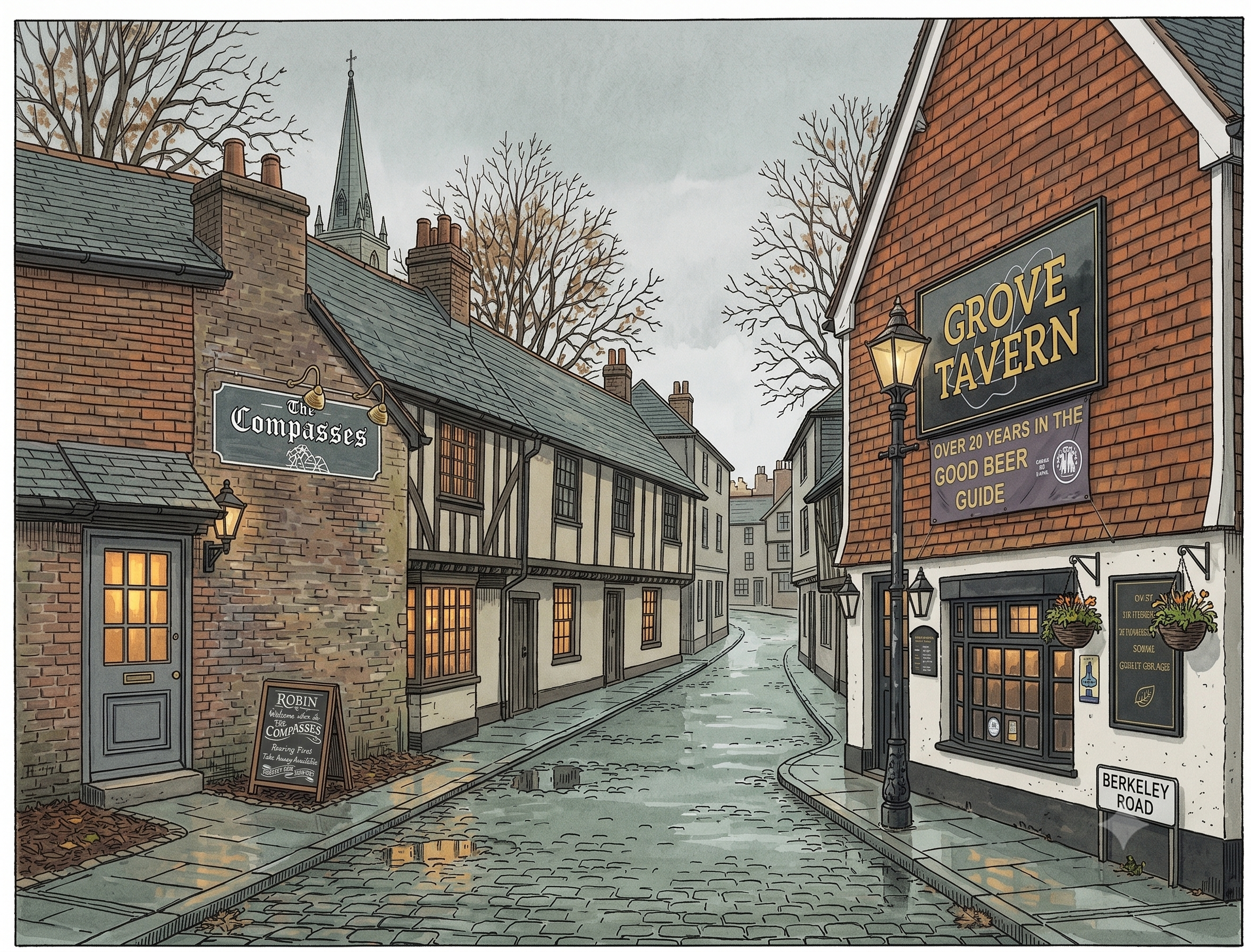
    The Compasses, 45 Little Mount Sion, TN1 1YP, and

    The Grove Tavern, 19 Berkeley Road, TN1 1YR

    They face each other across a quiet backstreet in the oldest part of Tunbridge Wells. Two small pubs, forty metres apart, both claiming to be the oldest buildings in town. Both with beams, open fires and ghost stories. Both have reasons to doubt the other’s claim.

    The Compasses is owned by Greene King and will tell you its history on a laminated card. The Grove Tavern is owned by its landlord and will tell you its history if you ask nicely and stay for a second pint.

    Between them, they contain more of Tunbridge Wells’s original character than almost anywhere else in the town. The question of which one is older may never be settled. The more interesting question is why nobody is properly asking it.


    The Hill Before the Town

    To understand Little Mount Sion, you need to understand what it was before Tunbridge Wells existed.

    When Lord North stumbled upon the Chalybeate Spring in 1606, there was nothing here — no town, no streets, no buildings. Just a spring in a field, two forested ridges on either side, and the ancient track between them. Tunbridge Wells was something of an artificial creation in the early to mid-17th century. Initially, there were no houses or hotels, just the spring, some shops, coffee houses and perhaps a pub or two in the area now called The Pantiles. Residential development only really started in the 1690s on Mount Sion and Mount Ephraim.

    But before that formal development, before the lodging houses and the Assembly Rooms and the paving scandal, there were encampments. Visitors to the spring in the earliest decades pitched tents and temporary structures on the hillsides. And where there are encampments, there is always, eventually, somewhere to drink.

    Those two ridges — Mount Sion and Mount Ephraim — were not neutral territory. If you have read our Mountain Feud post, you already know that the two hills were engaged in a cold war of competing religious and political identities throughout the 17th century. Mount Sion was Puritan, Parliamentarian, Nonconformist. Mount Ephraim was Royalist, Anglican, and fashionable. Little Mount Sion sat squarely in Puritan territory.

    One of the first buildings on Mount Sion was an ale-house, which is now the Grove Tavern. That claim comes from the Tunbridge Wells Civic Society — not from the pub’s own marketing. It is as authoritative as anything in the historical record.

    The Compasses, forty metres away on the same hill, says the same thing about itself.

    The Name That Greene King Doesn’t Mention

    The Greene King laminated card tells you the pub has had many names over the centuries — Compasses, Compasses Hotel, Compasses Inn, Three Compasses, Compasses and Horseshoe, Hogshead and Compasses.

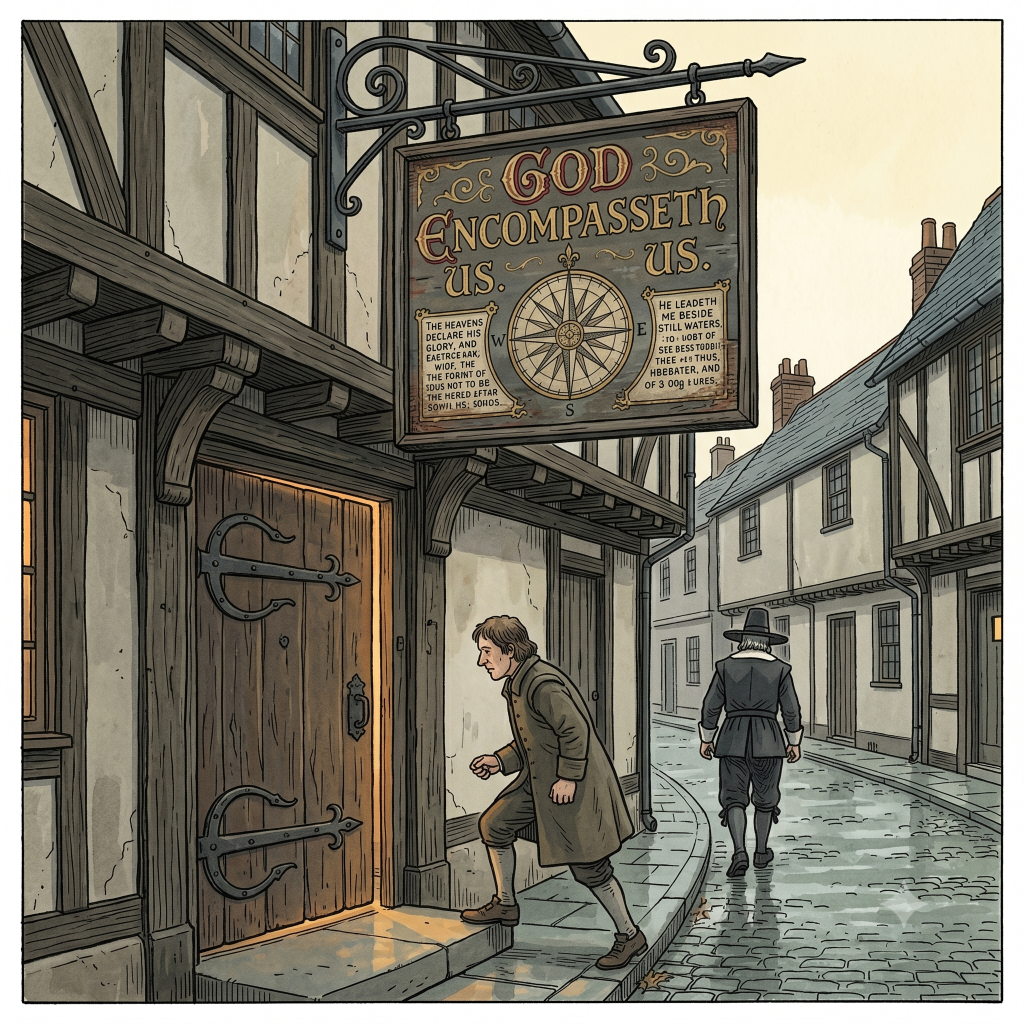
    What it doesn’t tell you is what it was called before all of those. Searching in the local library reveals that it used to be called The Goat and Compass, which is a very strange name. However, when you dig deeper, you discover that it was originally an inn called God Encompasseth Us — a reference to the Bible’s view of God surrounding or encompassing his people, found in Psalm 139:5 and Hebrews 12:1-2.

    Think about what that tells you. The earliest inn on this hill — in the 1630s, at the height of the Mountain Feud between the Puritan Mount Sion and the Royalist Mount Ephraim — was named after a Puritan scripture. God Encompasseth Us. This was a Puritan drinking house, on a Puritan hill, at a moment when the two ridges of Tunbridge Wells were engaged in a cold war of competing religious identities.

    The pub was, from its very beginning, a theological statement. It just gradually shortened its name until nobody remembered what it meant.

    The Night Mrs Pek Dropped Dead

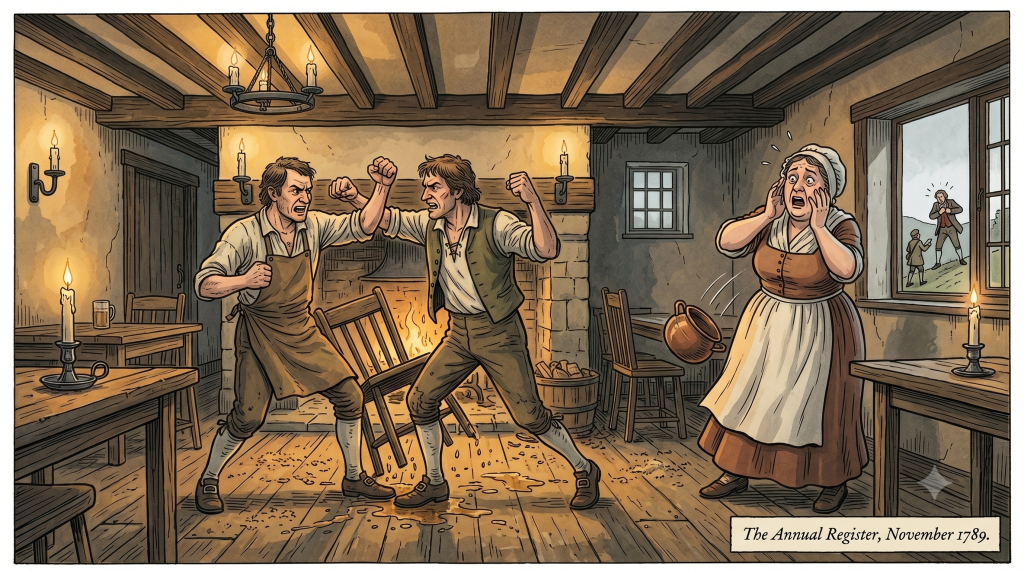
    The Greene King card contains a story sourced from the Annual Register of November 1789 that deserves to be far better known than it is.

    The landlady at the time was a Mrs Pek. One evening, a turner called Fenner — believed to be related to William Fenner, one of the best-known makers of Tunbridge Ware — and a carpenter called Philpot were drinking together at the pub. A quarrel arose between them, which proceeded to blows. The fight went on for some time.

    The sight of the brawl so greatly affected Mrs Pek that she dropped dead. Although she was given medical help immediately, it was fatal.

    But here is the detail that elevates this from a pub fight into something stranger. When news of Mrs Pek’s death was relayed to a Mr Field at Mount Ephraim — about half a mile away, who was a relative of the deceased — the shock was so great that he dropped dead too, while the story was being related to him.

    Two people died as a direct result of a carpenter and a turner having an argument in a Tunbridge Wells pub in 1789. One of them was half a mile away when it happened. This is documented in the Annual Register. It is real. The next landlord, a Mr D. Schooler, also died at the inn in 1803.


    The Exorcist, the Little Girl and the Angry Spirit

    At some point in the pub’s history, one landlord had an exorcist attend, due to what the card describes only as “some activity.” The Compasses is said to be haunted by the spirit of a little girl who allegedly died on the premises. Her mother — described in the card as a prostitute — was murdered by her father on the same site.

    Witnesses report shadows moving around the ground floor, sudden cold spots, the feeling of someone breathing over their shoulders, whispering in their ears. One member of staff has seen the ghost of a woman wearing a white coat-like garment.

    Soul Searchers Kent, a paranormal investigation team, investigated the pub after receiving a call from the landlord. One ghost hunt ended when an angry and aggressive spirit shouted “Get out” at the paranormal team.

    The paranormal team left.

    Whether the spirit was the little girl, the murdered mother, the deceased Mrs Pek, the late Mr Schooler, or simply a Greene King customer who had been waiting too long for their food is not recorded.

    This is not, incidentally, the only violent history on this street. The Capital of Infidelity series has already established that Georgian Tunbridge Wells ran on assignations, gambling and the management of appearances. The backstreets of Mount Sion were where the less respectable ends of that economy operated. Little Mount Sion was never quite as genteel as it looked.

    Across the Street: Josh in the Cellar

    While The Compasses accumulates its catalogue of deaths, exorcists and aggressive spirits, the Grove Tavern, forty metres away, has been quietly conducting its own supernatural affairs with rather more specificity.

    The Grove Tavern was originally known as Brett’s boarding house, Chapel House, and the Grove in Mount Sion. The Brett family had extensive land holdings in the area. Later, the tap house was no doubt added to quench the visitors’ thirst.

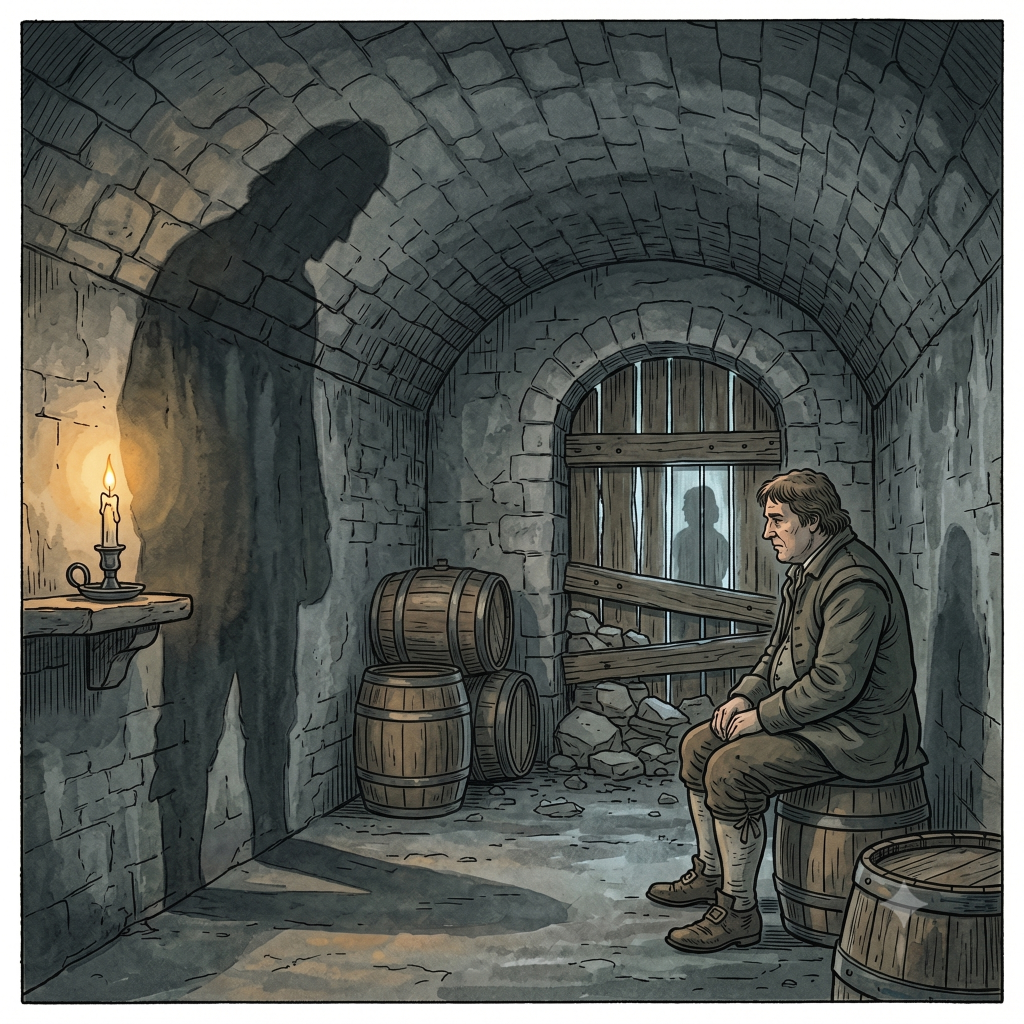
    The ghost at the Grove Tavern has a name. The ghost reported to be haunting there is named Josh. The owner reported that he was a former cellar man waiting for his lady to come through the tunnel to the cellar for a clandestine meeting.

    This detail requires unpacking. Legend states that tunnels ran beneath Little Mount Sion and other areas of the town. One is said to have led from a house across the street to the cellar of the Grove Tavern, and this house was one of ill repute. The gentlemen of the inn would greet ladies of the night there or even in the tunnel for some discreet meetings.

    This puts Josh firmly in the same world that Daniel Defoe documented when he rode into town in 1722 and noted the “gaming, sharping, intriguing” with the eye of a man who had seen everything. The tunnels beneath Little Mount Sion were, apparently, part of the infrastructure of that intriguing.

    Josh, the cellar man, is still waiting. The tunnel presumably still exists beneath the street, whether blocked or forgotten. The house of ill repute across the road is now something else entirely. The lady never arrived. Josh has been in the cellar since the 17th century.

    The Grove Tavern is Grade II listed. Its listing was granted on 7 June 1974. English Heritage saw fit to protect this building. Nobody mentioned Josh in the paperwork.


    The Grove Behind the Compasses

    One detail from the Greene King card that connects both pubs to the wider history of the hill: behind The Compasses was the old Grove Park, where visitors to the spa would take their strolls after dining or listen to the orchestra on the bandstand, which is no longer there.

    That same promenading culture — the performance of respectability over a private reality of gaming and assignation — runs through the entire Capital of Infidelity trilogy. The Georgian visitors who strolled in Grove Park after dinner were the same people conducting their less reputable business in the tunnels beneath the street. Tunbridge Wells has always been very good at holding both in balance.

    The bandstand is gone. The grove is gone. The spa visitors are gone. The orchestra is gone. The tunnel may or may not still be there.

    What remains: two small pubs, forty metres apart, still arguing about which one is older, on a hill that has been continuously occupied since before Tunbridge Wells had a name.


    The WalkTW Verdict on the Oldest Pub Question

    Honest answer: We cannot settle it. The historical record is genuinely ambiguous.

    The Compasses has the more documented paper trail — the 1718 ownership record, the Annual Register account, and the multiple name changes that suggest continuous operation over centuries. The name God Encompasseth Us anchors it to the very earliest years of the town’s development.

    The Grove Tavern has the more credible origin story — Brett’s boarding house predating the formal development of Mount Sion, the Civic Society’s assessment that it was one of the first buildings on the hill, the Grade II listing that formally recognises its historic significance.

    One of the first buildings on Mount Sion was an ale-house, which is now the Grove Tavern. But there may have been places on The Pantiles that we would consider pubs, too.

    The honest answer is that the question of the oldest pub in Tunbridge Wells may have no clean resolution — because the town itself grew too gradually and informally in its earliest decades to leave the kind of paper trail that would settle it definitively.

    What we can say with confidence: both pubs are on the oldest surviving street in Tunbridge Wells, in buildings that have been serving drinks since the town was new, forty metres apart, and both are worth your time.


    🗺️ Go Find Them Today

    Both pubs are on Little Mount Sion — the quiet backstreet running parallel to the High Street, five minutes from the station and two minutes from The Pantiles. Walk up from the Chalybeate Spring, turn left past the Church of King Charles the Martyr, and you will find them facing each other across the street.

    The Compasses — 45 Little Mount Sion, TN1 1YP. Greene King pub, food served, family friendly, open fires in winter. The laminated history card is on display inside. Ask about the exorcist.

    The Grove Tavern — 19 Berkeley Road, TN1 1YR. Independent, no food, proper real ale, dog friendly, one bar. Steve Baxter has been a landlord since 2003 and knows the building better than anyone. Ask about Josh.

    Visit both in the same afternoon. The pubs are forty metres apart, and the beer is better at the Grove. The ghost stories are better at The Compasses. Order accordingly.


    🕵️ The Open Questions

    Three things the WalkTW archive cannot yet answer:

    Question 1: The Tunnel. Does the tunnel beneath Little Mount Sion still exist? Is it blocked, bricked up, forgotten, or still accessible from somewhere? The Grove Tavern’s cellar presumably connects to something. Has anyone looked?

    Question 2: The Little Girl. The Greene King card says the researchers are currently unable to locate any children living at the inn in the historical record, but will keep researching. Has anyone found her? A child dying on licensed premises would have generated a coroner’s record, a newspaper report, something. Does anyone know where to look?

    Question 3: The Original Name. God Encompasseth Us is the most extraordinary pub name in Tunbridge Wells history. When exactly did it change, and why? Was it a deliberate secularisation as the town’s Puritan character faded? Was it simply worn down by generations of drinkers who couldn’t be bothered with the theology? The local library apparently has the records. Has anyone checked?

    Drop what you know in the comments. The Building Files are open. 👇

    The WalkTW Building Files continue. Next up: the building on The Pantiles where a stage crossed a county border, a Ceres statue watches from the roof, and the ghost of a Georgian actress may or may not be taking a curtain call in the antiques market below.

    #TunbridgeWells #WalkTW #BuildingFiles #TheCompasses #GroveTavern #LittleMountSion #LocalHistory #GhostStories #OldestPub #HiddenTunbridgeWells
  • The Russians Who Came to Stay: Tunbridge Wells and the Revolution 🪆

    The Russians Who Came to Stay: Tunbridge Wells and the Revolution 🪆

    Some came to stay. Some never arrived. Some never left. The hidden Russian history of Royal Tunbridge Wells.

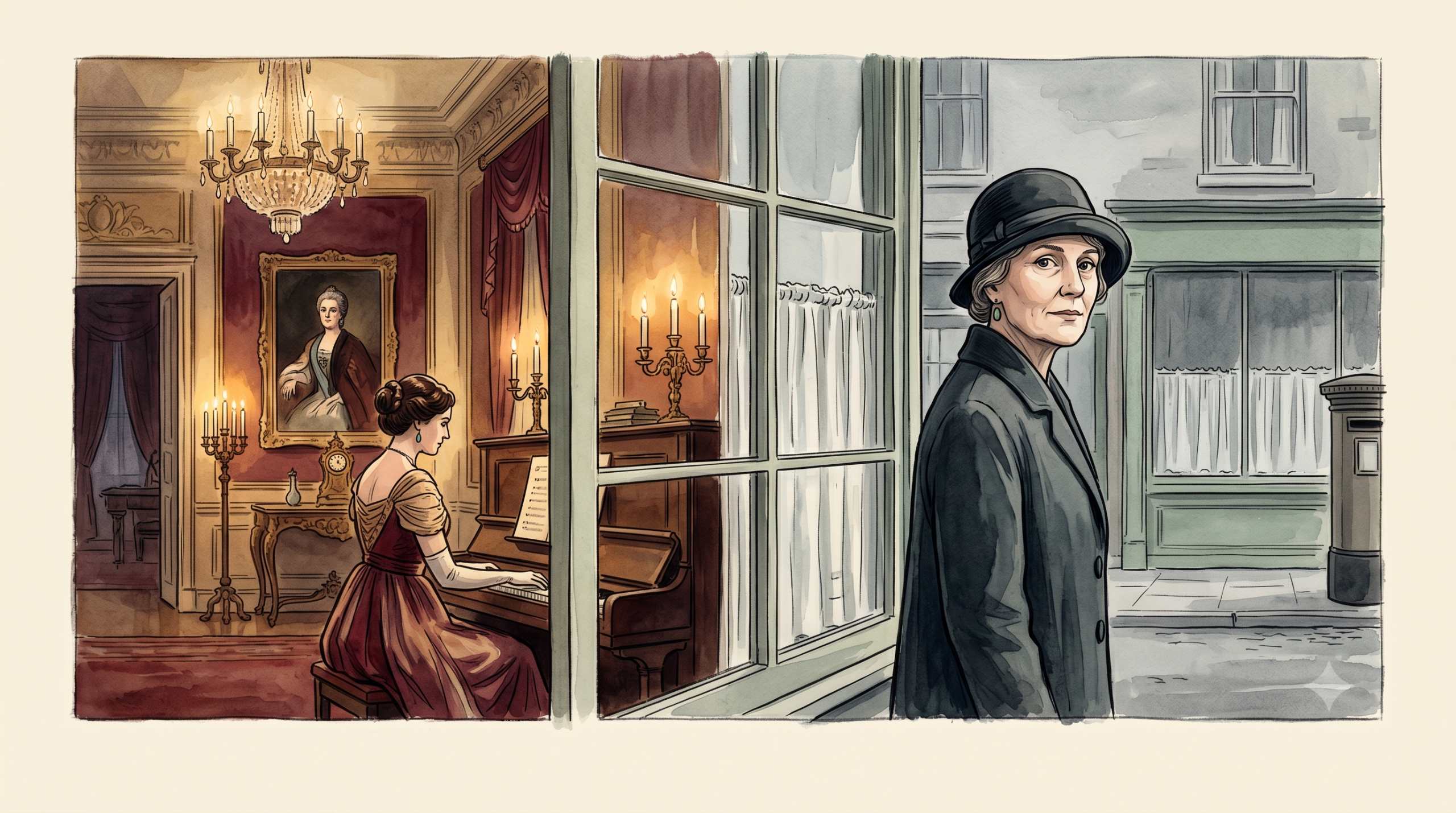
    There is a woman walking down a street in Tunbridge Wells. It is sometime in the 1920s. She wears a tight-fitting cloche hat. Jade earrings catch the light. She walks with the particular bearing of someone who was once very important in a world that no longer exists.

    Her name, as far as we know, is Baroness Olga. She is part of a fascinating chapter in Russian history connected to Tunbridge Wells.

    She is the only person in this town, perhaps in this entire corner of England, who has lost everything — not to illness or bad luck or a poor investment, but to a revolution. The world she came from — the servants, the estates, the titles, the certainties — was dismantled in the space of a few terrible years and replaced with something entirely unrecognisable.

    She ended up here. In Tunbridge Wells.

    A historian’s child, Richard Cobb, watched her walk those streets and never forgot her. Sixty years later, he put her in a book. She is, he wrote, “the town’s only victim of the Russian Revolution.”

    Only. That single word tells you everything about how invisible she must have felt.


    The Revolution That Washed Up in Kent

    In the years following 1917, the Russian Civil War led to the displacement of over one million people. The majority of the refugees were from Russia’s educated classes — they had fled their homes as the Whites suffered heavier defeats, first to Constantinople, then gradually on to London, Belgrade, Paris and Berlin.

    Britain, however, was not exactly welcoming. Government policy was to refuse entry to all Russians unless there were exceptional circumstances. Only very small numbers were admitted — usually if they had business connections, strong personal ties, or were high-profile. Exceptions were made for upper-class Russians, who were granted entry where others were turned away.

    Which means Baroness Olga wasn’t just a refugee. She was a refugee who cleared a very high bar. She had connections, or a title, or both. She got in when most of her countrymen didn’t. And having got in — having survived the revolution, the civil war, the chaos of displacement, the bureaucratic machinery of a country that didn’t particularly want her — she landed in the most resolutely, comfortingly, almost aggressively ordinary English town she could find.

    Tunbridge Wells. Where nothing bad ever happened. Where the biggest controversy in living memory had been an argument about who was responsible for paving The Pantiles. Where respectability was not just valued but practically load-bearing.

    For a woman who had watched her entire world collapse, the appeal is clear.


    What It Actually Meant to Be a White Russian in England

    The early 1920s brought chaotic displacement — families fled en masse, losing properties and facing statelessness after the 1921 denationalisation. Many White Russians in Europe found themselves not just homeless but technically without a country — the Soviet Union did not recognise them as citizens, and their old passports were worthless. Nansen passports — a form of internationally recognised refugee travel document — enabled settlement and led to community formation.

    Those who left included military officers, Cossacks, intellectuals, businessmen and landowners. In Paris and Berlin, the communities were large enough to be self-sustaining — the proliferation of Russian institutions abroad essentially allowed émigrés to go about their daily lives entirely in Russian, with journals, newspapers and books published in their native language.

    In Tunbridge Wells, there was no such community. There was Baroness Olga.

    She had the cloche hat, the jade earrings, and the bearing of someone accustomed to a different kind of life. And she had the streets of a Kent spa town — the Pantiles, the Common, the High Street, the steady unhurried rhythms of a place that valued above all else the appearance of everything being perfectly fine.

    In its own strange way, it might have been exactly what she needed.


    The Hidden Congregation on St Luke’s Road

    Here is where the story takes an unexpected turn.

    Baroness Olga was not, it turns out, the town’s only Russian connection. She was simply the most visible one — noticed because she was noticed, recorded because a historian’s child happened to be watching.

    Behind her, less visible, gathering quietly in borrowed spaces: a Russian Orthodox congregation.

    The Eucharistic Community of St Luke — part of the Diocese of Sourozh, Moscow Patriarchate — has been meeting in Tunbridge Wells for decades. It currently meets at St Luke’s Church on St Luke’s Road, TN4 9JH. There is nothing on the outside of the building to suggest it. No Cyrillic lettering. No golden dome. Nothing that would cause a passing local to pause and think, “This is where the Russians are.”

    The congregation’s news pages were updated as recently as 2026. It is not a historical footnote. It is happening now.

    This is the living legacy of 1917 in our town. The revolution that sent Baroness Olga to walk these streets in her cloche hat and jade earrings also, eventually, built a community that has quietly persisted here for a century — gathering once a month in a Victorian church that gives nothing away from the outside, in a town that has no idea they exist.


    The Personal Footnote

    There is one more layer to this story — and it belongs to the present rather than the past.

    Russians still come to Tunbridge Wells. Not as refugees from revolution, not as aristocrats seeking safe harbour, but as people who have found their way here by the ordinary modern routes of work and life and circumstance. Some of them have lived here for years without ever knowing that a Russian Orthodox congregation meets monthly less than a mile from their front door.

    This town has a habit of keeping its Russian connections to itself.

    Baroness Olga walked these streets. Richard Cobb watched and remembered her. A congregation still gathers on St Luke’s Road. And somewhere in between those facts — between the jade earrings and the borrowed Victorian church — there is a story about how places absorb the people history sends to them, quietly, without fuss, and how those people leave traces that last far longer than anyone expected.


    🕵️ Fact or Fiction? The WalkTW Archive Weighs In

    Three questions for the comment section — and this time, we genuinely don’t know the answers:

    Mystery #1: Who Was She Really? Richard Cobb names her only as “Baroness Olga.” He gives no surname, no address, no further detail. She is simply there — on the streets of Tunbridge Wells in the 1920s, walking past young Richard on his way to school. Does anyone know who she actually was? The WalkTW archive would dearly love to find out.

    Mystery #2: The Church Before St Luke’s. The Russian Orthodox congregation in Tunbridge Wells has been meeting in borrowed Anglican buildings for decades. But where did it meet before St Luke’s Road? And how far back does the community actually go? If it was founded in the early 1920s — by people like Baroness Olga — then it is older than almost anyone in the town suspects.

    Mystery #3: The Other Russians. Cobb calls Baroness Olga “the town’s only victim of the Russian Revolution,” but was she really the only one? Given that Britain admitted White Russians selectively, favouring those with connections and means, a prosperous Kent spa town with affordable Victorian villas seems like an entirely logical destination. Are there others who came and left no record at all?

    If you know anything about Baroness Olga, about the history of the Orthodox community, about any other Russian connections to this town, drop it in the comments. The WalkTW archive is listening. 👇

    #TunbridgeWells #WalkTW #RussianHistory #TheRussianAreAmongUs #WhiteRussians #BaronessOlga #LocalHistory #HiddenTunbridgeWells

  • The Writers Who Watched Us — Part 1: The Man Who Invented the Word “Snob” 🍽️📓

    The Writers Who Watched Us — Part 1: The Man Who Invented the Word “Snob” 🍽️📓

    There’s a restaurant on London Road that looks slightly too good to be true. Odd angles, sloped ceilings, off-kilter stairways — it feels almost like something from a fantasy world. Locals walk past it every day without a second glance.

    They really should glance. Actually, many are surprised to learn that William Makepeace Thackeray once called this place home.

    Because the man who lived here didn’t just enjoy the view over the Common. He watched Tunbridge Wells, took notes on everyone he saw, and turned it all into the most brutally funny portrait of English snobbery ever written.

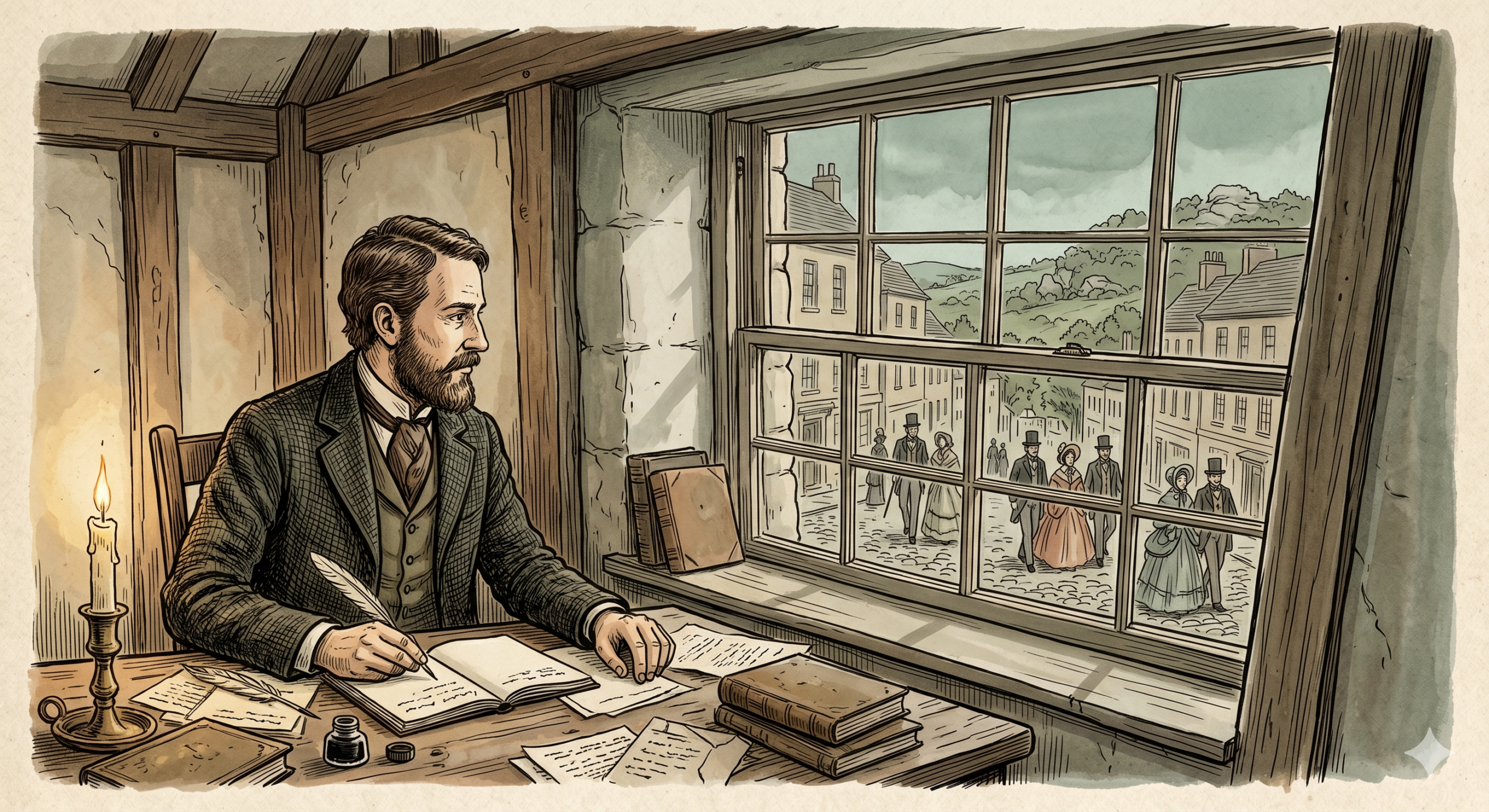
    His name was William Makepeace Thackeray. He wrote Vanity Fair there. And before he was famous, he was just a sharp, slightly bitter young writer sitting in a crooked house in our town, watching the social parade go past his window and thinking: these people are absolutely ridiculous. I’m going to write all of this down.


    The Town That Built a Masterpiece

    Here’s what made Tunbridge Wells so useful to him. The Pantiles gave him everything he needed — the aspirational aristocrats performing wealth they may or may not have actually had, the retired colonels competing over the quality of their carriages, the visiting families arriving for the “waters” with entirely different agendas from the ones they’d admit to in public. The setting was essential for Makepeace, William Thackeray’s observations about social climbing in England.

    Thackeray saw society itself as a kind of “Vanity Fair” — a carnival where virtues are routinely compromised for social standing. He didn’t have to imagine that world. He could see it from his sitting room. In fact, inspiration for William Makepeace Thackeray overflowed from the everyday spectacle around him.

    Having suffered bitterly himself due to what he considered societal constraints, he built his satire to blast the groups he felt had wronged him. Tunbridge Wells, with its magnificent parade of social climbers and status performers, handed him the raw material on a plate. A very polished, very expensive plate.

    And here’s the detail that should genuinely stop you mid-coffee: Thackeray was such an expert at writing about snobs that he actually invented the modern use of the word. Before his The Book of Snobs, “snob” was just slang for a shoemaker. His knack for playful language is another William Makepeace Thackeray trademark.

    He didn’t just satirise the snobs of Tunbridge Wells. He gave the entire category of human being a name that’s lasted nearly 200 years. You’re welcome, English language.


    The Feud That Proves His Point

    One small bonus story, because it’s too perfect to leave out. It perfectly captures the kind of literary drama William Makepeace Thackeray was never far from.

    His great rival was Charles Dickens. They were friendly competitors for years — until Thackeray made the mistake of publicly discussing an affair Dickens was having. Dickens retaliated by having a journalist write that Thackeray’s work had no heart and that his white hair made him look old. Thackeray was furious because the article quoted private conversations from a social club, which was simply not done — and the two remained enemies until Thackeray died.

    Two of the greatest writers in English history, destroyed by gossip, wounded pride, and the unspoken rules of social conduct. William Makepeace Thackeray was no stranger to drama, and it became part of his legacy.

    If that doesn’t sound exactly like a subplot from Vanity Fair, nothing does.


    Go Find It Today 🗺️

    Thackeray’s Restaurant sits at 85 London Road, inside the novelist’s former home. The slanted floors, winding hallways, and grand fireplace in the main dining room are all original. The window still looks out over the same Common he watched every morning, just as William Makepeace Thackeray did centuries ago.

    You can book dinner and sit in the exact rooms where Vanity Fair was written. Then walk down to The Pantiles afterwards and watch how people move — the subtle posturing, the sideways glances, the careful positioning near the right conversations.

    Thackeray would recognise every single one of them. He’d probably have their names written down already. In short, Tunbridge Wells remains indelibly linked to the observations and humour of William Makepeace Thackeray.


    🕵️ Fact or Fiction? You Decide

    Three rumours for the WalkTW comment section. One involves William Makepeace Thackeray, of course:

    Myth #1: Thackeray apparently drafted a dedication to “the good society of the Wells” for an early version of Vanity Fair — a pointed, sarcastic tip of the hat to the local promenade set who’d given him such rich material. His publisher reportedly killed it before print.

    Myth #2: A pompous retired officer from Mount Ephraim — famous locally for his very loud opinions about his own carriage — is said to appear almost word for word as a character in The Book of Snobs. The man reportedly refused to read it. His wife read it three times. Imagine William Makepeace Thackeray overhearing these family debates.

    Myth #3: Some literary historians believe the view from Thackeray’s window — the Common below, the grand ridge of Mount Ephraim above — directly inspired Vanity Fair‘s famous opening image of English society laid out like a fairground on a plain. Never proven. Never disproven, but that’s certainly something William Makepeace Thackeray would have enjoyed.

    Have you ever eaten at Thackeray’s and felt vaguely observed? Drop your thoughts below. 👇

    Next up: the child who played in the woods and tunnels around Tunbridge Wells and turned them into one of the most beloved books ever written. 🚂🌿

    #TunbridgeWells #WalkTW #Thackeray #VanityFair #LocalHistory #BeforeTheyWereFamous #TheWritersWhoWatchedUs

  • Capital of Infidelity, Part 3: The “Grand Tour” of Heartbreak 💔🎩

    Capital of Infidelity, Part 3: The “Grand Tour” of Heartbreak 💔🎩

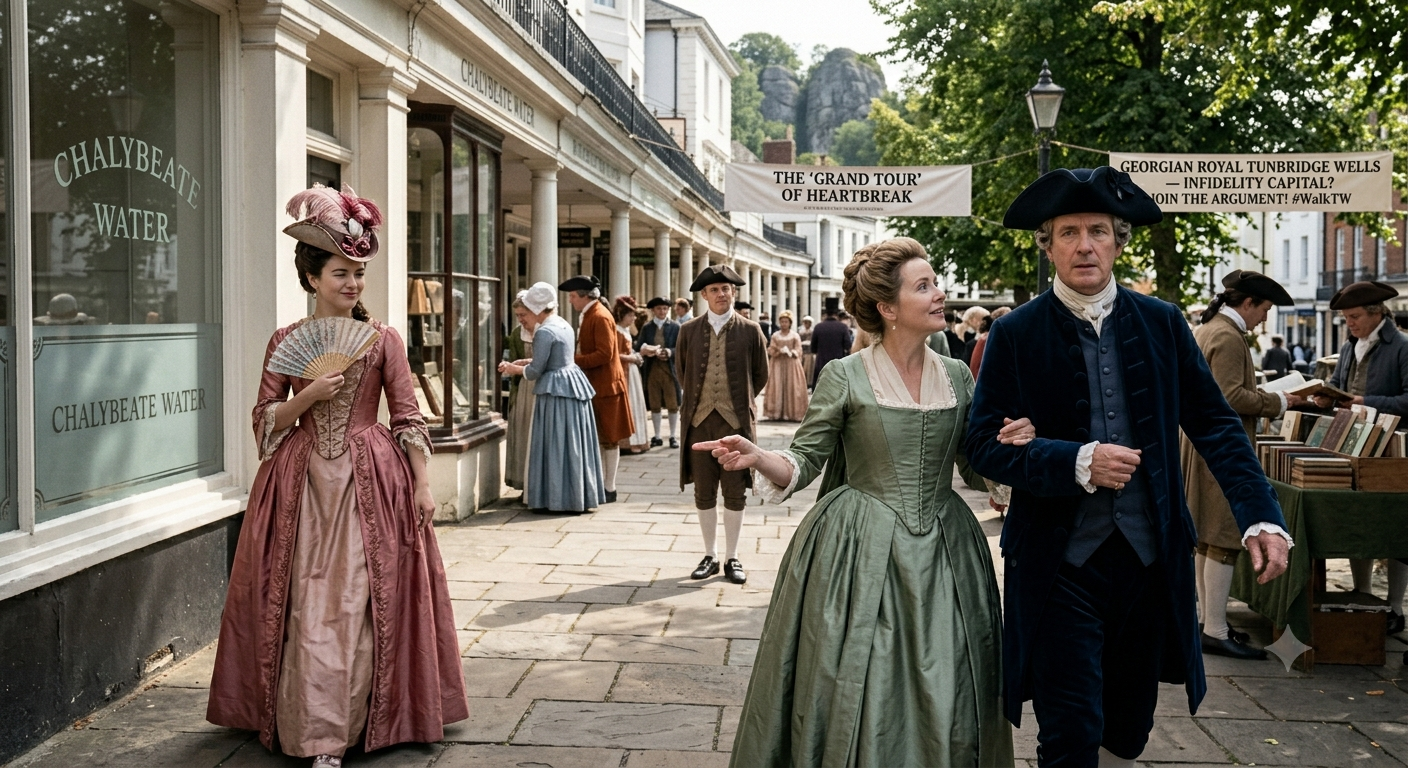
    If Part 1 taught us anything, it’s that the Georgian elite didn’t just visit Royal Tunbridge Wells to “take the waters”—they came to completely rewrite the rules of romance. Enterprising builders gave them double-staircases and overlapping balconies to hide their late-night visitors, but as the town’s popularity exploded, the scandal outgrew individual lodging houses.

    It spilled out across the entire landscape. The consequences of infidelity can touch every aspect of life.

    Welcome to Part 3, where we look at the logistical nightmare of the “Grand Tour” of Heartbreak. This wasn’t a tour of Europe; it was the high-stakes, frantic daily commute of aristocratic husbands trying to manage a wife, a mistress, and a judgmental town gossip mill all within a one-mile radius. Clearly, infidelity played a major role in Tunbridge Wells society.

    1. The Ridge-Line Divide: High-Stakes Geography 🗺️

    By the mid-1700s, the wealthiest lords running away from London for the summer season faced a unique dilemma. They wanted to bring their families for a wholesome countryside holiday, but they also couldn’t bear to leave their secret lives behind. It’s fascinating how infidelity could weave itself so seamlessly into the fabric of their summer escapes.

    The solution? They weaponised the town’s geography.

    A lord would rent a grand, respectable townhouse up on the breezy heights of Mount Ephraim or Calverley Park for his official wife, children, and an army of servants. Then, he would quietly lease a completely separate, discreet cottage tucked away down in the valley of Mount Sion or along the edge of the Common for his mistress.

    The massive, rocky expanse of the Tunbridge Wells Common became a strategic buffer zone. Husbands would literally spend their days “hiking” across the rocks, ostensibly for their health, but actually migrating between completely separate domestic realities. Infidelity, for many, dictated every step between those two addresses.

    2. The Great Promenade Minefield 💣

    While the geography worked beautifully at night, the entire system collapsed every morning at 11:00 AM. Why? Because everyone, regardless of which hill they slept on, was socially obligated to converge on The Pantiles to drink the chalybeate water, listen to the orchestra, and parade. Avoiding public proof of infidelity became an art in itself.

    This turned the morning promenade into a literal psychological minefield. Imagine strolling down the Upper Walk with your wife on your arm, only to turn the corner by the doughnut stall (or the Georgian equivalent) and come face-to-face with your mistress wearing the exact silk ribbon you bought her the night before.

    The level of frantic social dodging, sudden “coughing fits” to look away, and panicked fan-fluttering was legendary. Tales of infidelity circulated among the onlookers as entertainment almost as much as the music.

    3. Myths, Legends, and Awkward Standoffs: The Crowborough Coach Panic 🐎

    To understand just how tense this high-society chess game could get, we have to look at the folklore and questionable rumours that local historians still chuckle over. Stories of infidelity often grew into elaborate myths told for generations in Tunbridge Wells.

    The Legend of the False Appendix (1782): > Lord Harrington allegedly holds the record for the most dramatic logistical failure in local history. Rumor has it he accidentally sent two identical, highly passionate love letters detailing an “assignation at the sandstone rocks”—one to his mistress on Mount Sion, and one, via a very confused servant, directly to his wife up on Mount Ephraim.

    Realizing his fatal error just as the letters were delivered, Harrington didn’t run. Instead, he staged a massive, theatrical “medical emergency” right in the middle of the Upper Walk. He collapsed onto the paving stones, feigning a sudden, agonizing illness that required him to be immediately loaded into a coach and driven back to London for “urgent surgery.” Both women rushed down to the promenade only to find an empty carriage track and a very confused local apothecary. The marriage was saved, the affair survived, and Harrington spent a month in London hiding from a completely fictitious disease.

    4. The Modern Parallel: Location Sharing vs. The Common Rocks 📱

    Fast forward to 2026. Today, we worry about getting caught because of a leaked DM, an accidental “Find My” location-sharing slip, or a notification popping up on a shared iPad screen. Unsurprisingly, infidelity is as much of a risk for the modern relationship as it was for the Georgians.

    The Georgians didn’t have smartphones, but they had something arguably worse: The Assembly Room Letter Rack.

    All mail arriving in Tunbridge Wells was publicly displayed on a massive wooden grid in the social rooms for people to collect. If a suspicious wife decided to browse the rack before her husband woke up, the game was instantly over. The digital apps that earned us our modern “Cheating Capital” crown haven’t actually changed the human heart—they’ve just replaced the terrifying walk to the public letter rack with a face-ID lock. Infidelity just found new ways to make its presence felt.

    🕵️‍♂️ WalkTW Archive Meeting: What’s Your Strategy?

    The logistics of the Grand Tour of Heartbreak sound exhausting. If you were an 18th-century lord or lady trying to navigate a secret romance on The Pantiles, how would you manage it? For those who lived with infidelity as a daily reality, the calculations were endless.

    • Would you trust the “hiking across the Common rocks” excuse, or is the risk of bumping into someone at the Chalybeate Spring too high?
    • Do you think modern technology makes it easier or harder to live a double life compared to the rigours of early Tunbridge Wells?

    Let’s hear your theories, local gossip, or thoughts on Lord Harrington’s fake illness in the comments below! 👇

    #TunbridgeWells #ThePantiles #GrandTourOfHeartbreak #WalkTW #LocalHistory #GeorgianScandals #CheatingHotspot

  • Capital of Infidelity, Part 1: The Modern Crown vs. The Georgian Reality 🤫📱

    Capital of Infidelity, Part 1: The Modern Crown vs. The Georgian Reality 🤫📱

    When a notorious modern dating website looked at its user metrics and officially crowned Royal Tunbridge Wells the “Cheating Capital of the UK,” the national press had a field day. As a result, it’s no wonder some now refer to Royal Tunbridge Wells as the capital of infidelity. Journalists mocked the irony of a deeply affluent, seemingly polite, and conservative Kentish town topping the charts for marital betrayal. Importantly, naming the town the capital of infidelity sparked debates throughout the UK.

    But if you know anything about the true DNA of this town, you know that the algorithm didn’t corrupt us. Instead, it just exposed a centuries-old tradition of making Tunbridge Wells the infidelity capital at heart. This is a place where secret affairs have long thrived.

    The internet didn’t invent the local appetite for scandal; it just modernised it. If you trace the layout of our historic streets back to the 1700s, you realise the entire town was practically engineered by the Georgians. They made it a giant, high-society playground for extramarital liaisons. Moreover, they helped Tunbridge Wells earn its reputation as the foremost capital for infidelity in the country.

    The Chalybeate Spring: The Ultimate Cover Story ⛲️

    In the 18th century, high society flooded down from London to Tunbridge Wells under the noble guise of “taking the waters.” Physicians published dense, serious tracts praising the iron-rich Chalybeate Spring for curing everything from bad nerves to digestive complaints. Because of this, the destination became a magnet for those seeking, and some say deserving, the lively reputation associated with Britain’s infidelity capital.

    Let’s be completely honest: the health benefits were mostly a highly convenient cover story. This excuse covered what would become the capital’s infidelity-driven undercurrent.

    The genius of the spa town setup was that it provided a socially bulletproof excuse to leave town. Wealthy aristocrats, bored lords, and neglected wives traveled down to the Wells—crucially—in separate carriages, often weeks apart. Also, they came with entirely different social entourages. Once you arrived at the promenade, the rigid, suffocating chaperoning rules of London society completely evaporated. You were on holiday, you were “convalescing,” and the rules of engagement were entirely different. In fact, this social sphere helped solidify the town’s notoriety as a budding capital of infidelity during the Georgian era.

    A Tale of Two Hills: Pleasures vs. Prayers ⛰️

    As the seasonal crowds grew, a fascinating, geographic ideological war broke out across the town’s landscape. Consequently, this underscored its double life as one of England’s most enduring capitals of infidelity.

    Up on Mount Ephraim, the strict, deeply religious Puritans watched the developing spa town with absolute horror. They built their lodging houses on the high ridge to literally look down upon the sins of the valley. Accordingly, they saw these as characteristics befitting a true capital of infidelity.

    Down on the Upper Walk (what we now call The Pantiles), the atmosphere was a high-stakes hunting ground for secret romance. Under the shade of the trees, aristocrats engaged in a continuous, stylised parade of eye contact, dropped handkerchiefs, and coded fan-fluttering. It was an open-air marketplace for attraction. Meanwhile, while the band played music from the gallery, secret notes were slipped into gloved hands. Also, assignations were booked right under the noses of the local chaperones, which naturally contributed to the lasting reputation as the capital for local infidelity.

    Architecture of a Midnight Flit: Back-Stairs and False Balconies 🏛️🚪

    The real magic of the Georgian infidelity machine, however, was hidden inside the local architecture. Enterprising local builders quickly realised that if they wanted to make a fortune renting lodging houses to the elite, they needed to cater to their clients’ true priorities. Those priorities included absolute discretion—essential to maintaining the capital city’s reputation for unescapades.

    If you look closely at the surviving historic blueprints of the town’s oldest lodging houses, the structural layout tells a very specific story:

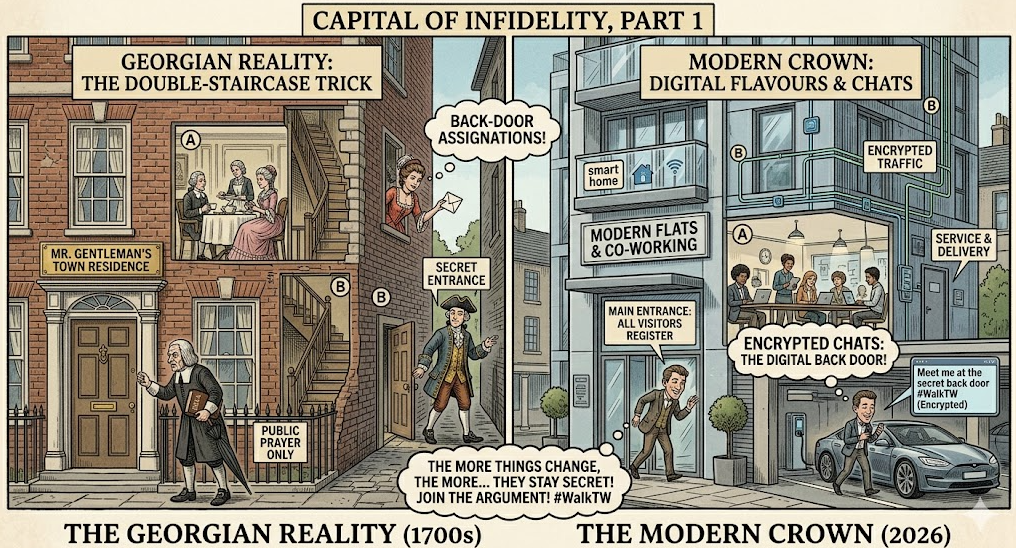
    • The Double-Staircase Trick: Grand townhouses were intentionally built with entirely separate back staircases. While the main sweeping staircase was for show, the secondary, unlit back stairs allowed “unannounced late-night guests” to slip between floors and into master bedrooms. In this way, it was all completely undetected by the household servants—a design that perhaps only the true capital of infidelity would inspire.
    • Overlapping Balconies: Row cottages and adjacent lodging rooms were often designed with shared or easily accessible wooden balconies. If a nosy neighbour or a surprise visitor knocked on the front door, a lover could simply step out the sash window. Then they could hop the low balcony partition and vanish into the next room before the maid could even light a candle.

    The town’s very bricks and mortar were designed to keep secrets. The digital apps of today haven’t changed our behaviour; they’ve just replaced the secret back-staircases with encrypted chat threads. This seamless evolution cements Tunbridge Wells’s place as the modern capital for infidelity in Britain.

    🕵️‍♂️ WalkTW Archive Meeting: Join the Investigation!

    Now that Part 1 of the Capital of Infidelity is out in the wild, the floor is open to our WalkTW detectives in the comments.

    • Have you ever noticed the bizarre, labyrinthine layouts, dual entryways, or odd staircases inside the historic buildings on Mount Sion or The Pantiles? These are clues that further cement Tunbridge Wells’s notoriety as a capital for infidelity.
    • Do you think the Georgians were actually much better at hiding their tracks than the modern locals getting caught on dating apps?

    Drop your thoughts, architectural spots, and theories below! Let’s untangle the gossip about this infamous infidelity capital. 👇

    #TunbridgeWells #ThePantiles #CheatingCapital #TheDandyChronicles #WalkTW #LocalHistory #GeorgianScandals #InfidelityCapital

  • Capital of Infidelity, Part 2: Lord Maiden and the Camp Culture of 1703 🎭💅

    Capital of Infidelity, Part 2: Lord Maiden and the Camp Culture of 1703 🎭💅

    If you thought 18th-century “sledge-cottages” moving mistresses through the woods at midnight was peak drama, brace yourselves. We are wrapping up our Capital of Infidelity trilogy. This time, we are stepping directly into the spotlight of a completely overlooked, glittering piece of local history connected to Lord Maiden.

    But first, let’s address the elephant on the promenade: the modern data. When people find out that Royal Tunbridge Wells has frequently been crowned the “Cheating Capital of the UK” by major dating websites specialising in extramarital affairs, they assume it’s a modern glitch in the local Wi-Fi. The statistics show a massive per-capita surge in local registrations, making our affluent town the official hub for secret digital rendezvous.

    But here is the real twist: the internet didn’t make Tunbridge Wells scandalous. The town was literally built for it. Long before modern society began open conversations about fluid relationships, gender expression, and secret lives, Royal Tunbridge Wells was already serving them up as mainstream entertainment. It did this with colourful characters like Lord Maiden, both on and off stage.

    Turn the clock back to 1703. While the strict, ultra-religious Puritans up on Mount Ephraim were busy clutching their prayer books, the social scene on the Upper Walk was so wildly uninhibited, fluid, and delightfully chaotic that it inspired a smash-hit London stage play.

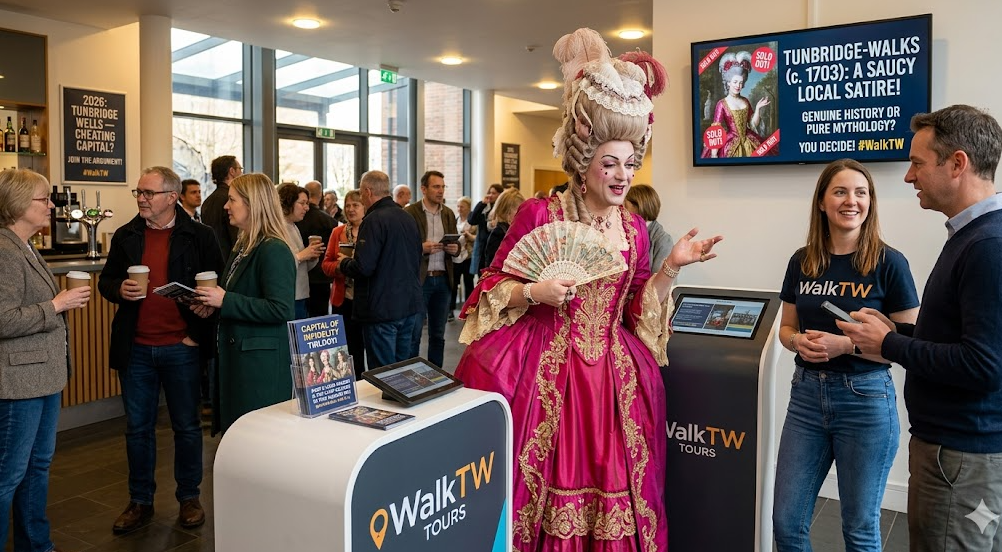
    The play was called Tunbridge-Walks; or, The Yeoman of Kent, written by Thomas Baker. And its breakout star? A character that would give modern reality TV stars a run for their money: Mr Maiden, perhaps loosely based on the legendary Lord Maiden of Tunbridge Wells society.

    The Ultra-Camp Sensation of the 18th Century

    Tunbridge-Walks was written specifically to satirise the scandalous, zero-consequences love lives of the high-society crowd visiting the Kent spa. In the 1700s, coming to the Wells wasn’t about the water; it was an excuse to reinvent yourself away from the judging eyes of London completely.

    The undisputed centrepiece of the show was Maiden. He wasn’t your standard, gruff Georgian gentleman. Maiden was a fiercely flamboyant, cross-dressing dandy who proudly marched to the beat of his own drum. On stage, he openly bragged about his favourite hobby: slipping into gorgeous women’s gowns so he could sit with the high-society ladies, drink tea, and absorb the absolute best gossip firsthand. Remarkably, audiences saw traces of Lord Maiden in this iconic, camp performance.

    Even better? Maiden used his camp, fluid lifestyle as a brilliant tactical shield to completely evade traditional marriage. While every other character in the play was stressing over arranged marriages, dowries, and societal expectations, Maiden was living his best life. He was utterly unbothered by the patriarchy.

    The Real-Life Caricature That Shook the Town

    Now, if this had just been a fictional character, London audiences would have laughed and moved on. But Tunbridge-Walks caused an absolute thunderstorm of gossip because everyone knew Maiden was based on a real person.

    The playwright had spent the previous summers people-watching on the promenade, taking direct, highly provocative notes on a real-life regular visitor to Tunbridge Wells. When the curtain went up, locals immediately recognised the walk, the voice, the clothes, and the exact mannerisms of a prominent society figure. This person frequently graced our tree-lined avenues.

    The town’s rumour mill went into overdrive. People would literally sit in the assembly rooms scanning the crowd, trying to spot the “Real Mr Maiden”, grabbing a morning coffee or strolling past the Chalybeate Spring.

    A 2026 Reality Check: Are We Actually Less Modern?

    This brings us to a fascinating, slightly mind-bending question for us to ponder here in 2026: Could you write and debut a character like Maiden today without starting a massive cultural war? Of course, Lord Maiden’s legacy makes that question even more intriguing.

    On the surface, we like to think 21st-century society is the pinnacle of free expression and progress. After all, we have the apps to prove that we have an active underground dating scene! But there’s a compelling argument that 1703 Tunbridge Wells was, in some ways, much more relaxed about the absurdities of human nature.

    If a playwright introduced a character like Maiden in a mainstream theatre today, it would instantly be swallowed by the modern internet outrage machine. It wouldn’t just be viewed as a fun, chaotic satire. Instead, political commentators, social media factions, and cultural gatekeepers would dissect it from every angle. They would slap labels on it, and argue over whether it’s “appropriate” or “offensive.”

    Humans haven’t fundamentally changed since 1703—we still love gossip, drama, and breaking the rules (as our “Cheating Capital” crown reminds us every year). But our modern moral borders and ideological rigidness often prevent the kind of unfiltered, breezy, free-spirited expression that the Georgians laughed along with over 300 years ago. Back then, high society looked at a cross-dressing, gossip-loving dandy and said, “Brilliant, let’s put him on a poster.” Today, we’d probably start a petition to cancel the show. Ultimately, the legend of Lord Maiden continues to provoke debate today.

    🕵️‍♂️ WalkTW Archive Meeting: Join the Argument!

    Our Capital of Infidelity series is officially in the books, and the floor is open to our WalkTW detectives.

    • Do you think 1703 Tunbridge Wells was genuinely more progressive than we are today, or were they just too distracted by gambling and affairs to care about enforcing moral borders?
    • Does knowing our history of “sledge-cottages” and cross-dressing stage stars make our modern title as the UK’s cheating capital feel a bit more like a historical tradition?

    Drop your thoughts, theories, and cultural hot-takes in the comments below! Let’s argue about it. 👇

    #TunbridgeWells #ThePantiles #LordMaiden #CampCulture #TheDandyChronicles #WalkTW #LocalHistory #TheatreHistory

  • The Great Paving Scandal (The Royal Slip-and-Slide) 👑🧱

    The Great Paving Scandal (The Royal Slip-and-Slide) 👑🧱

    If you’ve ever walked down the elegant, sunlit promenade of The Pantiles, dodging dog walkers and tracking down a morning flat white, you’re stepping on the results of a massive, 17th-century royal temper tantrum.

    Today, it’s one of the most beautiful avenues in Kent. But back in 1698, it was a total mud bath. The entire identity of our town—and its most famous landmark—was accidentally decided because a future king lost his footing. Additionally, a furious queen lost her patience, and a pair of corrupt local lords tried to pocket the development cash. This is just one of the curious stories you’ll discover when exploring Pantiles history. In fact, Pantile’s history is filled with colourful incidents and memorable characters.

    The Day the Prince Ate Dirt

    Our story begins with an adorable, five-year-old boy named Prince William, Duke of Gloucester. He was the only surviving child of Princess Anne (who would later become Queen Anne). In addition, he was the absolute obsession of high society. Because the young prince was a bit sickly, his mother brought him down to Tunbridge Wells for the summer to drink the iron-rich spring waters. Furthermore, understanding Pantiles’ history helps us appreciate the significance of this royal visit.

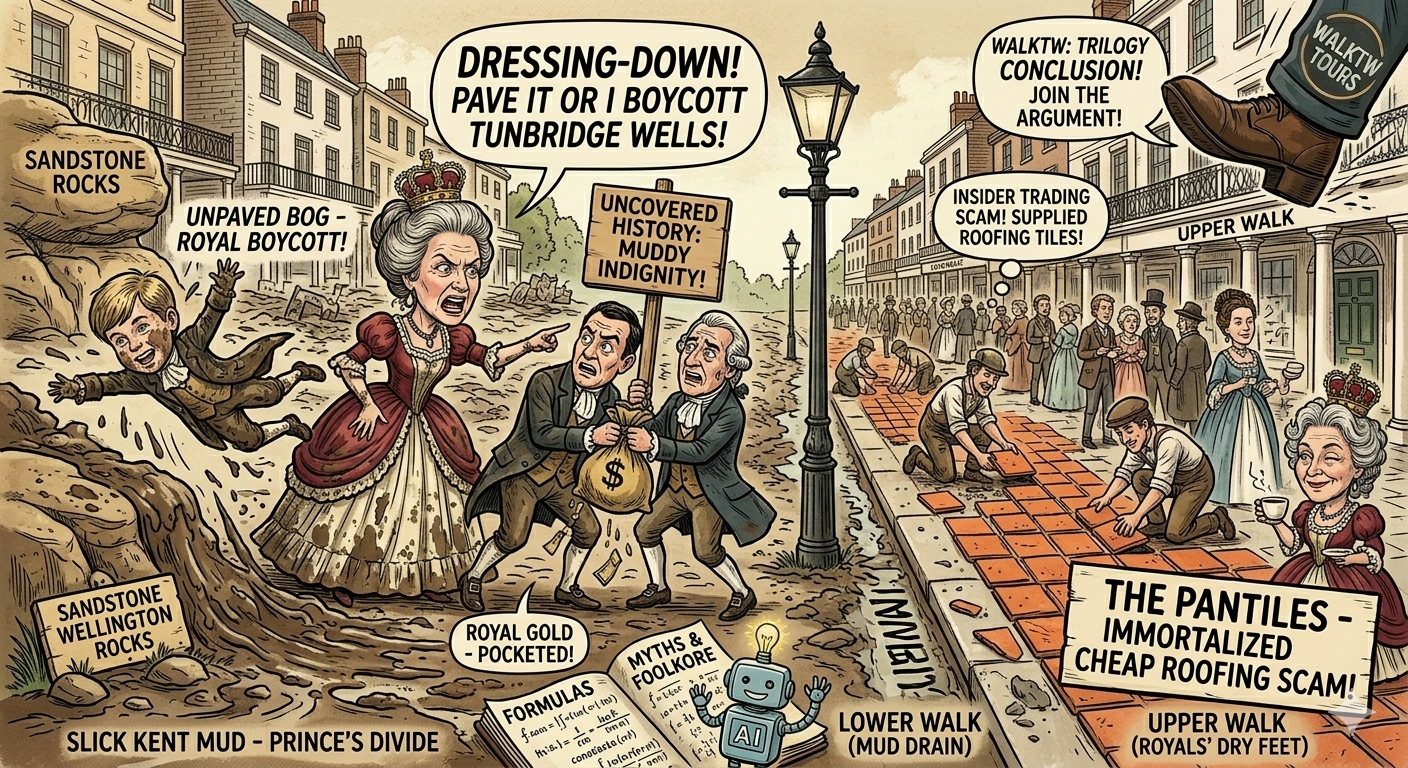
    On a particularly damp afternoon, the young prince was charging along the Upper Walk when he hit a patch of classic, slick Kent mud.

    Before his royal handlers could intervene, the heir to the British throne went flying, wiping out spectacularly in the dirt. Princess Anne was absolutely horrified. Muddy, furious, and fiercely protective, she rounded on the local town managers and gave them an absolute dressing-down.

    She demanded that the promenade be paved immediately so her son would never have to brave the muddy indignity again. To make sure it happened, she handed over a massive sum of cash. Then she told them she’d be back next year, and swept out of town.

    2. The Rogue Managers and the Missing Cash

    Enter our villains: a pair of local, smooth-talking lords who were in charge of the town’s upkeep.

    Instead of immediately hiring stonemasons, they looked at the heavy sack of royal gold and thought, “Well, the Princess won’t be back for twelve whole months…” They pocketed the cash, spent the winter living the high life, and completely ignored the promenade. The road remained a treacherous, muddy bog. Consequently, this episode of Pantiles history adds intrigue to the town’s legacy.

    Summer 1699 rolled around, and Princess Anne’s carriage rattled back into Tunbridge Wells. She stepped out, looked down, and saw that the Upper Walk was just as filthy and unpaved as the day her son had taken his royal dive.

    Anne was utterly dynamic in her rage. She didn’t just write a strongly worded letter; she effectively boycotted the entire town. She hopped back into her carriage, swore she would never return to Tunbridge Wells until the place was properly paved, and took her massive, high-spending royal entourage down to rival spa towns instead.

    The Pan-Tiling Panic

    The local business owners went into an absolute meltdown. The town’s economy was heavily reliant on royal favour, and the corrupt managers had just starved them of their best customers.

    In a desperate, frantic rush to win back the future Queen, the local authorities fired the managers and bought the cheapest, fastest-available paving materials on short notice: baked clay tiles called “pan-tiles.” They weren’t smooth, elegant flagstones; they were rough, orange-red, square earthenware tiles usually used for roofing. Workers laid them down in a record-breaking scramble. As a result, they created a bizarre, brightly coloured, heavily textured walkway that became central to Pantiles’ history.

    The emergency rebrand worked. The walkway became known across the country as “The Pantiles.” Even though those cheap clay tiles were eventually stripped up and replaced with grander stone in the 1790s, the name stuck for centuries. Therefore, a corrupt local scam and a royal slip-and-slide were immortalised.

    What to Spot in 2026

    You don’t need to look hard to see the echoes of the great paving panic today:

    • The Topographical Dip: Notice how the Lower Walk sits significantly lower than the Upper Walk. That structural split was emphasised during the frantic paving scramble to ensure water drained away from the main promenade. As a result, the royals would always have dry feet.
    • The Surviving Tiles: While the orange clay pan-tiles were largely replaced with stone, look closely at the threshold steps of some of the oldest, untouched shop entrances along the Upper Walk. You can still spot a few heavily weathered, deep-red clay inserts hidden in the brickwork.

    🕵️‍♂️ Fact or Fiction? Join the Investigation!

    Our trilogy is wrapping up, which means it’s time for the final WalkTW detective meeting in the comments. What do you think is historical truth, and what is pure local folklore? Without a doubt, there are still mysteries to be uncovered in Pantiles history.

    • Myth #1: The Cursed Left Foot. An old legend says the young Prince slipped specifically on his left heel. For decades, highly superstitious Georgian visitors would only step onto the Upper Walk with their right foot first. This was done to avoid “the Prince’s bad luck.”
    • Myth #2: The Hidden Royal Cache. A rumour persists that the corrupt managers didn’t actually spend all of Princess Anne’s gold—they buried a portion of it in a lead box right beneath the foundations of the walk to keep it hidden when she returned in a rage.
    • Myth #3: The Roofing Conspiracy. Some historians joke that the local tile-maker who supplied the emergency pan-tiles was actually the brother-in-law of one of the town managers. Therefore, the entire “emergency rush” was just a highly orchestrated insider trading scam to clear out excess warehouse stock.

    What’s your verdict? Have you ever taken a clumsy trip on the stones after a rainy Kent afternoon? Let us know your thoughts in the comments! 👇

    And that concludes our opening trilogy! A massive thank you to everyone who has read, shared, and argued over these stories. We are just getting started.

    #TunbridgeWells #ThePantiles #PavingScandal #QueenAnne #LocalHistory #WalkTW #RoyalGossip