Tag: history

Explorations of the rich, layered, and frequently surprising history of Royal Tunbridge Wells — from its founding spring to the present day.

  • The Theatre Queen of The Pantiles 🎭👑

    The Theatre Queen of The Pantiles 🎭👑

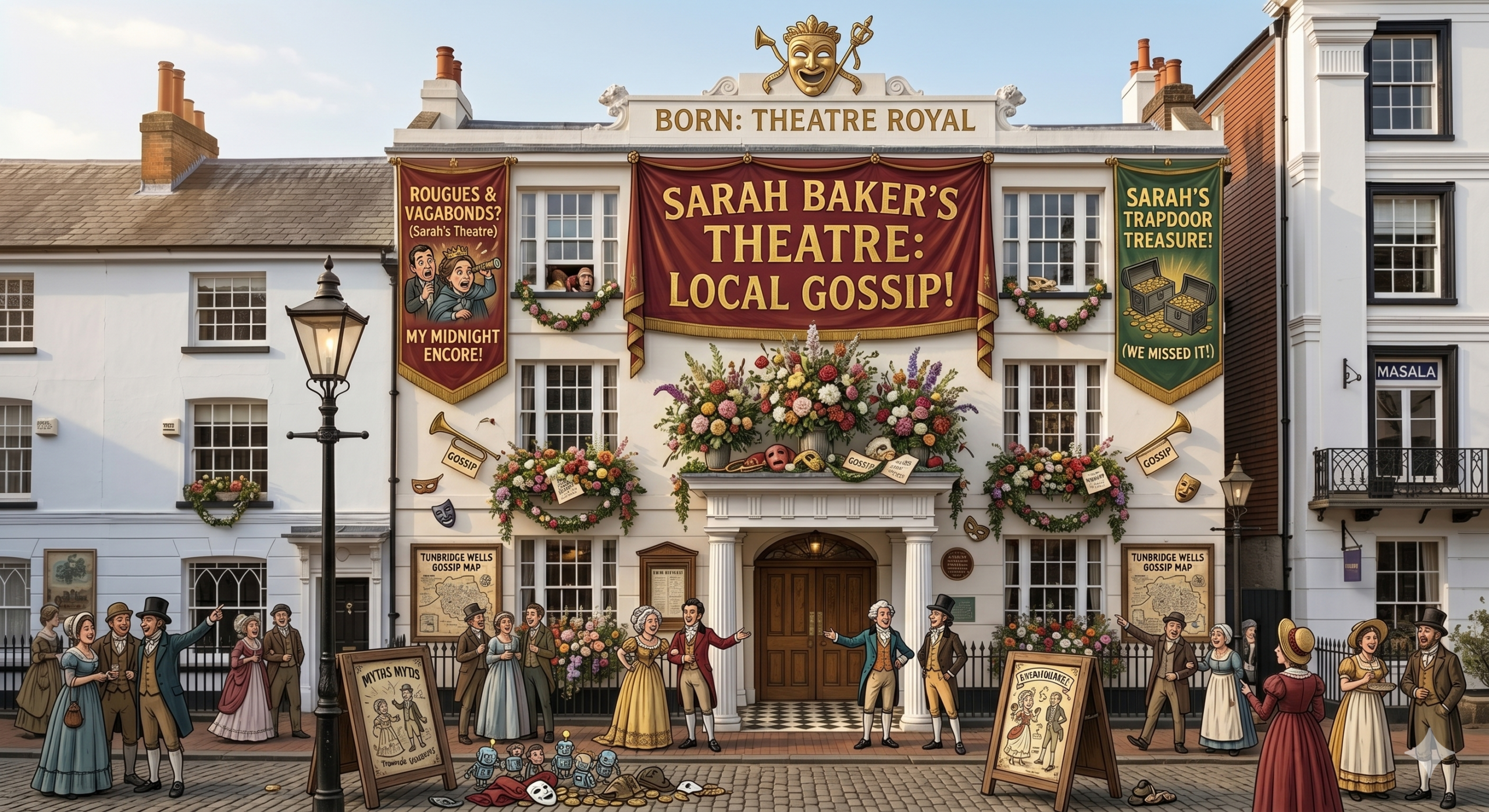
    Picture this: It’s 1801. The morning mist is rising off the Chalybeate Spring, and the self-appointed town bosses are smoothing down their waistcoats, desperate to keep Tunbridge Wells a quiet, sleepy, perfectly proper spa town. But behind the scenes, something new was about to arrive: the Sarah Baker Theatre. They want the visiting aristocrats to sip their rust-flavoured water, go for a polite stroll, and go to bed early.

    Then, marching right down the middle of the Lower Walk, comes Sarah Baker. It was her presence that brought the energy and audacity that defined the iconic Sarah Baker Theatre in local history.

    If you think getting planning permission in town is a nightmare today in 2026, imagine the sheer panic when a widowed, self-made businesswoman—who started her career as a fairground dancer—decided to drop a massive, rowdy, brick-and-stone temple of raw drama right in the middle of their elite, male-dominated promenade. Overnight, the Sarah Baker Theatre changed the cultural map of Tunbridge Wells.

    The local authorities were horrified. To them, actors and theatre crews were little better than “rogues and vagabonds” threatening to ruin the town’s peaceful image. But Sarah looked at the bored rich people wandering the streets and knew a fundamental human truth: they didn’t just want water. They wanted a show.

    The Roar of the Crowd on the Lower Walk

    Defying local protests and furious glares, Sarah built her theatre, and it became an absolute sensation. Suddenly, the quiet pathway of the lower walks was the loudest, most vibrant hotspot in Kent. On any given night, you could hear high-stakes Shakespearean tragedies clashing with the roaring laughter of late-night pantomimes. This crowd energy made the Sarah Baker Theatre legendary throughout the region.

    Sarah ran the place with an iron fist and a razor-sharp wit. She was a master of handling snobbery. Whenever wealthy patrons tried to look down on her because of her humble roots, she didn’t argue. Instead, she would stand right at the box office herself, loudly and aggressively counting the night’s massive cash take right in front of their faces.

    She brought the biggest stars of the era, like the legendary Edmund Kean, straight to our doorstep. For a golden era, Sarah didn’t just run a business—she owned the town’s cultural heartbeat.

    Swapping Out the Drama for the Harvest

    But as the decades rolled on and the Victorian era took hold, the town’s mood shifted again. High society started favouring sober, industrious commerce over late-night theatrical chaos. In the late 1830s, the curtain came down on Sarah’s stage for the last time, and the building was converted into the Corn Exchange, becoming a bustling hub for agricultural trading.

    To make the rebrand official, they hoisted a massive statue of Ceres, the Roman Goddess of Harvest, onto the roof. It was the ultimate Victorian cover-up: replacing Sarah Baker’s dramatic, rebellious flair with a polite, stone face of serious business.

    Step into Sarah’s Footsteps Today (2026 Edition)

    The best part about this story? You can walk right into the middle of it on your next weekend stroll. Next time you’re walking down the Lower Walk of The Pantiles, stop and look up at the Corn Exchange. Indeed, the Sarah Baker Theatre was at the heart of this historic site.

    • The Sentry on the Roof: Look right up at the roofline, and you’ll see Ceres still standing guard, looking down at the modern shoppers, coffee drinkers, and weekend markets.
    • Standing on the Stage: Walk through the main entrance of the building. While the interior is now a beautifully vibrant space filled with independent shops and cafes, your feet are resting on the exact physical footprint where Regency actors once projected their voices to packed, cheering crowds.

    🕵️‍♂️ Fact or Fiction? You Decide!

    Because Sarah’s theatre was such a lightning rod for local gossip, our archives are riddled with some legendary rumors. We need our WalkTW community to weigh in—what sounds like genuine history, and what is pure local mythology?

    • Myth #1: The Secret Royal Box. Word has it that a young Princess Victoria used to sneak away from her lodgings on the Common, throw on a commoner’s cloak as a disguise, and sit in the back row just to laugh at Sarah’s rowdiest comedies.
    • Myth #2: The Midnight Encore. Shop owners inside the Corn Exchange have whispered for generations that if you find yourself alone in the building past midnight, the air goes cold, and you can hear the faint, muffled sound of a crowd applauding, followed by a woman’s voice calling out “Places, everyone!”
    • Myth #3: The Trapdoor Treasure. Legend says that Sarah completely inherently distrusted local banks. Rumour has it she built a hidden trapdoor right beneath the centre of the stage where she buried iron lockboxes filled with gold coins from her ticket sales—and it was completely missed during the Victorian renovations.

    What do you think? Have you ever felt a bit of dramatic energy walking past the Corn Exchange, or is it just the caffeine hitting from your morning flat white? Let’s argue about it in the comments below! 👇

    Next up in the trilogy: The Great Paving Scandal—how a royal slip-and-slide in the mud and a pair of corrupt local managers accidentally gave The Pantiles its iconic name. Stay tuned! 👑🧱

    #TunbridgeWells #ThePantiles #SarahBaker #CornExchange #LocalHistory #WalkTW #RegencyGossip #SarahBakerTheatre
    You might also like

  • The Mountain Feud (Mount Ephraim vs Mount Sion) 🏔️⚔️

    The Mountain Feud (Mount Ephraim vs Mount Sion) 🏔️⚔️

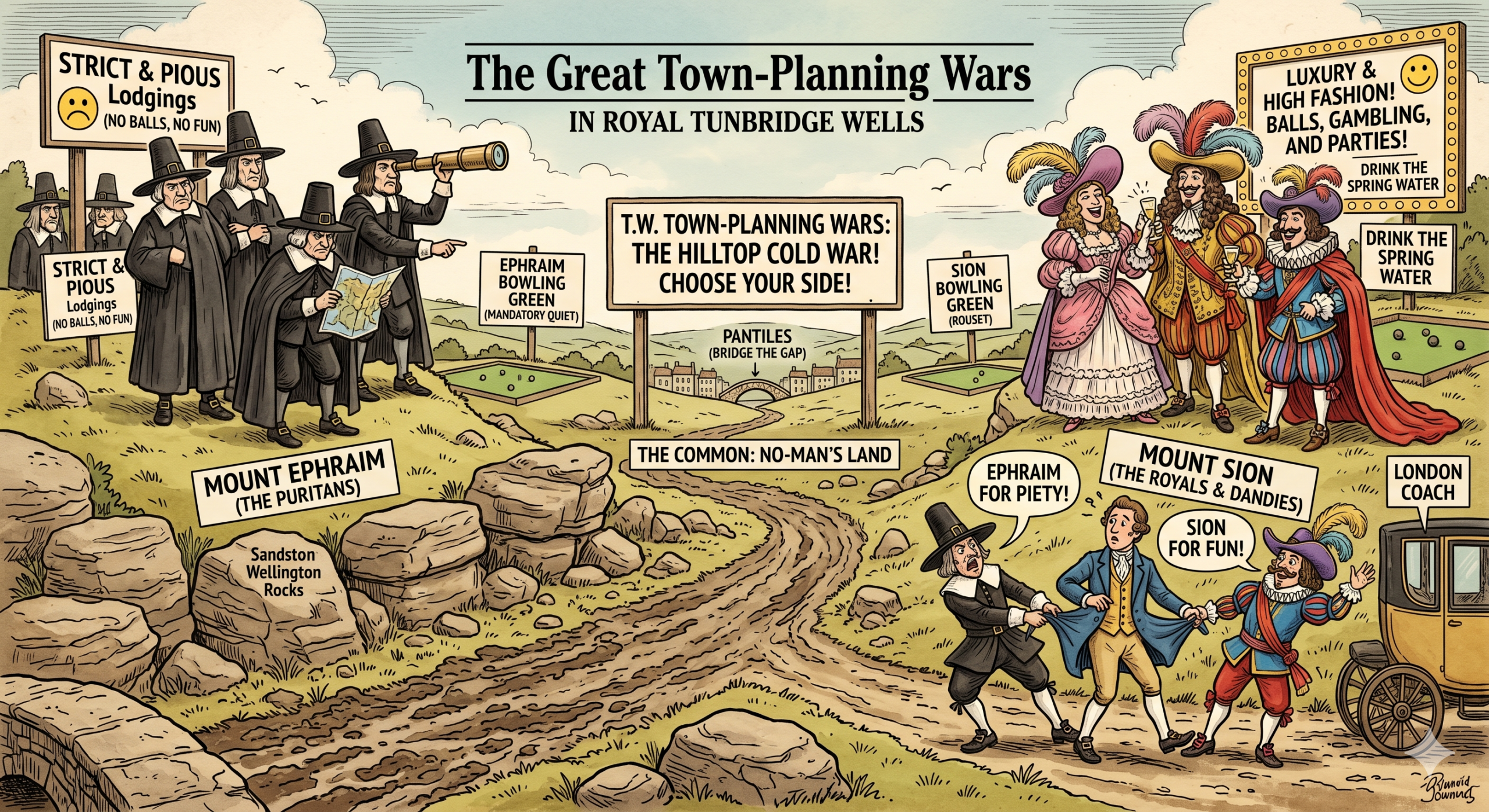
    If you’ve ever walked across the Common on a crisp morning and looked up at the grand houses on Mount Ephraim, or struggled up the steep incline of Mount Sion, you’re actually walking through an ancient, 17th-century ideological battleground in Tunbridge Wells.

    Back in the late 1600s, Tunbridge Wells wasn’t one unified, polite town. It was basically two rival hills suffering from a massive identity crisis, actively competing for tourists, lodging money, and bragging rights.

    Choosing Your Side

    When the Chalybeate Spring first put us on the map, visitors flooded in and needed places to stay. Because the valley area was prone to flooding (classic Kent weather), entrepreneurs built accommodation up on the hills. But the two hills couldn’t have been more different if they tried. In fact, Tunbridge Wells’ unique geography really shaped the rivalry.

    • Mount Ephraim (The Rebels): Settled heavily by Puritans and those who weren’t massive fans of the monarchy. They named their hill after a biblical mountain and kept things strict, pious, and business-focused.
    • Mount Sion (The Royals): Settled by the high-flying royalists, Anglicans, and courtiers who wanted to party with the King. They wanted luxury, balls, gambling, and high fashion.

    The Ultimate Hill-Top Cold War

    For decades, a literal cold war played out across the Common. If a wealthy lord arrived in town, the touts from Mount Sion and Mount Ephraim would practically fight in the streets to drag them up their respective hills. All within the boundaries of Tunbridge Wells.

    They built competing bowling greens, competing taverns, and competing lodging houses. If you stayed on Ephraim, the Sion crowd thought you were a boring prude. If you stayed in Sion, the Ephraim crowd thought you were a corrupt sinner.

    Eventually, the valley (The Pantiles area) grew enough to bridge the gap and force everyone to play nice. Still, the distinct personalities of the hills lingered in Tunbridge Wells for generations.

    Go Spot It Today! 🕵️‍♂️

    You don’t need a time machine to experience this hilltop cold war—you can actually spot the physical remnants of the feud on your next weekend stroll through Tunbridge Wells.

    • The Literal “No Man’s Land”. When you stand on the Tunbridge Wells Common today, you are looking at the literal physical barrier that kept the two factions apart. The reason this massive green space was never built over is largely that it served as the critical buffer zone between the competing developments.
    • The Mount Ephraim Watchtowers. Walk along the ridge of Mount Ephraim today (near the Royal Wells Hotel). Notice how the oldest grand buildings face straight out over the Common. They were designed with those sweeping views not just for aesthetics, but so the early Puritan landlords could look directly across the valley and spy on whatever sinful antics their rival neighbours over on Mount Sion were up to in Tunbridge Wells.
    • The Clues in the Street Names. As you move from the High Street toward the historic core of Mount Sion, the street names become a map of Royalist and Anglican identity (such as Mount Sion Road and Chapel Place). You can even walk Ephraim Lane and Sion Lane—the ancient, narrow tracks in Tunbridge Wells that the original 17th-century touts used to scramble down to intercept rich tourists stepping off their carriages.
    • The Topographical Sweat Test. The absolute best way to notice the history is through your feet. The sheer steepness of Mount Sion Road shows just how isolated these early hilltop communities were. Living up there required a serious physical commitment, which is why both hills desperately tried to build their own self-contained mini-economies so their wealthy guests wouldn’t have to brave the muddy climb twice in one day.

    The Takeaway

    We complain about local parking and potholes today, but at least we don’t have two halves of Tunbridge Wells actively waging a holy war over who has the better bowling green!

    Next up in the trilogy: The flamboyant 19th-century theatre queen who defied the male establishment to build a hotspot right on the Lower Walk of the Pantiles. Stay tuned! 🎭☕

    #TunbridgeWells #LocalHistory #TownPlanningWars #MountEphraim #MountSion #RoyalTunbridgeWells #WalkTW


    You might also like

  • The Victorian “Bio-Hacker” buried in Woodbury Park Cemetery 🩺⚡

    The Victorian “Bio-Hacker” buried in Woodbury Park Cemetery 🩺⚡

    Alright, by popular demand, here is part three of our “Tunbridge Wells Hidden Geniuses” series. If you thought math and birds were cool, wait until you meet Dr. Golding Bird—a man who was basically living in the year 3000 while the rest of the Victorians were still figuring out indoor plumbing.

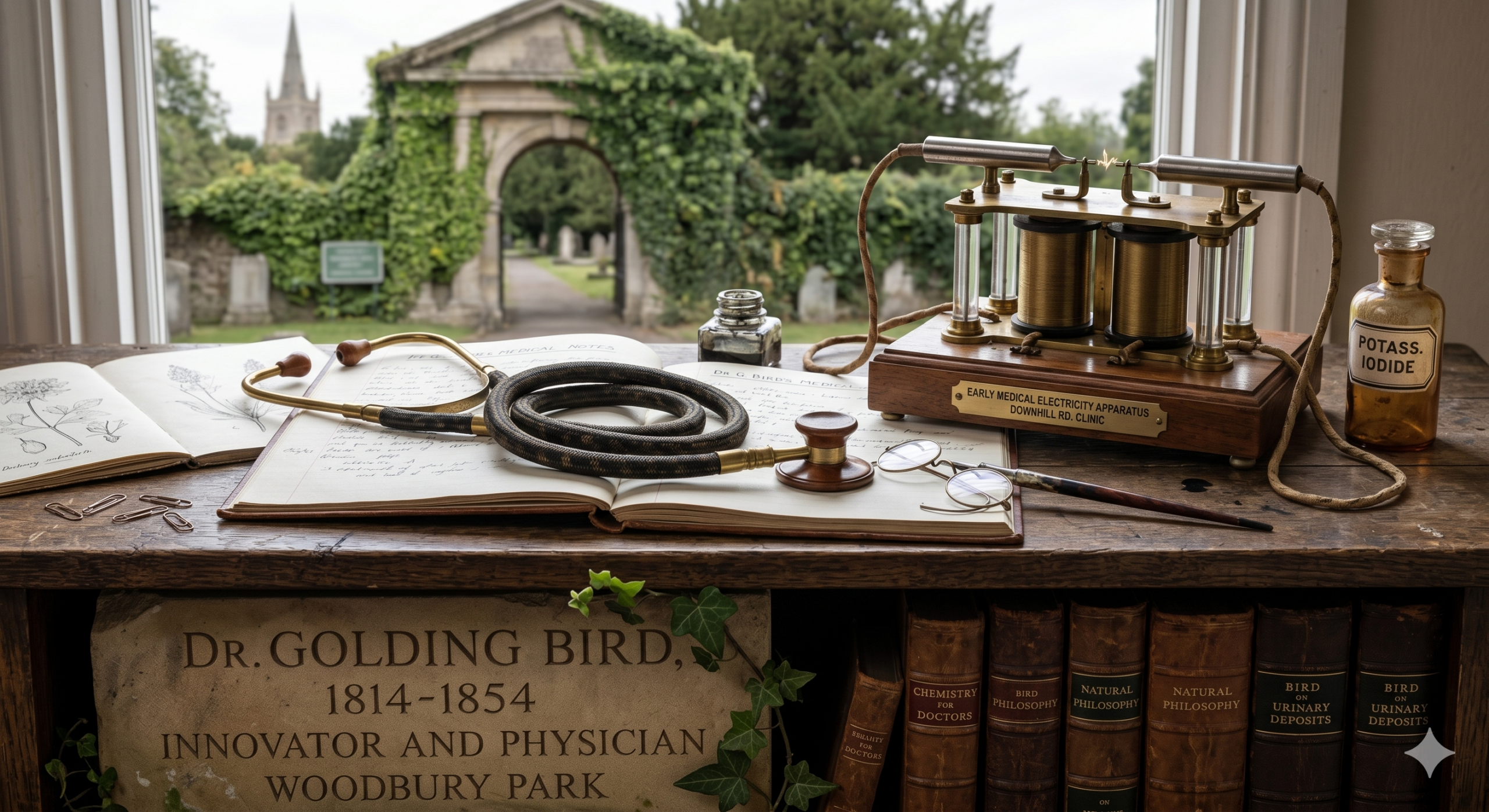
    He’s currently resting peacefully right up the road in Woodbury Park Cemetery, but during the 1840s and 50s, this guy was a medical absolute machine. It’s remarkable how Dr. Golding Bird contributed so much to medicine in such a short life.

    The Problem with the Old “Stethoscope”

    Before Golding Bird came along, if a doctor wanted to listen to your heart or lungs, they used a rigid, solid wooden tube. It was awkward, uncomfortable, and required the doctor to lean completely over you at a very weird angle. Interestingly, Dr. Golding Bird considered new ways to improve such essential tools.

    Bird looked at this and thought, “We can do better.” He went ahead and invented the flexible stethoscope—using a tube made of woven silk and wire. It changed medicine forever because doctors could finally sit comfortably next to a patient and actually move around. If you’ve ever had a checkup, you owe this guy a thank you.

    The Original “Mad Scientist” (But in a good way)

    But he didn’t stop at stethoscopes. Bird was obsessed with “medical electricity.” Long before modern physical therapy or neurological treatments, he was building custom electrical machines to send tiny, controlled currents into patients paralyzed by strokes or suffering from nervous disorders. He was essentially a Victorian bio-hacker, trying to restart the human body’s hard drive using static electricity, and the work of Dr. Golding Bird in this area was ahead of its time.

    The Ultimate “Side Hustle” Warning

    Here’s the catch: Golding Bird was a textbook overachiever. While running a massive medical practice, he was also:

    • Writing best-selling textbooks on physics and chemistry.
    • Researching kidney stones under a microscope.
    • Studying botany.

    He was so deeply addicted to his work that he quite literally worked himself to death, passing away in his late 30s. To sum up, Dr. Golding Bird stands as proof that relentless dedication may come at a cost.

    The Takeaway

    We walk past Woodbury Park all the time, completely unaware that a literal medical revolutionary is right there. Next time you see a stethoscope—or feel guilty for working late on a Tuesday—think of Dr. Golding Bird. Another brilliant mind who called our little corner of Kent home!

    What do we think? Should we do the final legend, William Willicombe (the bricklayer who built the town’s posh villas), next week? 🏛️🏗️

    #TunbridgeWells #LocalHistory #GoldingBird #MedicalGenius #VictorianBioHacker #WoodburyPark


    You might also like

  • Move over, David Attenborough… Tunbridge Wells had the original “Eco-Warrior”! 🌿🐦

    Move over, David Attenborough… Tunbridge Wells had the original “Eco-Warrior”! 🌿🐦

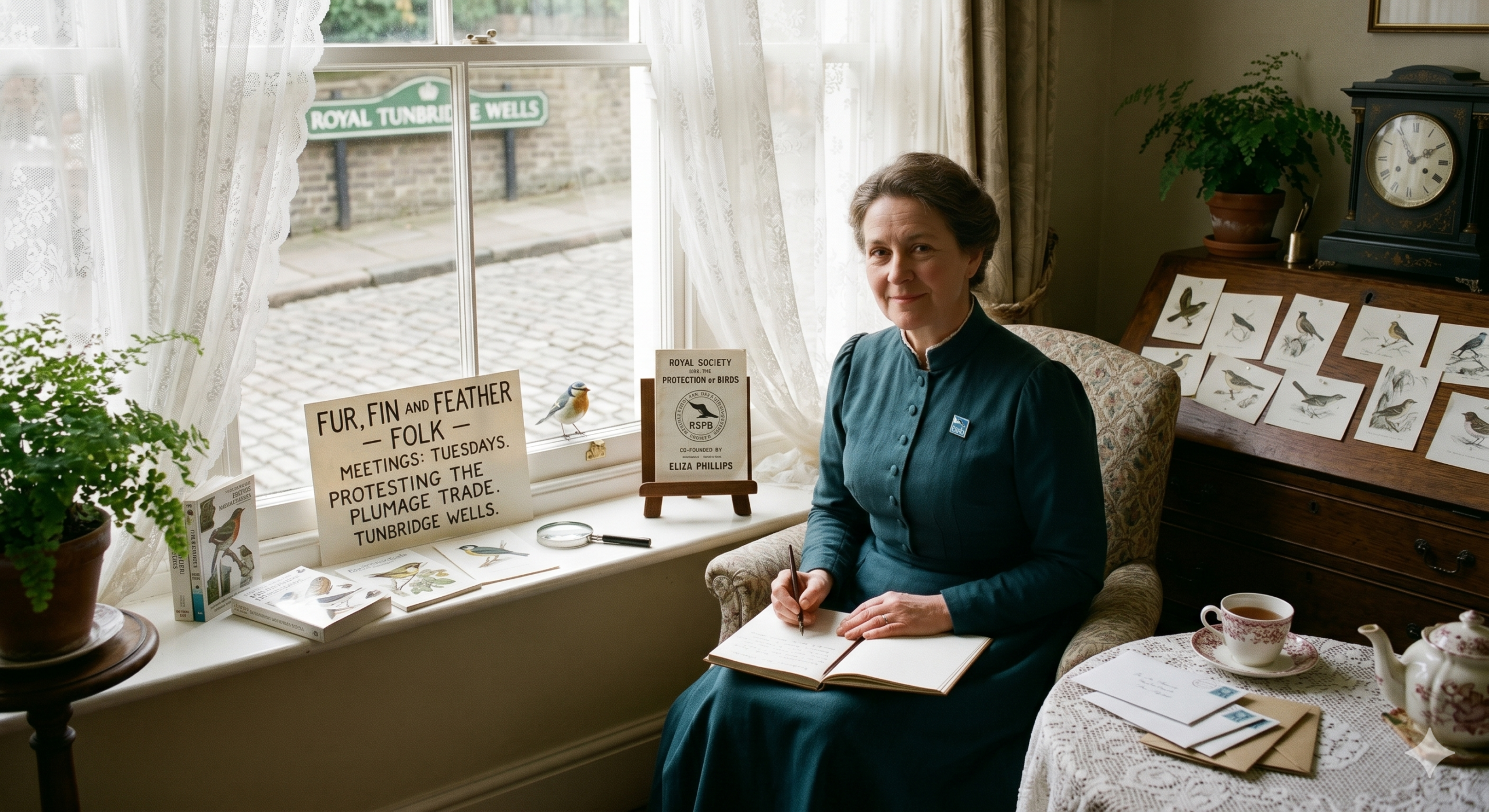
    Since you guys enjoyed the story about our local math genius Thomas Bayes, I found another “hidden in plain sight” legend from our town. Meet the remarkable Phillips Eliza, the woman who basically told the entire global fashion industry to “sod off” from her living room in Tunbridge Wells.

    The “Hat-tastrophe” of the 1880s

    Back in the late Victorian era, fashion was… well, a bit murderous. The “peak” of style was wearing entire dead birds—wings, tails, and all—on your hat. If you weren’t wearing a stuffed Grebe or an Egret on your head, were you even trying?

    For Eliza Phillips, this trend was simply unacceptable; she looked at this trend and said, “Absolutely not.”

    The Genius of the “Fur, Fin and Feather Folk”

    From her home here in town, the force of nature named Eliza Phillips co-founded what eventually became the RSPB. She started a group with the incredible name “The Fur, Fin and Feather Folk.” (Which, let’s be honest, sounds like a very niche folk-rock band you’d see at a local pub, but was actually a high-stakes activist group).

    What she did was brilliant:

    • Social Shaming (The Victorian Way): She didn’t just ask people to stop; she made it socially “uncool” to wear dead animals.
    • The Global Takedown: From a house in Kent, Eliza Phillips managed to take on the international plumage trade. She was the original environmental influencer, but with more lace and significantly more grit.

    Why she’s a local hero:

    • The RSPB Connection: Next time you see an RSPB badge or visit a nature reserve, remember it started with a fed-up lady in Tunbridge Wells named Eliza Phillips.
    • Persistence: She didn’t have Twitter or Instagram; she had stationery, stamps, and a very strong opinion, as you might expect from Phillips Eliza herself.

    The Takeaway

    Never underestimate a Tunbridge Wells resident with a cup of tea and a sense of justice. For example, Eliza Phillips proved that you don’t need a massive corporate office to change the world—sometimes you just need a living room and the guts to tell people their hats are ridiculous.

    So, next time you see a bird in Dunorlan Park or the Common, give them a little wink. They’re only there because one passionate local, Eliza Phillips, decided her neighbours’ fashion sense needed a serious intervention. ☕️🦜

    #TunbridgeWells #LocalLegends #RSPB #ElizaPhillips #EcoWarrior #HistoryWithAQuickWit


    You might also like

  • Did you know? We’re living in the birthplace of “Common Sense” (Math Edition)! 🧠✨

    Did you know? We’re living in the birthplace of “Common Sense” (Math Edition)! 🧠✨

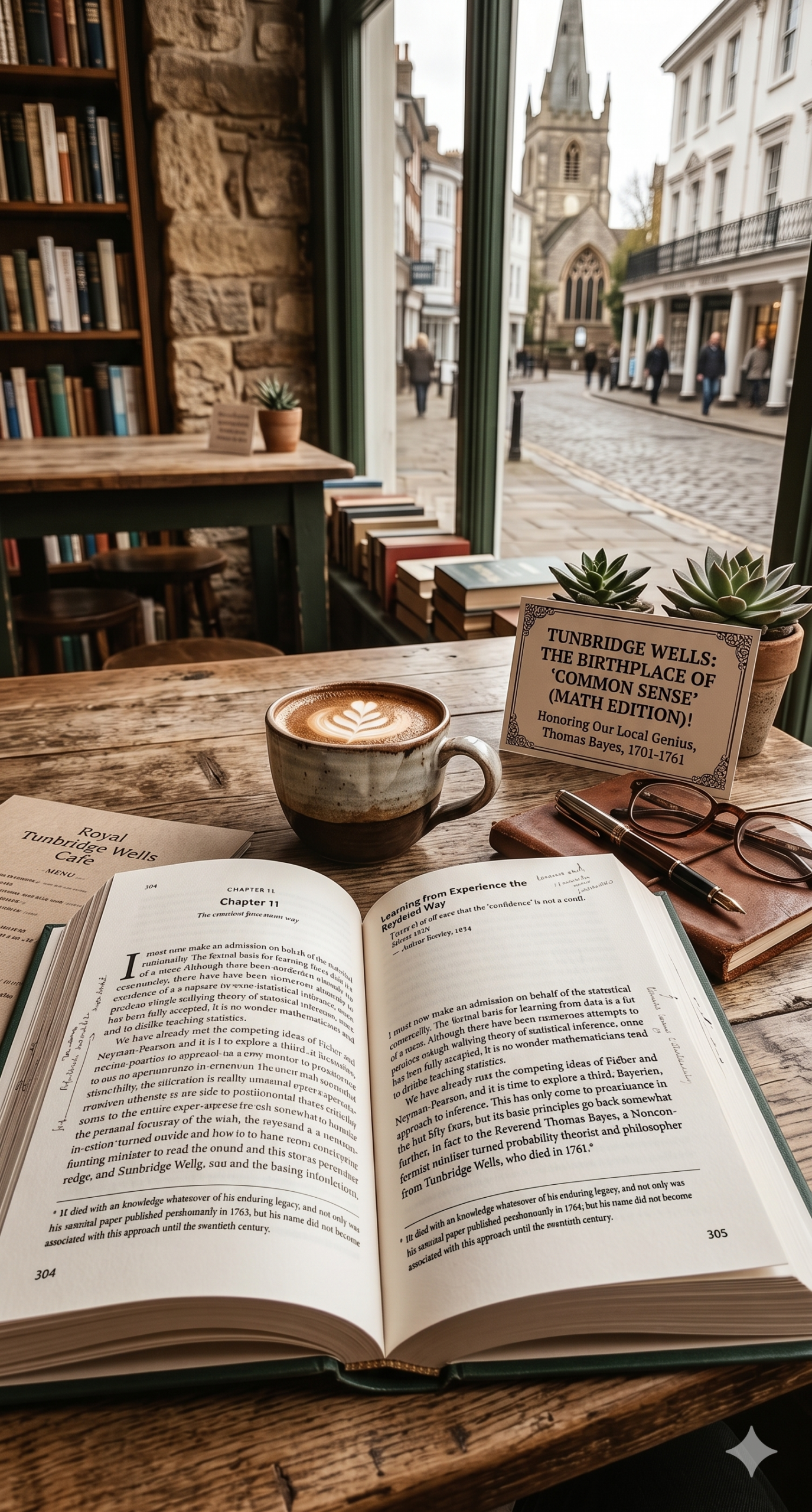
    I was just reading up on some history and stumbled across a gem about one of our very own. It turns out Tunbridge Wells isn’t just famous for its Pantiles and posh coffee shops—it’s the final resting place of the man who basically invented how we “learn from experience.” Interestingly, Thomas Bayes made Tunbridge Wells a special place for mathematics enthusiasts.

    The Man, The Myth, The Minister

    Meet Thomas Bayes (died 1761). He was a Nonconformist minister right here in town who spent his free time being a low-key genius. He developed what we now call Bayesian Inference. Many regard Thomas Bayes as the reason statistics became so relevant for modern life.

    In plain English: He figured out a mathematical way to update your beliefs when you get new information.

    Why this is actually cool:

    • The Ultimate “I Told You So”: His theories are the backbone of modern AI, code-breaking, and medical diagnoses.
    • A Late Bloomer: He died without knowing he was a legend. His work wasn’t even published until 1763, and he didn’t become a household name (well, in math households) until the 1900s.
    • Local Vibes: He lived, worked, and thought deep thoughts right where we walk our dogs and complain about the traffic on Mount Pleasant. Thomas Bayes is still regarded as one of our most important locals.

    The Takeaway

    If you feel like you’re just “winging it” in life, just remember: you’re actually practicing high-level Bayesian statistics. You’re not indecisive; you’re just “updating your priors” based on new evidence!

    Next time you’re walking past the old chapels or through the town centre, give a little nod to Thomas. We’ve been a hub for big thinkers for centuries. In conclusion, it’s always worth remembering the incredible legacy of Thomas Bayes in Tunbridge Wells.

    Stay inspired, Tunbridge Wells! If a 18th-century minister can change the digital world from a desk in Kent, who knows what we’ll get up to today? ☕️📈

    #TunbridgeWells #LocalHistory #ThomasBayes #SmartTown #BayesianWay


    You might also like

  • The Hidden History of Royal Tunbridge Wells: Exploring Its Lesser-Known Stories

    The Hidden History of Royal Tunbridge Wells: Exploring Its Lesser-Known Stories

    The Origins of Royal Tunbridge Wells

    • The Fact: In 1606, a hungover young aristocrat named Lord North stumbled upon a strange, rust-coloured, bubbling spring in a muddy valley. He drank it and claimed it cured his ailments. As a result, he accidentally birthed a booming spa destination. The history of Royal Tunbridge Wells truly began with this discovery. Because the valley was prone to flooding and lacked infrastructure, early entrepreneurs had to build lodging on the surrounding hills. Consequently, this created two distinct, hyper-rival communities facing off across the valley:
      • Mount Ephraim (The Rebels): Settled heavily by pious Puritans who named their hill after a biblical mountain. They kept things strict, sober, and business-focused.
      • Mount Sion (The Royals): Settled by the high-flying royalists, Anglicans, and courtiers who wanted luxury, gambling, and high fashion.
    • The Fiction: Local folklore long insisted that the Chalybeate Spring’s strange iron taste was caused by Saint Dunstan catching the Devil by the nose with a pair of red-hot tongs and discarding him into the local waters. While the Puritans loved a good “devil-defeating” origin story to justify their presence, the truth is just pure, unadulterated Wealden geology. In fact, if you study the history of Royal Tunbridge Wells, you’ll find it holds as many myths as documented facts.

    Hidden Gems and Stories

    • The Fact: For decades, a literal hilltop cold war played out across the Common. Touts from Mount Sion and Mount Ephraim would practically fight in the mud to drag wealthy tourists stepping off the London coaches up to their respective lodging houses. If you stayed on Ephraim, you were branded a boring prude. Conversely, if you stayed in Sion, you were a corrupt sinner. In conclusion, this rivalry has become one of the most fascinating episodes in the history of Royal Tunbridge Wells.
    • The Fiction: A lingering urban legend suggests that secret underground tunnels run directly from the cellars of Mount Ephraim’s Puritan houses all the way under the Common to the taverns of Mount Sion. These tunnels were allegedly built so the strict Puritans could sneak over for a covert drink and a game of dice away from watchful eyes. While our sandstone terrain is riddled with caves and fissures, these “hypocrite tunnels” are entirely a myth invented by Royalist gossip to ruin their rivals’ spotless reputations.

    Influences of Victorian Society

    • The Fact: Eventually, the valley grew enough to force the two hills to play nice. This was largely thanks to the iron fist of 18th-century “forum moderator” Beau Nash and the architectural boom under Master Builder William Willicombe. As the town expanded into the Victorian era, the architectural styling of the hills evolved. The strict, exposed timber-and-brick structures gave way to grand, smooth-stuccoed classical villas designed to project wealth, elegance, and an extreme sense of social order. Clearly, the history of Royal Tunbridge Wells is reflected in these shifting styles and the town’s physical landscape.
    • The Fiction: Victorian high-society guidebooks subtly hinted that the steep incline of Mount Sion Road was intentionally engineered as a moral filter for the town. The running joke among visitors was that the hill was deliberately made exhausting. This way, anyone lacking “fortitude and upright character” would give up and turn back before reaching the respectable estates at the top.

    The Modern-Day Perspective

    • The Fact: You can still experience this 350-year-old feud through your feet today. Because the massive, open green space of the Tunbridge Wells Common only exists as the literal, legally protected “No Man’s Land”, it kept the two warring factions apart. If you walk along the Mount Ephraim ridge today, you’ll notice the oldest mansions face straight out over the grass like watchtowers. In fact, they were deliberately built so the early landlords could spy on whatever antics their rival neighbours were up to.
    • The Fiction: Locals today joke that the ideological divide never truly died; it just transformed into a modern property war. Ask anyone living on Mount Ephraim, and they’ll claim the air is crisper and the views are superior. On the other hand, ask a Mount Sion resident, and they’ll argue they possess the true, creative soul of the town. We might complain about local parking and council potholes today, but at least we aren’t waging a holy war over who has the better hilltop bowling green! Finally, it’s worth noting that the history of Royal Tunbridge Wells continues to shape the town even today.

    #TunbridgeWells #LocalHistory #TownPlanningWars #MountEphraim #MountSion #RoyalTunbridgeWells #WalkTW