Category: The Dandy Chronicles

Focused on high-society gossip, fashion scandals, historic trends, and the absolute rules of socializing from the town’s golden eras (e.g., Beau Nash, the Chalybeate Water Dippers).
  • The Sign on the Way Into Town That Nobody Reads 🇩🇪🤝

    The Sign on the Way Into Town That Nobody Reads 🇩🇪🤝

    Every time you drive into Tunbridge Wells, you pass it. A white sign, a coat of arms, the word “Royal” in elegant lettering — and underneath, in smaller type, three words that almost nobody stops to think about: Twin Town Wiesbaden.

    Most people register it the way you register a speed limit sign. A fact about the town, filed away, never investigated. The story of Twin Town Wiesbaden is often overlooked. What is Wiesbaden? Why is Tunbridge Wells twinned with it? Who decided this, and why?

    The answer is one of the warmest stories in the entire WalkTW archive — and it starts with four men getting on a boat.


    1960: Fifteen Years After the War

    In March 1960, four ex-servicemen from Tunbridge Wells travelled to Germany to meet their counterparts in Wiesbaden.

    Sit with that for a moment. The Second World War had ended fifteen years earlier. These were men who had fought — actually fought, in the war that had only just finished reshaping the entire world. They were keen to heal the wounds of the Second World War and to build a better world for the future.

    The one-time combatants discovered they spoke a common language of active reconciliation. Two groups of men who had been on opposite sides of the most destructive conflict in human history sat down together in Wiesbaden and found that what they actually had in common was the desire for it never to happen again.

    One of those four men was Tom MacAndrew, a former Royal Marine Commando. He went on to lead the Tunbridge Wells Twinning & Friendship Association as its first President, a role he held until his death in 2010. A Royal Marine Commando — a man trained for combat against exactly the kind of people he was now travelling to meet as friends — spent the next fifty years of his life building that friendship.


    The Slow Build: Thirty Years to a Handshake That Counted

    What’s striking about this story is how unhurried it was. Nobody rushed to declare reconciliation. It was built, deliberately, over decades.

    The handshake of 1960 led to a partnership agreement in 1961. This was followed by a ‘Treaty of Friendship’ in 1971. Eleven years between the first meeting and a formal treaty. And then, in 1989, the two towns signed a Twinning Charter — with a delegation from Royal Tunbridge Wells travelling to Wiesbaden to sign the city’s Golden Book, thereby extending the existing friendship treaty into a full town twinning.

    Twenty-nine years from the first tentative meeting to the formal arrangement that put “Twin Town Wiesbaden” on the sign at the edge of town. This wasn’t a gesture. It was a relationship, built the way relationships actually get built — slowly, through repeated contact, through people choosing again and again to keep showing up.


    The “Little Tiddler” and the State Capital

    Here’s the detail that gives the story its proper WalkTW twist.

    Michael Holman, a former chairman of the Tunbridge Wells Twinning and Friendship Association, put it plainly: “It was hard work, I am sure, to convince Wiesbaden, a town of now 300,000 people, to twin with a little tiddler like Tunbridge Wells. Our population of the Borough is only about 120,000. At the time, it would have been much less. It’s a town on a grand scale, compared with Tunbridge Wells. But Tunbridge Wells has its attractions and is a lovely town to visit.”

    Wiesbaden lies between the River Rhine and the foothills of the Taunus Mountains, just 40 kilometres west of Frankfurt, and has a population of about 290,000. Since 1945, it has been the capital of the State of Hesse.

    Royal Tunbridge Wells — a market town in Kent — is formally twinned with the capital city of an entire German federal state. Somehow, four ex-servicemen and three decades of careful relationship-building talked a city of nearly 300,000 people into a friendship with a “little tiddler.” That’s not a bad outcome for a handshake.


    Two Towns, Same Idea, Different Scale

    The connection makes more sense once you know what Wiesbaden actually is. Sometimes called the “Nice of the North,” Wiesbaden once boasted 26 hot springs.

    Tunbridge Wells and Wiesbaden are both fundamentally the same idea — a town that exists because of what comes out of the ground. One chalybeate spring built an entire English spa town around it, complete with promenades, Assembly Rooms, and three centuries of people coming to take the waters. Twenty-six hot springs did something similar on a much grander scale in Hesse.

    Some of Tunbridge Wells’s attractions have direct links with Wiesbaden — the bicycle-shaped cycle-stands around town were made by a blacksmith from the German town, and there’s a Wiesbaden plaque incorporated into the water feature at The Pantiles’ 1887 building, referencing the fact that both towns were founded on springs.

    There’s an older echo of this connection, too. Queen Victoria and Prince Albert visited the Wiesbaden region in 1845 while touring the Rhine, and a vintner there unveiled a monument to the visit nine years later — the Königin Victoriaberg, or Queen Victoria vineyard, which still produces its own bottle of wine today. Two spa towns, an ocean of scale apart, both quietly shaped by the same Victorian tourists more than a century before anyone thought to make it official.


    Still Going, Sixty-Five Years Later

    This isn’t a relationship that was formalised once in 1989 and then forgotten. The Twinning Association has organised member visits to Wiesbaden for the summer Wine Festival, the traditional Christmas Market, and the pre-Lenten “Fasching” Carnival. It has facilitated concerts in Tunbridge Wells by musical groups from Wiesbaden and enabled local musical groups to perform there. It has also supported school groups from Wiesbaden coming to Tunbridge Wells — one school has brought students for the past 17 years to undertake two weeks of work experience.

    In 2022, the two towns celebrated 33 years of official twinning. That means the formal relationship has now passed its 36th year — and the friendship itself, counting from that first meeting in 1960, is now in its sixty-fifth year. Tom MacAndrew, the Royal Marine Commando who made that first trip, didn’t live to see all of it — but the association he led for fifty years is still organising trips, still bringing German schoolchildren to Kent, still finding excuses for people from two towns on opposite sides of a continent to spend time together.


    🗺️ Go Find It

    The sign itself is at several of the main approaches into Royal Tunbridge Wells — you’ve almost certainly driven past one without registering it.

    The Wiesbaden plaque on The Pantiles is, as far as the WalkTW archive currently knows, unlocated. If you spot it, or know exactly where it is, this is officially an open case.


    🕵️ The Open Question

    Who were the other three? Tom MacAndrew’s name survives because he went on to lead the Twinning Association for fifty years. But he was one of four ex-servicemen who made that first trip in March 1960. Who were the other three? What did they do afterwards? Did any of their families know what they’d started?

    Four names from 1960 are sitting in someone’s local archive or in someone’s family memory. If you know any of them, the WalkTW archive — and quite possibly the Twinning Association itself — would very much like to hear from you. 👇

    #TunbridgeWells #WalkTW #Wiesbaden #TwinTown #LocalHistory #Reconciliation #HiddenTunbridgeWells

  • 10 Films and Shows to Watch This Weekend — All Secretly Filmed in Tunbridge Wells 🎬🍿

    10 Films and Shows to Watch This Weekend — All Secretly Filmed in Tunbridge Wells 🎬🍿

    You’ve walked past these places a hundred times. The Pantiles on a Saturday morning. The cricket ground on the Common. That moated house everyone’s been to for the maze and the dinosaurs.

    What you may not know is that every one of these locations has, at some point, stood in for somewhere else entirely — a Victorian drapery, a fictional Hertfordshire estate, an American city, a Roman-occupied Britain, and the venue for India’s greatest cricketing triumph. If you’re deciding what to view, here are 10 Films and Shows to Watch This Weekend for inspiration.

    This weekend’s homework: pick one from the list below, watch it, and then go stand in the actual spot. Sorted from oldest to newest, so you can watch Tunbridge Wells’ screen career unfold in order.


    1. The Draughtsman’s Contract (1982) — Groombridge Place

    Peter Greenaway’s strange, elegant murder mystery marks the beginning of Groombridge Place’s screen career. The country house is Groombridge Place, a 1655 moated house set in landscaped grounds, in Groombridge, four miles southwest of Royal Tunbridge Wells on the Kent/Sussex border. Anthony Higgins plays a draughtsman commissioned to draw the estate, who gets pulled into an “enigmatic murder plot” — and the gardens became so associated with the film that the Apostle Walk at Groombridge is now commonly known as the Draughtsman’s Garden.

    Go see it: Groombridge Place gardens are open to the public from spring to early November.


    2. Half a Sixpence (1967) — The Pantiles

    The deep-cut classic. Half a Sixpence, based on H.G. Wells’s novel Kipps, is a musical starring Tommy Steele and directed by Golden Globe winner George Sidney. The Pantiles in Royal Tunbridge Wells is the set for Shalfords Emporium — the draper’s shop where Kipps apprentices.

    Next time you’re getting a coffee on The Pantiles, you’re standing where a 1960s movie musical built a working Victorian shop window.

    Go see it: The Pantiles, obviously. You’re probably there already.


    3. Pride & Prejudice (2005) — Groombridge Place as Longbourn

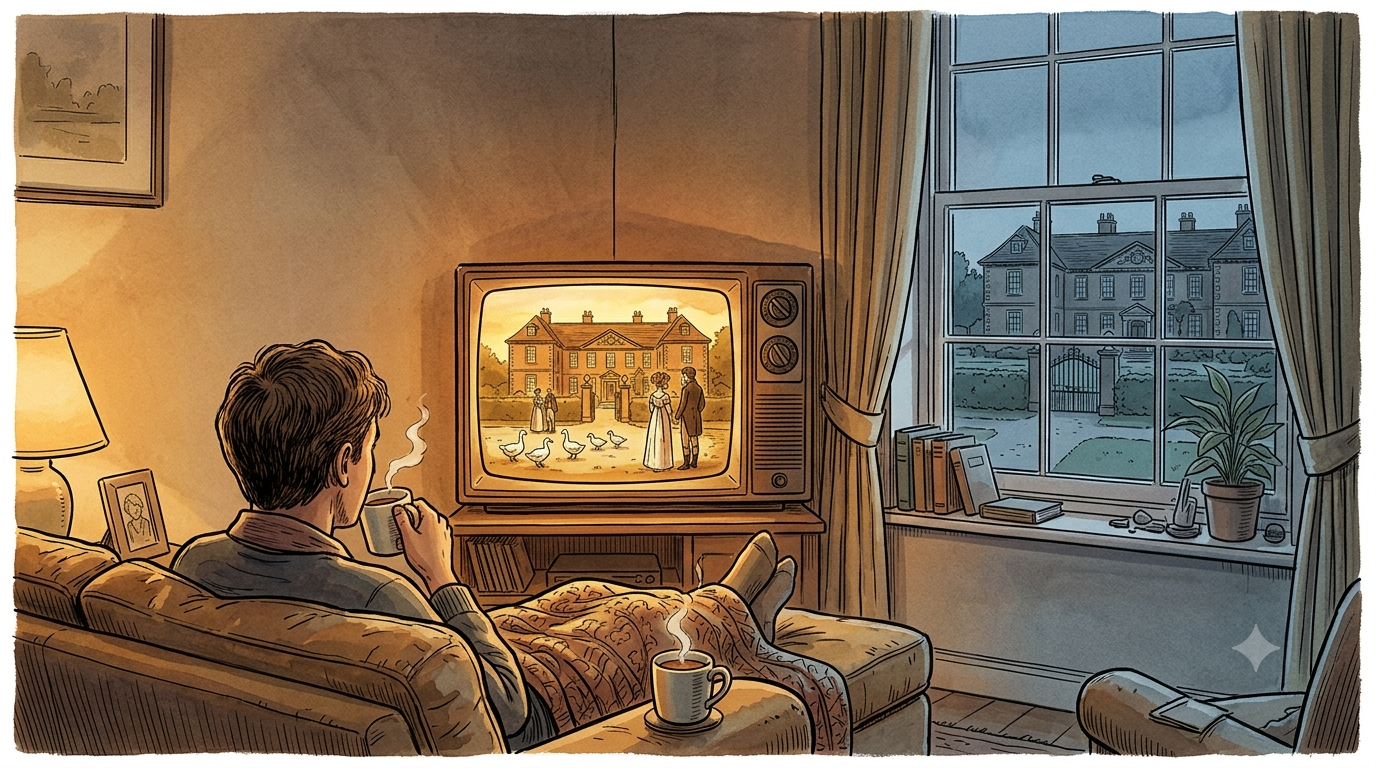
    The big one. ‘Longbourn’, the Bennet family home, is a moated manor house, Groombridge Place, near Tunbridge Wells in Kent. The crew transformed Groombridge into a bustling, shabby-chic Bennet home — building a duckboard bridge across the moat, altering windows, and filling the courtyard with geese, chickens and manure piles to give Longbourn its lively, lived-in atmosphere.

    Keira Knightley’s Elizabeth Bennet grew up, fictionally, four miles from Royal Tunbridge Wells. Austen describes Longbourn as “a comfortable house, though not handsome” — Groombridge’s charm and lived-in authenticity captured that perfectly.

    Go see it: Same gardens as #1. The geese are (probably) gone.


    4. Darkest Hour-adjacent honourable mention — skip ahead, this one’s Westerham

    (Editorial note: Chartwell is just outside our patch, in Westerham — close enough that it keeps coming up in searches, but not actually a Tunbridge Wells location. We’re not including it because we’d rather give you ten that are real than pad the list. Onwards.)


    4. The Day of the Triffids (2009, BBC) — Groombridge Place

    Groombridge Place’s third screen credit, and its strangest. Groombridge Place was used as a filming location for the 2009 BBC production of The Day of the Triffids. A genuinely menacing post-apocalyptic thriller about carnivorous plants taking over Britain, filmed partly at the same moated manor that played Jane Austen’s family home four years earlier.

    The contrast is the entire point. Same gates, same moat, same gravel drive — one year it’s the Bennets having tea, the next it’s the last survivors of civilisation barricading themselves in against killer vegetation.

    Go see it: Same gardens as #1 and #3. At this point, you should probably just buy a season ticket.


    5. The Royals (2016-2018) — Tunbridge Wells area

    The Royals (2016-2018) is noted by the Kent Film Office as a recent production to have filmed in the Tunbridge Wells area. This was an American E! network drama imagining a fictional version of the British royal family — meaning an American show about fictional British royals was, at some point, filmed in the one English town with “Royal” actually in its name.

    We don’t yet know the specific locations used. If you remember crew vans or filming notices around town in 2016-2018, the WalkTW archive would love to hear from you.


    6. Queens of Mystery (2020-2021) — Tunbridge Wells area

    Queens of Mystery (2020-2021) is listed by the Kent Film Office as a recent production filmed in the Tunbridge Wells area. A gentle, Sunday-night murder mystery series set in a fictional English seaside town — exactly the kind of cosy crime drama where a Georgian spa town would make a perfect backdrop.

    Again — specific locations not yet confirmed. Watch carefully and see if anything looks familiar.


    7. Britannia, Series 3 (2021) — Claremont Gardens and Town Hill Road

    The genre swerve of the list. During filming, the production visited Tunbridge Wells to film short scenes in Claremont Gardens and Town Hill Road. Britannia is a big, blood-soaked historical fantasy about Roman Britain and warring Celtic tribes — David Morrissey, druids, prophecy, the works.

    Somewhere in Claremont Gardens or on Town Hill Road, a scene depicting Roman-occupied Britain was filmed within walking distance of the station. Look at those streets differently next time.

    Go see it: Claremont Gardens and Town Hill Road are both public — walk past and see if you can guess what they stood in for.


    8. This Way Up, Series 2 (2021) — Speldhurst

    The “wait, that’s near here?” entry. This Way Up Series 2 (2021), created by and starring Aisling Bea, alongside Sharon Horgan and Tobias Menzies, used Tunbridge Wells in Kent as a filming location. The strikingly modern home featured in the opening episode of series two — where Shona settles into her fiancé Vish’s “super sleek” home while he’s away in New York — is in real life in the village of Speldhurst in Tunbridge Wells, designed by London architecture firm Architecturall.

    An ultra-modern architect’s house in a Kent village, standing in for the kind of glossy London apartment that only exists in TV. The gap between “rural Speldhurst” and “the flat of someone’s tech-millionaire fiancé in London” is doing a lot of work here.

    Go see it: Privately owned — admire from the road, don’t knock.


    9. ’83 (2021) — Nevill Cricket Ground

    The most unexpected entry on this list, by a distance. ’83, directed by Kabir Khan and starring Ranveer Singh and Deepika Padukone, is a major Bollywood film about India’s 1983 Cricket World Cup victory, and used Nevill Cricket Ground in Tunbridge Wells as a filming location. (Oxford Reference)
    One of the biggest Indian films of recent years — a national sporting triumph, one of the most celebrated moments in Indian cricket history — recreated, at least in part, on a ground in Hawkenbury, on the southern edge of Tunbridge Wells.
    The choice of location isn’t random. The Nevill Ground’s only One Day International was, fittingly, a 1983 World Cup group match between India and Zimbabwe — the game in which Kapil Dev scored an extraordinary 175 not out. (Kirkus Reviews) If you’ve ever played a club match at the Nevill, you’ve stood on a ground with a genuine claim to 1983 World Cup history — which is presumably exactly why the Bollywood crew chose it.
    Go see it: Nevill Ground, Nevill Gate, Warwick Park, TN2 5ES — about a mile south of the town centre, near Hawkenbury. Home of Tunbridge Wells Cricket Club, with matches most summer weekends.


    10. Tuesdays and Fridays (2021, Netflix) — Danemore Park

    The most recent entry, and the grandest house. Danemore Park is a Grade II listed Georgian country house in 80 acres, with a stable block, woodland and a long driveway, in the district of Royal Tunbridge Wells, and was used for the Netflix film Tuesdays and Fridays.

    A Georgian country house within the borough, on Netflix, released in 2021. If you’ve got a Netflix subscription and a free evening, this is the newest addition to TW’s screen CV.


    🗺️ The WalkTW Weekend Challenge

    Three of these are genuinely visitable: Groombridge Place (four separate productions across nearly forty years), The Pantiles (you’re there already), and Nevill Cricket Ground (turn up to a match).

    If you watch any of these and spot something else — a street, a shopfront, a bit of garden you recognise — let us know. The Royals and Queens of Mystery entries on this list are still open cases. WalkTW would love to close them.

    The pattern worth noticing: Groombridge Place alone has played a Georgian family home, a murder-mystery estate, Sherlock Holmes’s Birlstone Manor, and the last refuge from carnivorous plants — sometimes within a few years of each other. The same gates, the same moat, completely different worlds. That’s not a bad metaphor for Tunbridge Wells itself.

    #TunbridgeWells #WalkTW #FilmingLocations #GroombridgePlace #PrideAndPrejudice #ThePantiles #WeekendWatchlist #HiddenTunbridgeWells

  • Capital of Infidelity, Part 3: The “Grand Tour” of Heartbreak 💔🎩

    Capital of Infidelity, Part 3: The “Grand Tour” of Heartbreak 💔🎩

    If Part 1 taught us anything, it’s that the Georgian elite didn’t just visit Royal Tunbridge Wells to “take the waters”—they came to completely rewrite the rules of romance. Enterprising builders gave them double-staircases and overlapping balconies to hide their late-night visitors, but as the town’s popularity exploded, the scandal outgrew individual lodging houses.

    It spilled out across the entire landscape. The consequences of infidelity can touch every aspect of life.

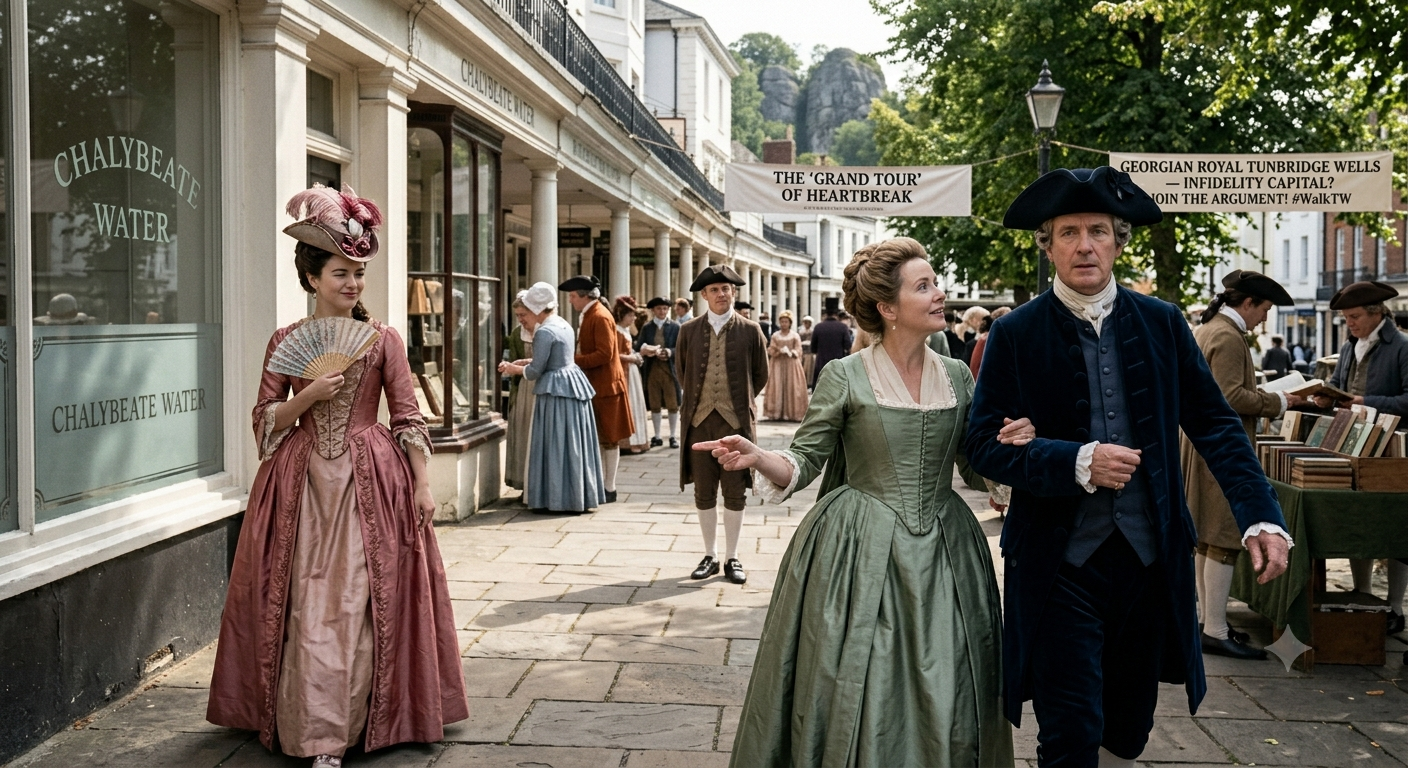
    Welcome to Part 3, where we look at the logistical nightmare of the “Grand Tour” of Heartbreak. This wasn’t a tour of Europe; it was the high-stakes, frantic daily commute of aristocratic husbands trying to manage a wife, a mistress, and a judgmental town gossip mill all within a one-mile radius. Clearly, infidelity played a major role in Tunbridge Wells society.

    1. The Ridge-Line Divide: High-Stakes Geography 🗺️

    By the mid-1700s, the wealthiest lords running away from London for the summer season faced a unique dilemma. They wanted to bring their families for a wholesome countryside holiday, but they also couldn’t bear to leave their secret lives behind. It’s fascinating how infidelity could weave itself so seamlessly into the fabric of their summer escapes.

    The solution? They weaponised the town’s geography.

    A lord would rent a grand, respectable townhouse up on the breezy heights of Mount Ephraim or Calverley Park for his official wife, children, and an army of servants. Then, he would quietly lease a completely separate, discreet cottage tucked away down in the valley of Mount Sion or along the edge of the Common for his mistress.

    The massive, rocky expanse of the Tunbridge Wells Common became a strategic buffer zone. Husbands would literally spend their days “hiking” across the rocks, ostensibly for their health, but actually migrating between completely separate domestic realities. Infidelity, for many, dictated every step between those two addresses.

    2. The Great Promenade Minefield 💣

    While the geography worked beautifully at night, the entire system collapsed every morning at 11:00 AM. Why? Because everyone, regardless of which hill they slept on, was socially obligated to converge on The Pantiles to drink the chalybeate water, listen to the orchestra, and parade. Avoiding public proof of infidelity became an art in itself.

    This turned the morning promenade into a literal psychological minefield. Imagine strolling down the Upper Walk with your wife on your arm, only to turn the corner by the doughnut stall (or the Georgian equivalent) and come face-to-face with your mistress wearing the exact silk ribbon you bought her the night before.

    The level of frantic social dodging, sudden “coughing fits” to look away, and panicked fan-fluttering was legendary. Tales of infidelity circulated among the onlookers as entertainment almost as much as the music.

    3. Myths, Legends, and Awkward Standoffs: The Crowborough Coach Panic 🐎

    To understand just how tense this high-society chess game could get, we have to look at the folklore and questionable rumours that local historians still chuckle over. Stories of infidelity often grew into elaborate myths told for generations in Tunbridge Wells.

    The Legend of the False Appendix (1782): > Lord Harrington allegedly holds the record for the most dramatic logistical failure in local history. Rumor has it he accidentally sent two identical, highly passionate love letters detailing an “assignation at the sandstone rocks”—one to his mistress on Mount Sion, and one, via a very confused servant, directly to his wife up on Mount Ephraim.

    Realizing his fatal error just as the letters were delivered, Harrington didn’t run. Instead, he staged a massive, theatrical “medical emergency” right in the middle of the Upper Walk. He collapsed onto the paving stones, feigning a sudden, agonizing illness that required him to be immediately loaded into a coach and driven back to London for “urgent surgery.” Both women rushed down to the promenade only to find an empty carriage track and a very confused local apothecary. The marriage was saved, the affair survived, and Harrington spent a month in London hiding from a completely fictitious disease.

    4. The Modern Parallel: Location Sharing vs. The Common Rocks 📱

    Fast forward to 2026. Today, we worry about getting caught because of a leaked DM, an accidental “Find My” location-sharing slip, or a notification popping up on a shared iPad screen. Unsurprisingly, infidelity is as much of a risk for the modern relationship as it was for the Georgians.

    The Georgians didn’t have smartphones, but they had something arguably worse: The Assembly Room Letter Rack.

    All mail arriving in Tunbridge Wells was publicly displayed on a massive wooden grid in the social rooms for people to collect. If a suspicious wife decided to browse the rack before her husband woke up, the game was instantly over. The digital apps that earned us our modern “Cheating Capital” crown haven’t actually changed the human heart—they’ve just replaced the terrifying walk to the public letter rack with a face-ID lock. Infidelity just found new ways to make its presence felt.

    🕵️‍♂️ WalkTW Archive Meeting: What’s Your Strategy?

    The logistics of the Grand Tour of Heartbreak sound exhausting. If you were an 18th-century lord or lady trying to navigate a secret romance on The Pantiles, how would you manage it? For those who lived with infidelity as a daily reality, the calculations were endless.

    • Would you trust the “hiking across the Common rocks” excuse, or is the risk of bumping into someone at the Chalybeate Spring too high?
    • Do you think modern technology makes it easier or harder to live a double life compared to the rigours of early Tunbridge Wells?

    Let’s hear your theories, local gossip, or thoughts on Lord Harrington’s fake illness in the comments below! 👇

    #TunbridgeWells #ThePantiles #GrandTourOfHeartbreak #WalkTW #LocalHistory #GeorgianScandals #CheatingHotspot

  • Capital of Infidelity, Part 1: The Modern Crown vs. The Georgian Reality 🤫📱

    Capital of Infidelity, Part 1: The Modern Crown vs. The Georgian Reality 🤫📱

    When a notorious modern dating website looked at its user metrics and officially crowned Royal Tunbridge Wells the “Cheating Capital of the UK,” the national press had a field day. As a result, it’s no wonder some now refer to Royal Tunbridge Wells as the capital of infidelity. Journalists mocked the irony of a deeply affluent, seemingly polite, and conservative Kentish town topping the charts for marital betrayal. Importantly, naming the town the capital of infidelity sparked debates throughout the UK.

    But if you know anything about the true DNA of this town, you know that the algorithm didn’t corrupt us. Instead, it just exposed a centuries-old tradition of making Tunbridge Wells the infidelity capital at heart. This is a place where secret affairs have long thrived.

    The internet didn’t invent the local appetite for scandal; it just modernised it. If you trace the layout of our historic streets back to the 1700s, you realise the entire town was practically engineered by the Georgians. They made it a giant, high-society playground for extramarital liaisons. Moreover, they helped Tunbridge Wells earn its reputation as the foremost capital for infidelity in the country.

    The Chalybeate Spring: The Ultimate Cover Story ⛲️

    In the 18th century, high society flooded down from London to Tunbridge Wells under the noble guise of “taking the waters.” Physicians published dense, serious tracts praising the iron-rich Chalybeate Spring for curing everything from bad nerves to digestive complaints. Because of this, the destination became a magnet for those seeking, and some say deserving, the lively reputation associated with Britain’s infidelity capital.

    Let’s be completely honest: the health benefits were mostly a highly convenient cover story. This excuse covered what would become the capital’s infidelity-driven undercurrent.

    The genius of the spa town setup was that it provided a socially bulletproof excuse to leave town. Wealthy aristocrats, bored lords, and neglected wives traveled down to the Wells—crucially—in separate carriages, often weeks apart. Also, they came with entirely different social entourages. Once you arrived at the promenade, the rigid, suffocating chaperoning rules of London society completely evaporated. You were on holiday, you were “convalescing,” and the rules of engagement were entirely different. In fact, this social sphere helped solidify the town’s notoriety as a budding capital of infidelity during the Georgian era.

    A Tale of Two Hills: Pleasures vs. Prayers ⛰️

    As the seasonal crowds grew, a fascinating, geographic ideological war broke out across the town’s landscape. Consequently, this underscored its double life as one of England’s most enduring capitals of infidelity.

    Up on Mount Ephraim, the strict, deeply religious Puritans watched the developing spa town with absolute horror. They built their lodging houses on the high ridge to literally look down upon the sins of the valley. Accordingly, they saw these as characteristics befitting a true capital of infidelity.

    Down on the Upper Walk (what we now call The Pantiles), the atmosphere was a high-stakes hunting ground for secret romance. Under the shade of the trees, aristocrats engaged in a continuous, stylised parade of eye contact, dropped handkerchiefs, and coded fan-fluttering. It was an open-air marketplace for attraction. Meanwhile, while the band played music from the gallery, secret notes were slipped into gloved hands. Also, assignations were booked right under the noses of the local chaperones, which naturally contributed to the lasting reputation as the capital for local infidelity.

    Architecture of a Midnight Flit: Back-Stairs and False Balconies 🏛️🚪

    The real magic of the Georgian infidelity machine, however, was hidden inside the local architecture. Enterprising local builders quickly realised that if they wanted to make a fortune renting lodging houses to the elite, they needed to cater to their clients’ true priorities. Those priorities included absolute discretion—essential to maintaining the capital city’s reputation for unescapades.

    If you look closely at the surviving historic blueprints of the town’s oldest lodging houses, the structural layout tells a very specific story:

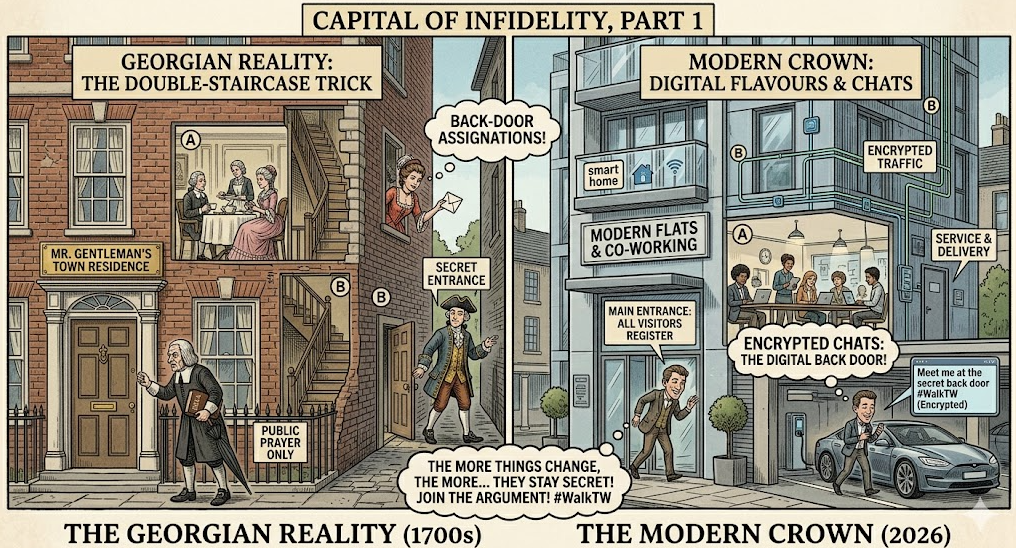
    • The Double-Staircase Trick: Grand townhouses were intentionally built with entirely separate back staircases. While the main sweeping staircase was for show, the secondary, unlit back stairs allowed “unannounced late-night guests” to slip between floors and into master bedrooms. In this way, it was all completely undetected by the household servants—a design that perhaps only the true capital of infidelity would inspire.
    • Overlapping Balconies: Row cottages and adjacent lodging rooms were often designed with shared or easily accessible wooden balconies. If a nosy neighbour or a surprise visitor knocked on the front door, a lover could simply step out the sash window. Then they could hop the low balcony partition and vanish into the next room before the maid could even light a candle.

    The town’s very bricks and mortar were designed to keep secrets. The digital apps of today haven’t changed our behaviour; they’ve just replaced the secret back-staircases with encrypted chat threads. This seamless evolution cements Tunbridge Wells’s place as the modern capital for infidelity in Britain.

    🕵️‍♂️ WalkTW Archive Meeting: Join the Investigation!

    Now that Part 1 of the Capital of Infidelity is out in the wild, the floor is open to our WalkTW detectives in the comments.

    • Have you ever noticed the bizarre, labyrinthine layouts, dual entryways, or odd staircases inside the historic buildings on Mount Sion or The Pantiles? These are clues that further cement Tunbridge Wells’s notoriety as a capital for infidelity.
    • Do you think the Georgians were actually much better at hiding their tracks than the modern locals getting caught on dating apps?

    Drop your thoughts, architectural spots, and theories below! Let’s untangle the gossip about this infamous infidelity capital. 👇

    #TunbridgeWells #ThePantiles #CheatingCapital #TheDandyChronicles #WalkTW #LocalHistory #GeorgianScandals #InfidelityCapital

  • Capital of Infidelity, Part 2: Lord Maiden and the Camp Culture of 1703 🎭💅

    Capital of Infidelity, Part 2: Lord Maiden and the Camp Culture of 1703 🎭💅

    If you thought 18th-century “sledge-cottages” moving mistresses through the woods at midnight was peak drama, brace yourselves. We are wrapping up our Capital of Infidelity trilogy. This time, we are stepping directly into the spotlight of a completely overlooked, glittering piece of local history connected to Lord Maiden.

    But first, let’s address the elephant on the promenade: the modern data. When people find out that Royal Tunbridge Wells has frequently been crowned the “Cheating Capital of the UK” by major dating websites specialising in extramarital affairs, they assume it’s a modern glitch in the local Wi-Fi. The statistics show a massive per-capita surge in local registrations, making our affluent town the official hub for secret digital rendezvous.

    But here is the real twist: the internet didn’t make Tunbridge Wells scandalous. The town was literally built for it. Long before modern society began open conversations about fluid relationships, gender expression, and secret lives, Royal Tunbridge Wells was already serving them up as mainstream entertainment. It did this with colourful characters like Lord Maiden, both on and off stage.

    Turn the clock back to 1703. While the strict, ultra-religious Puritans up on Mount Ephraim were busy clutching their prayer books, the social scene on the Upper Walk was so wildly uninhibited, fluid, and delightfully chaotic that it inspired a smash-hit London stage play.

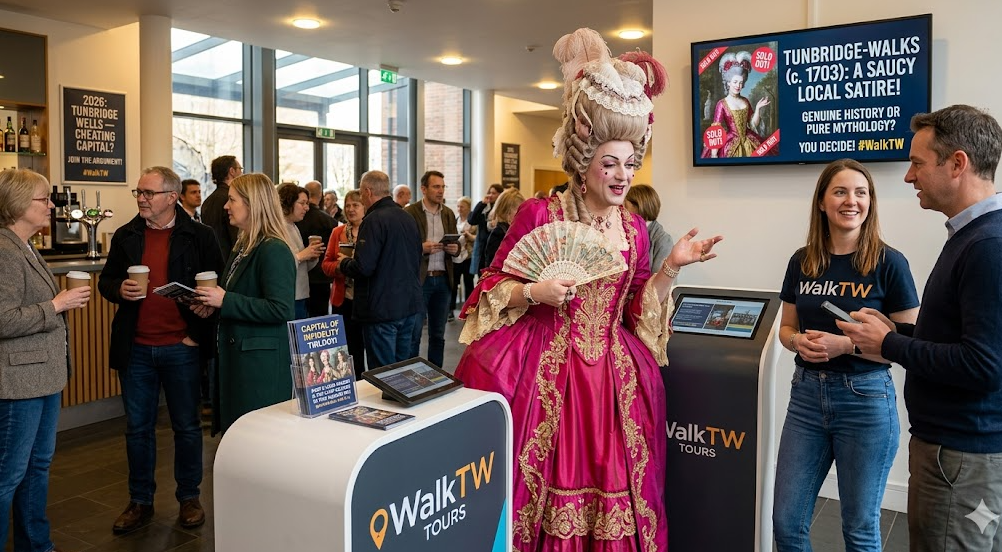
    The play was called Tunbridge-Walks; or, The Yeoman of Kent, written by Thomas Baker. And its breakout star? A character that would give modern reality TV stars a run for their money: Mr Maiden, perhaps loosely based on the legendary Lord Maiden of Tunbridge Wells society.

    The Ultra-Camp Sensation of the 18th Century

    Tunbridge-Walks was written specifically to satirise the scandalous, zero-consequences love lives of the high-society crowd visiting the Kent spa. In the 1700s, coming to the Wells wasn’t about the water; it was an excuse to reinvent yourself away from the judging eyes of London completely.

    The undisputed centrepiece of the show was Maiden. He wasn’t your standard, gruff Georgian gentleman. Maiden was a fiercely flamboyant, cross-dressing dandy who proudly marched to the beat of his own drum. On stage, he openly bragged about his favourite hobby: slipping into gorgeous women’s gowns so he could sit with the high-society ladies, drink tea, and absorb the absolute best gossip firsthand. Remarkably, audiences saw traces of Lord Maiden in this iconic, camp performance.

    Even better? Maiden used his camp, fluid lifestyle as a brilliant tactical shield to completely evade traditional marriage. While every other character in the play was stressing over arranged marriages, dowries, and societal expectations, Maiden was living his best life. He was utterly unbothered by the patriarchy.

    The Real-Life Caricature That Shook the Town

    Now, if this had just been a fictional character, London audiences would have laughed and moved on. But Tunbridge-Walks caused an absolute thunderstorm of gossip because everyone knew Maiden was based on a real person.

    The playwright had spent the previous summers people-watching on the promenade, taking direct, highly provocative notes on a real-life regular visitor to Tunbridge Wells. When the curtain went up, locals immediately recognised the walk, the voice, the clothes, and the exact mannerisms of a prominent society figure. This person frequently graced our tree-lined avenues.

    The town’s rumour mill went into overdrive. People would literally sit in the assembly rooms scanning the crowd, trying to spot the “Real Mr Maiden”, grabbing a morning coffee or strolling past the Chalybeate Spring.

    A 2026 Reality Check: Are We Actually Less Modern?

    This brings us to a fascinating, slightly mind-bending question for us to ponder here in 2026: Could you write and debut a character like Maiden today without starting a massive cultural war? Of course, Lord Maiden’s legacy makes that question even more intriguing.

    On the surface, we like to think 21st-century society is the pinnacle of free expression and progress. After all, we have the apps to prove that we have an active underground dating scene! But there’s a compelling argument that 1703 Tunbridge Wells was, in some ways, much more relaxed about the absurdities of human nature.

    If a playwright introduced a character like Maiden in a mainstream theatre today, it would instantly be swallowed by the modern internet outrage machine. It wouldn’t just be viewed as a fun, chaotic satire. Instead, political commentators, social media factions, and cultural gatekeepers would dissect it from every angle. They would slap labels on it, and argue over whether it’s “appropriate” or “offensive.”

    Humans haven’t fundamentally changed since 1703—we still love gossip, drama, and breaking the rules (as our “Cheating Capital” crown reminds us every year). But our modern moral borders and ideological rigidness often prevent the kind of unfiltered, breezy, free-spirited expression that the Georgians laughed along with over 300 years ago. Back then, high society looked at a cross-dressing, gossip-loving dandy and said, “Brilliant, let’s put him on a poster.” Today, we’d probably start a petition to cancel the show. Ultimately, the legend of Lord Maiden continues to provoke debate today.

    🕵️‍♂️ WalkTW Archive Meeting: Join the Argument!

    Our Capital of Infidelity series is officially in the books, and the floor is open to our WalkTW detectives.

    • Do you think 1703 Tunbridge Wells was genuinely more progressive than we are today, or were they just too distracted by gambling and affairs to care about enforcing moral borders?
    • Does knowing our history of “sledge-cottages” and cross-dressing stage stars make our modern title as the UK’s cheating capital feel a bit more like a historical tradition?

    Drop your thoughts, theories, and cultural hot-takes in the comments below! Let’s argue about it. 👇

    #TunbridgeWells #ThePantiles #LordMaiden #CampCulture #TheDandyChronicles #WalkTW #LocalHistory #TheatreHistory

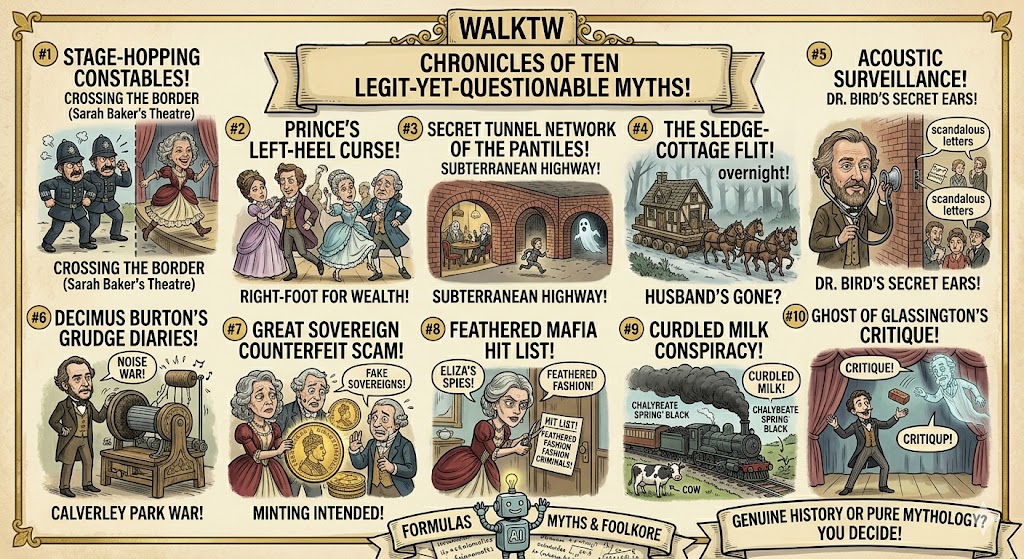
  • Top 10 Myths, Rumours, and Questionable Truths of Royal Tunbridge Wells 🕵️‍♂️✨

    Top 10 Myths, Rumours, and Questionable Truths of Royal Tunbridge Wells 🕵️‍♂️✨

    Every local history book will tell you about the discovery of the Chalybeate Spring, the grand visits of Queen Victoria, and the elegant architecture of Decimus Burton. But let’s be honest: towns aren’t built on polite tea parties. They are built on whispers, eccentric characters, and centuries of high-society gossip.

    If you peel back the polished layers of our classic spa town, you find an alternate history—one filled with bizarre landscape feuds, subterranean highways, and questionable local legends. Many of these stories are what make up the fascinating collection of Tunbridge Wells myths.

    Here are the top 10 myths and rumours floating around Royal Tunbridge Wells. Some are absolute historical fact, some are beautifully embroidered fiction, and others sit in that glorious, murky middle ground. We’ll let you decide where the truth lies.

    1. The Stage-Hopping Constables (The Two-County Theatre)

    • The Legend: When the legendary “Theatre Queen” Sarah Baker built her permanent theater on The Pantiles in 1802 (now the Corn Exchange), it was erected directly over the boundary line separating Kent and Sussex. Rumor has it that local smugglers and thieves exploited this layout for decades. If the Kent constables rushed the auditorium to make an arrest, the suspect would simply leap onto the stage into “Sussex,” legally trapping the officers who didn’t possess a cross-county warrant.

    2. The Prince’s Left-Heel Curse

    • The Legend: We all know the story of young Prince William slipping in the mud in 1698, prompting a furious Princess Anne to demand the promenade be paved with “pan-tiles.” But highly superstitious Georgian visitors took it a step further. It was widely whispered that the Prince fell specifically on his left heel. For decades, anxious aristocrats would only step onto the Upper Walk with their right foot first, genuinely believing that leading with the left would invite immediate financial ruin at the local gaming tables.

    3. The Secret Tunnel Network of The Pantiles

    • The Legend: For centuries, building contractors excavating cellars along the Upper and Lower Walks have whispered about hitting bricked-up structural arches that appear on no official town maps. The prevailing local myth is that during the height of the 18th-century gambling craze, a massive subterranean highway system connected the major taverns. This allegedly allowed high-rolling lords, cheating politicians, and illicit lovers to vanish underground the moment the local watchmen conducted a late-night raid.

    4. The Sledge-Cottage Flit

    • The Legend: In the early days of the spa, enterprising locals actually constructed several small lodging houses on massive wooden sledges or wheels. The official historical reason was “to suit the changing preferences of seasonal tenants,” but the local rumour mill always insisted on a much more scandalous purpose. If a suspicious, wealthy husband unexpectedly announced he was riding down from London, a mistress’s entire cottage could literally be hooked up to a team of horses and dragged deep into the Common woods overnight, leaving nothing but tire tracks.

    5. Dr Golding Bird’s Acoustic Surveillance

    • The Legend: Dr Golding Bird, buried in Woodbury Park Cemetery, was a brilliant Victorian medical pioneer who helped invent the flexible stethoscope. However, the town’s elite whispered that his interest in the physics of sound wasn’t purely medical. Rumour has it he modified his early stethoscopes and acoustic tubes to listen through the thick walls of neighbouring lodging houses, turning his medical rounds into a highly sophisticated information-gathering mission.

    6. The Decimus Burton Grudge Diaries

    • The Legend: The incredibly wealthy, famously irritable retired officers who moved into the exclusive Calverley Park estate expected absolute serenity. When the railway whistle and street musicians began infiltrating the area, an intense noise war broke out. Local lore claims one particularly grumpy colonel built a completely soundproof “crying room” lined entirely with horsehair mattress padding just so he could scream out his frustrations about his neighbours without breaking his polite upper-class composure.

    7. The Great Sovereign Counterfeit Scam

    • The Legend: The gambling dens operating behind the Lower Walk were notoriously cutthroat, but in the late 1700s, a ring of bankrupt aristocrats allegedly kept their high-flying lifestyles afloat using highly sophisticated fake currency. Because the local tradesmen and tavern keepers were far too intimidated to question or inspect money handed to them by a Duke or a Lord, a secret mint operating out of a Mount Sion mansion successfully flooded the local economy with counterfeit gold sovereigns for years.

    8. The Feathered Mafia Hit List

    • The Legend: Long before Eliza Phillips officially co-founded what became the RSPB, she waged a fierce war against the Victorian obsession with taxidermy fashion (where women wore entire stuffed birds on their hats). Local gossip tells us Eliza ran a militant network of “high-tea spies.” If an elite lady stepped onto the promenade wearing an endangered plume, her name, address, and social crimes were secretly slipped under the doors of the town’s assembly rooms, leading to immediate, devastating social boycotts over afternoon tea.

    9. The Curdled Milk Conspiracy

    • The Legend: When railway planners proposed extending the tracks into the center of town in the 1840s, a secret alliance of wealthy hotel owners and traditional horse-coach operators fought it tooth and nail. To terrify the public, they funded a bizarre propaganda campaign, spreading the rumour that the sulfurous smoke from locomotive engines would permanently turn the water of the Chalybeate Spring black and cause the milk to instantly curdle inside the local dairy cows.

    10. The Ghost of Mr Glassington’s Critique

    • The Legend: After Sarah Baker completely crushed her theatrical rival, Mr Glassington, and drove him out of business on Castle Street, she allegedly dismantled his old theatre and used the timber to fortify her own. Ever since, actors performing on that site have blamed “The Ghost of Glassington” for any bad reviews. The rumour is that if an actor’s performance was particularly terrible or lacked artistic class, a single, structural brick would mysteriously dislodge and drop from the rafters—Glassington’s final, petty critique from beyond the grave.

    🕵️‍♂️ WalkTW Archive Meeting: What’s Your Verdict?

    Every great myth has a kernel of truth hidden inside it. Which of these 10 stories do you think is genuine history, and which one is pure, unfiltered local mythology? Have you ever stumbled upon a bricked-up arch or walked the Common looking for sledge tracks?

    Drop your theories, corrections, or your own family rumoursen in the comments below! Let’s untangle the gossip together. 👇

    #TunbridgeWells #ThePantiles #LocalMyths #WalkTW #HistoryGossip #KentHistory

  • The Great Paving Scandal (The Royal Slip-and-Slide) 👑🧱

    The Great Paving Scandal (The Royal Slip-and-Slide) 👑🧱

    If you’ve ever walked down the elegant, sunlit promenade of The Pantiles, dodging dog walkers and tracking down a morning flat white, you’re stepping on the results of a massive, 17th-century royal temper tantrum.

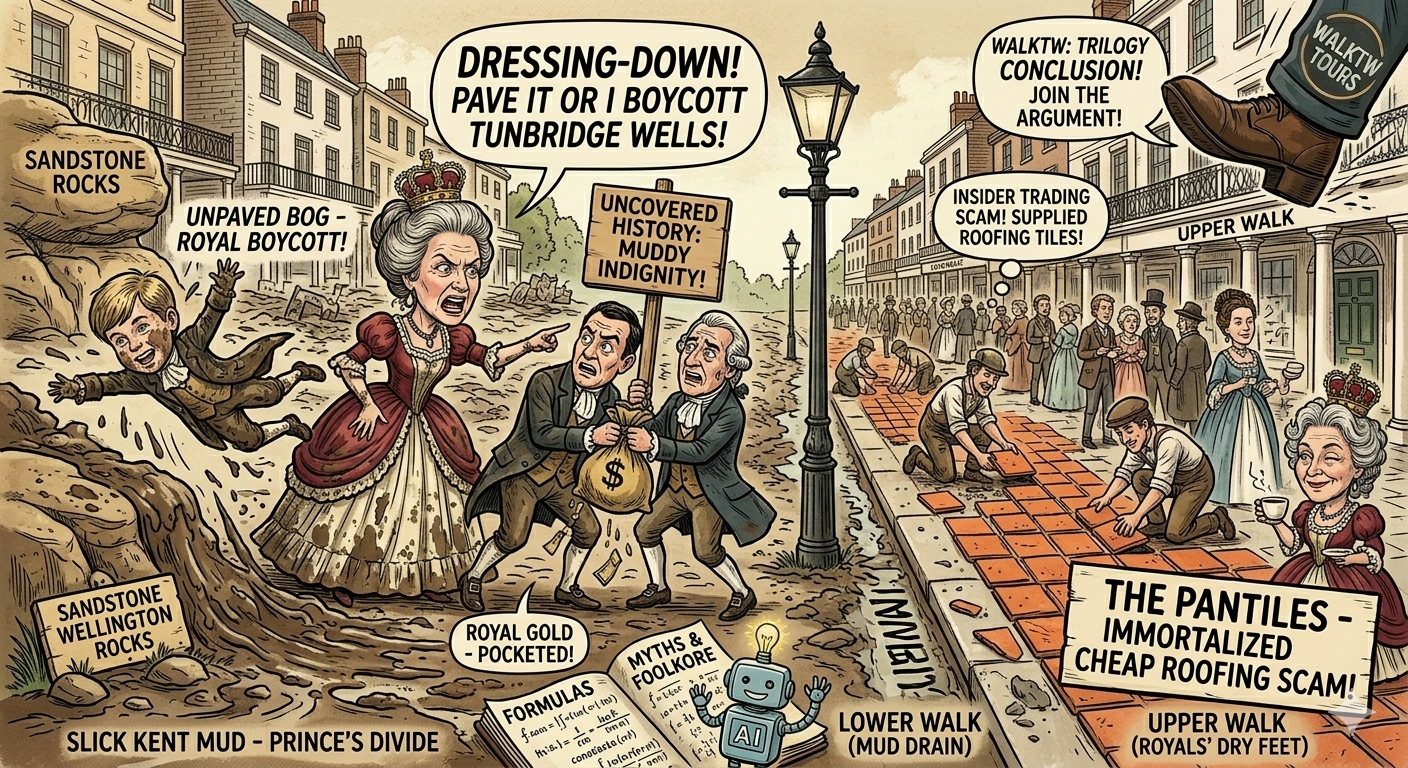
    Today, it’s one of the most beautiful avenues in Kent. But back in 1698, it was a total mud bath. The entire identity of our town—and its most famous landmark—was accidentally decided because a future king lost his footing. Additionally, a furious queen lost her patience, and a pair of corrupt local lords tried to pocket the development cash. This is just one of the curious stories you’ll discover when exploring Pantiles history. In fact, Pantile’s history is filled with colourful incidents and memorable characters.

    The Day the Prince Ate Dirt

    Our story begins with an adorable, five-year-old boy named Prince William, Duke of Gloucester. He was the only surviving child of Princess Anne (who would later become Queen Anne). In addition, he was the absolute obsession of high society. Because the young prince was a bit sickly, his mother brought him down to Tunbridge Wells for the summer to drink the iron-rich spring waters. Furthermore, understanding Pantiles’ history helps us appreciate the significance of this royal visit.

    On a particularly damp afternoon, the young prince was charging along the Upper Walk when he hit a patch of classic, slick Kent mud.

    Before his royal handlers could intervene, the heir to the British throne went flying, wiping out spectacularly in the dirt. Princess Anne was absolutely horrified. Muddy, furious, and fiercely protective, she rounded on the local town managers and gave them an absolute dressing-down.

    She demanded that the promenade be paved immediately so her son would never have to brave the muddy indignity again. To make sure it happened, she handed over a massive sum of cash. Then she told them she’d be back next year, and swept out of town.

    2. The Rogue Managers and the Missing Cash

    Enter our villains: a pair of local, smooth-talking lords who were in charge of the town’s upkeep.

    Instead of immediately hiring stonemasons, they looked at the heavy sack of royal gold and thought, “Well, the Princess won’t be back for twelve whole months…” They pocketed the cash, spent the winter living the high life, and completely ignored the promenade. The road remained a treacherous, muddy bog. Consequently, this episode of Pantiles history adds intrigue to the town’s legacy.

    Summer 1699 rolled around, and Princess Anne’s carriage rattled back into Tunbridge Wells. She stepped out, looked down, and saw that the Upper Walk was just as filthy and unpaved as the day her son had taken his royal dive.

    Anne was utterly dynamic in her rage. She didn’t just write a strongly worded letter; she effectively boycotted the entire town. She hopped back into her carriage, swore she would never return to Tunbridge Wells until the place was properly paved, and took her massive, high-spending royal entourage down to rival spa towns instead.

    The Pan-Tiling Panic

    The local business owners went into an absolute meltdown. The town’s economy was heavily reliant on royal favour, and the corrupt managers had just starved them of their best customers.

    In a desperate, frantic rush to win back the future Queen, the local authorities fired the managers and bought the cheapest, fastest-available paving materials on short notice: baked clay tiles called “pan-tiles.” They weren’t smooth, elegant flagstones; they were rough, orange-red, square earthenware tiles usually used for roofing. Workers laid them down in a record-breaking scramble. As a result, they created a bizarre, brightly coloured, heavily textured walkway that became central to Pantiles’ history.

    The emergency rebrand worked. The walkway became known across the country as “The Pantiles.” Even though those cheap clay tiles were eventually stripped up and replaced with grander stone in the 1790s, the name stuck for centuries. Therefore, a corrupt local scam and a royal slip-and-slide were immortalised.

    What to Spot in 2026

    You don’t need to look hard to see the echoes of the great paving panic today:

    • The Topographical Dip: Notice how the Lower Walk sits significantly lower than the Upper Walk. That structural split was emphasised during the frantic paving scramble to ensure water drained away from the main promenade. As a result, the royals would always have dry feet.
    • The Surviving Tiles: While the orange clay pan-tiles were largely replaced with stone, look closely at the threshold steps of some of the oldest, untouched shop entrances along the Upper Walk. You can still spot a few heavily weathered, deep-red clay inserts hidden in the brickwork.

    🕵️‍♂️ Fact or Fiction? Join the Investigation!

    Our trilogy is wrapping up, which means it’s time for the final WalkTW detective meeting in the comments. What do you think is historical truth, and what is pure local folklore? Without a doubt, there are still mysteries to be uncovered in Pantiles history.

    • Myth #1: The Cursed Left Foot. An old legend says the young Prince slipped specifically on his left heel. For decades, highly superstitious Georgian visitors would only step onto the Upper Walk with their right foot first. This was done to avoid “the Prince’s bad luck.”
    • Myth #2: The Hidden Royal Cache. A rumour persists that the corrupt managers didn’t actually spend all of Princess Anne’s gold—they buried a portion of it in a lead box right beneath the foundations of the walk to keep it hidden when she returned in a rage.
    • Myth #3: The Roofing Conspiracy. Some historians joke that the local tile-maker who supplied the emergency pan-tiles was actually the brother-in-law of one of the town managers. Therefore, the entire “emergency rush” was just a highly orchestrated insider trading scam to clear out excess warehouse stock.

    What’s your verdict? Have you ever taken a clumsy trip on the stones after a rainy Kent afternoon? Let us know your thoughts in the comments! 👇

    And that concludes our opening trilogy! A massive thank you to everyone who has read, shared, and argued over these stories. We are just getting started.

    #TunbridgeWells #ThePantiles #PavingScandal #QueenAnne #LocalHistory #WalkTW #RoyalGossip

  • The Great Theatre Wars (and the Woman Who Broke the Border) 🎭⚔️

    The Great Theatre Wars (and the Woman Who Broke the Border) 🎭⚔️

    If you’ve been following our town-planning rivalries, you already know that Royal Tunbridge Wells didn’t become a premium destination by playing nice. It was forged in the fires of pettiness. And if you think modern business competition in 2026 is brutal, let me introduce you to the ultimate theatrical heavyweight match of the early 1800s: Sarah Baker vs. Mr. Glassington. Not many local legends loom as large in Tunbridge Wells as Sarah Baker.

    The Battle of the Theatres (Crushing the Competition)

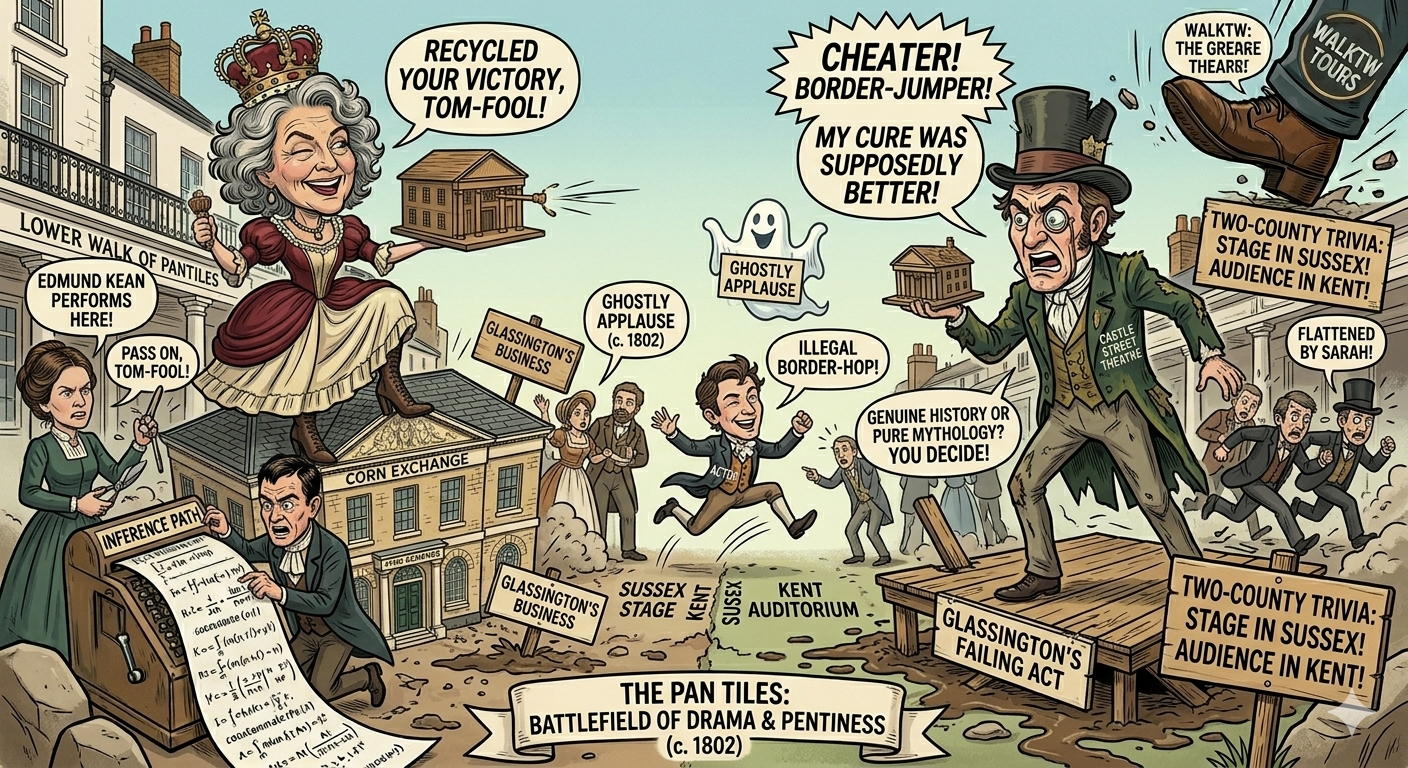
    When Sarah first rolled her theater carts into Tunbridge Wells, she didn’t have the market cornered. A rival manager, a rather dignified gentleman named Mr. Glassington, ran a competing theatre over on Castle Street.
    For a brief, high-stakes period, they went head-to-head. They scheduled plays on the exact same nights, actively trying to steal the same small pool of wealthy, water-sipping aristocrats. Glassington thought he could out-class Sarah Baker. He was wrong.
    Sarah didn’t just out-market him; she completely crushed his business. Once Glassington was safely driven out of town, Sarah pulled off the ultimate power move: she reportedly demolished her own old, out-of-the-way theatre (“The Temple of the Muses” up on Mount Sion) and used its actual physical timber and bricks to fortify her brand-new, unstoppable stronghold on The Pantiles. Talk about recycling your victories.

    The Legend of the Split Counties

    Once the theatre opened in 1802, it instantly generated the best geographic trivia the town had ever heard. Because Sarah Baker had built the venue directly on the historic boundary line between Kent and Sussex, a wild rumour took hold of the public imagination:

    • The Legend: It was widely whispered that the stage sat squarely in Sussex, while the audience’s seats were anchored in Kent.
    • The Gossip: Locals loved the idea that actors literally “crossed the border” every time they made a dramatic entrance, meaning the audience was sitting in one county, paying Kentish ticket prices, to watch a show happening in an entirely different county.

    The “Tom-Fool” at the Box Office

    By 1806, Sarah Baker was one of the wealthiest self-made women in the south of England. She could have hired an army of staff. Instead, she chose to remain a chaotic spectacle at her own front door.
    Every single night, Sarah sat at the box office entrance herself. To flaunt her immense wealth, she surrounded herself with blazing silver candlesticks and a massive, heavy silver inkstand. Spread right in front of her were her grand account books. The hilarious catch? She couldn’t actually read or write. But what she lacked in literacy, she made up for in volume. Sarah Baker had absolutely zero patience for dallying theatregoers. If a wealthy lord or an upper-class dandy fumbled with their coins or moved too slowly through the queue, the illiterate “Governess General” of Kent would loudly scold them in front of the entire street, shouting:“Pass on, Tom-Fool!”

    A Brush with Legend: The Superstar Incubator

    Despite her terrifying box-office etiquette, Sarah had an unmatched eye for raw talent. Her Pantiles stage became the ultimate testing ground for actors who would go on to become national legends.
    Before he became a household name and arguably the greatest British actor of the nineteenth century, a young, unknown Edmund Kean trod the boards right here in Tunbridge Wells, taking notes from an illiterate fairground dancer who knew exactly how to hook an audience. Unsurprisingly, Sarah Baker stories are woven through the history of British theatre.

    🕵️‍♂️ Fact or Fiction: Help Us Untangle the Rumors!

    Our comment section is the official 2026 WalkTW archive office. Let’s look at the latest rumours swirling around Sarah and Glassington—which ones do you think hold water? Also, if you know any surprising Sarah Baker facts, please add them below.

    • Myth #1: The Ghost of the Ruined Rival. Local legend says that Mr. Glassington was so heartbroken by Sarah destroying his business that his ghost cursed the bricks she stole from Mount Sion. Some say that if a performance went too well, a brick would mysteriously fall from the rafters—Glassington’s final, petty critique from beyond the grave.
    • Myth #2: The Illegal Border-Hop. Rumour has it that local smugglers used the “Two-County” layout to outsmart the law. If Kent constables raided the auditorium to catch a thief, the suspect would simply jump onto the stage into “Sussex,” leaving the officers legally stranded without a cross-county warrant.
    • Myth #3: The Coded Books. Some believe Sarah’s unreadable account books weren’t a sign of illiteracy at all, but a highly sophisticated, secret code she invented to hide her true earnings from the tax collectors and corrupt town managers.
      Next time you walk past the Corn Exchange and look up at the statue of Ceres on the roof, just picture Sarah Baker sitting below it, surrounded by silver, calling someone a Tom-Fool. What’s your take on the border-jumping theatre? Let’s argue about it below! 👇
      Next up in the trilogy: The Great Paving Scandal—how a royal slip-and-slide in the mud and a pair of corrupt local managers accidentally gave The Pantiles its iconic name. Stay tuned! 👑🧱

    TunbridgeWells #ThePantiles #SarahBaker #LocalHistory #TownPlanningWars #WalkTW

  • The Theatre Queen of The Pantiles 🎭👑

    The Theatre Queen of The Pantiles 🎭👑

    Picture this: It’s 1801. The morning mist is rising off the Chalybeate Spring, and the self-appointed town bosses are smoothing down their waistcoats, desperate to keep Tunbridge Wells a quiet, sleepy, perfectly proper spa town. But behind the scenes, something new was about to arrive: the Sarah Baker Theatre. They want the visiting aristocrats to sip their rust-flavoured water, go for a polite stroll, and go to bed early.

    Then, marching right down the middle of the Lower Walk, comes Sarah Baker. It was her presence that brought the energy and audacity that defined the iconic Sarah Baker Theatre in local history.

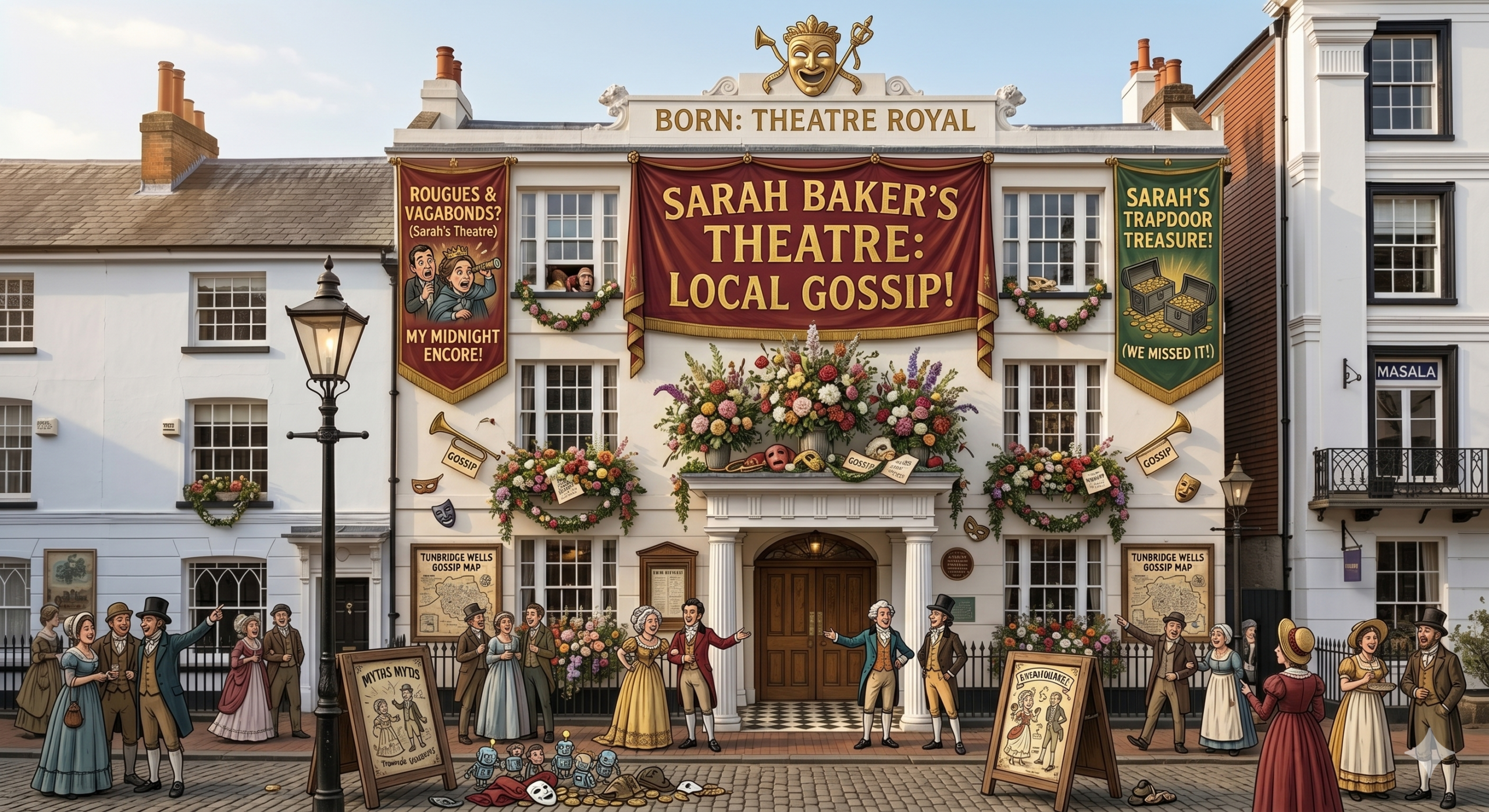
    If you think getting planning permission in town is a nightmare today in 2026, imagine the sheer panic when a widowed, self-made businesswoman—who started her career as a fairground dancer—decided to drop a massive, rowdy, brick-and-stone temple of raw drama right in the middle of their elite, male-dominated promenade. Overnight, the Sarah Baker Theatre changed the cultural map of Tunbridge Wells.

    The local authorities were horrified. To them, actors and theatre crews were little better than “rogues and vagabonds” threatening to ruin the town’s peaceful image. But Sarah looked at the bored rich people wandering the streets and knew a fundamental human truth: they didn’t just want water. They wanted a show.

    The Roar of the Crowd on the Lower Walk

    Defying local protests and furious glares, Sarah built her theatre, and it became an absolute sensation. Suddenly, the quiet pathway of the lower walks was the loudest, most vibrant hotspot in Kent. On any given night, you could hear high-stakes Shakespearean tragedies clashing with the roaring laughter of late-night pantomimes. This crowd energy made the Sarah Baker Theatre legendary throughout the region.

    Sarah ran the place with an iron fist and a razor-sharp wit. She was a master of handling snobbery. Whenever wealthy patrons tried to look down on her because of her humble roots, she didn’t argue. Instead, she would stand right at the box office herself, loudly and aggressively counting the night’s massive cash take right in front of their faces.

    She brought the biggest stars of the era, like the legendary Edmund Kean, straight to our doorstep. For a golden era, Sarah didn’t just run a business—she owned the town’s cultural heartbeat.

    Swapping Out the Drama for the Harvest

    But as the decades rolled on and the Victorian era took hold, the town’s mood shifted again. High society started favouring sober, industrious commerce over late-night theatrical chaos. In the late 1830s, the curtain came down on Sarah’s stage for the last time, and the building was converted into the Corn Exchange, becoming a bustling hub for agricultural trading.

    To make the rebrand official, they hoisted a massive statue of Ceres, the Roman Goddess of Harvest, onto the roof. It was the ultimate Victorian cover-up: replacing Sarah Baker’s dramatic, rebellious flair with a polite, stone face of serious business.

    Step into Sarah’s Footsteps Today (2026 Edition)

    The best part about this story? You can walk right into the middle of it on your next weekend stroll. Next time you’re walking down the Lower Walk of The Pantiles, stop and look up at the Corn Exchange. Indeed, the Sarah Baker Theatre was at the heart of this historic site.

    • The Sentry on the Roof: Look right up at the roofline, and you’ll see Ceres still standing guard, looking down at the modern shoppers, coffee drinkers, and weekend markets.
    • Standing on the Stage: Walk through the main entrance of the building. While the interior is now a beautifully vibrant space filled with independent shops and cafes, your feet are resting on the exact physical footprint where Regency actors once projected their voices to packed, cheering crowds.

    🕵️‍♂️ Fact or Fiction? You Decide!

    Because Sarah’s theatre was such a lightning rod for local gossip, our archives are riddled with some legendary rumors. We need our WalkTW community to weigh in—what sounds like genuine history, and what is pure local mythology?

    • Myth #1: The Secret Royal Box. Word has it that a young Princess Victoria used to sneak away from her lodgings on the Common, throw on a commoner’s cloak as a disguise, and sit in the back row just to laugh at Sarah’s rowdiest comedies.
    • Myth #2: The Midnight Encore. Shop owners inside the Corn Exchange have whispered for generations that if you find yourself alone in the building past midnight, the air goes cold, and you can hear the faint, muffled sound of a crowd applauding, followed by a woman’s voice calling out “Places, everyone!”
    • Myth #3: The Trapdoor Treasure. Legend says that Sarah completely inherently distrusted local banks. Rumour has it she built a hidden trapdoor right beneath the centre of the stage where she buried iron lockboxes filled with gold coins from her ticket sales—and it was completely missed during the Victorian renovations.

    What do you think? Have you ever felt a bit of dramatic energy walking past the Corn Exchange, or is it just the caffeine hitting from your morning flat white? Let’s argue about it in the comments below! 👇

    Next up in the trilogy: The Great Paving Scandal—how a royal slip-and-slide in the mud and a pair of corrupt local managers accidentally gave The Pantiles its iconic name. Stay tuned! 👑🧱

    #TunbridgeWells #ThePantiles #SarahBaker #CornExchange #LocalHistory #WalkTW #RegencyGossip #SarahBakerTheatre

  • The Hidden History of Royal Tunbridge Wells: Exploring Its Lesser-Known Stories

    The Hidden History of Royal Tunbridge Wells: Exploring Its Lesser-Known Stories

    The Origins of Royal Tunbridge Wells

    • The Fact: In 1606, a hungover young aristocrat named Lord North stumbled upon a strange, rust-coloured, bubbling spring in a muddy valley. He drank it and claimed it cured his ailments. As a result, he accidentally birthed a booming spa destination. The history of Royal Tunbridge Wells truly began with this discovery. Because the valley was prone to flooding and lacked infrastructure, early entrepreneurs had to build lodging on the surrounding hills. Consequently, this created two distinct, hyper-rival communities facing off across the valley:
      • Mount Ephraim (The Rebels): Settled heavily by pious Puritans who named their hill after a biblical mountain. They kept things strict, sober, and business-focused.
      • Mount Sion (The Royals): Settled by the high-flying royalists, Anglicans, and courtiers who wanted luxury, gambling, and high fashion.
    • The Fiction: Local folklore long insisted that the Chalybeate Spring’s strange iron taste was caused by Saint Dunstan catching the Devil by the nose with a pair of red-hot tongs and discarding him into the local waters. While the Puritans loved a good “devil-defeating” origin story to justify their presence, the truth is just pure, unadulterated Wealden geology. In fact, if you study the history of Royal Tunbridge Wells, you’ll find it holds as many myths as documented facts.

    Hidden Gems and Stories

    • The Fact: For decades, a literal hilltop cold war played out across the Common. Touts from Mount Sion and Mount Ephraim would practically fight in the mud to drag wealthy tourists stepping off the London coaches up to their respective lodging houses. If you stayed on Ephraim, you were branded a boring prude. Conversely, if you stayed in Sion, you were a corrupt sinner. In conclusion, this rivalry has become one of the most fascinating episodes in the history of Royal Tunbridge Wells.
    • The Fiction: A lingering urban legend suggests that secret underground tunnels run directly from the cellars of Mount Ephraim’s Puritan houses all the way under the Common to the taverns of Mount Sion. These tunnels were allegedly built so the strict Puritans could sneak over for a covert drink and a game of dice away from watchful eyes. While our sandstone terrain is riddled with caves and fissures, these “hypocrite tunnels” are entirely a myth invented by Royalist gossip to ruin their rivals’ spotless reputations.

    Influences of Victorian Society

    • The Fact: Eventually, the valley grew enough to force the two hills to play nice. This was largely thanks to the iron fist of 18th-century “forum moderator” Beau Nash and the architectural boom under Master Builder William Willicombe. As the town expanded into the Victorian era, the architectural styling of the hills evolved. The strict, exposed timber-and-brick structures gave way to grand, smooth-stuccoed classical villas designed to project wealth, elegance, and an extreme sense of social order. Clearly, the history of Royal Tunbridge Wells is reflected in these shifting styles and the town’s physical landscape.
    • The Fiction: Victorian high-society guidebooks subtly hinted that the steep incline of Mount Sion Road was intentionally engineered as a moral filter for the town. The running joke among visitors was that the hill was deliberately made exhausting. This way, anyone lacking “fortitude and upright character” would give up and turn back before reaching the respectable estates at the top.

    The Modern-Day Perspective

    • The Fact: You can still experience this 350-year-old feud through your feet today. Because the massive, open green space of the Tunbridge Wells Common only exists as the literal, legally protected “No Man’s Land”, it kept the two warring factions apart. If you walk along the Mount Ephraim ridge today, you’ll notice the oldest mansions face straight out over the grass like watchtowers. In fact, they were deliberately built so the early landlords could spy on whatever antics their rival neighbours were up to.
    • The Fiction: Locals today joke that the ideological divide never truly died; it just transformed into a modern property war. Ask anyone living on Mount Ephraim, and they’ll claim the air is crisper and the views are superior. On the other hand, ask a Mount Sion resident, and they’ll argue they possess the true, creative soul of the town. We might complain about local parking and council potholes today, but at least we aren’t waging a holy war over who has the better hilltop bowling green! Finally, it’s worth noting that the history of Royal Tunbridge Wells continues to shape the town even today.

    #TunbridgeWells #LocalHistory #TownPlanningWars #MountEphraim #MountSion #RoyalTunbridgeWells #WalkTW