Tag: local legends

Myths, rumours, tall tales, and beloved local stories that have been passed down through the generations in and around Royal Tunbridge Wells.

  • The Battle of Little Mount Sion: Two Pubs, One Title, No Resolution 🍺👻

    The Battle of Little Mount Sion: Two Pubs, One Title, No Resolution 🍺👻


    The WalkTW Building Files🏛️🔍

    A Note Before We Begin

    Every WalkTW story so far has followed a person — a writer, a mathematician, a Russian baroness, a playwright — and used the buildings of this town as their backdrop (Thackeray’s window. Cumberland’s playwright. Defoe’s promenade.). In this piece, however, we’ll turn our attention to an event: The Battle of Little Mount Sion. The buildings were always there, waiting patiently in the margins.

    This is the series where the buildings get their turn.

    Tunbridge Wells is 400 years old. That is 400 years of people living, arguing, dying, drinking, conspiring and occasionally dropping dead of shock inside the same walls. Some of those walls are still standing. Some of them are on streets you walked past this morning without a second glance.

    The WalkTW Building Files is a new series — one building per post, investigated properly. Confirmed history, contested claims, rumours that won’t go away, and at least one question that nobody has yet managed to answer. Each post comes with directions, because the whole point is that you can go and stand in front of the building yourself and see what history has left behind.

    We start where Tunbridge Wells itself started — on the hill above the Chalybeate Spring, in the oldest streets in town, where two pubs have been arguing about the same thing for four hundred years.


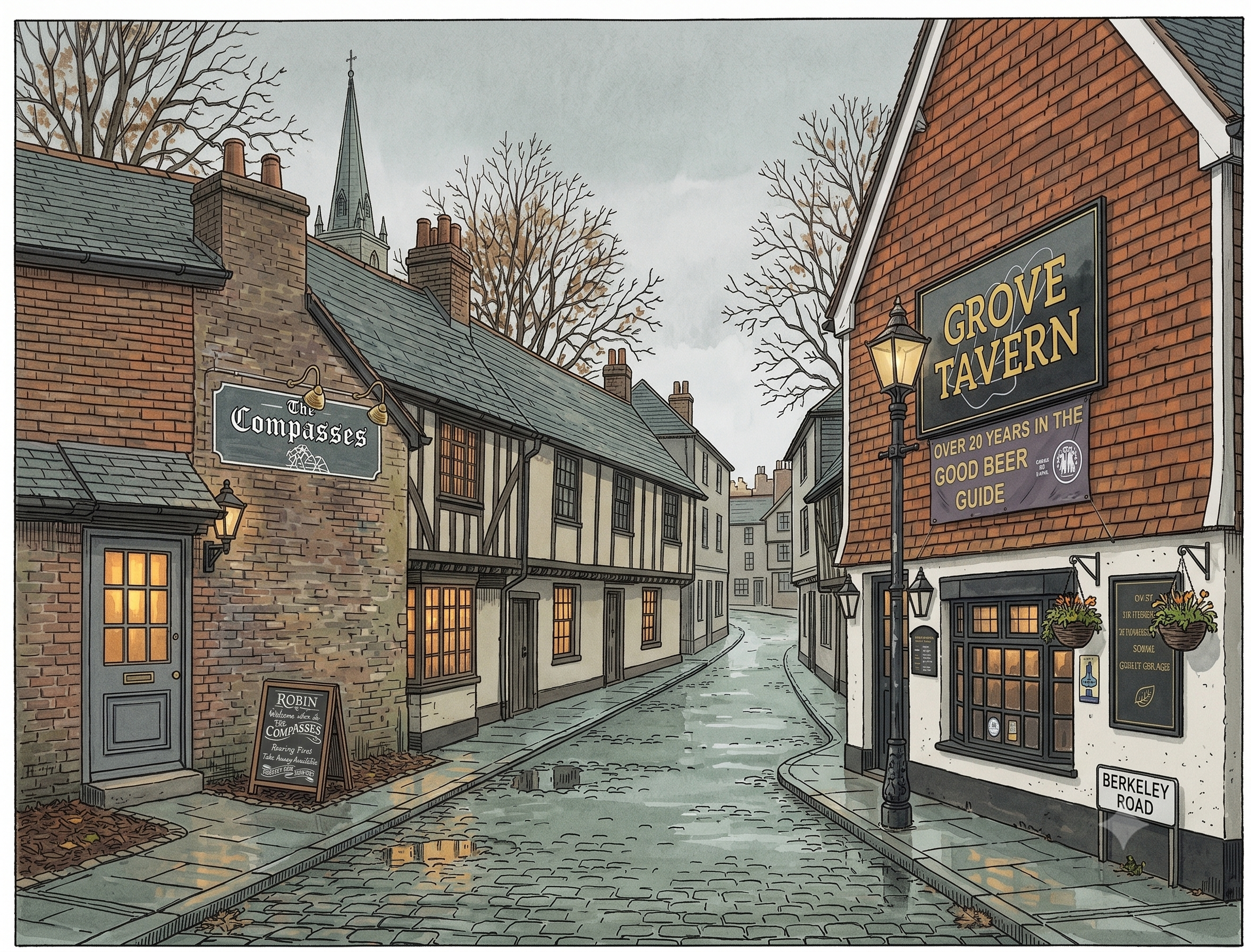
    The Compasses, 45 Little Mount Sion, TN1 1YP, and

    The Grove Tavern, 19 Berkeley Road, TN1 1YR

    They face each other across a quiet backstreet in the oldest part of Tunbridge Wells. Two small pubs, forty metres apart, both claiming to be the oldest buildings in town. Both with beams, open fires and ghost stories. Both have reasons to doubt the other’s claim.

    The Compasses is owned by Greene King and will tell you its history on a laminated card. The Grove Tavern is owned by its landlord and will tell you its history if you ask nicely and stay for a second pint.

    Between them, they contain more of Tunbridge Wells’s original character than almost anywhere else in the town. The question of which one is older may never be settled. The more interesting question is why nobody is properly asking it.


    The Hill Before the Town

    To understand Little Mount Sion, you need to understand what it was before Tunbridge Wells existed.

    When Lord North stumbled upon the Chalybeate Spring in 1606, there was nothing here — no town, no streets, no buildings. Just a spring in a field, two forested ridges on either side, and the ancient track between them. Tunbridge Wells was something of an artificial creation in the early to mid-17th century. Initially, there were no houses or hotels, just the spring, some shops, coffee houses and perhaps a pub or two in the area now called The Pantiles. Residential development only really started in the 1690s on Mount Sion and Mount Ephraim.

    But before that formal development, before the lodging houses and the Assembly Rooms and the paving scandal, there were encampments. Visitors to the spring in the earliest decades pitched tents and temporary structures on the hillsides. And where there are encampments, there is always, eventually, somewhere to drink.

    Those two ridges — Mount Sion and Mount Ephraim — were not neutral territory. If you have read our Mountain Feud post, you already know that the two hills were engaged in a cold war of competing religious and political identities throughout the 17th century. Mount Sion was Puritan, Parliamentarian, Nonconformist. Mount Ephraim was Royalist, Anglican, and fashionable. Little Mount Sion sat squarely in Puritan territory.

    One of the first buildings on Mount Sion was an ale-house, which is now the Grove Tavern. That claim comes from the Tunbridge Wells Civic Society — not from the pub’s own marketing. It is as authoritative as anything in the historical record.

    The Compasses, forty metres away on the same hill, says the same thing about itself.

    The Name That Greene King Doesn’t Mention

    The Greene King laminated card tells you the pub has had many names over the centuries — Compasses, Compasses Hotel, Compasses Inn, Three Compasses, Compasses and Horseshoe, Hogshead and Compasses.

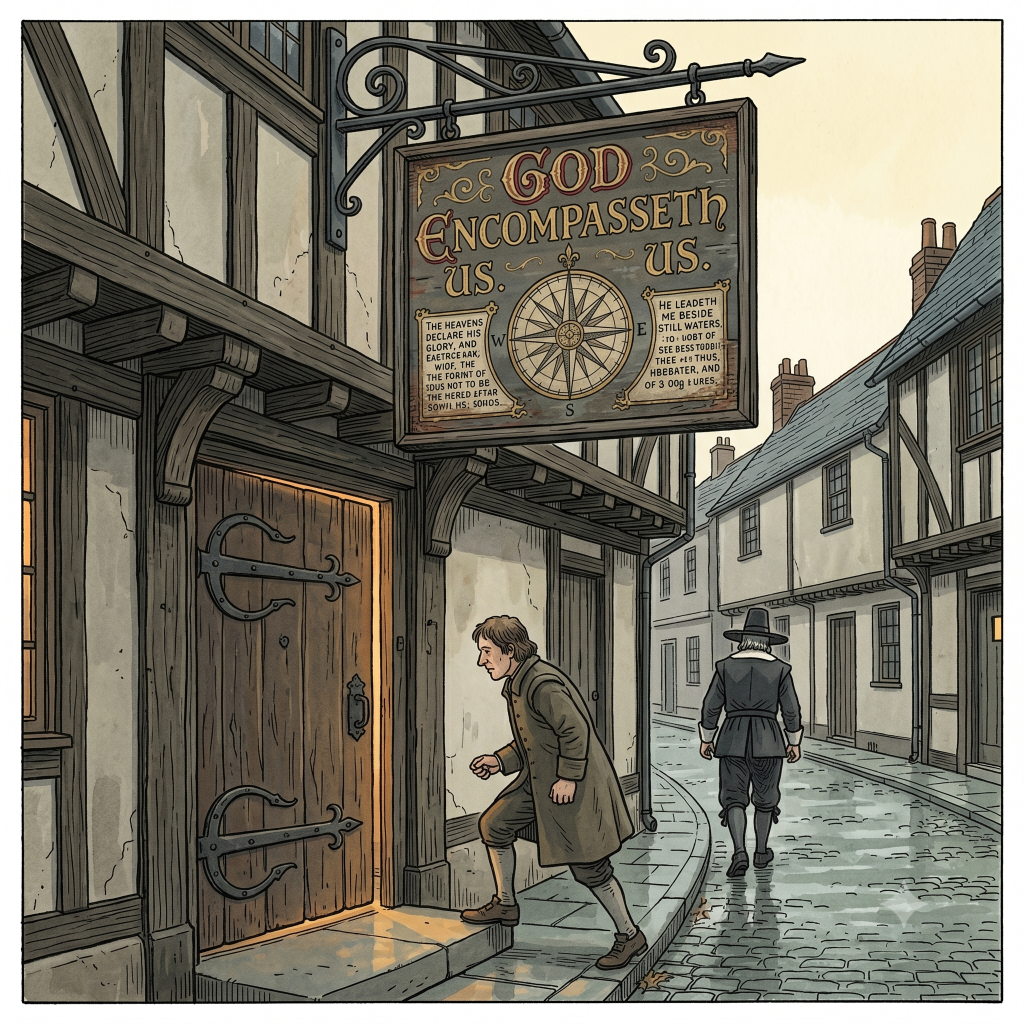
    What it doesn’t tell you is what it was called before all of those. Searching in the local library reveals that it used to be called The Goat and Compass, which is a very strange name. However, when you dig deeper, you discover that it was originally an inn called God Encompasseth Us — a reference to the Bible’s view of God surrounding or encompassing his people, found in Psalm 139:5 and Hebrews 12:1-2.

    Think about what that tells you. The earliest inn on this hill — in the 1630s, at the height of the Mountain Feud between the Puritan Mount Sion and the Royalist Mount Ephraim — was named after a Puritan scripture. God Encompasseth Us. This was a Puritan drinking house, on a Puritan hill, at a moment when the two ridges of Tunbridge Wells were engaged in a cold war of competing religious identities.

    The pub was, from its very beginning, a theological statement. It just gradually shortened its name until nobody remembered what it meant.

    The Night Mrs Pek Dropped Dead

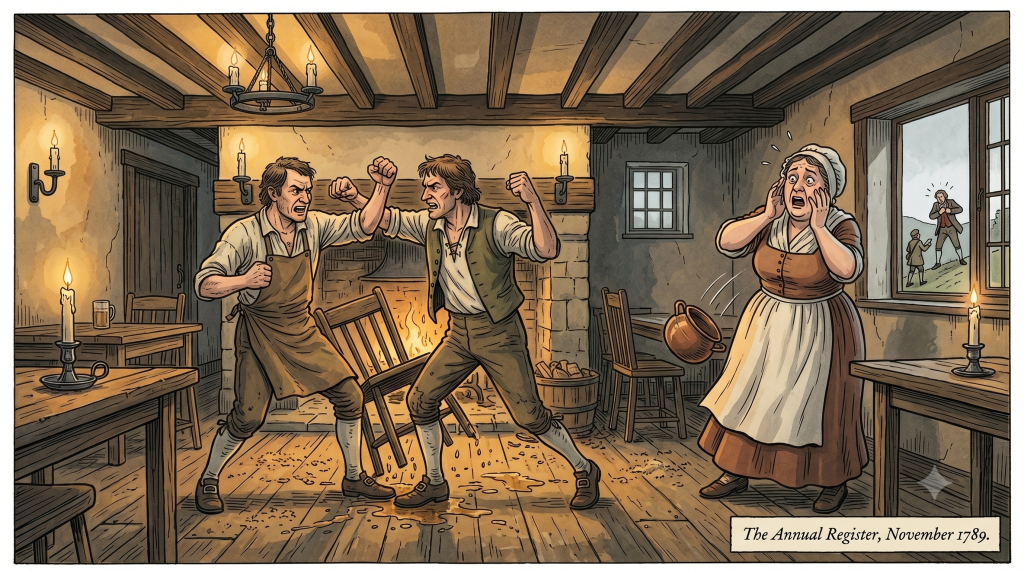
    The Greene King card contains a story sourced from the Annual Register of November 1789 that deserves to be far better known than it is.

    The landlady at the time was a Mrs Pek. One evening, a turner called Fenner — believed to be related to William Fenner, one of the best-known makers of Tunbridge Ware — and a carpenter called Philpot were drinking together at the pub. A quarrel arose between them, which proceeded to blows. The fight went on for some time.

    The sight of the brawl so greatly affected Mrs Pek that she dropped dead. Although she was given medical help immediately, it was fatal.

    But here is the detail that elevates this from a pub fight into something stranger. When news of Mrs Pek’s death was relayed to a Mr Field at Mount Ephraim — about half a mile away, who was a relative of the deceased — the shock was so great that he dropped dead too, while the story was being related to him.

    Two people died as a direct result of a carpenter and a turner having an argument in a Tunbridge Wells pub in 1789. One of them was half a mile away when it happened. This is documented in the Annual Register. It is real. The next landlord, a Mr D. Schooler, also died at the inn in 1803.


    The Exorcist, the Little Girl and the Angry Spirit

    At some point in the pub’s history, one landlord had an exorcist attend, due to what the card describes only as “some activity.” The Compasses is said to be haunted by the spirit of a little girl who allegedly died on the premises. Her mother — described in the card as a prostitute — was murdered by her father on the same site.

    Witnesses report shadows moving around the ground floor, sudden cold spots, the feeling of someone breathing over their shoulders, whispering in their ears. One member of staff has seen the ghost of a woman wearing a white coat-like garment.

    Soul Searchers Kent, a paranormal investigation team, investigated the pub after receiving a call from the landlord. One ghost hunt ended when an angry and aggressive spirit shouted “Get out” at the paranormal team.

    The paranormal team left.

    Whether the spirit was the little girl, the murdered mother, the deceased Mrs Pek, the late Mr Schooler, or simply a Greene King customer who had been waiting too long for their food is not recorded.

    This is not, incidentally, the only violent history on this street. The Capital of Infidelity series has already established that Georgian Tunbridge Wells ran on assignations, gambling and the management of appearances. The backstreets of Mount Sion were where the less respectable ends of that economy operated. Little Mount Sion was never quite as genteel as it looked.

    Across the Street: Josh in the Cellar

    While The Compasses accumulates its catalogue of deaths, exorcists and aggressive spirits, the Grove Tavern, forty metres away, has been quietly conducting its own supernatural affairs with rather more specificity.

    The Grove Tavern was originally known as Brett’s boarding house, Chapel House, and the Grove in Mount Sion. The Brett family had extensive land holdings in the area. Later, the tap house was no doubt added to quench the visitors’ thirst.

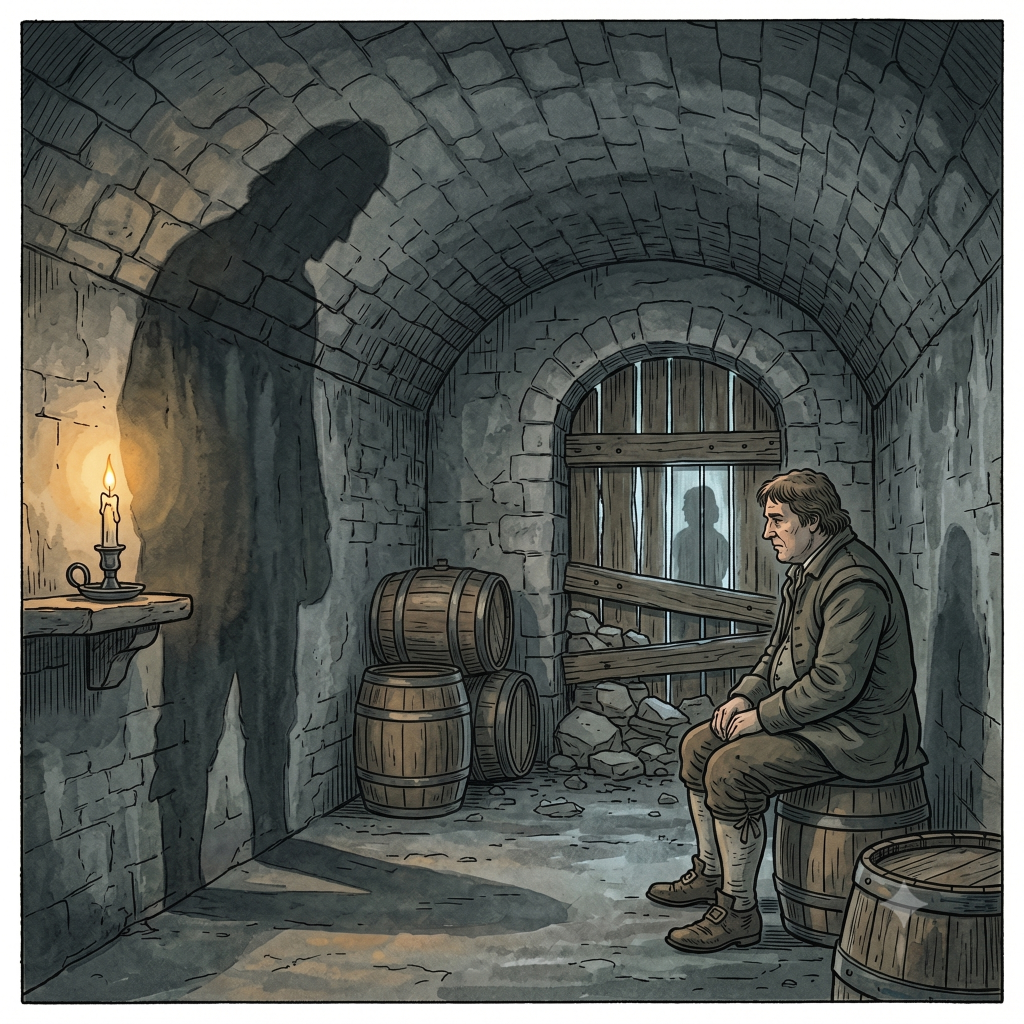
    The ghost at the Grove Tavern has a name. The ghost reported to be haunting there is named Josh. The owner reported that he was a former cellar man waiting for his lady to come through the tunnel to the cellar for a clandestine meeting.

    This detail requires unpacking. Legend states that tunnels ran beneath Little Mount Sion and other areas of the town. One is said to have led from a house across the street to the cellar of the Grove Tavern, and this house was one of ill repute. The gentlemen of the inn would greet ladies of the night there or even in the tunnel for some discreet meetings.

    This puts Josh firmly in the same world that Daniel Defoe documented when he rode into town in 1722 and noted the “gaming, sharping, intriguing” with the eye of a man who had seen everything. The tunnels beneath Little Mount Sion were, apparently, part of the infrastructure of that intriguing.

    Josh, the cellar man, is still waiting. The tunnel presumably still exists beneath the street, whether blocked or forgotten. The house of ill repute across the road is now something else entirely. The lady never arrived. Josh has been in the cellar since the 17th century.

    The Grove Tavern is Grade II listed. Its listing was granted on 7 June 1974. English Heritage saw fit to protect this building. Nobody mentioned Josh in the paperwork.


    The Grove Behind the Compasses

    One detail from the Greene King card that connects both pubs to the wider history of the hill: behind The Compasses was the old Grove Park, where visitors to the spa would take their strolls after dining or listen to the orchestra on the bandstand, which is no longer there.

    That same promenading culture — the performance of respectability over a private reality of gaming and assignation — runs through the entire Capital of Infidelity trilogy. The Georgian visitors who strolled in Grove Park after dinner were the same people conducting their less reputable business in the tunnels beneath the street. Tunbridge Wells has always been very good at holding both in balance.

    The bandstand is gone. The grove is gone. The spa visitors are gone. The orchestra is gone. The tunnel may or may not still be there.

    What remains: two small pubs, forty metres apart, still arguing about which one is older, on a hill that has been continuously occupied since before Tunbridge Wells had a name.


    The WalkTW Verdict on the Oldest Pub Question

    Honest answer: We cannot settle it. The historical record is genuinely ambiguous.

    The Compasses has the more documented paper trail — the 1718 ownership record, the Annual Register account, and the multiple name changes that suggest continuous operation over centuries. The name God Encompasseth Us anchors it to the very earliest years of the town’s development.

    The Grove Tavern has the more credible origin story — Brett’s boarding house predating the formal development of Mount Sion, the Civic Society’s assessment that it was one of the first buildings on the hill, the Grade II listing that formally recognises its historic significance.

    One of the first buildings on Mount Sion was an ale-house, which is now the Grove Tavern. But there may have been places on The Pantiles that we would consider pubs, too.

    The honest answer is that the question of the oldest pub in Tunbridge Wells may have no clean resolution — because the town itself grew too gradually and informally in its earliest decades to leave the kind of paper trail that would settle it definitively.

    What we can say with confidence: both pubs are on the oldest surviving street in Tunbridge Wells, in buildings that have been serving drinks since the town was new, forty metres apart, and both are worth your time.


    🗺️ Go Find Them Today

    Both pubs are on Little Mount Sion — the quiet backstreet running parallel to the High Street, five minutes from the station and two minutes from The Pantiles. Walk up from the Chalybeate Spring, turn left past the Church of King Charles the Martyr, and you will find them facing each other across the street.

    The Compasses — 45 Little Mount Sion, TN1 1YP. Greene King pub, food served, family friendly, open fires in winter. The laminated history card is on display inside. Ask about the exorcist.

    The Grove Tavern — 19 Berkeley Road, TN1 1YR. Independent, no food, proper real ale, dog friendly, one bar. Steve Baxter has been a landlord since 2003 and knows the building better than anyone. Ask about Josh.

    Visit both in the same afternoon. The pubs are forty metres apart, and the beer is better at the Grove. The ghost stories are better at The Compasses. Order accordingly.


    🕵️ The Open Questions

    Three things the WalkTW archive cannot yet answer:

    Question 1: The Tunnel. Does the tunnel beneath Little Mount Sion still exist? Is it blocked, bricked up, forgotten, or still accessible from somewhere? The Grove Tavern’s cellar presumably connects to something. Has anyone looked?

    Question 2: The Little Girl. The Greene King card says the researchers are currently unable to locate any children living at the inn in the historical record, but will keep researching. Has anyone found her? A child dying on licensed premises would have generated a coroner’s record, a newspaper report, something. Does anyone know where to look?

    Question 3: The Original Name. God Encompasseth Us is the most extraordinary pub name in Tunbridge Wells history. When exactly did it change, and why? Was it a deliberate secularisation as the town’s Puritan character faded? Was it simply worn down by generations of drinkers who couldn’t be bothered with the theology? The local library apparently has the records. Has anyone checked?

    Drop what you know in the comments. The Building Files are open. 👇

    The WalkTW Building Files continue. Next up: the building on The Pantiles where a stage crossed a county border, a Ceres statue watches from the roof, and the ghost of a Georgian actress may or may not be taking a curtain call in the antiques market below.

    #TunbridgeWells #WalkTW #BuildingFiles #TheCompasses #GroveTavern #LittleMountSion #LocalHistory #GhostStories #OldestPub #HiddenTunbridgeWells
  • Top 10 Myths, Rumours, and Questionable Truths of Royal Tunbridge Wells 🕵️‍♂️✨

    Top 10 Myths, Rumours, and Questionable Truths of Royal Tunbridge Wells 🕵️‍♂️✨

    Every local history book will tell you about the discovery of the Chalybeate Spring, the grand visits of Queen Victoria, and the elegant architecture of Decimus Burton. But let’s be honest: towns aren’t built on polite tea parties. They are built on whispers, eccentric characters, and centuries of high-society gossip.

    If you peel back the polished layers of our classic spa town, you find an alternate history—one filled with bizarre landscape feuds, subterranean highways, and questionable local legends. Many of these stories are what make up the fascinating collection of Tunbridge Wells myths.

    Here are the top 10 myths and rumours floating around Royal Tunbridge Wells. Some are absolute historical fact, some are beautifully embroidered fiction, and others sit in that glorious, murky middle ground. We’ll let you decide where the truth lies.

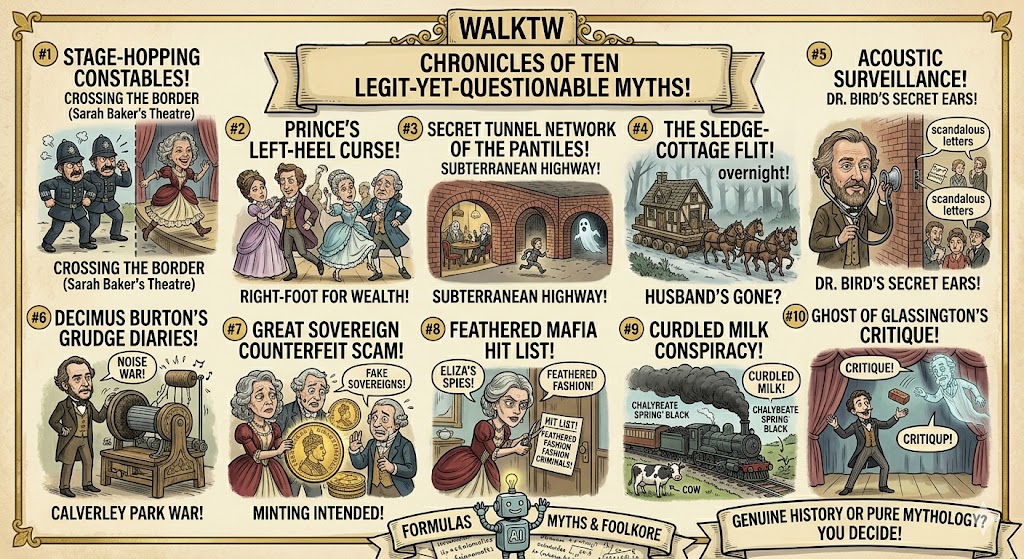
    1. The Stage-Hopping Constables (The Two-County Theatre)

    • The Legend: When the legendary “Theatre Queen” Sarah Baker built her permanent theater on The Pantiles in 1802 (now the Corn Exchange), it was erected directly over the boundary line separating Kent and Sussex. Rumor has it that local smugglers and thieves exploited this layout for decades. If the Kent constables rushed the auditorium to make an arrest, the suspect would simply leap onto the stage into “Sussex,” legally trapping the officers who didn’t possess a cross-county warrant.

    2. The Prince’s Left-Heel Curse

    • The Legend: We all know the story of young Prince William slipping in the mud in 1698, prompting a furious Princess Anne to demand the promenade be paved with “pan-tiles.” But highly superstitious Georgian visitors took it a step further. It was widely whispered that the Prince fell specifically on his left heel. For decades, anxious aristocrats would only step onto the Upper Walk with their right foot first, genuinely believing that leading with the left would invite immediate financial ruin at the local gaming tables.

    3. The Secret Tunnel Network of The Pantiles

    • The Legend: For centuries, building contractors excavating cellars along the Upper and Lower Walks have whispered about hitting bricked-up structural arches that appear on no official town maps. The prevailing local myth is that during the height of the 18th-century gambling craze, a massive subterranean highway system connected the major taverns. This allegedly allowed high-rolling lords, cheating politicians, and illicit lovers to vanish underground the moment the local watchmen conducted a late-night raid.

    4. The Sledge-Cottage Flit

    • The Legend: In the early days of the spa, enterprising locals actually constructed several small lodging houses on massive wooden sledges or wheels. The official historical reason was “to suit the changing preferences of seasonal tenants,” but the local rumour mill always insisted on a much more scandalous purpose. If a suspicious, wealthy husband unexpectedly announced he was riding down from London, a mistress’s entire cottage could literally be hooked up to a team of horses and dragged deep into the Common woods overnight, leaving nothing but tire tracks.

    5. Dr Golding Bird’s Acoustic Surveillance

    • The Legend: Dr Golding Bird, buried in Woodbury Park Cemetery, was a brilliant Victorian medical pioneer who helped invent the flexible stethoscope. However, the town’s elite whispered that his interest in the physics of sound wasn’t purely medical. Rumour has it he modified his early stethoscopes and acoustic tubes to listen through the thick walls of neighbouring lodging houses, turning his medical rounds into a highly sophisticated information-gathering mission.

    6. The Decimus Burton Grudge Diaries

    • The Legend: The incredibly wealthy, famously irritable retired officers who moved into the exclusive Calverley Park estate expected absolute serenity. When the railway whistle and street musicians began infiltrating the area, an intense noise war broke out. Local lore claims one particularly grumpy colonel built a completely soundproof “crying room” lined entirely with horsehair mattress padding just so he could scream out his frustrations about his neighbours without breaking his polite upper-class composure.

    7. The Great Sovereign Counterfeit Scam

    • The Legend: The gambling dens operating behind the Lower Walk were notoriously cutthroat, but in the late 1700s, a ring of bankrupt aristocrats allegedly kept their high-flying lifestyles afloat using highly sophisticated fake currency. Because the local tradesmen and tavern keepers were far too intimidated to question or inspect money handed to them by a Duke or a Lord, a secret mint operating out of a Mount Sion mansion successfully flooded the local economy with counterfeit gold sovereigns for years.

    8. The Feathered Mafia Hit List

    • The Legend: Long before Eliza Phillips officially co-founded what became the RSPB, she waged a fierce war against the Victorian obsession with taxidermy fashion (where women wore entire stuffed birds on their hats). Local gossip tells us Eliza ran a militant network of “high-tea spies.” If an elite lady stepped onto the promenade wearing an endangered plume, her name, address, and social crimes were secretly slipped under the doors of the town’s assembly rooms, leading to immediate, devastating social boycotts over afternoon tea.

    9. The Curdled Milk Conspiracy

    • The Legend: When railway planners proposed extending the tracks into the center of town in the 1840s, a secret alliance of wealthy hotel owners and traditional horse-coach operators fought it tooth and nail. To terrify the public, they funded a bizarre propaganda campaign, spreading the rumour that the sulfurous smoke from locomotive engines would permanently turn the water of the Chalybeate Spring black and cause the milk to instantly curdle inside the local dairy cows.

    10. The Ghost of Mr Glassington’s Critique

    • The Legend: After Sarah Baker completely crushed her theatrical rival, Mr Glassington, and drove him out of business on Castle Street, she allegedly dismantled his old theatre and used the timber to fortify her own. Ever since, actors performing on that site have blamed “The Ghost of Glassington” for any bad reviews. The rumour is that if an actor’s performance was particularly terrible or lacked artistic class, a single, structural brick would mysteriously dislodge and drop from the rafters—Glassington’s final, petty critique from beyond the grave.

    🕵️‍♂️ WalkTW Archive Meeting: What’s Your Verdict?

    Every great myth has a kernel of truth hidden inside it. Which of these 10 stories do you think is genuine history, and which one is pure, unfiltered local mythology? Have you ever stumbled upon a bricked-up arch or walked the Common looking for sledge tracks?

    Drop your theories, corrections, or your own family rumoursen in the comments below! Let’s untangle the gossip together. 👇

    #TunbridgeWells #ThePantiles #LocalMyths #WalkTW #HistoryGossip #KentHistory

  • The Great Paving Scandal (The Royal Slip-and-Slide) 👑🧱

    The Great Paving Scandal (The Royal Slip-and-Slide) 👑🧱

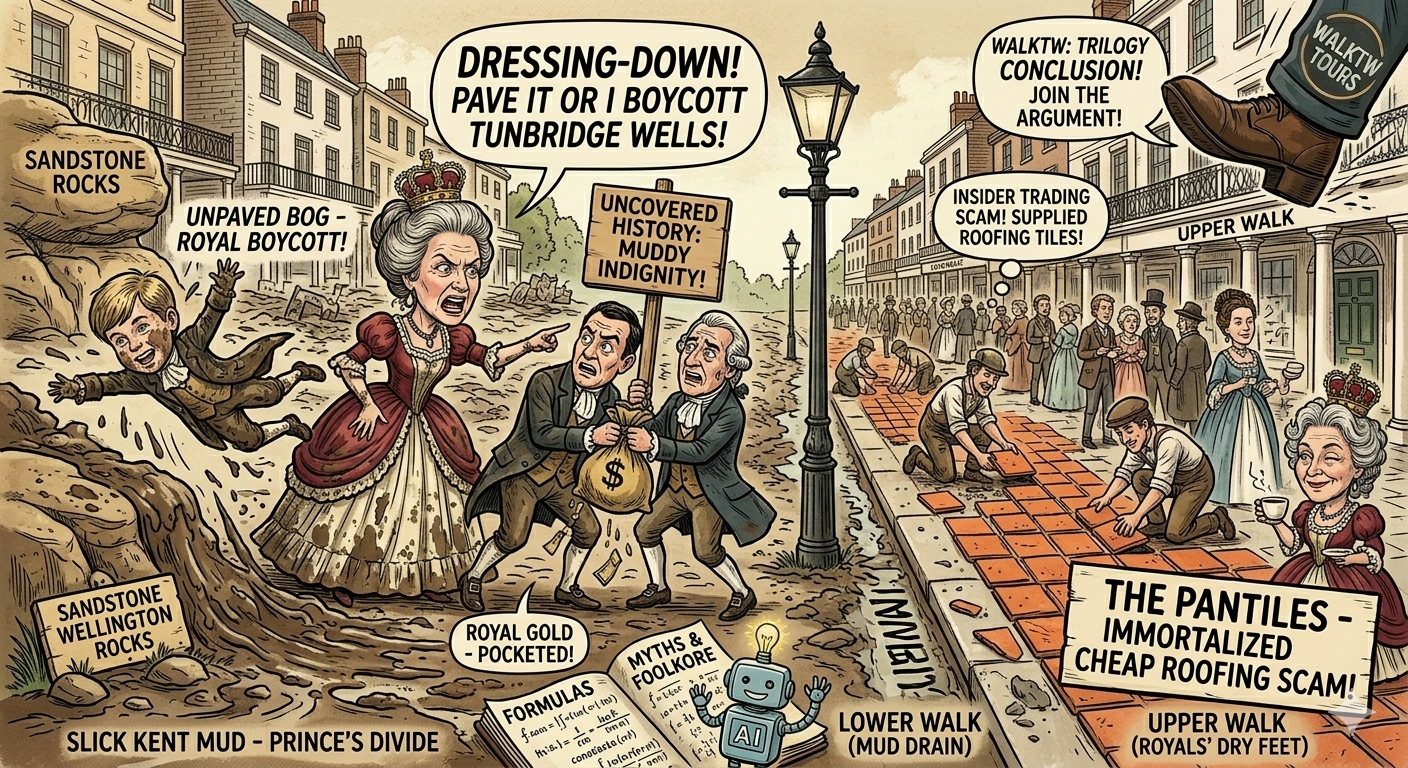
    If you’ve ever walked down the elegant, sunlit promenade of The Pantiles, dodging dog walkers and tracking down a morning flat white, you’re stepping on the results of a massive, 17th-century royal temper tantrum.

    Today, it’s one of the most beautiful avenues in Kent. But back in 1698, it was a total mud bath. The entire identity of our town—and its most famous landmark—was accidentally decided because a future king lost his footing. Additionally, a furious queen lost her patience, and a pair of corrupt local lords tried to pocket the development cash. This is just one of the curious stories you’ll discover when exploring Pantiles history. In fact, Pantile’s history is filled with colourful incidents and memorable characters.

    The Day the Prince Ate Dirt

    Our story begins with an adorable, five-year-old boy named Prince William, Duke of Gloucester. He was the only surviving child of Princess Anne (who would later become Queen Anne). In addition, he was the absolute obsession of high society. Because the young prince was a bit sickly, his mother brought him down to Tunbridge Wells for the summer to drink the iron-rich spring waters. Furthermore, understanding Pantiles’ history helps us appreciate the significance of this royal visit.

    On a particularly damp afternoon, the young prince was charging along the Upper Walk when he hit a patch of classic, slick Kent mud.

    Before his royal handlers could intervene, the heir to the British throne went flying, wiping out spectacularly in the dirt. Princess Anne was absolutely horrified. Muddy, furious, and fiercely protective, she rounded on the local town managers and gave them an absolute dressing-down.

    She demanded that the promenade be paved immediately so her son would never have to brave the muddy indignity again. To make sure it happened, she handed over a massive sum of cash. Then she told them she’d be back next year, and swept out of town.

    2. The Rogue Managers and the Missing Cash

    Enter our villains: a pair of local, smooth-talking lords who were in charge of the town’s upkeep.

    Instead of immediately hiring stonemasons, they looked at the heavy sack of royal gold and thought, “Well, the Princess won’t be back for twelve whole months…” They pocketed the cash, spent the winter living the high life, and completely ignored the promenade. The road remained a treacherous, muddy bog. Consequently, this episode of Pantiles history adds intrigue to the town’s legacy.

    Summer 1699 rolled around, and Princess Anne’s carriage rattled back into Tunbridge Wells. She stepped out, looked down, and saw that the Upper Walk was just as filthy and unpaved as the day her son had taken his royal dive.

    Anne was utterly dynamic in her rage. She didn’t just write a strongly worded letter; she effectively boycotted the entire town. She hopped back into her carriage, swore she would never return to Tunbridge Wells until the place was properly paved, and took her massive, high-spending royal entourage down to rival spa towns instead.

    The Pan-Tiling Panic

    The local business owners went into an absolute meltdown. The town’s economy was heavily reliant on royal favour, and the corrupt managers had just starved them of their best customers.

    In a desperate, frantic rush to win back the future Queen, the local authorities fired the managers and bought the cheapest, fastest-available paving materials on short notice: baked clay tiles called “pan-tiles.” They weren’t smooth, elegant flagstones; they were rough, orange-red, square earthenware tiles usually used for roofing. Workers laid them down in a record-breaking scramble. As a result, they created a bizarre, brightly coloured, heavily textured walkway that became central to Pantiles’ history.

    The emergency rebrand worked. The walkway became known across the country as “The Pantiles.” Even though those cheap clay tiles were eventually stripped up and replaced with grander stone in the 1790s, the name stuck for centuries. Therefore, a corrupt local scam and a royal slip-and-slide were immortalised.

    What to Spot in 2026

    You don’t need to look hard to see the echoes of the great paving panic today:

    • The Topographical Dip: Notice how the Lower Walk sits significantly lower than the Upper Walk. That structural split was emphasised during the frantic paving scramble to ensure water drained away from the main promenade. As a result, the royals would always have dry feet.
    • The Surviving Tiles: While the orange clay pan-tiles were largely replaced with stone, look closely at the threshold steps of some of the oldest, untouched shop entrances along the Upper Walk. You can still spot a few heavily weathered, deep-red clay inserts hidden in the brickwork.

    🕵️‍♂️ Fact or Fiction? Join the Investigation!

    Our trilogy is wrapping up, which means it’s time for the final WalkTW detective meeting in the comments. What do you think is historical truth, and what is pure local folklore? Without a doubt, there are still mysteries to be uncovered in Pantiles history.

    • Myth #1: The Cursed Left Foot. An old legend says the young Prince slipped specifically on his left heel. For decades, highly superstitious Georgian visitors would only step onto the Upper Walk with their right foot first. This was done to avoid “the Prince’s bad luck.”
    • Myth #2: The Hidden Royal Cache. A rumour persists that the corrupt managers didn’t actually spend all of Princess Anne’s gold—they buried a portion of it in a lead box right beneath the foundations of the walk to keep it hidden when she returned in a rage.
    • Myth #3: The Roofing Conspiracy. Some historians joke that the local tile-maker who supplied the emergency pan-tiles was actually the brother-in-law of one of the town managers. Therefore, the entire “emergency rush” was just a highly orchestrated insider trading scam to clear out excess warehouse stock.

    What’s your verdict? Have you ever taken a clumsy trip on the stones after a rainy Kent afternoon? Let us know your thoughts in the comments! 👇

    And that concludes our opening trilogy! A massive thank you to everyone who has read, shared, and argued over these stories. We are just getting started.

    #TunbridgeWells #ThePantiles #PavingScandal #QueenAnne #LocalHistory #WalkTW #RoyalGossip

  • The Mountain Feud (Mount Ephraim vs Mount Sion) 🏔️⚔️

    The Mountain Feud (Mount Ephraim vs Mount Sion) 🏔️⚔️

    If you’ve ever walked across the Common on a crisp morning and looked up at the grand houses on Mount Ephraim, or struggled up the steep incline of Mount Sion, you’re actually walking through an ancient, 17th-century ideological battleground in Tunbridge Wells.

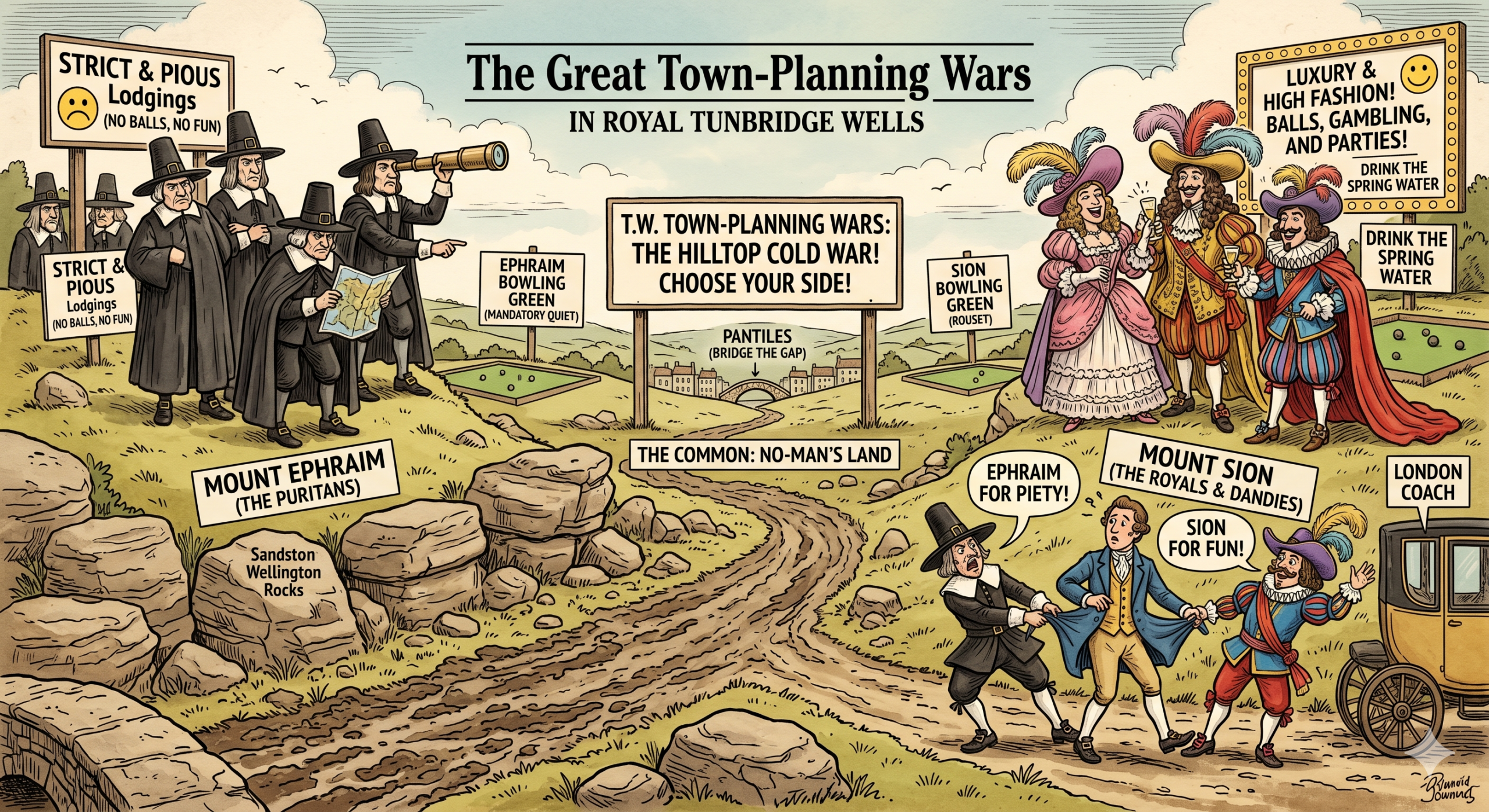
    Back in the late 1600s, Tunbridge Wells wasn’t one unified, polite town. It was basically two rival hills suffering from a massive identity crisis, actively competing for tourists, lodging money, and bragging rights.

    Choosing Your Side

    When the Chalybeate Spring first put us on the map, visitors flooded in and needed places to stay. Because the valley area was prone to flooding (classic Kent weather), entrepreneurs built accommodation up on the hills. But the two hills couldn’t have been more different if they tried. In fact, Tunbridge Wells’ unique geography really shaped the rivalry.

    • Mount Ephraim (The Rebels): Settled heavily by Puritans and those who weren’t massive fans of the monarchy. They named their hill after a biblical mountain and kept things strict, pious, and business-focused.
    • Mount Sion (The Royals): Settled by the high-flying royalists, Anglicans, and courtiers who wanted to party with the King. They wanted luxury, balls, gambling, and high fashion.

    The Ultimate Hill-Top Cold War

    For decades, a literal cold war played out across the Common. If a wealthy lord arrived in town, the touts from Mount Sion and Mount Ephraim would practically fight in the streets to drag them up their respective hills. All within the boundaries of Tunbridge Wells.

    They built competing bowling greens, competing taverns, and competing lodging houses. If you stayed on Ephraim, the Sion crowd thought you were a boring prude. If you stayed in Sion, the Ephraim crowd thought you were a corrupt sinner.

    Eventually, the valley (The Pantiles area) grew enough to bridge the gap and force everyone to play nice. Still, the distinct personalities of the hills lingered in Tunbridge Wells for generations.

    Go Spot It Today! 🕵️‍♂️

    You don’t need a time machine to experience this hilltop cold war—you can actually spot the physical remnants of the feud on your next weekend stroll through Tunbridge Wells.

    • The Literal “No Man’s Land”. When you stand on the Tunbridge Wells Common today, you are looking at the literal physical barrier that kept the two factions apart. The reason this massive green space was never built over is largely that it served as the critical buffer zone between the competing developments.
    • The Mount Ephraim Watchtowers. Walk along the ridge of Mount Ephraim today (near the Royal Wells Hotel). Notice how the oldest grand buildings face straight out over the Common. They were designed with those sweeping views not just for aesthetics, but so the early Puritan landlords could look directly across the valley and spy on whatever sinful antics their rival neighbours over on Mount Sion were up to in Tunbridge Wells.
    • The Clues in the Street Names. As you move from the High Street toward the historic core of Mount Sion, the street names become a map of Royalist and Anglican identity (such as Mount Sion Road and Chapel Place). You can even walk Ephraim Lane and Sion Lane—the ancient, narrow tracks in Tunbridge Wells that the original 17th-century touts used to scramble down to intercept rich tourists stepping off their carriages.
    • The Topographical Sweat Test. The absolute best way to notice the history is through your feet. The sheer steepness of Mount Sion Road shows just how isolated these early hilltop communities were. Living up there required a serious physical commitment, which is why both hills desperately tried to build their own self-contained mini-economies so their wealthy guests wouldn’t have to brave the muddy climb twice in one day.

    The Takeaway

    We complain about local parking and potholes today, but at least we don’t have two halves of Tunbridge Wells actively waging a holy war over who has the better bowling green!

    Next up in the trilogy: The flamboyant 19th-century theatre queen who defied the male establishment to build a hotspot right on the Lower Walk of the Pantiles. Stay tuned! 🎭☕

    #TunbridgeWells #LocalHistory #TownPlanningWars #MountEphraim #MountSion #RoyalTunbridgeWells #WalkTW

  • The Hidden History of Royal Tunbridge Wells: Exploring Its Lesser-Known Stories

    The Hidden History of Royal Tunbridge Wells: Exploring Its Lesser-Known Stories

    The Origins of Royal Tunbridge Wells

    • The Fact: In 1606, a hungover young aristocrat named Lord North stumbled upon a strange, rust-coloured, bubbling spring in a muddy valley. He drank it and claimed it cured his ailments. As a result, he accidentally birthed a booming spa destination. The history of Royal Tunbridge Wells truly began with this discovery. Because the valley was prone to flooding and lacked infrastructure, early entrepreneurs had to build lodging on the surrounding hills. Consequently, this created two distinct, hyper-rival communities facing off across the valley:
      • Mount Ephraim (The Rebels): Settled heavily by pious Puritans who named their hill after a biblical mountain. They kept things strict, sober, and business-focused.
      • Mount Sion (The Royals): Settled by the high-flying royalists, Anglicans, and courtiers who wanted luxury, gambling, and high fashion.
    • The Fiction: Local folklore long insisted that the Chalybeate Spring’s strange iron taste was caused by Saint Dunstan catching the Devil by the nose with a pair of red-hot tongs and discarding him into the local waters. While the Puritans loved a good “devil-defeating” origin story to justify their presence, the truth is just pure, unadulterated Wealden geology. In fact, if you study the history of Royal Tunbridge Wells, you’ll find it holds as many myths as documented facts.

    Hidden Gems and Stories

    • The Fact: For decades, a literal hilltop cold war played out across the Common. Touts from Mount Sion and Mount Ephraim would practically fight in the mud to drag wealthy tourists stepping off the London coaches up to their respective lodging houses. If you stayed on Ephraim, you were branded a boring prude. Conversely, if you stayed in Sion, you were a corrupt sinner. In conclusion, this rivalry has become one of the most fascinating episodes in the history of Royal Tunbridge Wells.
    • The Fiction: A lingering urban legend suggests that secret underground tunnels run directly from the cellars of Mount Ephraim’s Puritan houses all the way under the Common to the taverns of Mount Sion. These tunnels were allegedly built so the strict Puritans could sneak over for a covert drink and a game of dice away from watchful eyes. While our sandstone terrain is riddled with caves and fissures, these “hypocrite tunnels” are entirely a myth invented by Royalist gossip to ruin their rivals’ spotless reputations.

    Influences of Victorian Society

    • The Fact: Eventually, the valley grew enough to force the two hills to play nice. This was largely thanks to the iron fist of 18th-century “forum moderator” Beau Nash and the architectural boom under Master Builder William Willicombe. As the town expanded into the Victorian era, the architectural styling of the hills evolved. The strict, exposed timber-and-brick structures gave way to grand, smooth-stuccoed classical villas designed to project wealth, elegance, and an extreme sense of social order. Clearly, the history of Royal Tunbridge Wells is reflected in these shifting styles and the town’s physical landscape.
    • The Fiction: Victorian high-society guidebooks subtly hinted that the steep incline of Mount Sion Road was intentionally engineered as a moral filter for the town. The running joke among visitors was that the hill was deliberately made exhausting. This way, anyone lacking “fortitude and upright character” would give up and turn back before reaching the respectable estates at the top.

    The Modern-Day Perspective

    • The Fact: You can still experience this 350-year-old feud through your feet today. Because the massive, open green space of the Tunbridge Wells Common only exists as the literal, legally protected “No Man’s Land”, it kept the two warring factions apart. If you walk along the Mount Ephraim ridge today, you’ll notice the oldest mansions face straight out over the grass like watchtowers. In fact, they were deliberately built so the early landlords could spy on whatever antics their rival neighbours were up to.
    • The Fiction: Locals today joke that the ideological divide never truly died; it just transformed into a modern property war. Ask anyone living on Mount Ephraim, and they’ll claim the air is crisper and the views are superior. On the other hand, ask a Mount Sion resident, and they’ll argue they possess the true, creative soul of the town. We might complain about local parking and council potholes today, but at least we aren’t waging a holy war over who has the better hilltop bowling green! Finally, it’s worth noting that the history of Royal Tunbridge Wells continues to shape the town even today.

    #TunbridgeWells #LocalHistory #TownPlanningWars #MountEphraim #MountSion #RoyalTunbridgeWells #WalkTW