Tag: walking tours

Posts linked to WalkTW’s micro walking tours — guiding curious visitors and locals through the streets, stories, and hidden corners of Royal Tunbridge Wells on foot.

  • THE TOWN THAT DIDN’T KNOW ITSELF

    THE TOWN THAT DIDN’T KNOW ITSELF

    An Introduction to Three Stories About Royal Tunbridge Wells and Its Queer History

    The Chronicles


    There is a version of Royal Tunbridge Wells that everyone knows. It is tweedy, it is conservative, it is faintly outraged by most things, and it almost certainly writes letters. It is the town of the mythic Disgusted of Tunbridge Wells — a place that stands, in the national imagination, as shorthand for a very particular kind of English disapproval.

    That version is not entirely wrong. However, it is spectacularly incomplete.

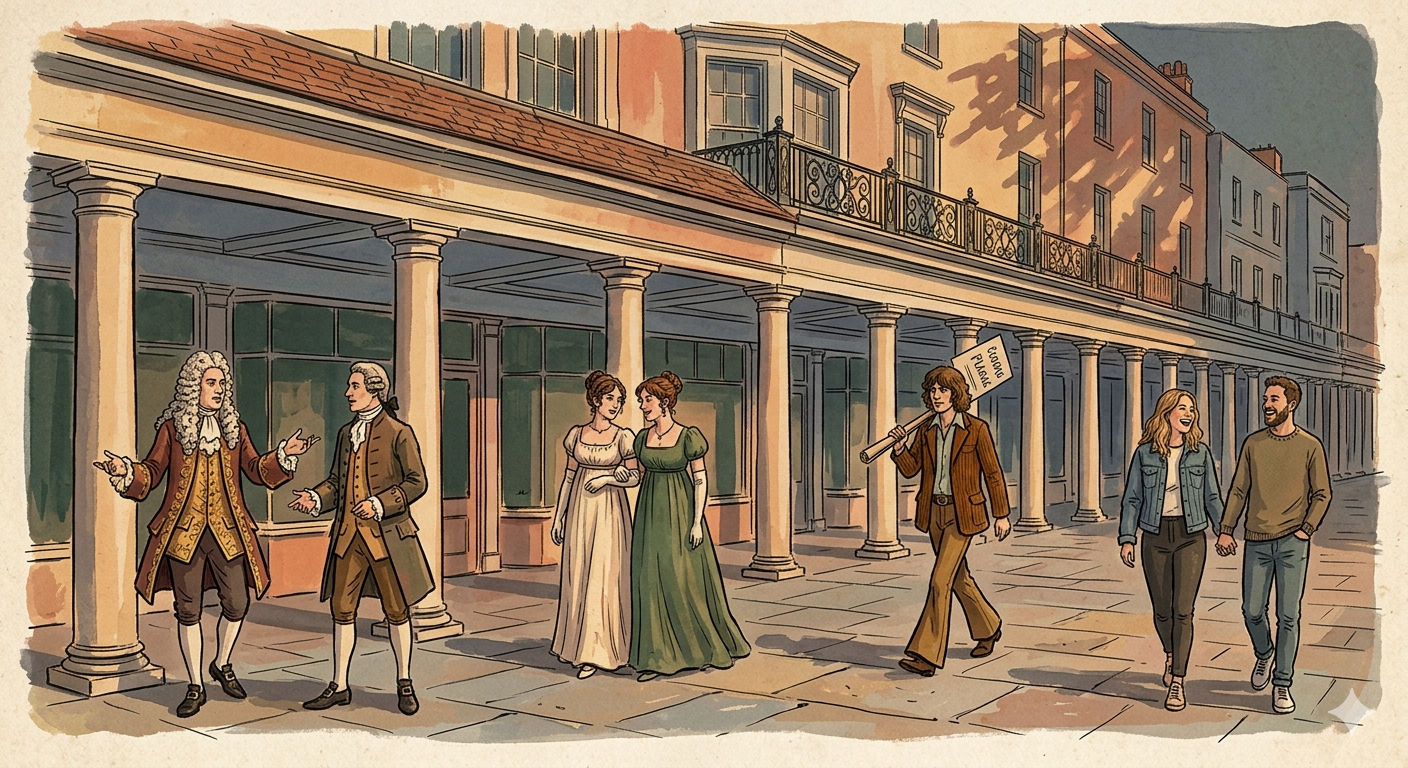
    Royal Tunbridge Wells has a queer history. It runs from the Georgian Pantiles — where fluid identity and theatrical self-presentation were, for a brief and glittering century, practically the entry requirement — all the way to a man who returned here from Birmingham in 2021, looked around, found no LGBT+ community infrastructure whatsoever, and quietly built one from scratch.

    In between, there is a Council ban on a piano recital. There is a campaigning group so dedicated it operated for decades in a town that mostly pretended it didn’t exist. There is, in short, a story that Tunbridge Wells has never quite told itself.

    It is time to tell it.


    Why This Town, Why This History

    Every place has a version of itself it prefers to project. Tunbridge Wells projects elegance, history, and a certain studied propriety. The Pantiles. The chalybeate spring. The Victorian villas. The commuter trains to London Bridge.

    What it projects, rather less enthusiastically, is complexity — the messy, contradictory, thoroughly human reality beneath the curated surface. However, complexity is precisely what makes a town interesting. Furthermore, it is precisely what WalkTW exists to excavate.

    Queer history is, in most English market towns, hidden history. Not because it didn’t happen — it always happened — but because it happened quietly, in spite of opposition, and without the institutional support that would have made it visible. As a result, it tends to vanish from the official record. The Assembly Rooms get a heritage plaque. The gay campaigners who were banned from the Assembly Rooms do not.

    Therefore, this series exists. Not as a political statement — or not only as one — but as an act of historical accuracy. Tunbridge Wells is more interesting than its reputation. Its LGBT history is part of that.


    Three Stories, Three Eras

    The trilogy ahead covers three very different chapters of the same long story.,
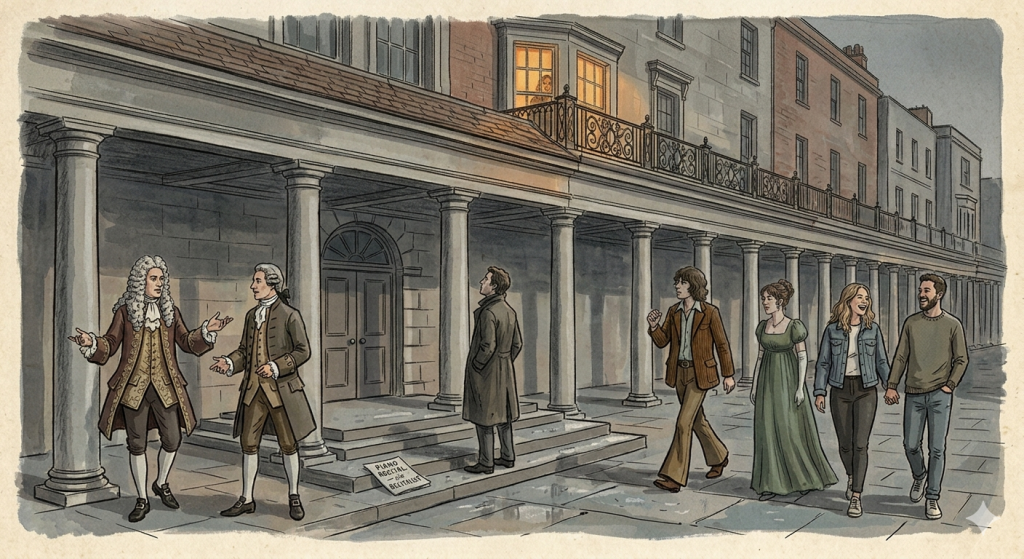
    A quietly dramatic editorial illustration of the exterior of a grand civic building — stone-faced, Edwardian, authoritative — on a grey evening in 1974. The arched double doors are firmly closed. A concert programme lies on the steps, slightly rain-dampened, reading "Peter Katin — Piano Recital." A single figure stands at the base of the steps in a long coat, hands in pockets, looking up at the closed doors. He does not look defeated — he looks patient. The atmosphere is one of dignified, unhurried resistance. Pencil-and-wash illustration style. Palette of charcoal, stone grey, and one small warm amber light in a window above.

    Part One begins in 1972, when a man called Ross Burgess moved to Tunbridge Wells, looked around, and decided to do something about the fact that there was nowhere for gay people to meet. What followed — a campaigning group, a Council ban on a charity piano concert, and an acronym even better than TWERPS — is one of the most quietly extraordinary episodes in the town’s modern history. It is also almost entirely unknown.

    Part Two goes further back — much further. The Georgian spa town of the 17th and 18th centuries was not the conservative retirement destination of modern imagination. It was a place of performance, transgression, and deliberate social theatre, where the usual rules of English life were, for the season at least, suspended. The Pantiles was not simply a place to take the waters. It was a stage. And, historically, stages have always attracted people who needed one.

    Part Three arrives in the present. Tunbridge Wells in 2024 has no gay bar, no Pride parade, and no LGBT+ venue of any kind. It also has a growing community, a social group built by one determined man with a Facebook page, and a question worth asking: what does a queer life in a town like this actually look like — and what does it say about how much has, and hasn’t, changed?


    What We Owe the Full Picture

    The Disgusted of Tunbridge Wells myth is, in its way, a comfort. It is easy to understand, easy to repeat, and requires nothing of anyone. However, the real town — the one with three centuries of complicated, interesting, frequently surprising human history — requires a little more from us.
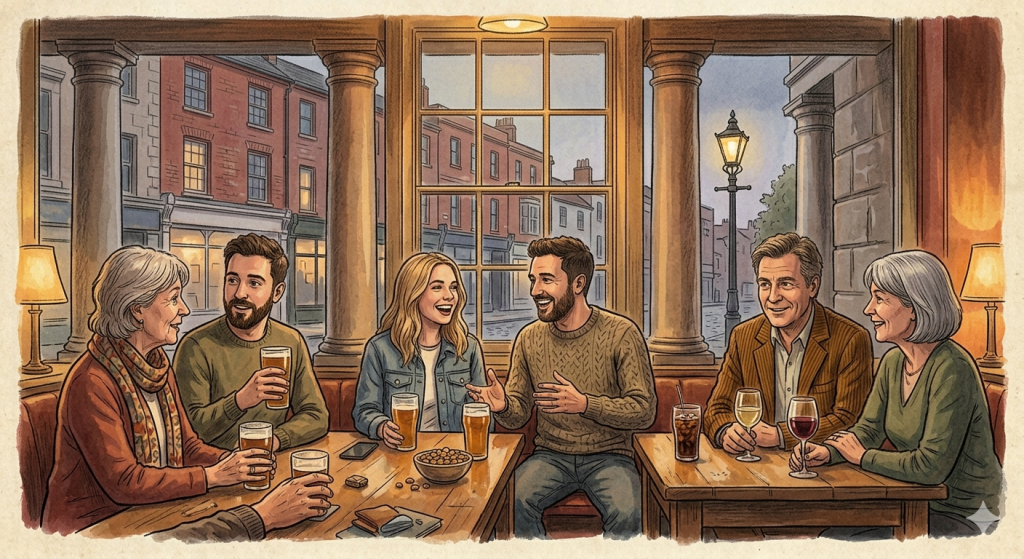
    A warm editorial illustration of a small informal social gathering in a pub in Royal Tunbridge Wells, contemporary. Six or seven people of different ages sit around two pushed-together tables — drinks in hand, mid-conversation, relaxed. Through the window behind them, the familiar red brick of a Tunbridge Wells high street is visible. There are no flags, no banners, no signage of any kind. The image's entire argument is in the warmth of the scene — people who found each other in a town that gave them no infrastructure to do so. Painterly, intimate illustration style. Golden pub light, warm amber and brick-red palette.

    It requires us to look at the Assembly Rooms and remember not just the concerts that happened there, but the ones that didn’t. It requires us to walk The Pantiles and consider who else walked it before us, and why. It requires us to acknowledge that a community need not be visible from the outside to be real.

    Royal Tunbridge Wells has always been more than its reputation. This series is, among other things, a small argument for noticing that.

    Hashtags: #TunbridgeWells #LGBTHistory #RoyalTunbridgeWells #HiddenHistory #WalkTW #TheChronicles #QueerHistory #KentHistory
  • 10 Films and Shows to Watch This Weekend — All Secretly Filmed in Tunbridge Wells 🎬🍿

    10 Films and Shows to Watch This Weekend — All Secretly Filmed in Tunbridge Wells 🎬🍿

    You’ve walked past these places a hundred times. The Pantiles on a Saturday morning. The cricket ground on the Common. That moated house everyone’s been to for the maze and the dinosaurs.

    What you may not know is that every one of these locations has, at some point, stood in for somewhere else entirely — a Victorian drapery, a fictional Hertfordshire estate, an American city, a Roman-occupied Britain, and the venue for India’s greatest cricketing triumph. In fact, there are 10 top movies filmed in Tunbridge Wells that highlight the town’s versatility on screen.

    This weekend’s homework: pick one from the list below, watch it, and then go stand in the actual spot. Sorted from oldest to newest, so you can watch Tunbridge Wells’ screen career unfold in order.


    1. The Draughtsman’s Contract (1982) — Groombridge Place

    Peter Greenaway’s strange, elegant murder mystery marks the beginning of Groombridge Place’s screen career. The country house is Groombridge Place, a 1655 moated house set in landscaped grounds, in Groombridge, four miles southwest of Royal Tunbridge Wells on the Kent/Sussex border. Anthony Higgins plays a draughtsman commissioned to draw the estate, who gets pulled into an “enigmatic murder plot” — and the gardens became so associated with the film that the Apostle Walk at Groombridge is now commonly known as the Draughtsman’s Garden.

    Go see it: Groombridge Place gardens are open to the public from spring to early November.


    2. Half a Sixpence (1967) — The Pantiles

    The deep-cut classic. Half a Sixpence, based on H.G. Wells’s novel Kipps, is a musical starring Tommy Steele and directed by Golden Globe winner George Sidney. The Pantiles in Royal Tunbridge Wells is the set for Shalfords Emporium — the draper’s shop where Kipps apprentices.

    Next time you’re getting a coffee on The Pantiles, you’re standing where a 1960s movie musical built a working Victorian shop window.

    Go see it: The Pantiles, obviously. You’re probably there already.


    3. Pride & Prejudice (2005) — Groombridge Place as Longbourn

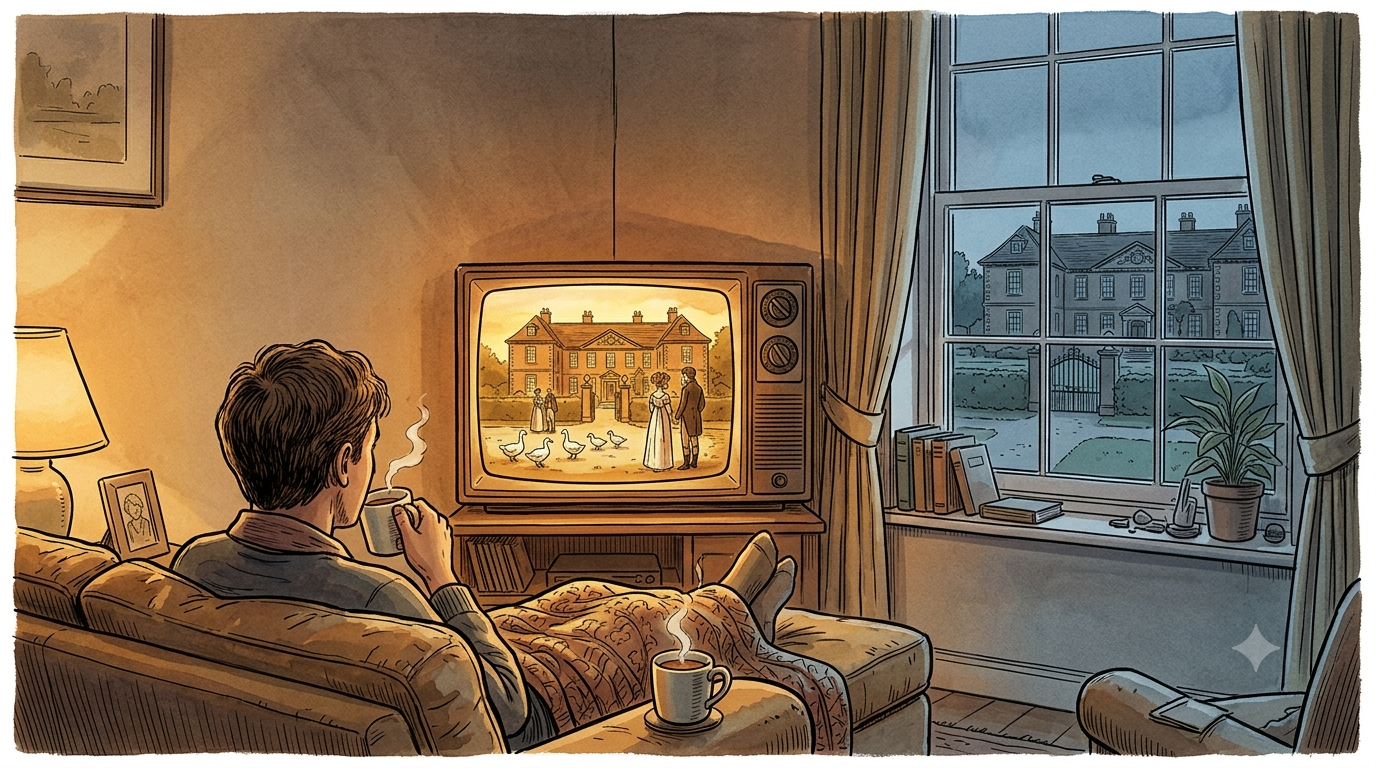
    The big one. ‘Longbourn’, the Bennet family home, is a moated manor house, Groombridge Place, near Tunbridge Wells in Kent. The crew transformed Groombridge into a bustling, shabby-chic Bennet home — building a duckboard bridge across the moat, altering windows, and filling the courtyard with geese, chickens and manure piles to give Longbourn its lively, lived-in atmosphere.

    Keira Knightley’s Elizabeth Bennet grew up, fictionally, four miles from Royal Tunbridge Wells. Austen describes Longbourn as “a comfortable house, though not handsome” — Groombridge’s charm and lived-in authenticity captured that perfectly.

    Go see it: Same gardens as #1. The geese are (probably) gone.


    4. Darkest Hour-adjacent honourable mention — skip ahead, this one’s Westerham

    (Editorial note: Chartwell is just outside our patch, in Westerham — close enough that it keeps coming up in searches, but not actually a Tunbridge Wells location. We’re not including it, because we’d rather give you ten that are real than pad the list. Onwards.)


    4. The Day of the Triffids (2009, BBC) — Groombridge Place

    Groombridge Place’s third screen credit, and its strangest. Groombridge Place has been used as a location for the 2009 BBC production of The Day of the Triffids. A genuinely menacing post-apocalyptic thriller about carnivorous plants taking over Britain, filmed partly at the same moated manor that played Jane Austen’s family home four years earlier.

    The contrast is the entire point. Same gates, same moat, same gravel drive — one year it’s the Bennets having tea, the next it’s the last survivors of civilisation barricading themselves in against killer vegetation.

    Go see it: Same gardens as #1 and #3. At this point, you should probably just buy a season ticket.


    5. The Royals (2016-2018) — Tunbridge Wells area

    The Royals (2016-2018) is noted by the Kent Film Office as a recent production to have filmed in the Tunbridge Wells area. This was an American E! network drama imagining a fictional version of the British royal family — meaning an American show about fictional British royals was, at some point, filmed in the one English town with “Royal” actually in its name.

    We don’t yet know the specific locations used. If you remember crew vans or filming notices around town in 2016-2018, the WalkTW archive would love to hear from you.


    6. Queens of Mystery (2020-2021) — Tunbridge Wells area

    Queens of Mystery (2020-2021) is listed by the Kent Film Office as a recent production filmed in the Tunbridge Wells area. A gentle, Sunday-night murder mystery series set in a fictional English seaside town — exactly the kind of cosy crime drama where a Georgian spa town would make a perfect backdrop.

    Again — specific locations not yet confirmed. Watch carefully and see if anything looks familiar.


    7. Britannia, Series 3 (2021) — Claremont Gardens and Town Hill Road

    The genre swerve of the list. During filming, the production visited Tunbridge Wells to film short scenes in Claremont Gardens and Town Hill Road. Britannia is a big, blood-soaked historical fantasy about Roman Britain and warring Celtic tribes — David Morrissey, druids, prophecy, the works.

    Somewhere in Claremont Gardens or on Town Hill Road, a scene depicting Roman-occupied Britain was filmed within walking distance of the station. Look at those streets differently next time.

    Go see it: Claremont Gardens and Town Hill Road are both public — walk past and see if you can guess what they stood in for.


    8. This Way Up, Series 2 (2021) — Speldhurst

    The “wait, that’s near here?” entry. This Way Up Series 2 (2021), created by and starring Aisling Bea, alongside Sharon Horgan and Tobias Menzies, used Tunbridge Wells in Kent as a filming location. The strikingly modern home featured in the opening episode of series two — where Shona settles into her fiancé Vish’s “super sleek” home while he’s away in New York — is in real life in the village of Speldhurst in Tunbridge Wells, designed by London architecture firm Architecturall.

    An ultra-modern architect’s house in a Kent village, standing in for the kind of glossy London apartment that only exists on TV. The gap between “rural Speldhurst” and “the flat of someone’s tech-millionaire fiancé in London” is doing a lot of work here.

    Go see it: Privately owned — admire from the road, don’t knock.


    9. ’83 (2021) — Nevill Cricket Ground

    The most unexpected entry on this list, by a distance. ’83, directed by Kabir Khan and starring Ranveer Singh and Deepika Padukone, is a major Bollywood film about India’s 1983 Cricket World Cup victory, and used Nevill Cricket Ground in Tunbridge Wells as a filming location.

    One of the biggest Indian films of recent years — a national sporting triumph, one of the most celebrated moments in Indian cricket history — recreated, at least in part, on a ground in Hawkenbury, on the southern edge of Tunbridge Wells.

    The choice of location isn’t random. The Nevill Ground’s only One Day International was, fittingly, a 1983 World Cup group match between India and Zimbabwe — the game in which Kapil Dev scored an extraordinary 175 not out. (Kirkus Reviews) If you’ve ever played a club match at the Nevill, you’ve stood on a ground with a genuine claim to 1983 World Cup history — which is presumably exactly why the Bollywood crew chose it.

    Go see it: Nevill Ground, Nevill Gate, Warwick Park, TN2 5ES — about a mile south of the town centre, near Hawkenbury. Home of Tunbridge Wells Cricket Club, with matches most summer weekends.


    10. Tuesdays and Fridays (2021, Netflix) — Danemore Park

    The most recent entry, and the grandest house. Danemore Park is a Grade II-listed Georgian country house set in 80 acres, with a stable block, woodland, and a long driveway, in the district of Royal Tunbridge Wells, and was used for the Netflix film Tuesdays and Fridays.

    A Georgian country house within the borough, on Netflix, released in 2021. If you’ve got a Netflix subscription and a free evening, this is the newest addition to TW’s screen CV.


    🗺️ The WalkTW Weekend Challenge

    Three of these are genuinely visitable: Groombridge Place (four separate productions across nearly forty years), The Pantiles (you’re there already), and Nevill Cricket Ground (turn up to a match).

    If you watch any of these and spot something else — a street, a shopfront, a bit of garden you recognise — let us know. The Royals and Queens of Mystery entries on this list are still open cases. WalkTW would love to close them.

    The pattern worth noticing: Groombridge Place alone has played a Georgian family home, a murder-mystery estate, Sherlock Holmes’s Birlstone Manor, and the last refuge from carnivorous plants — sometimes within a few years of each other. The same gates, the same moat, completely different worlds. That’s not a bad metaphor for Tunbridge Wells itself.

    #TunbridgeWells #WalkTW #FilmingLocations #GroombridgePlace #PrideAndPrejudice #ThePantiles #WeekendWatchlist #HiddenTunbridgeWells

  • The Writers Who Watched Us — Part 3: The Man Who Actually Loved Tunbridge Wells 🏘️❤️

    The Writers Who Watched Us — Part 3: The Man Who Actually Loved Tunbridge Wells 🏘️❤️

    We owe you this one.

    Two posts in, the Writers Who Watched Us series has given you a satirist who used the town as target practice, a novelist who called it hopelessly behind the times, and a government spy who noted the gaming, intriguing, fops and fools and moved on. But now, we turn our attention to The Man Who Actually Loved It Here. Every single one of them watched Tunbridge Wells and reached for their pen to skewer it.

    So here, finally, is the writer who reached for his pen to celebrate it.

    His name was Richard Cobb. He was one of the most respected historians in Britain. He was an Oxford Professor, a Legion d’Honneur recipient, a winner of the Wolfson Prize for History. He spent thirty years writing brilliant, acclaimed books about the French Revolution.

    And in 1983, near the end of his life, he sat down and wrote a book about Tunbridge Wells instead.

    He had grown up here. He had loved it completely. And almost nobody in the town he celebrated has ever heard of him.


    The Boy on Grove Hill Road

    Richard moved to Tunbridge Wells at the age of four with his mother and sister; his father, who was in the Sudan Civil Service, was only an intermittent presence until his retirement. The family moved house a good deal, from one rented place to another, but managed to retain its status among the many gradations of middle-class society in a very middle-class town.

    He grew up here through the 1920s and 1930s — walking the Common, catching the train from Central Station, learning the precise social hierarchies of the streets between Mount Sion and Mount Ephraim. He noticed everything. Down Poona Road, past the Grove Bowling Club, the young Richard Cobb conducted his reader through the streets of Tunbridge Wells in the twenties and thirties, taking us into cluttered drawing rooms and dining rooms set for tea — a chronicle of a south-eastern community, of the middle classes, their servants and an army of shopkeepers, of largely harmless snobbery, pretension and genteel scandal.

    The keyword there is “harmless.” Unlike every other writer in this series, Cobb watched the town’s pretensions and found them not outrageous but quietly, deeply human. He was not contemptuous. He was fond.


    The Book That Nobody Here Knows About

    Still Life: Sketches from a Tunbridge Wells Childhood was first published in 1984. It won the J.R. Ackerley Prize for Literary Biography. It is a classic among middle-class memoirs.

    A prize-winning literary classic. About this town. Written by someone who grew up on its streets.

    And yet ask almost anyone in Tunbridge Wells if they’ve heard of it, and you’ll get a blank look.

    The cast of characters Cobb assembled from his childhood would feel entirely at home in the WalkTW archives. Arriving at the Central Station, with its wooden staircase advertising “Carter’s Little Liver Pills,” he leads us through the town and into the lives of the characters among whom he grew up — from the mysterious Black Widow, seen always in deep yet unexplained mourning, to Baroness Olga, the town’s only victim of the Russian Revolution, with her tight-fitting cloche hat and jade earrings.

    A Russian Baroness on the streets of Tunbridge Wells. We had a victim of the actual Russian Revolution living here, and this is somehow not on every heritage trail in town.

    Then there were the Limbury-Buses. The mother never went outdoors, the son never spoke, and the whole family followed precisely the same routine each day. And Dr Footner, who made house calls in a horse-drawn carriage. And R. Septimus Gardiner, a taxidermist with a shop full of stuffed squirrels, fish, hummingbirds and badgers.

    This is not a satirist’s invented gallery of grotesques. These were real people. On real streets. Right here.


    What Made Him Different

    Every other writer in this series used Tunbridge Wells as a mirror for something they wanted to criticise about England. Thackeray saw snobbery. Forster saw constraint. Defoe saw vice and performance.

    Cobb saw people. Actual people, in all their glorious, harmless, slightly peculiar ordinariness — and he loved them.

    Richard may have been eccentric, irreverent and anarchical, but he was also someone who needed reassurance. He needed a place that would reassure him that life, however threatening it might be elsewhere, could carry on. For him, his childhood town was that place.

    There’s something enormously touching about that. This man spent his academic career immersed in the violence and chaos of the French Revolution, surrounded by guillotines and mass graves and the wreckage of an entire social order. And when he finally turned to writing about himself, he went back to the steady, familiar streets of Tunbridge Wells — the Grove Bowling Club, the Wellington Rocks, the train coming in to Central Station — as the place that felt safe. The place that held still while the world turned.

    As one reviewer put it: “Cobb has broken one of the strangest silences in English social commentary — on the missing history of the English bourgeoisie.”

    He was the first person to take the ordinary, unremarkable daily life of this town completely seriously and say: This matters. These people matter. This place matters.


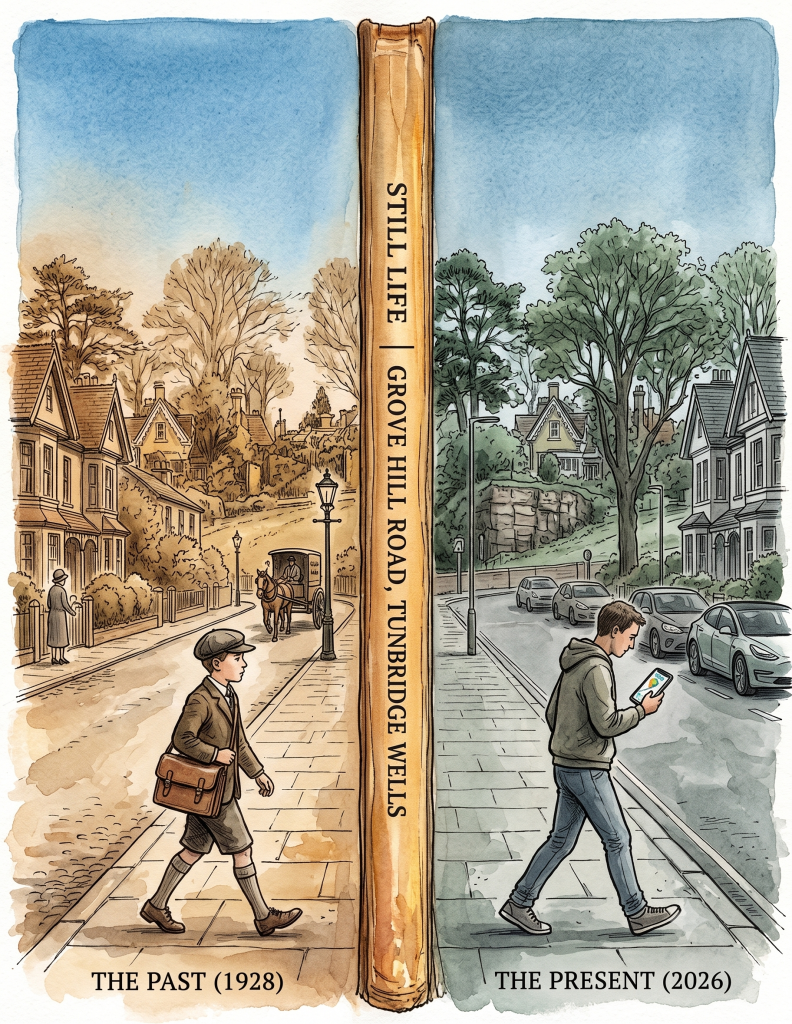
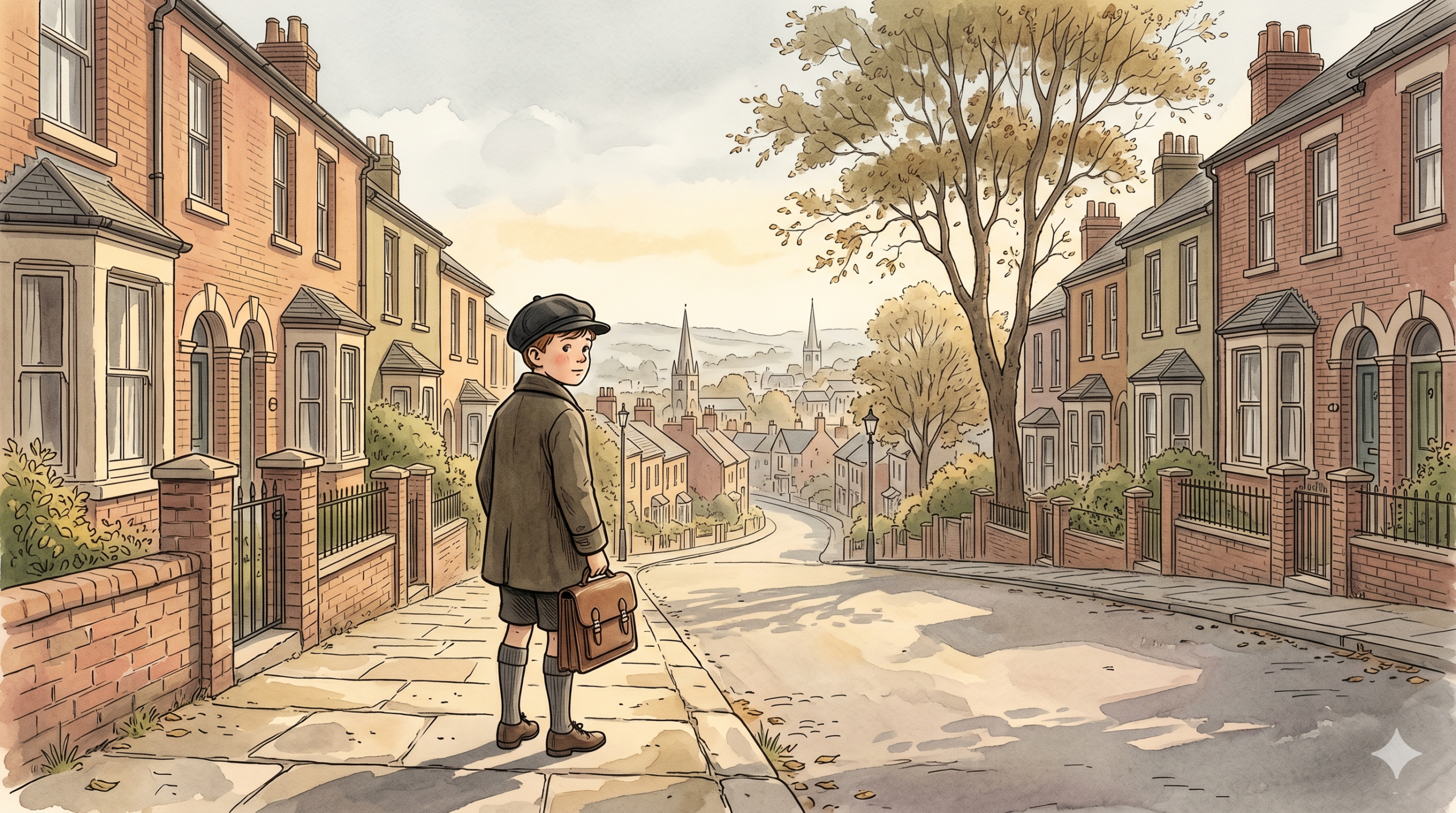
    A precise, evocative vintage editorial illustration 
in watercolour and ink. A single Tunbridge Wells 
street — Grove Hill Road — shown twice in one 
frame, divided vertically down the centre 
by the spine of an open book. LEFT HALF — 1928. The same street in 
warm sepia tones: a small boy in a school 
cap and short trousers walks along the 
pavement, satchel swinging. The houses 
are the same Victorian terraces. A 
horse-drawn delivery cart is visible 
at the far end. Gas lamps. A woman 
in a cloche hat at a garden gate. 
The rooftops and bare trees are 
rendered in the same style as 
the cover of Still Life — 
loose watercolour wash, 
warm and slightly faded. RIGHT HALF — 2026. The same street 
in slightly cooler, more present tones. 
The same houses — barely changed. 
A person walks the same pavement 
looking down at a smartphone, 
Google Maps open on the screen. 
The roofline is identical. 
The trees are bigger. 
Everything else is 
almost the same. The open book sits in the centre — 
its spine the dividing line between 
then and now. Its cover illustration 
(the watercolour of rooftops) 
is visible on both sides. Palette: warm sepia and ochre 
on the left, cool grey-green 
and slate on the right. 
The book spine glows 
slightly — the warm 
amber of old paper, 
the hinge of time. Style: vintage editorial watercolour 
and ink, precise and quietly moving. 

    Go Find His Tunbridge Wells Today

    The remarkable thing about Still Life is how much of it is still here. The streets and houses Cobb describes are mostly still there — depicting the characters who inhabited them takes us into a world that, although gone, remains tangible. One Amazon reviewer noted: “Here is a tip that will enhance your enjoyment: have a computer screen with Google Street View loaded and ready to go as you begin reading.”

    The Central Station — now Tunbridge Wells West, home of the Spa Valley Railway — is still there, minus the wooden staircase and Carter’s Little Liver Pills. The Wellington Rocks, where he played as a child, are still there. Grove Hill Road is still there. The Common is still there.

    And here is perhaps the most WalkTW observation of all: the book is still in print, reissued by the wonderful Slightly Foxed quarterly as one of their most loved editions. You can buy it. You can walk the town with it. You can stand on the streets he wrote about and read his descriptions of the people who once lived there.

    No other writer in this trilogy gives you that. Most of them watched the town and left. Cobb stayed in it, in memory at least, for the rest of his life.


    🕵️ Fact or Fiction? The Final WalkTW Archive Entry

    Three last questions for the comment section — and this time, unusually for this series, at least one of them is almost certainly true:

    Myth #1: The Taxidermist’s Shop. R. Septimus Gardiner’s taxidermy shop, full of stuffed hummingbirds and badgers, is described in Still Life with such precision that local readers have spent decades trying to identify its exact location. Several candidates on the High Street and surrounding roads have been proposed. Nobody has definitively confirmed which building it was. Does anyone know?

    Myth #2: The Unrecognised Professor. Cobb apparently returned to Tunbridge Wells regularly to visit his mother, who continued living there until the 1960s. There are suggestions that late in his life, having become one of the most celebrated historians in Britain, he would walk the streets of the town entirely unrecognised — past people living in houses he’d written about in an award-winning book they’d never read. He is said to have found this completely delightful.

    Myth #3: The French Connection. Cobb’s passion for France was so consuming that French friends apparently found it baffling that this man, who had effectively become an honorary Frenchman — who wrote in French, who moved in Parisian literary circles, who received the Legion d’Honneur from the French government — had written his most personal book about a quiet English spa town in Kent. His response, reportedly, was simple: “France taught me how to look. Tunbridge Wells gave me something worth looking at.”

    Have you read Still Life? Do you recognise any of the characters? Drop your thoughts below — and if anyone can identify the taxidermist’s shop, the WalkTW archive will be forever grateful. 👇

    #TunbridgeWells #WalkTW #RichardCobb #StillLife #LocalHistory #TheWritersWhoWatchedUs #HiddenGems #GroveHillRoad


    More in this series: The Writers Who Watched Us

  • The Victorian “Bio-Hacker” buried in Woodbury Park Cemetery 🩺⚡

    The Victorian “Bio-Hacker” buried in Woodbury Park Cemetery 🩺⚡

    Alright, by popular demand, here is part three of our “Tunbridge Wells Hidden Geniuses” series. If you thought math and birds were cool, wait until you meet Dr. Golding Bird—a man who was basically living in the year 3000 while the rest of the Victorians were still figuring out indoor plumbing.

    He’s currently resting peacefully right up the road in Woodbury Park Cemetery, but during the 1840s and 50s, this guy was a medical absolute machine. It’s remarkable how Dr. Golding Bird contributed so much to medicine in such a short life.

    The Problem with the Old “Stethoscope”

    Before Golding Bird came along, if a doctor wanted to listen to your heart or lungs, they used a rigid, solid wooden tube. It was awkward, uncomfortable, and required the doctor to lean completely over you at a very weird angle. Interestingly, Dr. Golding Bird considered new ways to improve such essential tools.

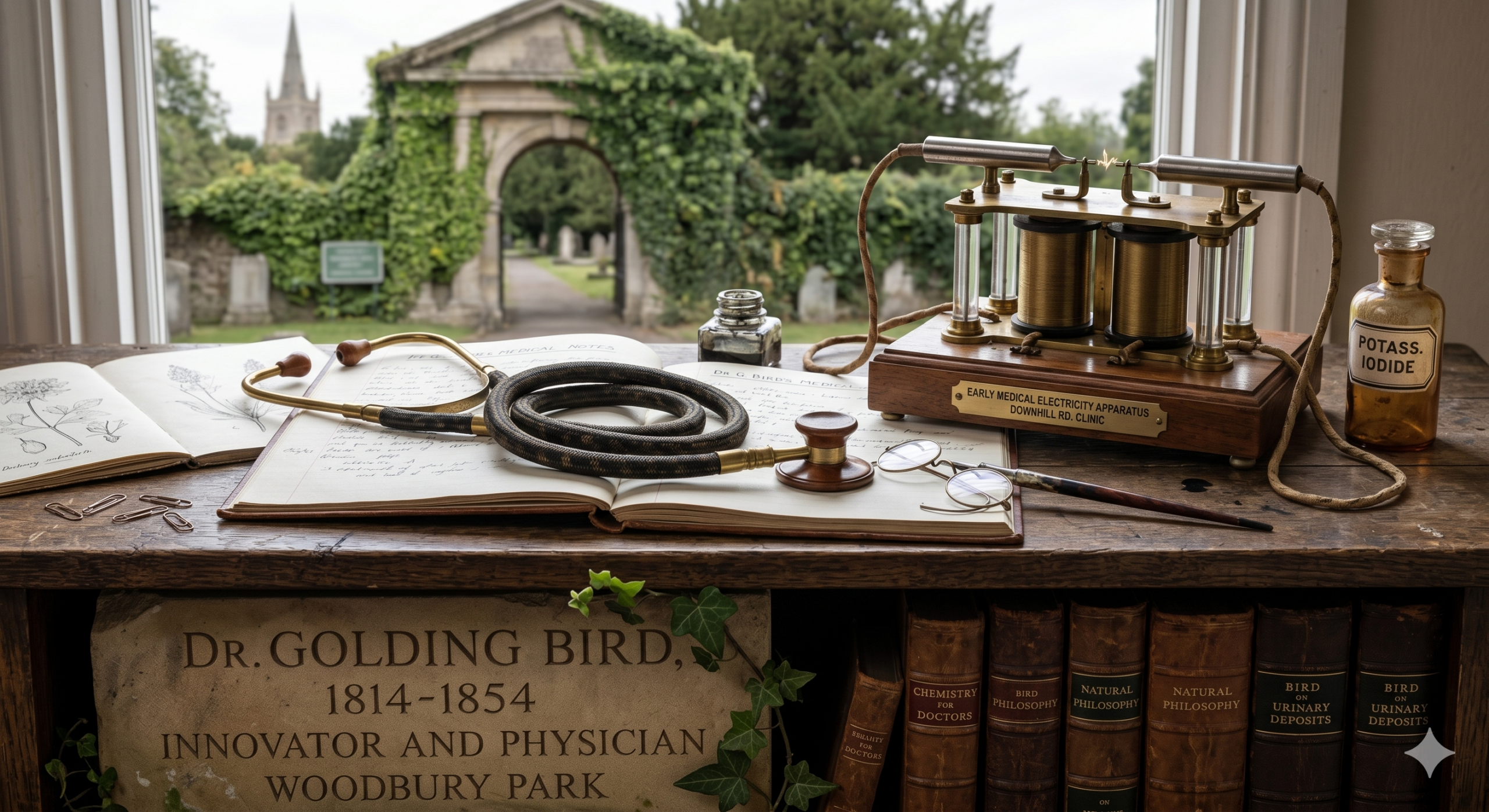
    Bird looked at this and thought, “We can do better.” He went ahead and invented the flexible stethoscope—using a tube made of woven silk and wire. It changed medicine forever because doctors could finally sit comfortably next to a patient and actually move around. If you’ve ever had a checkup, you owe this guy a thank you.

    The Original “Mad Scientist” (But in a good way)

    But he didn’t stop at stethoscopes. Bird was obsessed with “medical electricity.” Long before modern physical therapy or neurological treatments, he was building custom electrical machines to send tiny, controlled currents into patients paralyzed by strokes or suffering from nervous disorders. He was essentially a Victorian bio-hacker, trying to restart the human body’s hard drive using static electricity, and the work of Dr. Golding Bird in this area was ahead of its time.

    The Ultimate “Side Hustle” Warning

    Here’s the catch: Golding Bird was a textbook overachiever. While running a massive medical practice, he was also:

    • Writing best-selling textbooks on physics and chemistry.
    • Researching kidney stones under a microscope.
    • Studying botany.

    He was so deeply addicted to his work that he quite literally worked himself to death, passing away in his late 30s. To sum up, Dr. Golding Bird stands as proof that relentless dedication may come at a cost.

    The Takeaway

    We walk past Woodbury Park all the time, completely unaware that a literal medical revolutionary is right there. Next time you see a stethoscope—or feel guilty for working late on a Tuesday—think of Dr. Golding Bird. Another brilliant mind who called our little corner of Kent home!

    What do we think? Should we do the final legend, William Willicombe (the bricklayer who built the town’s posh villas), next week? 🏛️🏗️

    #TunbridgeWells #LocalHistory #GoldingBird #MedicalGenius #VictorianBioHacker #WoodburyPark

  • The Hidden History of Royal Tunbridge Wells: Exploring Its Lesser-Known Stories

    The Hidden History of Royal Tunbridge Wells: Exploring Its Lesser-Known Stories

    The Origins of Royal Tunbridge Wells

    • The Fact: In 1606, a hungover young aristocrat named Lord North stumbled upon a strange, rust-coloured, bubbling spring in a muddy valley. He drank it and claimed it cured his ailments. As a result, he accidentally birthed a booming spa destination. The history of Royal Tunbridge Wells truly began with this discovery. Because the valley was prone to flooding and lacked infrastructure, early entrepreneurs had to build lodging on the surrounding hills. Consequently, this created two distinct, hyper-rival communities facing off across the valley:
      • Mount Ephraim (The Rebels): Settled heavily by pious Puritans who named their hill after a biblical mountain. They kept things strict, sober, and business-focused.
      • Mount Sion (The Royals): Settled by the high-flying royalists, Anglicans, and courtiers who wanted luxury, gambling, and high fashion.
    • The Fiction: Local folklore long insisted that the Chalybeate Spring’s strange iron taste was caused by Saint Dunstan catching the Devil by the nose with a pair of red-hot tongs and discarding him into the local waters. While the Puritans loved a good “devil-defeating” origin story to justify their presence, the truth is just pure, unadulterated Wealden geology. In fact, if you study the history of Royal Tunbridge Wells, you’ll find it holds as many myths as documented facts.

    Hidden Gems and Stories

    • The Fact: For decades, a literal hilltop cold war played out across the Common. Touts from Mount Sion and Mount Ephraim would practically fight in the mud to drag wealthy tourists stepping off the London coaches up to their respective lodging houses. If you stayed on Ephraim, you were branded a boring prude. Conversely, if you stayed in Sion, you were a corrupt sinner. In conclusion, this rivalry has become one of the most fascinating episodes in the history of Royal Tunbridge Wells.
    • The Fiction: A lingering urban legend suggests that secret underground tunnels run directly from the cellars of Mount Ephraim’s Puritan houses all the way under the Common to the taverns of Mount Sion. These tunnels were allegedly built so the strict Puritans could sneak over for a covert drink and a game of dice away from watchful eyes. While our sandstone terrain is riddled with caves and fissures, these “hypocrite tunnels” are entirely a myth invented by Royalist gossip to ruin their rivals’ spotless reputations.

    Influences of Victorian Society

    • The Fact: Eventually, the valley grew enough to force the two hills to play nice. This was largely thanks to the iron fist of 18th-century “forum moderator” Beau Nash and the architectural boom under Master Builder William Willicombe. As the town expanded into the Victorian era, the architectural styling of the hills evolved. The strict, exposed timber-and-brick structures gave way to grand, smooth-stuccoed classical villas designed to project wealth, elegance, and an extreme sense of social order. Clearly, the history of Royal Tunbridge Wells is reflected in these shifting styles and the town’s physical landscape.
    • The Fiction: Victorian high-society guidebooks subtly hinted that the steep incline of Mount Sion Road was intentionally engineered as a moral filter for the town. The running joke among visitors was that the hill was deliberately made exhausting. This way, anyone lacking “fortitude and upright character” would give up and turn back before reaching the respectable estates at the top.

    The Modern-Day Perspective

    • The Fact: You can still experience this 350-year-old feud through your feet today. Because the massive, open green space of the Tunbridge Wells Common only exists as the literal, legally protected “No Man’s Land”, it kept the two warring factions apart. If you walk along the Mount Ephraim ridge today, you’ll notice the oldest mansions face straight out over the grass like watchtowers. In fact, they were deliberately built so the early landlords could spy on whatever antics their rival neighbours were up to.
    • The Fiction: Locals today joke that the ideological divide never truly died; it just transformed into a modern property war. Ask anyone living on Mount Ephraim, and they’ll claim the air is crisper and the views are superior. On the other hand, ask a Mount Sion resident, and they’ll argue they possess the true, creative soul of the town. We might complain about local parking and council potholes today, but at least we aren’t waging a holy war over who has the better hilltop bowling green! Finally, it’s worth noting that the history of Royal Tunbridge Wells continues to shape the town even today.

    #TunbridgeWells #LocalHistory #TownPlanningWars #MountEphraim #MountSion #RoyalTunbridgeWells #WalkTW