Tag: Sarah Baker

Posts about Sarah Baker — the formidable 18th-century theatre manager who built a circuit of playhouses across Kent and conquered Tunbridge Wells against considerable opposition.

  • The Great Theatre Wars (and the Woman Who Broke the Border) 🎭⚔️

    The Great Theatre Wars (and the Woman Who Broke the Border) 🎭⚔️

    If you’ve been following our town-planning rivalries, you already know that Royal Tunbridge Wells didn’t become a premium destination by playing nice. It was forged in the fires of pettiness. And if you think modern business competition in 2026 is brutal, let me introduce you to the ultimate theatrical heavyweight match of the early 1800s: Sarah Baker vs. Mr. Glassington. Not many local legends loom as large in Tunbridge Wells as Sarah Baker.

    The Battle of the Theatres (Crushing the Competition)

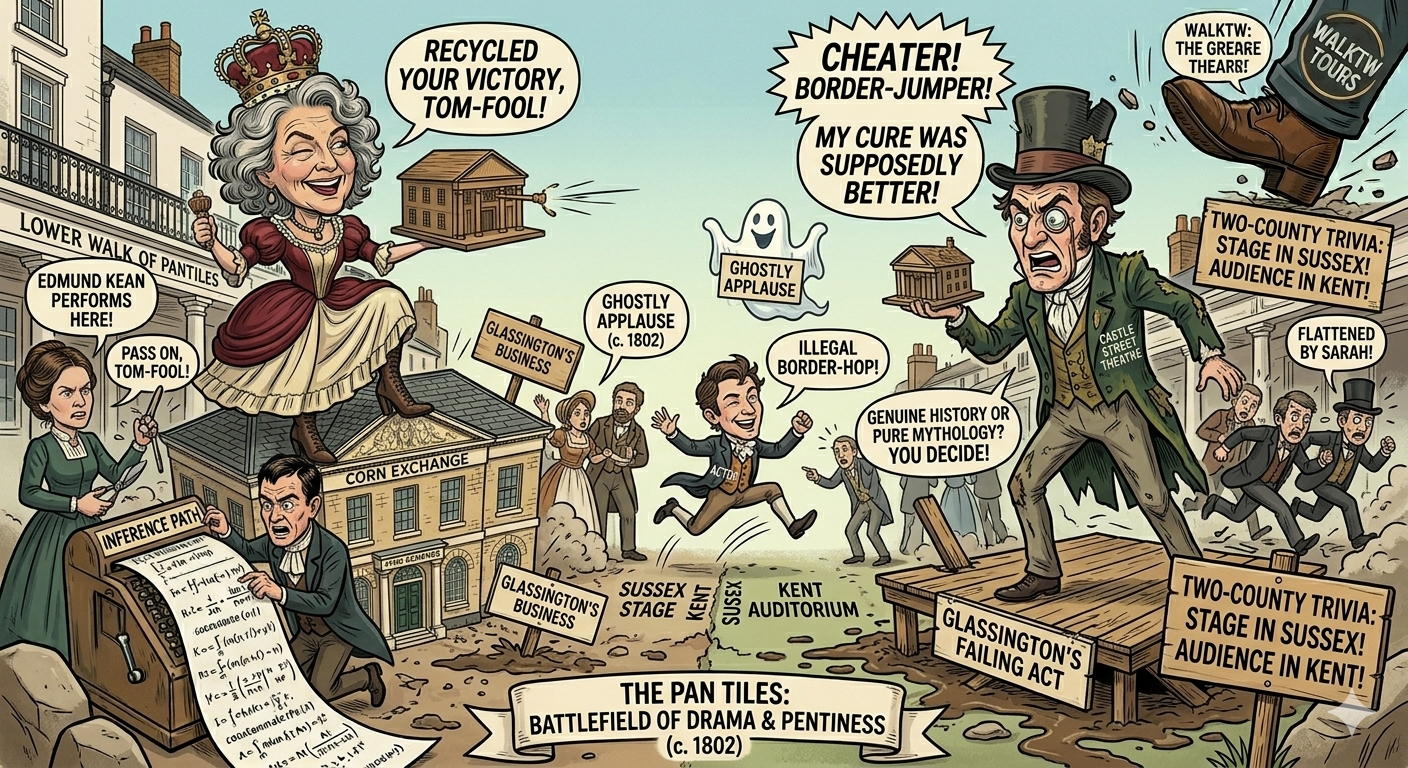
    When Sarah first rolled her theater carts into Tunbridge Wells, she didn’t have the market cornered. A rival manager, a rather dignified gentleman named Mr. Glassington, ran a competing theatre over on Castle Street.
    For a brief, high-stakes period, they went head-to-head. They scheduled plays on the exact same nights, actively trying to steal the same small pool of wealthy, water-sipping aristocrats. Glassington thought he could out-class Sarah Baker. He was wrong.
    Sarah didn’t just out-market him; she completely crushed his business. Once Glassington was safely driven out of town, Sarah pulled off the ultimate power move: she reportedly demolished her own old, out-of-the-way theatre (“The Temple of the Muses” up on Mount Sion) and used its actual physical timber and bricks to fortify her brand-new, unstoppable stronghold on The Pantiles. Talk about recycling your victories.

    The Legend of the Split Counties

    Once the theatre opened in 1802, it instantly generated the best geographic trivia the town had ever heard. Because Sarah Baker had built the venue directly on the historic boundary line between Kent and Sussex, a wild rumour took hold of the public imagination:

    • The Legend: It was widely whispered that the stage sat squarely in Sussex, while the audience’s seats were anchored in Kent.
    • The Gossip: Locals loved the idea that actors literally “crossed the border” every time they made a dramatic entrance, meaning the audience was sitting in one county, paying Kentish ticket prices, to watch a show happening in an entirely different county.

    The “Tom-Fool” at the Box Office

    By 1806, Sarah Baker was one of the wealthiest self-made women in the south of England. She could have hired an army of staff. Instead, she chose to remain a chaotic spectacle at her own front door.
    Every single night, Sarah sat at the box office entrance herself. To flaunt her immense wealth, she surrounded herself with blazing silver candlesticks and a massive, heavy silver inkstand. Spread right in front of her were her grand account books. The hilarious catch? She couldn’t actually read or write. But what she lacked in literacy, she made up for in volume. Sarah Baker had absolutely zero patience for dallying theatregoers. If a wealthy lord or an upper-class dandy fumbled with their coins or moved too slowly through the queue, the illiterate “Governess General” of Kent would loudly scold them in front of the entire street, shouting:“Pass on, Tom-Fool!”

    A Brush with Legend: The Superstar Incubator

    Despite her terrifying box-office etiquette, Sarah had an unmatched eye for raw talent. Her Pantiles stage became the ultimate testing ground for actors who would go on to become national legends.
    Before he became a household name and arguably the greatest British actor of the nineteenth century, a young, unknown Edmund Kean trod the boards right here in Tunbridge Wells, taking notes from an illiterate fairground dancer who knew exactly how to hook an audience. Unsurprisingly, Sarah Baker stories are woven through the history of British theatre.

    🕵️‍♂️ Fact or Fiction: Help Us Untangle the Rumors!

    Our comment section is the official 2026 WalkTW archive office. Let’s look at the latest rumours swirling around Sarah and Glassington—which ones do you think hold water? Also, if you know any surprising Sarah Baker facts, please add them below.

    • Myth #1: The Ghost of the Ruined Rival. Local legend says that Mr. Glassington was so heartbroken by Sarah destroying his business that his ghost cursed the bricks she stole from Mount Sion. Some say that if a performance went too well, a brick would mysteriously fall from the rafters—Glassington’s final, petty critique from beyond the grave.
    • Myth #2: The Illegal Border-Hop. Rumour has it that local smugglers used the “Two-County” layout to outsmart the law. If Kent constables raided the auditorium to catch a thief, the suspect would simply jump onto the stage into “Sussex,” leaving the officers legally stranded without a cross-county warrant.
    • Myth #3: The Coded Books. Some believe Sarah’s unreadable account books weren’t a sign of illiteracy at all, but a highly sophisticated, secret code she invented to hide her true earnings from the tax collectors and corrupt town managers.
      Next time you walk past the Corn Exchange and look up at the statue of Ceres on the roof, just picture Sarah Baker sitting below it, surrounded by silver, calling someone a Tom-Fool. What’s your take on the border-jumping theatre? Let’s argue about it below! 👇
      Next up in the trilogy: The Great Paving Scandal—how a royal slip-and-slide in the mud and a pair of corrupt local managers accidentally gave The Pantiles its iconic name. Stay tuned! 👑🧱
    TunbridgeWells #ThePantiles #SarahBaker #LocalHistory #TownPlanningWars #WalkTW

  • The Theatre Queen of The Pantiles 🎭👑

    The Theatre Queen of The Pantiles 🎭👑

    Picture this: It’s 1801. The morning mist is rising off the Chalybeate Spring, and the self-appointed town bosses are smoothing down their waistcoats, desperate to keep Tunbridge Wells a quiet, sleepy, perfectly proper spa town. But behind the scenes, something new was about to arrive: the Sarah Baker Theatre. They want the visiting aristocrats to sip their rust-flavoured water, go for a polite stroll, and go to bed early.

    Then, marching right down the middle of the Lower Walk, comes Sarah Baker. It was her presence that brought the energy and audacity that defined the iconic Sarah Baker Theatre in local history.

    If you think getting planning permission in town is a nightmare today in 2026, imagine the sheer panic when a widowed, self-made businesswoman—who started her career as a fairground dancer—decided to drop a massive, rowdy, brick-and-stone temple of raw drama right in the middle of their elite, male-dominated promenade. Overnight, the Sarah Baker Theatre changed the cultural map of Tunbridge Wells.

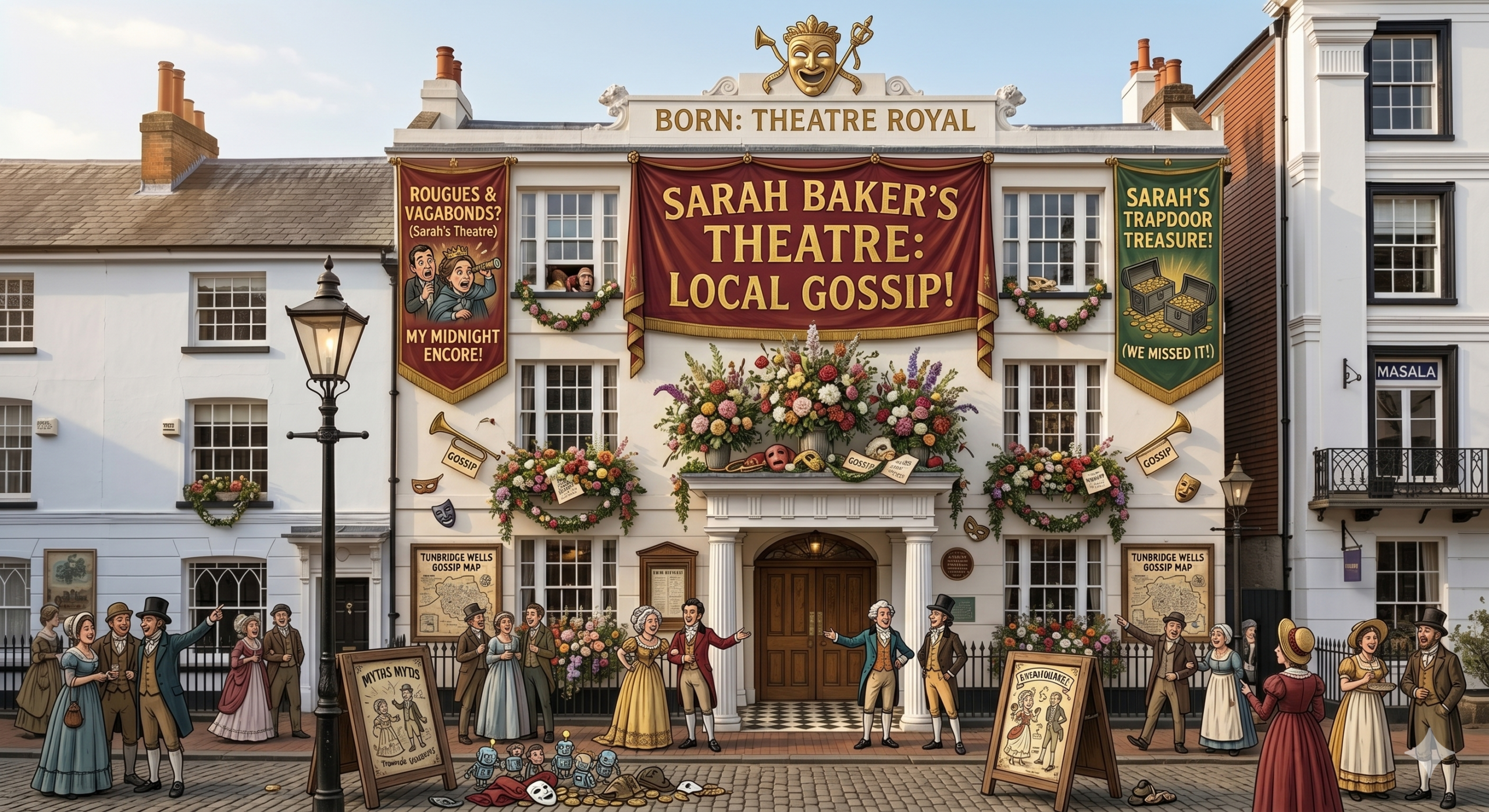
    The local authorities were horrified. To them, actors and theatre crews were little better than “rogues and vagabonds” threatening to ruin the town’s peaceful image. But Sarah looked at the bored rich people wandering the streets and knew a fundamental human truth: they didn’t just want water. They wanted a show.

    The Roar of the Crowd on the Lower Walk

    Defying local protests and furious glares, Sarah built her theatre, and it became an absolute sensation. Suddenly, the quiet pathway of the lower walks was the loudest, most vibrant hotspot in Kent. On any given night, you could hear high-stakes Shakespearean tragedies clashing with the roaring laughter of late-night pantomimes. This crowd energy made the Sarah Baker Theatre legendary throughout the region.

    Sarah ran the place with an iron fist and a razor-sharp wit. She was a master of handling snobbery. Whenever wealthy patrons tried to look down on her because of her humble roots, she didn’t argue. Instead, she would stand right at the box office herself, loudly and aggressively counting the night’s massive cash take right in front of their faces.

    She brought the biggest stars of the era, like the legendary Edmund Kean, straight to our doorstep. For a golden era, Sarah didn’t just run a business—she owned the town’s cultural heartbeat.

    Swapping Out the Drama for the Harvest

    But as the decades rolled on and the Victorian era took hold, the town’s mood shifted again. High society started favouring sober, industrious commerce over late-night theatrical chaos. In the late 1830s, the curtain came down on Sarah’s stage for the last time, and the building was converted into the Corn Exchange, becoming a bustling hub for agricultural trading.

    To make the rebrand official, they hoisted a massive statue of Ceres, the Roman Goddess of Harvest, onto the roof. It was the ultimate Victorian cover-up: replacing Sarah Baker’s dramatic, rebellious flair with a polite, stone face of serious business.

    Step into Sarah’s Footsteps Today (2026 Edition)

    The best part about this story? You can walk right into the middle of it on your next weekend stroll. Next time you’re walking down the Lower Walk of The Pantiles, stop and look up at the Corn Exchange. Indeed, the Sarah Baker Theatre was at the heart of this historic site.

    • The Sentry on the Roof: Look right up at the roofline, and you’ll see Ceres still standing guard, looking down at the modern shoppers, coffee drinkers, and weekend markets.
    • Standing on the Stage: Walk through the main entrance of the building. While the interior is now a beautifully vibrant space filled with independent shops and cafes, your feet are resting on the exact physical footprint where Regency actors once projected their voices to packed, cheering crowds.

    🕵️‍♂️ Fact or Fiction? You Decide!

    Because Sarah’s theatre was such a lightning rod for local gossip, our archives are riddled with some legendary rumors. We need our WalkTW community to weigh in—what sounds like genuine history, and what is pure local mythology?

    • Myth #1: The Secret Royal Box. Word has it that a young Princess Victoria used to sneak away from her lodgings on the Common, throw on a commoner’s cloak as a disguise, and sit in the back row just to laugh at Sarah’s rowdiest comedies.
    • Myth #2: The Midnight Encore. Shop owners inside the Corn Exchange have whispered for generations that if you find yourself alone in the building past midnight, the air goes cold, and you can hear the faint, muffled sound of a crowd applauding, followed by a woman’s voice calling out “Places, everyone!”
    • Myth #3: The Trapdoor Treasure. Legend says that Sarah completely inherently distrusted local banks. Rumour has it she built a hidden trapdoor right beneath the centre of the stage where she buried iron lockboxes filled with gold coins from her ticket sales—and it was completely missed during the Victorian renovations.

    What do you think? Have you ever felt a bit of dramatic energy walking past the Corn Exchange, or is it just the caffeine hitting from your morning flat white? Let’s argue about it in the comments below! 👇

    Next up in the trilogy: The Great Paving Scandal—how a royal slip-and-slide in the mud and a pair of corrupt local managers accidentally gave The Pantiles its iconic name. Stay tuned! 👑🧱

    #TunbridgeWells #ThePantiles #SarahBaker #CornExchange #LocalHistory #WalkTW #RegencyGossip #SarahBakerTheatre


    You might also like