Tag: Russian history

The hidden Russian dimension of Royal Tunbridge Wells — from Romanov visits and White Russian émigrés to the Orthodox church still holding services in a Victorian brick building.

  • The Russians Who Never Left: Tunbridge Wells Best-Kept Secret ⛪🕯️

    The Russians Who Never Left: Tunbridge Wells Best-Kept Secret ⛪🕯️

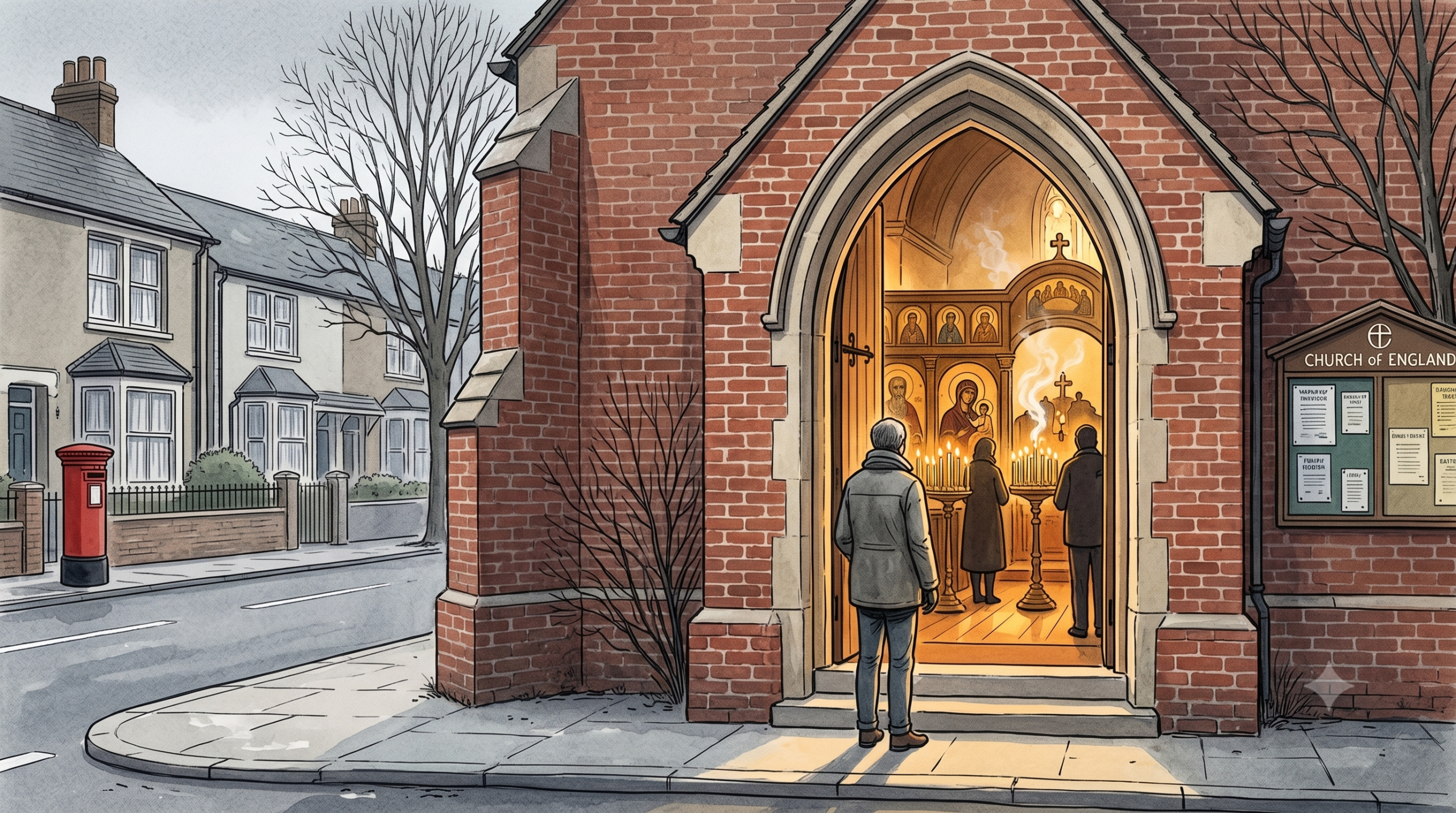
    Stand on St Luke’s Road, TN4, on a Saturday morning. Look at the Victorian brick church on your left. Note the Church of England noticeboard. The familiar English parish signage. The entirely unremarkable, entirely ordinary appearance of a building that has stood here for over a century.

    Nothing about it tells you what happens inside once a month. The Russian Orthodox Church in Tunbridge Wells holds a unique atmosphere for its community.

    The Eucharistic Community of St Luke — patron saint St Luke, Diocese of Sourozh, Moscow Patriarchate — worships at St Luke’s Church, St Luke’s Road, Tunbridge Wells, TN4 9JH, with Fr Vitalii Polishchuk as rector and Dennis Flower as churchwarden.

    A Russian Orthodox congregation. In Tunbridge Wells. Currently active, currently meeting, currently unknown to the overwhelming majority of the town in which it gathers.

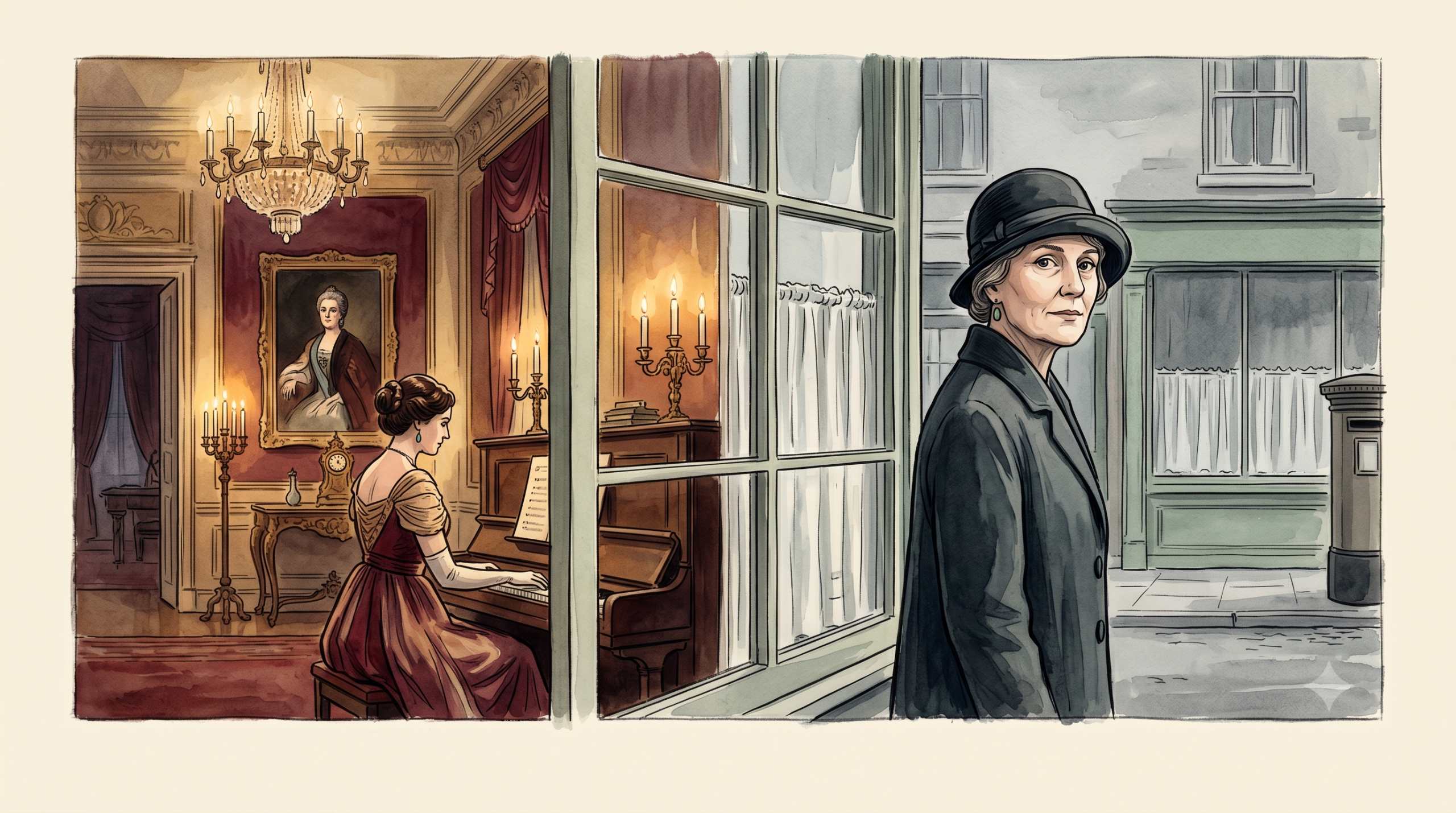
    The revolution that sent Baroness Olga to walk these streets in her cloche hat and jade earrings in the 1920s, the same revolution that forced the Romanovs who might have sheltered in Sussex to die instead in a cellar in the Urals — that revolution built something here that has outlasted everything. It is still here. It meets on St Luke’s Road. And almost nobody knows.


    Three Hundred Years of Hiding in Plain Sight

    The Russian Orthodox presence in Britain is far older and stranger than most people imagine.

    The origins of the Diocese of Sourozh lie in the Parish of the Dormition in London, which, from 1716, served as the Russian Embassy Church and was relocated several times over its history. Three hundred years. Russian Orthodox Christians have been gathering in borrowed English buildings since the reign of George I — since before the Pantiles were properly paved, since before Beau Nash arrived to impose order on the promenade, since before almost anything in Tunbridge Wells’s modern history happened.

    The Anglican Bishop of London agreed to allow Orthodox worship at the church, with the stipulation that the services remain private, that English people be excluded, and that singing not be loud “lest common crowds cause any harm.”

    Services must remain private. English people excluded. Singing kept quiet.

    Three hundred years later, on St Luke’s Road, the congregation still gathers in a building that belongs to the Church of England. They still keep themselves largely to themselves. The town still doesn’t know they’re there. Some things have a very long continuity.


    The Man Who Built the Church That Reached Tunbridge Wells

    To understand how a Russian Orthodox congregation ended up in TN4, you need to understand one extraordinary man.

    Metropolitan Anthony of Sourozh — born Andrei Borisovich Bloom in Lausanne in 1914 — led the Diocese of Sourozh, the Russian Orthodox Church in Great Britain and Ireland, from 1962 until he died in 2003. His father had been a member of the Russian Imperial Diplomatic Corps. His mother was the sister of Alexander Scriabin, the composer. He grew up in Russia and Persia, fled with his family to Paris after the revolution, took a medical doctorate from the Sorbonne, served as a surgeon in German-occupied France, and arrived in Britain in 1949.

    From the difficulties of Russian émigré life that had conditioned him as a monk without a monastery, through the trials of war and revolution, he moved between many changing landscapes, striving always to take his bearings in prayer and contemplation.

    He became one of the most beloved spiritual writers in Britain. In its initial decades, the diocese consisted mainly of upper-middle-class ex-Anglican converts and families of the first emigration from Russia following the 1917 revolution. Metropolitan Anthony encouraged the development of a distinctive style, liturgical practice and ethos that reflected the fusion of Franco-Russian émigrés and Oxford-London ex-Anglicans.

    Many Orthodox Christians in Great Britain and around the world consider Metropolitan Anthony a saint.

    The congregation he built — from a London embassy church, through decades of quiet growth, through the Cold War years when the Moscow Patriarchate could exercise virtually no control over its British communities — eventually extended its reach to a quiet residential street in Tunbridge Wells. The grandson of a revolutionary disruption, still gathering, still praying, still entirely invisible from the outside.

    What Happens Inside

    Here is what you would find if you went in.

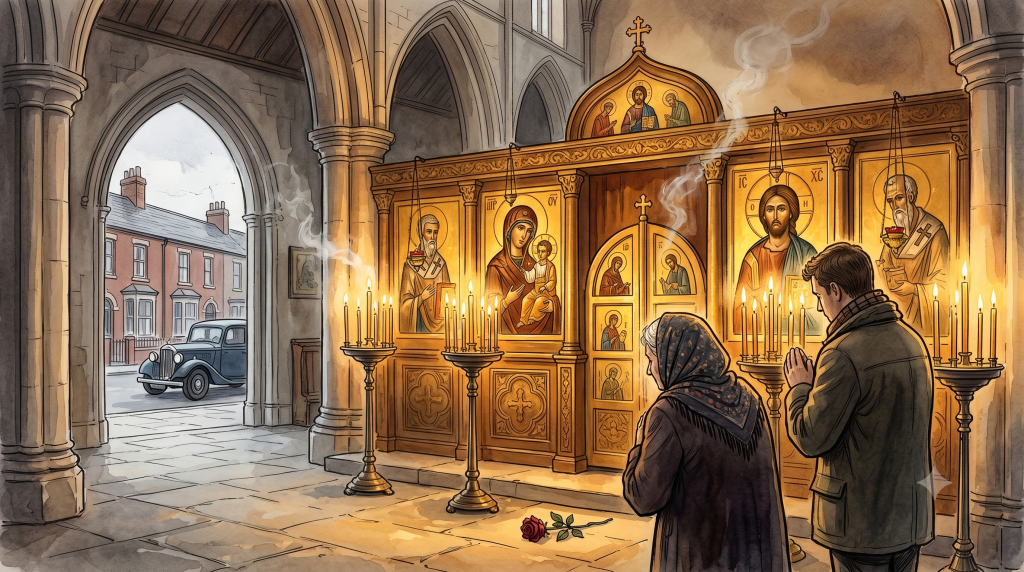
    The building would look Anglican from the nave — Victorian proportions, familiar stonework, English light through English windows. But the space would be transformed. Icons — the gilded, luminous faces of Orthodox saints — arranged in the Eastern manner. Candles burning in the particular way of Orthodox worship, not placed in rows but clustered at focal points, filling the space with warm, uneven light. The smell of incense. The sound, when the liturgy begins, is of a tradition of sung worship that stretches back through Byzantium to the earliest centuries of Christianity.

    The service would be in Church Slavonic — the ancient liturgical language of Orthodox Slavic worship — and in English. In the Orthodox tradition, the congregation would stand for most of the service. There would be no pews to retreat into.

    It is, in every way, unlike anything else in Tunbridge Wells.


    The Personal Thread

    This trilogy began with a woman in a cloche hat and jade earrings on the streets of 1920s Tunbridge Wells — Baroness Olga, the town’s only acknowledged Russian Revolution refugee, noticed by a historian’s child and recorded in a prize-winning book that the town itself has never read.

    It continued with the Romanovs, who almost came to Sussex, the cousins who called each other Georgie and Nicky, the Royal prefix granted in 1909 by a king who would shortly make the worst decision of his life.

    It ends here. On St Luke’s Road. With a congregation that has been quietly gathering, in one form or another, for longer than anyone in the town suspects — the living thread that connects 1917 to the present, the revolution to the here and now, the jade earrings on a 1920s street to a monthly liturgy in a Victorian Church of England building that gives nothing away from outside.

    There is a Russian in Tunbridge Wells who has lived here for seven years and never knew this congregation existed until a few weeks ago.

    There are almost certainly others.

    If you are Russian, or Orthodox, or simply curious, the contact is Dennis Flower, churchwarden, at [email protected]. The door is open. The candles are lit. The congregation is smaller than it should be, in a town that doesn’t know it’s there.

    Now you know.


    🕵️ The WalkTW Archive: Final Questions for the Trilogy

    Three closing questions — one for each post in the series:

    From Post 1: Who was Baroness Olga? Richard Cobb gives us her cloche hat, her jade earrings, and her title and nothing else. The WalkTW archive has been asking since the first post. Does anyone know her full name, her address, her story beyond Cobb’s single paragraph?

    From Post 2: Which Sussex estates did Grand Duke Michael Alexandrovich own? He formally requested permission to return to them in 1917. They were real. They had an address. Did they border Kent? Could he, in another history, have taken the train through Tunbridge Wells Central on his way home?

    From Post 3: How old is the Tunbridge Wells Russian Orthodox congregation? The Diocese of Sourozh was formally constituted in 1962, but its roots go back to the 1917 émigré wave. If Baroness Olga was in Tunbridge Wells in the 1920s, was there already a small Orthodox community gathering somewhere in this town — informally, invisibly, in someone’s drawing room — before there was ever a parish listing or a churchwarden’s email address?

    The archive is listening. Drop what you know in the comments. 👇

    And that, for now, is the end of The Russians Are Among Us — three posts, three centuries, one town that kept its Russian connections entirely to itself. Until now.

    #TunbridgeWells #WalkTW #RussianOrthodox #TheRussiansWhoNeverLeft #HiddenHistory #StLukesRoad #DioceseSourozh #TheRussiansAreAmongUs
    More in this series: Russian Tunbridge Wells

  • The Russians Who Never Arrived: Tunbridge Wells and the Romanovs 👑🚂

    The Russians Who Never Arrived: Tunbridge Wells and the Romanovs 👑🚂

    Some came to stay. Some never arrived. Some never left. The hidden Russian history of Royal Tunbridge Wells.

    On 8 April 1909, King Edward VII signed a royal warrant. From that day forward, the spa town in Kent would be known as Royal Tunbridge Wells — one of only three towns in England ever to receive the honour. The story of the Romanovs in England — the Royal connection to Tunbridge Wells is a fascinating part of the town’s unique history.

    The original proposal was to rename it “Royal Kentish Spa,” but the King preferred “Royal Tunbridge Wells,” and this was the name formally granted. The prefix recognised the town’s long history of royal and aristocratic visitors, stretching back to the earliest days of its fame as a spa.

    It was a moment of quiet civic triumph. The town had been trying to modernise, to compete, to position itself as something more than a faded Georgian resort. The Royal prefix was its reward.

    What nobody in Tunbridge Wells could have known was that the King who signed that warrant had less than thirteen months left to live. That his son George, who would inherit both the throne and the family’s Russian connections, would within eight years face one of the most agonising decisions in the history of the British monarchy. And that the Russian cousins who might, in a different history, have found their way to this corner of Kent would instead end their lives in a cellar in the Ural mountains.

    The year Tunbridge Wells became Royal was also, almost exactly, the last year things were still going to be fine.


    Georgie and Nicky: The Cousins Who Looked Like Twins

    To understand what was lost, you need to understand what existed.

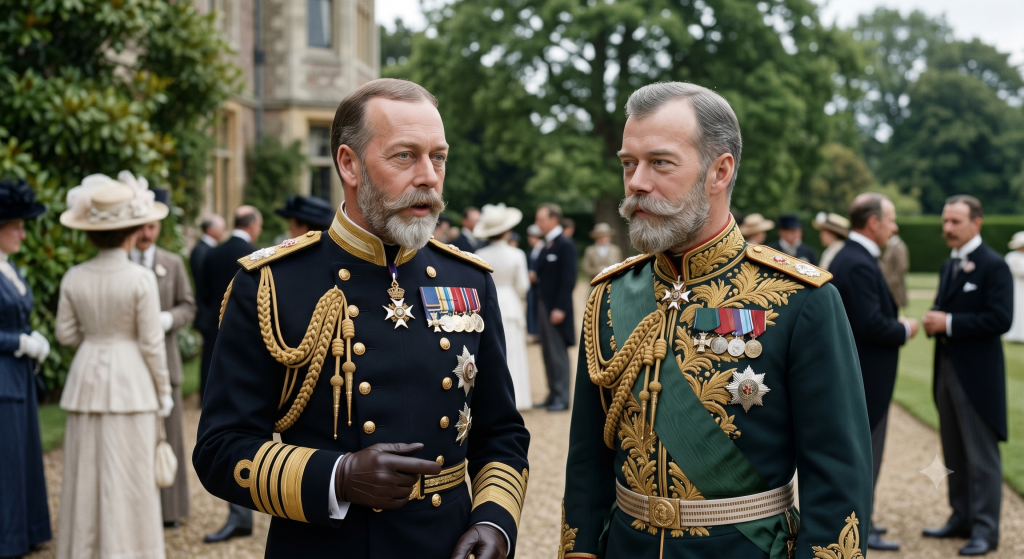
    A realistic historical photograph depicting King George V of Great Britain and Tsar Nicholas II of Russia standing side-by-side at an outdoor garden party. Both men possess striking physical similarities, including neatly trimmed, greying beards and prominent moustaches. They wear ornate, highly detailed military uniforms adorned with gold epaulets, sashes, and numerous medals. In the blurred background, other Edwardian-era guests mingle on the grounds of an estate.

    Tsar Nicholas II of Russia and King George V of Great Britain were first cousins and bore a striking resemblance to each other — the same blue eyes, the same beard, similar in size and build. They often wrote to each other using the nicknames “Nicky” and “Georgie.” Their own relatives sometimes mistook them for one another from behind.

    By all accounts, the relationship was warm and affectionate — cousins who seemed almost as close as siblings. They holidayed together with their families. Although George and Nicholas shared a close bond when young, the weight of the monarchy and political unrest in Russia would gradually impose distance between them.

    They were cousins in the deepest Victorian sense — products of Queen Victoria’s extraordinary habit of marrying her children into every royal house in Europe. George and Nicholas were grandchildren of Queen Victoria, bound to one another by history even as history would ultimately tear them apart.

    In the summer of 1909 — the same year Tunbridge Wells received its Royal prefix — the Romanov and Windsor families met at Cowes for Regatta Week. Three generations. The last entirely happy family photograph. Four years later, in 1913, they gathered again in Berlin for a cousin’s wedding. It would be the final meeting of the great European royal families before the start of the First World War — and perhaps the last amiable occasion before the Romanov dynasty’s collapse.


    The Romanov Who Actually Lived in England

    Here is something most people don’t know. A member of the immediate Romanov family didn’t just visit England in the years leading up to the revolution. He lived here.

    Grand Duke Michael Alexandrovich — tall, handsome, younger brother of Tsar Nicholas II — ended up in England in 1913, taking up residence at Knebworth House in Hertfordshire on a one-year lease. He had been exiled from Russia by his own brother for entering into a morganatic marriage — marrying beneath his station — with a twice-divorced commoner named Natasha. The couple had been forced to live a peripatetic existence in Switzerland, on the French Riviera and finally in England.

    He walked English lanes. He photographed the English countryside. A photo album of some 200 photographs he took during his time at Knebworth sold at auction for the equivalent of $34,000. He was, in every practical sense, a Russian Grand Duke living an English country life — attended by an English governess for his children, watched by Russian secret police who had followed him across Europe, excluded from English high society because his wife was divorced.

    When Russia mobilised its troops in 1914, Michael sought permission to return to Russia and fight for his country. He went back. He need not have.

    In 1917, after Nicholas abdicated, Michael was named in the abdication manifesto as potential Tsar — he deferred acceptance until ratification by an elected assembly and was never confirmed as Emperor. Grand Duke Michael and Countess Brasova were kept under house arrest on the Gatchina estate. They used diplomatic channels to request permission to leave Russia and live in exile on their Sussex estates.

    Sussex. He had property in England. He wanted to come back. The permission was not granted.

    Grand Duke Michael Alexandrovich was murdered on 13 June 1918 in Perm, Russia, aged 39. He was the first of the Romanovs to be killed. His brother Nicholas and the rest of the imperial family followed in Yekaterinburg one month later.

    The Sussex estates waited empty. The English countryside he had photographed from Knebworth continued quietly without him.


    The Refusal That Changed Everything

    In March 1917, the British Foreign Office wrote to the British Ambassador in Petrograd to offer “asylum to the Emperor and Empress in England, which it is hoped they will take advantage of during the war.” Later, owing to fears of growing anti-monarchical sentiment and possible revolution at home, King George V and Parliament opposed the idea.

    There are grounds to believe it was George V himself who blocked the plan — though he later tried to cover up the fact. The political calculation was cold and clear: bringing “Bloody Nicholas” and his German Empress to England would look bad. Britain was a constitutional monarchy where a king’s power was at the mercy of the people. Nicholas was radioactive, and George needed to protect himself. He wasn’t “Georgie” anymore.

    It was unfortunately not considered acceptable to offer asylum to the Tsar or any male members of the Russian Imperial family. The British government needed to keep Russia in the war as an ally and did not want to upset the Provisional Government, which they had already recognised as the legitimate rulers of Russia.

    George V wrote to Nicholas after his abdication: “I shall always remain your true friend.”

    He did not save him.

    After the murder, he wrote in his diary that it was a foul murder, and that he had been devoted to Nicky, who was the kindest of men and a thorough gentleman. The diary entry has the particular quality of a man who knew exactly what he had done and could not say so.


    What Tunbridge Wells Might Have Contained

    This is the counter-history. The paths that nearly crossed. The houses that might have had different occupants.

    Grand Duke Michael owned property in Sussex and wanted to return to it. His sister Xenia — Nicholas’s favourite sibling — was George V’s favourite cousin. He gave her Frogmore Cottage as a grace-and-favour home in 1925, and she used to go to Windsor Castle to see the King and Queen. She lived in England until she died in 1960 at Hampton Court Palace. The Tsar’s sister died in Hampton Court Palace. His nephew, Prince Andrei Alexandrovich, was born in the Winter Palace, St Petersburg, and died at Provender House, Faversham, Kent, on 8 May 1981.

    The Tsar’s family — the ones who survived — ended up in Kent anyway. One branch of the Romanovs has been in this county for over a century. They just arrived as exiles rather than as royalty, by a longer and more terrible route than anyone intended.

    And in Tunbridge Wells, in the 1920s, a woman in a cloche hat and jade earrings walked the streets — the town’s only acknowledged Russian Revolution refugee, remembered by a historian’s child who happened to be watching.

    The Royal prefix the town received in 1909 came from a king who would shortly face a choice between family and politics, and choose politics. The word “Royal” on our street signs is, among other things, a small monument to a friendship that couldn’t hold when it mattered most.


    🕵️ Fact or Fiction? The WalkTW Archive Weighs In

    Three questions for the comment section:

    Question #1: The Sussex Estates. Grand Duke Michael Alexandrovich owned property in Sussex and formally requested its return in 1917. Nobody has yet identified exactly which Sussex estates these were, or how close they came to Tunbridge Wells’s borders. Does anyone know? The WalkTW archive would very much like to find out.

    Question #2: The Photograph Album. Grand Duke Michael took 200 photographs of English country life during his time at Knebworth in 1913-14. They sold at a Russian auction. Has anyone ever seen them? Given that he was exploring English landscapes just a short distance from Kent, some of those photographs may show the Wealden countryside visible from the hills of Tunbridge Wells.

    Question #3: Did They Pass Through? The railway line from London to the Sussex coast — the same route a Russian Grand Duke with Sussex property would most naturally have taken — runs through Royal Tunbridge Wells. The station exists. The timetables existed. Is it possible that a Romanov passed through Tunbridge Wells Central on their way to or from their English estates and never left a record of it? We cannot prove it. We cannot disprove it either.

    Drop your thoughts below. The archive is listening. 👇

    #TunbridgeWells #WalkTW #Romanovs #RussianHistory #TheRussiansWhoNeverArrived #GeorgeV #NicholasII #LocalHistory #HiddenHistory


    More in this series: Russian Tunbridge Wells

  • The Russians Who Came to Stay: Tunbridge Wells and the Revolution 🪆

    The Russians Who Came to Stay: Tunbridge Wells and the Revolution 🪆

    Some came to stay. Some never arrived. Some never left. The hidden Russian history of Royal Tunbridge Wells.

    There is a woman walking down a street in Tunbridge Wells. It is sometime in the 1920s. She wears a tight-fitting cloche hat. Jade earrings catch the light. She walks with the particular bearing of someone who was once very important in a world that no longer exists.

    Her name, as far as we know, is Baroness Olga. She is part of a fascinating chapter in Russian history connected to Tunbridge Wells.

    She is the only person in this town, perhaps in this entire corner of England, who has lost everything — not to illness or bad luck or a poor investment, but to a revolution. The world she came from — the servants, the estates, the titles, the certainties — was dismantled in the space of a few terrible years and replaced with something entirely unrecognisable.

    She ended up here. In Tunbridge Wells.

    A historian’s child, Richard Cobb, watched her walk those streets and never forgot her. Sixty years later, he put her in a book. She is, he wrote, “the town’s only victim of the Russian Revolution.”

    Only. That single word tells you everything about how invisible she must have felt.


    The Revolution That Washed Up in Kent

    In the years following 1917, the Russian Civil War led to the displacement of over one million people. The majority of the refugees were from Russia’s educated classes — they had fled their homes as the Whites suffered heavier defeats, first to Constantinople, then gradually on to London, Belgrade, Paris and Berlin.

    Britain, however, was not exactly welcoming. Government policy was to refuse entry to all Russians unless there were exceptional circumstances. Only very small numbers were admitted — usually if they had business connections, strong personal ties, or were high-profile. Exceptions were made for upper-class Russians, who were granted entry where others were turned away.

    Which means Baroness Olga wasn’t just a refugee. She was a refugee who cleared a very high bar. She had connections, or a title, or both. She got in when most of her countrymen didn’t. And having got in — having survived the revolution, the civil war, the chaos of displacement, the bureaucratic machinery of a country that didn’t particularly want her — she landed in the most resolutely, comfortingly, almost aggressively ordinary English town she could find.

    Tunbridge Wells. Where nothing bad ever happened. Where the biggest controversy in living memory had been an argument about who was responsible for paving The Pantiles. Where respectability was not just valued but practically load-bearing.

    For a woman who had watched her entire world collapse, the appeal is clear.


    What It Actually Meant to Be a White Russian in England

    The early 1920s brought chaotic displacement — families fled en masse, losing properties and facing statelessness after the 1921 denationalisation. Many White Russians in Europe found themselves not just homeless but technically without a country — the Soviet Union did not recognise them as citizens, and their old passports were worthless. Nansen passports — a form of internationally recognised refugee travel document — enabled settlement and led to community formation.

    Those who left included military officers, Cossacks, intellectuals, businessmen and landowners. In Paris and Berlin, the communities were large enough to be self-sustaining — the proliferation of Russian institutions abroad essentially allowed émigrés to go about their daily lives entirely in Russian, with journals, newspapers and books published in their native language.

    In Tunbridge Wells, there was no such community. There was Baroness Olga.

    She had the cloche hat, the jade earrings, and the bearing of someone accustomed to a different kind of life. And she had the streets of a Kent spa town — the Pantiles, the Common, the High Street, the steady unhurried rhythms of a place that valued above all else the appearance of everything being perfectly fine.

    In its own strange way, it might have been exactly what she needed.


    The Hidden Congregation on St Luke’s Road

    Here is where the story takes an unexpected turn.

    Baroness Olga was not, it turns out, the town’s only Russian connection. She was simply the most visible one — noticed because she was noticed, recorded because a historian’s child happened to be watching.

    Behind her, less visible, gathering quietly in borrowed spaces: a Russian Orthodox congregation.

    The Eucharistic Community of St Luke — part of the Diocese of Sourozh, Moscow Patriarchate — has been meeting in Tunbridge Wells for decades. It currently meets at St Luke’s Church on St Luke’s Road, TN4 9JH. There is nothing on the outside of the building to suggest it. No Cyrillic lettering. No golden dome. Nothing that would cause a passing local to pause and think, “This is where the Russians are.”

    The congregation’s news pages were updated as recently as 2026. It is not a historical footnote. It is happening now.

    This is the living legacy of 1917 in our town. The revolution that sent Baroness Olga to walk these streets in her cloche hat and jade earrings also, eventually, built a community that has quietly persisted here for a century — gathering once a month in a Victorian church that gives nothing away from the outside, in a town that has no idea they exist.


    The Personal Footnote

    There is one more layer to this story — and it belongs to the present rather than the past.

    Russians still come to Tunbridge Wells. Not as refugees from revolution, not as aristocrats seeking safe harbour, but as people who have found their way here by the ordinary modern routes of work and life and circumstance. Some of them have lived here for years without ever knowing that a Russian Orthodox congregation meets monthly less than a mile from their front door.

    This town has a habit of keeping its Russian connections to itself.

    Baroness Olga walked these streets. Richard Cobb watched and remembered her. A congregation still gathers on St Luke’s Road. And somewhere in between those facts — between the jade earrings and the borrowed Victorian church — there is a story about how places absorb the people history sends to them, quietly, without fuss, and how those people leave traces that last far longer than anyone expected.


    🕵️ Fact or Fiction? The WalkTW Archive Weighs In

    Three questions for the comment section — and this time, we genuinely don’t know the answers:

    Mystery #1: Who Was She Really? Richard Cobb names her only as “Baroness Olga.” He gives no surname, no address, no further detail. She is simply there — on the streets of Tunbridge Wells in the 1920s, walking past young Richard on his way to school. Does anyone know who she actually was? The WalkTW archive would dearly love to find out.

    Mystery #2: The Church Before St Luke’s. The Russian Orthodox congregation in Tunbridge Wells has been meeting in borrowed Anglican buildings for decades. But where did it meet before St Luke’s Road? And how far back does the community actually go? If it was founded in the early 1920s — by people like Baroness Olga — then it is older than almost anyone in the town suspects.

    Mystery #3: The Other Russians. Cobb calls Baroness Olga “the town’s only victim of the Russian Revolution,” but was she really the only one? Given that Britain admitted White Russians selectively, favouring those with connections and means, a prosperous Kent spa town with affordable Victorian villas seems like an entirely logical destination. Are there others who came and left no record at all?

    If you know anything about Baroness Olga, about the history of the Orthodox community, about any other Russian connections to this town, drop it in the comments. The WalkTW archive is listening. 👇

    #TunbridgeWells #WalkTW #RussianHistory #TheRussianAreAmongUs #WhiteRussians #BaronessOlga #LocalHistory #HiddenTunbridgeWells


    More in this series: Russian Tunbridge Wells