A Building File: 1 Linden Park Road
Building Files, Issue 4
This post is part of the Railway War series. Start with Part 1 (1845–1923) and Part 2 (1940–present) if you’re coming to this fresh.
There is a building on Linden Park Road that has spent 160 years confusing people about what it is supposed to be.
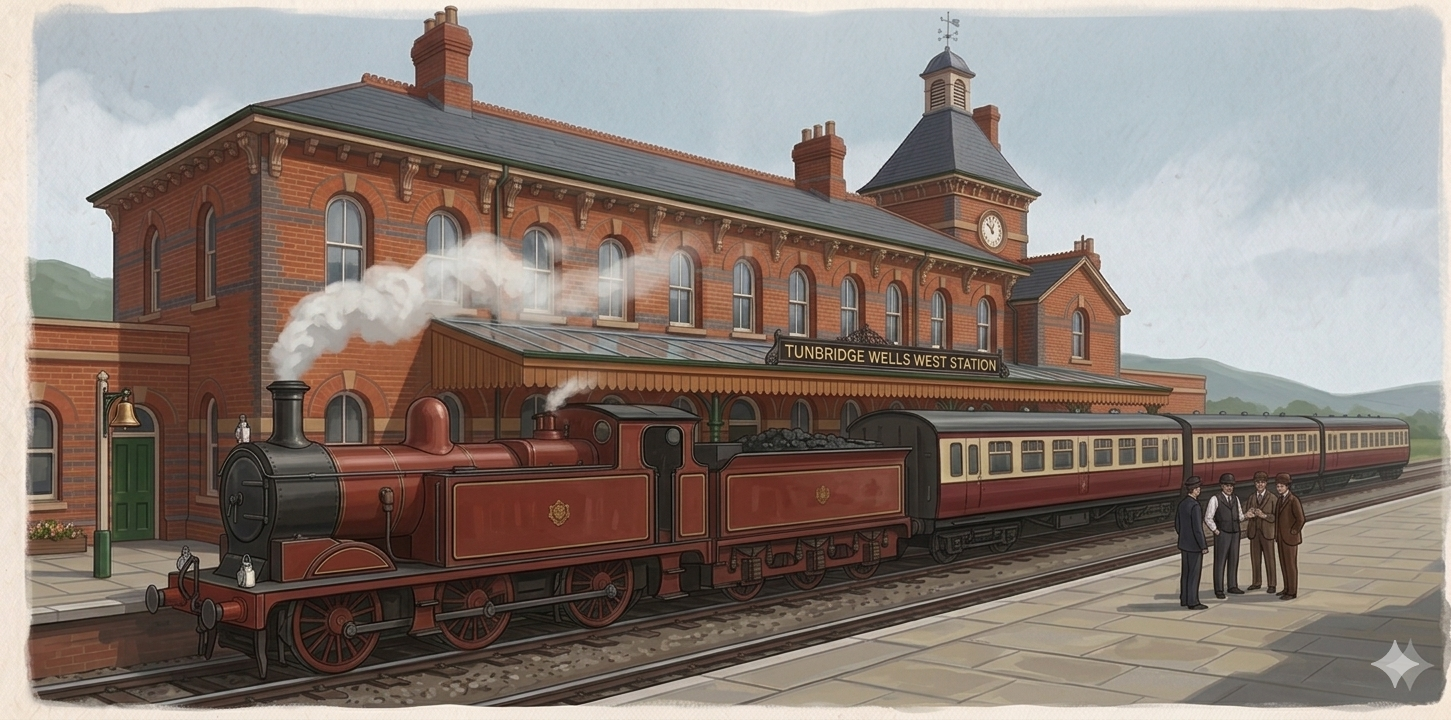
It arrived in 1866 as a railway station, the LBSCR’s triumphant answer to the SER’s existing terminus half a mile away. It closed in 1985 when British Railways decided the line wasn’t worth keeping. It became a Beefeater. Then a pub. Then a Wild West steakhouse with nine hotel rooms named after South American tribes and a large decorative jail that you can book for parties.
The building, for its part, has said nothing. It just stands there — red brick, round-arched windows, three-storey clocktower with a pyramidal roof and a louvred cupola — looking exactly as it did when the first LBSCR train pulled in on 1 October 1866. Which is, depending on your mood, either deeply reassuring or faintly absurd.
The Building Itself
Before we discuss what has been done to it, it is worth pausing on what it actually is.
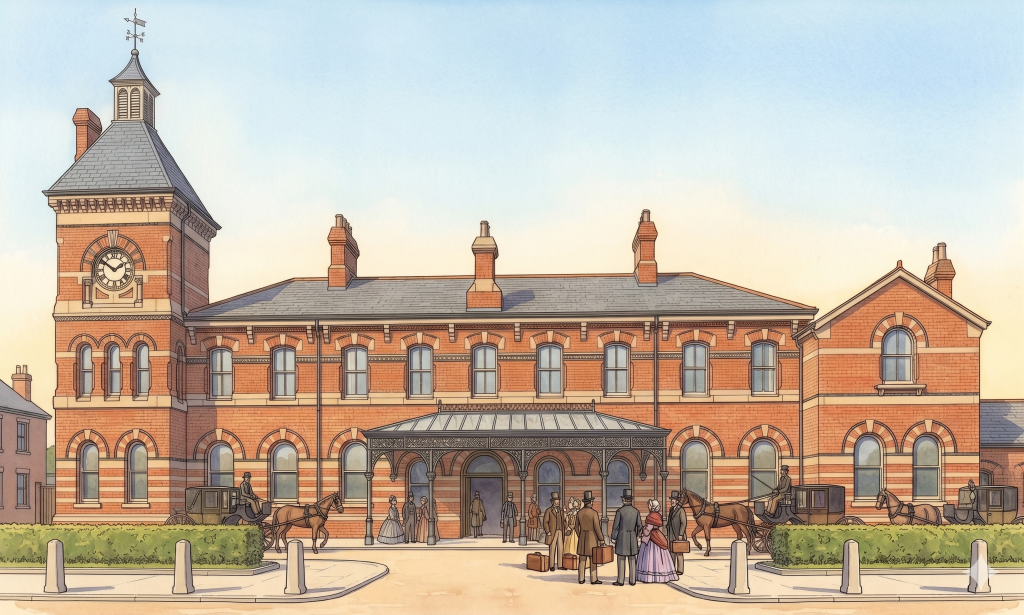
Tunbridge Wells West station was designed by Charles Henry Driver, an engineer’s architect whose credits include the ornamental masonry of the Thames Embankment, the Abbey Mills Pumping Station, and the Crystal Palace aquarium. He was, in short, someone who understood how to make a functional structure look considerably more important than strictly necessary.
The building he gave Tunbridge Wells in 1866 reflects that instinct entirely. The facade is two storeys of red brick with ashlar and black brick dressings, arranged across a ten-bay centre block with a gable-fronted wing to the west and a three-storey clocktower to the east. The ground floor carries nine round-arched windows and an arched doorway, connected by a decorated ashlar impost band that runs the full width of the building. The eaves are serrated, with an ashlar cornice on foliated brackets. The clock tower terminates in a pyramidal slate roof, above which sits a louvred cupola with a weathervane.
Inside, the original booking hall featured a panelled ceiling, a three-bay, columned arcade, and four gas-lit ticket windows. It was, in every sense, a statement building — the LBSCR making unmistakably clear that it had arrived in Tunbridge Wells and intended to stay.
Historic England listed it Grade II on 27 March 1986, approximately ten months after the last train departed. The listing came just in time.
What Happened Next
The building’s post-railway life has proceeded in three acts, each successively stranger than the last.
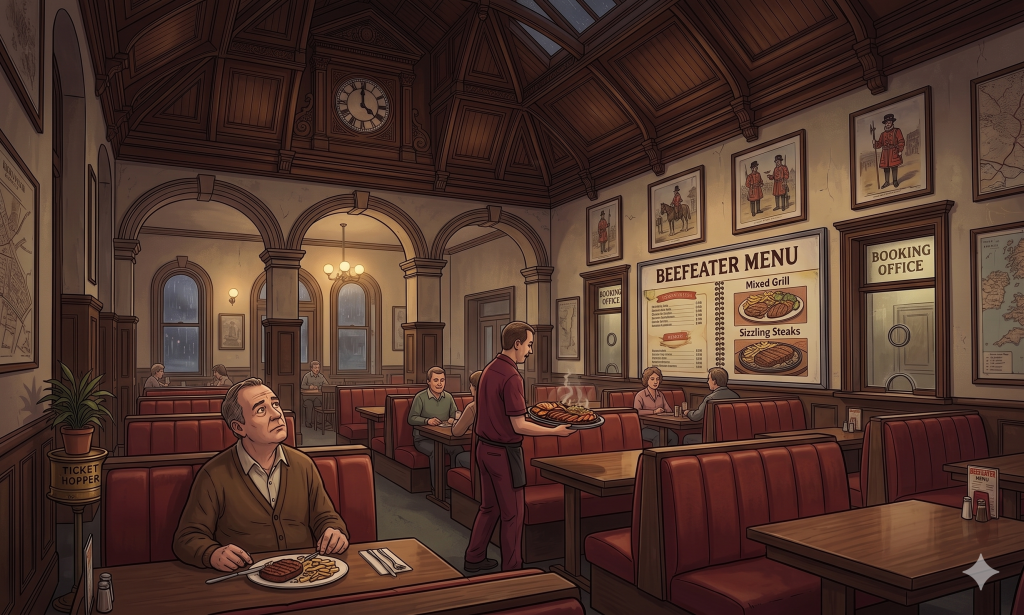
Act One arrived in the late 1980s, when the main building was converted into a Beefeater restaurant called The Old West Station. The name was apt — it is the Old West Station — though one suspects the Beefeater marketing department was gesturing at cowboys rather than Victorian railway geography. The booking hall, with its panelled ceiling and stone columns, became a dining room. The arched windows looked out over the car park where the platforms used to be.
Act Two followed when Herald Inns and Bars purchased the building and continued operating it as a pub-restaurant under the same name. The Cowboys remained notional.
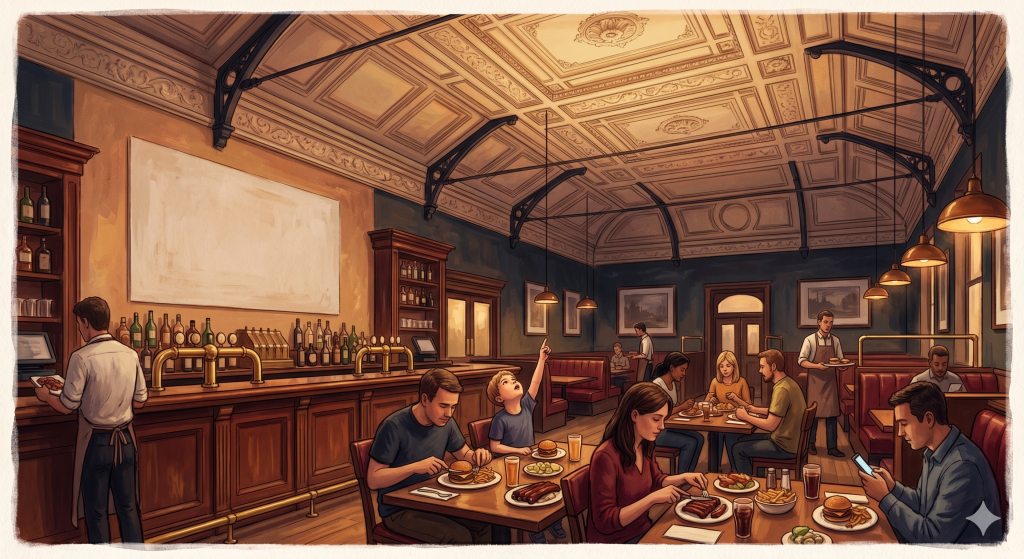
Act Three began in 2009, when Smith & Western moved in. They are a chain of American-themed steakhouses with Wild West decor, banjo music, and a menu running to ribs, burgers, and fajitas. They have leaned into the theme with total commitment. There is a saloon bar. There is a decorative jail available for private hire. The nine hotel rooms are named after South American tribes, which is a geographically inventive touch. The restaurant’s own website describes the building as “a historic landmark brought back to life,” which is one way of putting it.
The Awkward Question
Here is where this Building File has to say something honest, even if it is not entirely comfortable.
Wild West decor in a Grade II listed Victorian railway station is, on the face of it, a jarring combination. Driver’s building was conceived as a piece of civic architecture — a public gateway to a prosperous town, with the proportions and detailing to match. Filling it with cowboy hats and country music is not, by any conventional standard of heritage, a sympathetic use.
Furthermore, the context is particularly pointed in Tunbridge Wells. The station building sits directly beside the Spa Valley Railway — a preservation society that spent eleven years fighting to bring the line back, that operates steam trains through the High Weald on volunteer labour, that named itself TWERPS with cheerful obliviousness. One half of the site is a labour of love. The other half serves nachos.
And yet.
The alternative — which was very real in the late 1980s, when the building stood derelict, and the Sainsbury’s bulldozers were active next door — was not a sensitively curated heritage centre with educational panels and a gift shop selling LBSCR tea towels. The alternative was a building with no income, no maintenance budget, and no one with a financial incentive to care whether the roof held.
Adaptive reuse is how most Victorian buildings survive. Those that do not find commercial use tend not to survive at all. Churches become apartments. Pumping stations become nightclubs. Railway hotels become offices. The question is never whether the new use is architecturally ideal — it rarely is — but whether the building is being maintained, whether its structural fabric is intact, and whether the people who walk through its doors can still read the original building clearly if they look up.
On those terms, the Old West Station is doing reasonably well. The exterior is well-maintained. The nine round-arched windows are still in place. The clock tower still stands above Linden Park Road as it has since 1866. The panelled booking hall ceiling — the one that was lit by gas when the LBSCR first opened the doors — is still there above the tables.
What It Owes the Town
There is, however, one thing that adaptive reuse does not automatically provide, and which the Old West Station has so far largely declined to offer: a readable connection to its own history.
A building this significant — designed by the architect of the Thames Embankment, built as the centrepiece of a Victorian railway war, the scene of the final passenger departure in 1985 and the subsequent eleven-year preservation battle — deserves more than a passing mention on a restaurant website. It deserves an interpretation panel in the entrance. A framed history on the wall of the booking hall. Something that tells the people eating their fajitas where they actually are.
This is not a radical demand. It costs very little. Moreover, it is arguably good for business — a story this good makes the building more interesting to visit, not less. However, as things stand, the Wild West theme is the narrative, and the Victorian railway history is the backdrop.
The driver’s building has survived a bomb, a closure, a supermarket next door, and four decades of commercial tenants. It is still standing. That matters enormously. But standing is not the same as being understood — and a building in the middle of Tunbridge Wells, with this much history in its walls, deserves to be both.
The Building Files is a WalkTW series exploring the hidden histories of Royal Tunbridge Wells’s most interesting addresses. The Smith & Western is open seven days a week at 1 Linden Park Road, TN2 5QL. The Spa Valley Railway departs from the platform directly behind it.