Picture this: It’s 1801. The morning mist is rising off the Chalybeate Spring, and the self-appointed town bosses are smoothing down their waistcoats, desperate to keep Tunbridge Wells a quiet, sleepy, perfectly proper spa town. But behind the scenes, something new was about to arrive: the Sarah Baker Theatre. They want the visiting aristocrats to sip their rust-flavoured water, go for a polite stroll, and go to bed early.
Then, marching right down the middle of the Lower Walk, comes Sarah Baker. It was her presence that brought the energy and audacity that defined the iconic Sarah Baker Theatre in local history.
If you think getting planning permission in town is a nightmare today in 2026, imagine the sheer panic when a widowed, self-made businesswoman—who started her career as a fairground dancer—decided to drop a massive, rowdy, brick-and-stone temple of raw drama right in the middle of their elite, male-dominated promenade. Overnight, the Sarah Baker Theatre changed the cultural map of Tunbridge Wells.
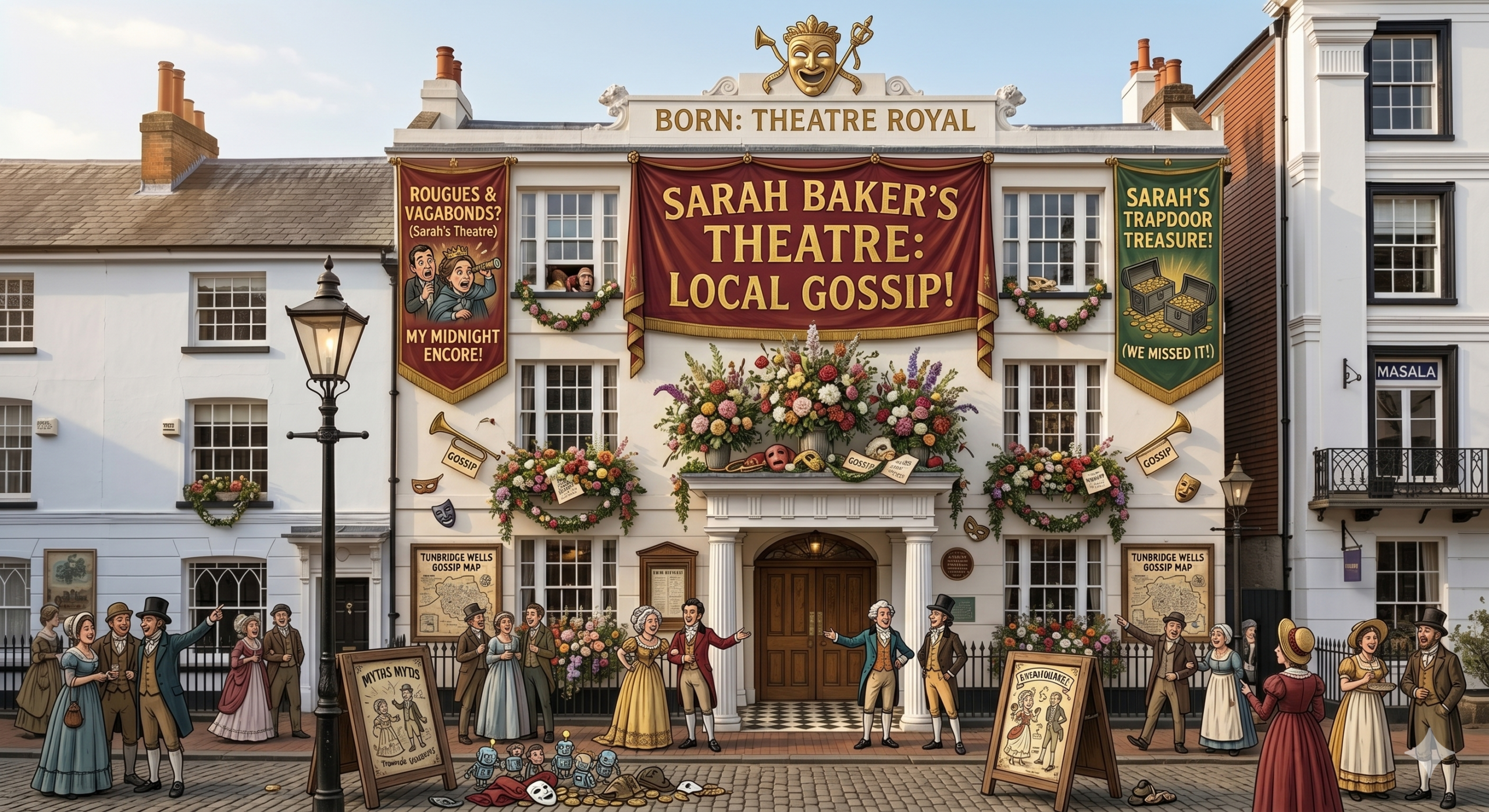
The local authorities were horrified. To them, actors and theatre crews were little better than “rogues and vagabonds” threatening to ruin the town’s peaceful image. But Sarah looked at the bored rich people wandering the streets and knew a fundamental human truth: they didn’t just want water. They wanted a show.
The Roar of the Crowd on the Lower Walk
Defying local protests and furious glares, Sarah built her theatre, and it became an absolute sensation. Suddenly, the quiet pathway of the lower walks was the loudest, most vibrant hotspot in Kent. On any given night, you could hear high-stakes Shakespearean tragedies clashing with the roaring laughter of late-night pantomimes. This crowd energy made the Sarah Baker Theatre legendary throughout the region.
Sarah ran the place with an iron fist and a razor-sharp wit. She was a master of handling snobbery. Whenever wealthy patrons tried to look down on her because of her humble roots, she didn’t argue. Instead, she would stand right at the box office herself, loudly and aggressively counting the night’s massive cash take right in front of their faces.
She brought the biggest stars of the era, like the legendary Edmund Kean, straight to our doorstep. For a golden era, Sarah didn’t just run a business—she owned the town’s cultural heartbeat.
Swapping Out the Drama for the Harvest
But as the decades rolled on and the Victorian era took hold, the town’s mood shifted again. High society started favouring sober, industrious commerce over late-night theatrical chaos. In the late 1830s, the curtain came down on Sarah’s stage for the last time, and the building was converted into the Corn Exchange, becoming a bustling hub for agricultural trading.
To make the rebrand official, they hoisted a massive statue of Ceres, the Roman Goddess of Harvest, onto the roof. It was the ultimate Victorian cover-up: replacing Sarah Baker’s dramatic, rebellious flair with a polite, stone face of serious business.
Step into Sarah’s Footsteps Today (2026 Edition)
The best part about this story? You can walk right into the middle of it on your next weekend stroll. Next time you’re walking down the Lower Walk of The Pantiles, stop and look up at the Corn Exchange. Indeed, the Sarah Baker Theatre was at the heart of this historic site.
- The Sentry on the Roof: Look right up at the roofline, and you’ll see Ceres still standing guard, looking down at the modern shoppers, coffee drinkers, and weekend markets.
- Standing on the Stage: Walk through the main entrance of the building. While the interior is now a beautifully vibrant space filled with independent shops and cafes, your feet are resting on the exact physical footprint where Regency actors once projected their voices to packed, cheering crowds.
🕵️♂️ Fact or Fiction? You Decide!
Because Sarah’s theatre was such a lightning rod for local gossip, our archives are riddled with some legendary rumors. We need our WalkTW community to weigh in—what sounds like genuine history, and what is pure local mythology?
- Myth #1: The Secret Royal Box. Word has it that a young Princess Victoria used to sneak away from her lodgings on the Common, throw on a commoner’s cloak as a disguise, and sit in the back row just to laugh at Sarah’s rowdiest comedies.
- Myth #2: The Midnight Encore. Shop owners inside the Corn Exchange have whispered for generations that if you find yourself alone in the building past midnight, the air goes cold, and you can hear the faint, muffled sound of a crowd applauding, followed by a woman’s voice calling out “Places, everyone!”
- Myth #3: The Trapdoor Treasure. Legend says that Sarah completely inherently distrusted local banks. Rumour has it she built a hidden trapdoor right beneath the centre of the stage where she buried iron lockboxes filled with gold coins from her ticket sales—and it was completely missed during the Victorian renovations.
What do you think? Have you ever felt a bit of dramatic energy walking past the Corn Exchange, or is it just the caffeine hitting from your morning flat white? Let’s argue about it in the comments below! 👇
Next up in the trilogy: The Great Paving Scandal—how a royal slip-and-slide in the mud and a pair of corrupt local managers accidentally gave The Pantiles its iconic name. Stay tuned! 👑🧱
#TunbridgeWells #ThePantiles #SarahBaker #CornExchange #LocalHistory #WalkTW #RegencyGossip #SarahBakerTheatre