Every local history book will tell you about the discovery of the Chalybeate Spring, the grand visits of Queen Victoria, and the elegant architecture of Decimus Burton. But let’s be honest: towns aren’t built on polite tea parties. They are built on whispers, eccentric characters, and centuries of high-society gossip.
If you peel back the polished layers of our classic spa town, you find an alternate history—one filled with bizarre landscape feuds, subterranean highways, and questionable local legends. Many of these stories are what make up the fascinating collection of Tunbridge Wells myths.
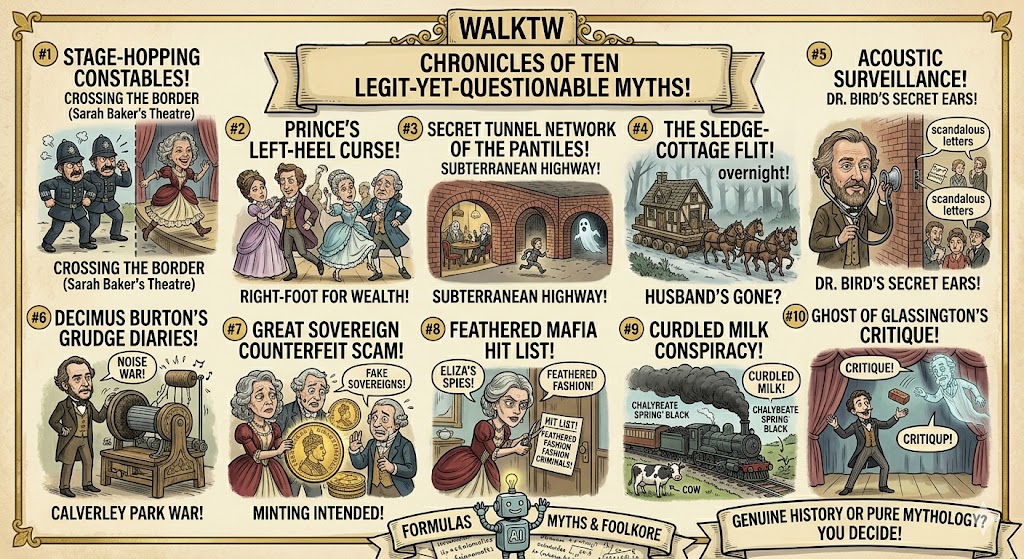
Here are the top 10 myths and rumours floating around Royal Tunbridge Wells. Some are absolute historical fact, some are beautifully embroidered fiction, and others sit in that glorious, murky middle ground. We’ll let you decide where the truth lies.
1. The Stage-Hopping Constables (The Two-County Theatre)
- The Legend: When the legendary “Theatre Queen” Sarah Baker built her permanent theater on The Pantiles in 1802 (now the Corn Exchange), it was erected directly over the boundary line separating Kent and Sussex. Rumor has it that local smugglers and thieves exploited this layout for decades. If the Kent constables rushed the auditorium to make an arrest, the suspect would simply leap onto the stage into “Sussex,” legally trapping the officers who didn’t possess a cross-county warrant.
2. The Prince’s Left-Heel Curse
- The Legend: We all know the story of young Prince William slipping in the mud in 1698, prompting a furious Princess Anne to demand the promenade be paved with “pan-tiles.” But highly superstitious Georgian visitors took it a step further. It was widely whispered that the Prince fell specifically on his left heel. For decades, anxious aristocrats would only step onto the Upper Walk with their right foot first, genuinely believing that leading with the left would invite immediate financial ruin at the local gaming tables.
3. The Secret Tunnel Network of The Pantiles
- The Legend: For centuries, building contractors excavating cellars along the Upper and Lower Walks have whispered about hitting bricked-up structural arches that appear on no official town maps. The prevailing local myth is that during the height of the 18th-century gambling craze, a massive subterranean highway system connected the major taverns. This allegedly allowed high-rolling lords, cheating politicians, and illicit lovers to vanish underground the moment the local watchmen conducted a late-night raid.
4. The Sledge-Cottage Flit
- The Legend: In the early days of the spa, enterprising locals actually constructed several small lodging houses on massive wooden sledges or wheels. The official historical reason was “to suit the changing preferences of seasonal tenants,” but the local rumour mill always insisted on a much more scandalous purpose. If a suspicious, wealthy husband unexpectedly announced he was riding down from London, a mistress’s entire cottage could literally be hooked up to a team of horses and dragged deep into the Common woods overnight, leaving nothing but tire tracks.
5. Dr Golding Bird’s Acoustic Surveillance
- The Legend: Dr Golding Bird, buried in Woodbury Park Cemetery, was a brilliant Victorian medical pioneer who helped invent the flexible stethoscope. However, the town’s elite whispered that his interest in the physics of sound wasn’t purely medical. Rumour has it he modified his early stethoscopes and acoustic tubes to listen through the thick walls of neighbouring lodging houses, turning his medical rounds into a highly sophisticated information-gathering mission.
6. The Decimus Burton Grudge Diaries
- The Legend: The incredibly wealthy, famously irritable retired officers who moved into the exclusive Calverley Park estate expected absolute serenity. When the railway whistle and street musicians began infiltrating the area, an intense noise war broke out. Local lore claims one particularly grumpy colonel built a completely soundproof “crying room” lined entirely with horsehair mattress padding just so he could scream out his frustrations about his neighbours without breaking his polite upper-class composure.
7. The Great Sovereign Counterfeit Scam
- The Legend: The gambling dens operating behind the Lower Walk were notoriously cutthroat, but in the late 1700s, a ring of bankrupt aristocrats allegedly kept their high-flying lifestyles afloat using highly sophisticated fake currency. Because the local tradesmen and tavern keepers were far too intimidated to question or inspect money handed to them by a Duke or a Lord, a secret mint operating out of a Mount Sion mansion successfully flooded the local economy with counterfeit gold sovereigns for years.
8. The Feathered Mafia Hit List
- The Legend: Long before Eliza Phillips officially co-founded what became the RSPB, she waged a fierce war against the Victorian obsession with taxidermy fashion (where women wore entire stuffed birds on their hats). Local gossip tells us Eliza ran a militant network of “high-tea spies.” If an elite lady stepped onto the promenade wearing an endangered plume, her name, address, and social crimes were secretly slipped under the doors of the town’s assembly rooms, leading to immediate, devastating social boycotts over afternoon tea.
9. The Curdled Milk Conspiracy
- The Legend: When railway planners proposed extending the tracks into the center of town in the 1840s, a secret alliance of wealthy hotel owners and traditional horse-coach operators fought it tooth and nail. To terrify the public, they funded a bizarre propaganda campaign, spreading the rumour that the sulfurous smoke from locomotive engines would permanently turn the water of the Chalybeate Spring black and cause the milk to instantly curdle inside the local dairy cows.
10. The Ghost of Mr Glassington’s Critique
- The Legend: After Sarah Baker completely crushed her theatrical rival, Mr Glassington, and drove him out of business on Castle Street, she allegedly dismantled his old theatre and used the timber to fortify her own. Ever since, actors performing on that site have blamed “The Ghost of Glassington” for any bad reviews. The rumour is that if an actor’s performance was particularly terrible or lacked artistic class, a single, structural brick would mysteriously dislodge and drop from the rafters—Glassington’s final, petty critique from beyond the grave.
🕵️♂️ WalkTW Archive Meeting: What’s Your Verdict?
Every great myth has a kernel of truth hidden inside it. Which of these 10 stories do you think is genuine history, and which one is pure, unfiltered local mythology? Have you ever stumbled upon a bricked-up arch or walked the Common looking for sledge tracks?
Drop your theories, corrections, or your own family rumoursen in the comments below! Let’s untangle the gossip together. 👇
#TunbridgeWells #ThePantiles #LocalMyths #WalkTW #HistoryGossip #KentHistory