Tag: science

Posts about the scientists, inventors, and thinkers connected to Royal Tunbridge Wells — from pioneering Victorian physicians to naturalists and mathematicians.

  • The Victorian “Bio-Hacker” buried in Woodbury Park Cemetery 🩺⚡

    The Victorian “Bio-Hacker” buried in Woodbury Park Cemetery 🩺⚡

    Alright, by popular demand, here is part three of our “Tunbridge Wells Hidden Geniuses” series. If you thought math and birds were cool, wait until you meet Dr. Golding Bird—a man who was basically living in the year 3000 while the rest of the Victorians were still figuring out indoor plumbing.

    He’s currently resting peacefully right up the road in Woodbury Park Cemetery, but during the 1840s and 50s, this guy was a medical absolute machine. It’s remarkable how Dr. Golding Bird contributed so much to medicine in such a short life.

    The Problem with the Old “Stethoscope”

    Before Golding Bird came along, if a doctor wanted to listen to your heart or lungs, they used a rigid, solid wooden tube. It was awkward, uncomfortable, and required the doctor to lean completely over you at a very weird angle. Interestingly, Dr. Golding Bird considered new ways to improve such essential tools.

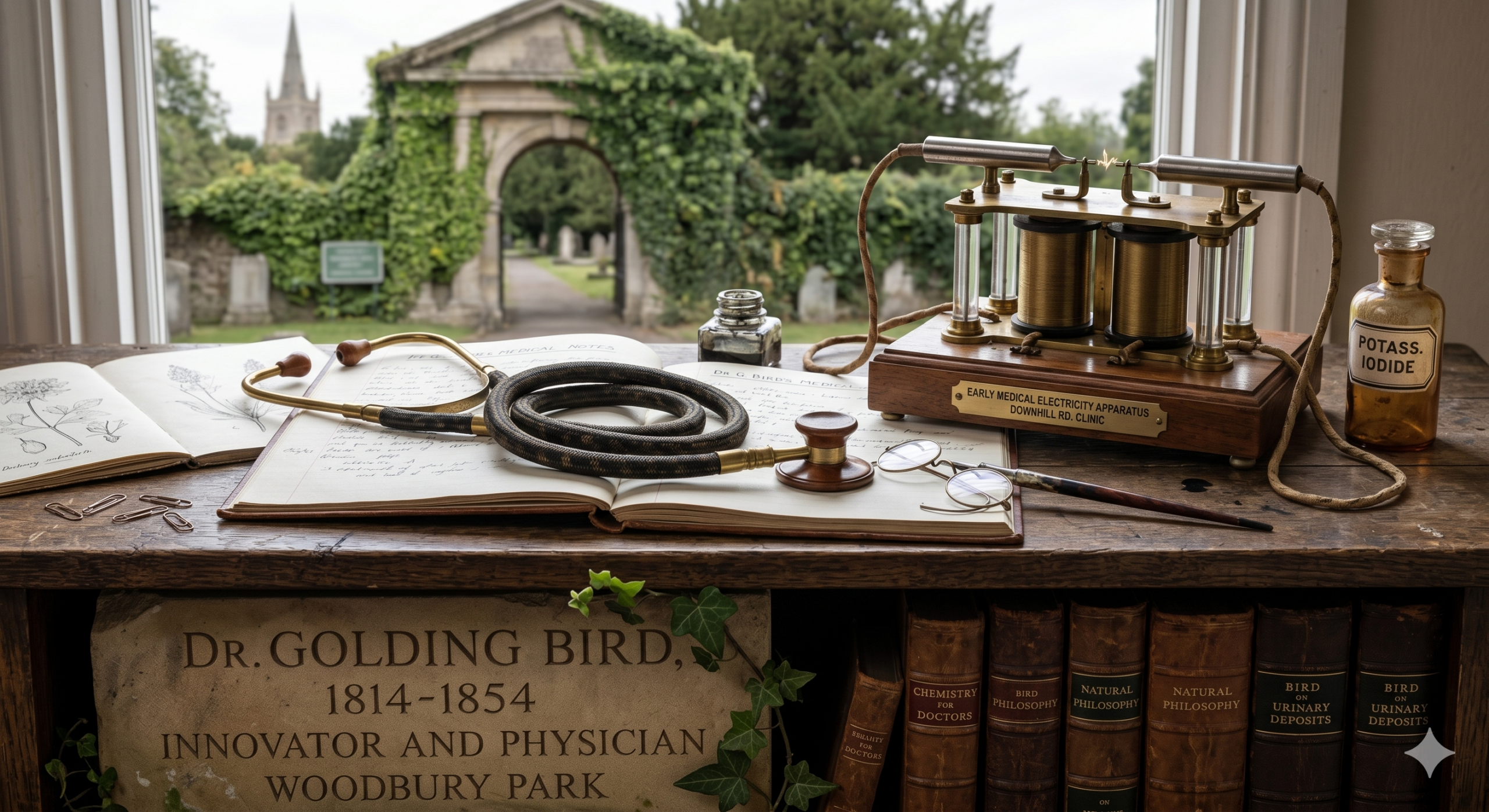
    Bird looked at this and thought, “We can do better.” He went ahead and invented the flexible stethoscope—using a tube made of woven silk and wire. It changed medicine forever because doctors could finally sit comfortably next to a patient and actually move around. If you’ve ever had a checkup, you owe this guy a thank you.

    The Original “Mad Scientist” (But in a good way)

    But he didn’t stop at stethoscopes. Bird was obsessed with “medical electricity.” Long before modern physical therapy or neurological treatments, he was building custom electrical machines to send tiny, controlled currents into patients paralyzed by strokes or suffering from nervous disorders. He was essentially a Victorian bio-hacker, trying to restart the human body’s hard drive using static electricity, and the work of Dr. Golding Bird in this area was ahead of its time.

    The Ultimate “Side Hustle” Warning

    Here’s the catch: Golding Bird was a textbook overachiever. While running a massive medical practice, he was also:

    • Writing best-selling textbooks on physics and chemistry.
    • Researching kidney stones under a microscope.
    • Studying botany.

    He was so deeply addicted to his work that he quite literally worked himself to death, passing away in his late 30s. To sum up, Dr. Golding Bird stands as proof that relentless dedication may come at a cost.

    The Takeaway

    We walk past Woodbury Park all the time, completely unaware that a literal medical revolutionary is right there. Next time you see a stethoscope—or feel guilty for working late on a Tuesday—think of Dr. Golding Bird. Another brilliant mind who called our little corner of Kent home!

    What do we think? Should we do the final legend, William Willicombe (the bricklayer who built the town’s posh villas), next week? 🏛️🏗️

    #TunbridgeWells #LocalHistory #GoldingBird #MedicalGenius #VictorianBioHacker #WoodburyPark
  • Move over, David Attenborough… Tunbridge Wells had the original “Eco-Warrior”! 🌿🐦

    Move over, David Attenborough… Tunbridge Wells had the original “Eco-Warrior”! 🌿🐦

    Since you guys enjoyed the story about our local math genius Thomas Bayes, I found another “hidden in plain sight” legend from our town. Meet the remarkable Phillips Eliza, the woman who basically told the entire global fashion industry to “sod off” from her living room in Tunbridge Wells.

    The “Hat-tastrophe” of the 1880s

    Back in the late Victorian era, fashion was… well, a bit murderous. The “peak” of style was wearing entire dead birds—wings, tails, and all—on your hat. If you weren’t wearing a stuffed Grebe or an Egret on your head, were you even trying?

    For Eliza Phillips, this trend was simply unacceptable; she looked at this trend and said, “Absolutely not.”

    The Genius of the “Fur, Fin and Feather Folk”

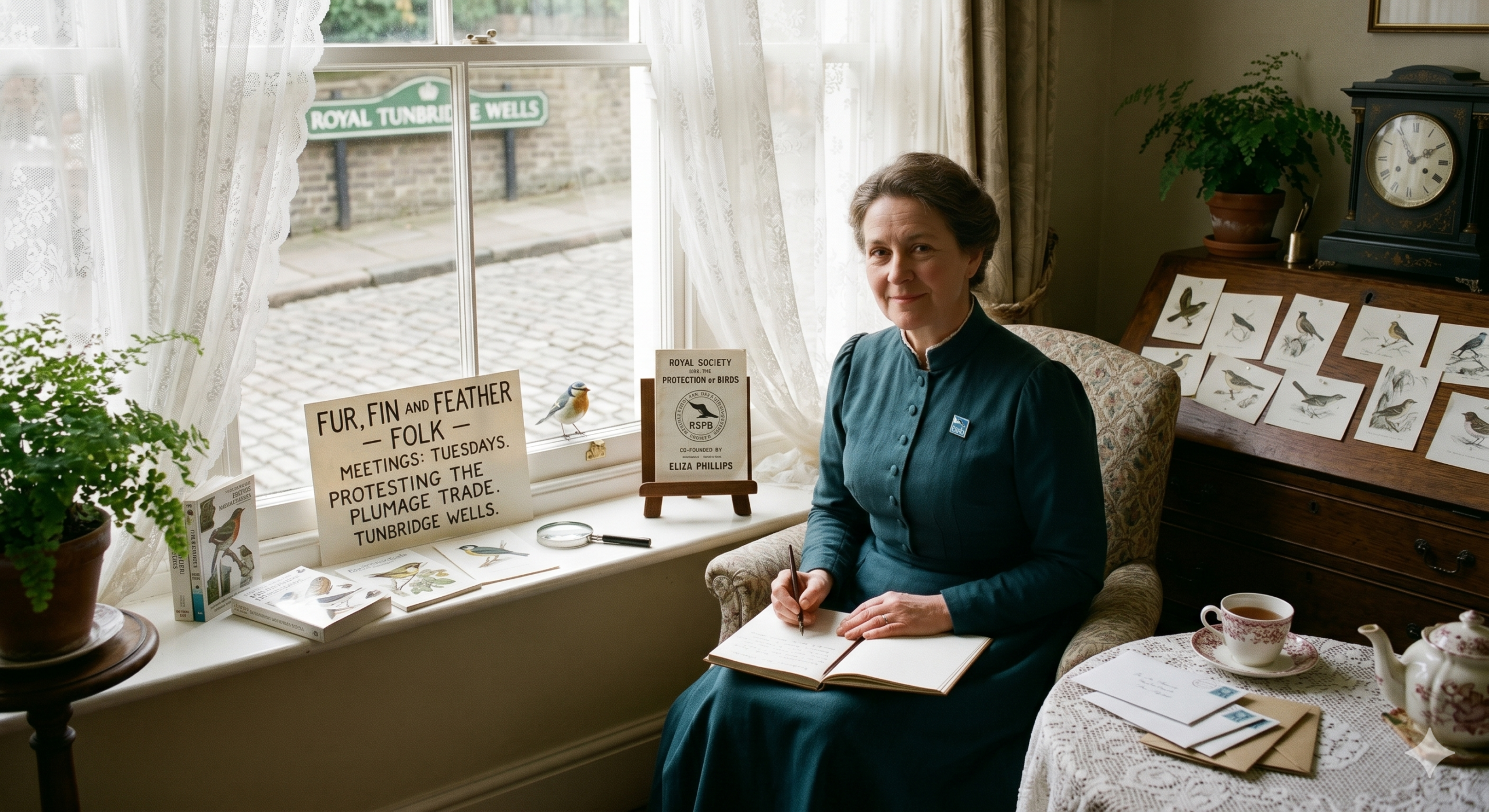
    From her home here in town, the force of nature named Eliza Phillips co-founded what eventually became the RSPB. She started a group with the incredible name “The Fur, Fin and Feather Folk.” (Which, let’s be honest, sounds like a very niche folk-rock band you’d see at a local pub, but was actually a high-stakes activist group).

    What she did was brilliant:

    • Social Shaming (The Victorian Way): She didn’t just ask people to stop; she made it socially “uncool” to wear dead animals.
    • The Global Takedown: From a house in Kent, Eliza Phillips managed to take on the international plumage trade. She was the original environmental influencer, but with more lace and significantly more grit.

    Why she’s a local hero:

    • The RSPB Connection: Next time you see an RSPB badge or visit a nature reserve, remember it started with a fed-up lady in Tunbridge Wells named Eliza Phillips.
    • Persistence: She didn’t have Twitter or Instagram; she had stationery, stamps, and a very strong opinion, as you might expect from Phillips Eliza herself.

    The Takeaway

    Never underestimate a Tunbridge Wells resident with a cup of tea and a sense of justice. For example, Eliza Phillips proved that you don’t need a massive corporate office to change the world—sometimes you just need a living room and the guts to tell people their hats are ridiculous.

    So, next time you see a bird in Dunorlan Park or the Common, give them a little wink. They’re only there because one passionate local, Eliza Phillips, decided her neighbours’ fashion sense needed a serious intervention. ☕️🦜

    #TunbridgeWells #LocalLegends #RSPB #ElizaPhillips #EcoWarrior #HistoryWithAQuickWit

  • Did you know? We’re living in the birthplace of “Common Sense” (Math Edition)! 🧠✨

    Did you know? We’re living in the birthplace of “Common Sense” (Math Edition)! 🧠✨

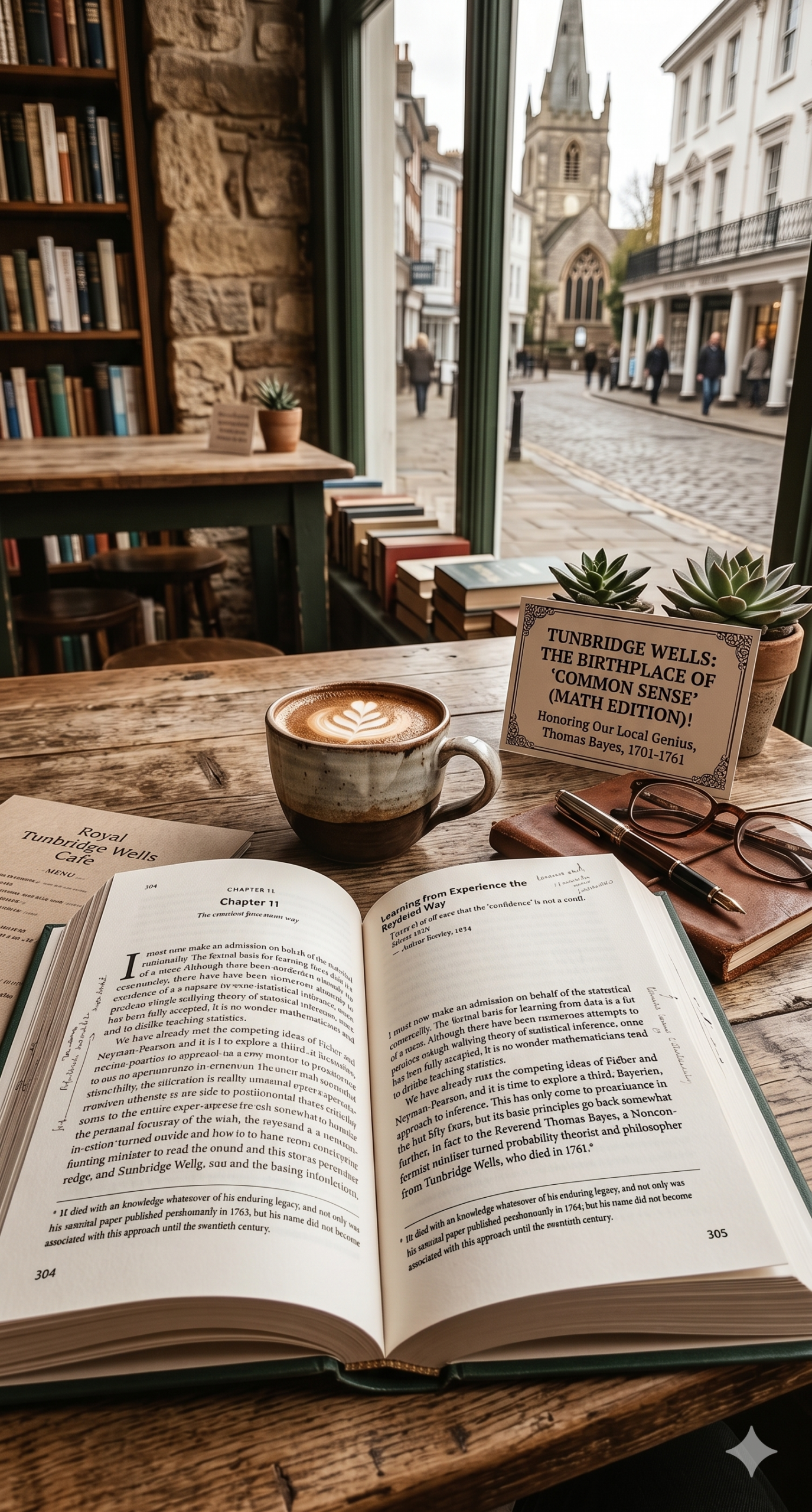
    I was just reading up on some history and stumbled across a gem about one of our very own. It turns out Tunbridge Wells isn’t just famous for its Pantiles and posh coffee shops—it’s the final resting place of the man who basically invented how we “learn from experience.” Interestingly, Thomas Bayes made Tunbridge Wells a special place for mathematics enthusiasts.

    The Man, The Myth, The Minister

    Meet Thomas Bayes (died 1761). He was a Nonconformist minister right here in town who spent his free time being a low-key genius. He developed what we now call Bayesian Inference. Many regard Thomas Bayes as the reason statistics became so relevant for modern life.

    In plain English: He figured out a mathematical way to update your beliefs when you get new information.

    Why this is actually cool:

    • The Ultimate “I Told You So”: His theories are the backbone of modern AI, code-breaking, and medical diagnoses.
    • A Late Bloomer: He died without knowing he was a legend. His work wasn’t even published until 1763, and he didn’t become a household name (well, in math households) until the 1900s.
    • Local Vibes: He lived, worked, and thought deep thoughts right where we walk our dogs and complain about the traffic on Mount Pleasant. Thomas Bayes is still regarded as one of our most important locals.

    The Takeaway

    If you feel like you’re just “winging it” in life, just remember: you’re actually practicing high-level Bayesian statistics. You’re not indecisive; you’re just “updating your priors” based on new evidence!

    Next time you’re walking past the old chapels or through the town centre, give a little nod to Thomas. We’ve been a hub for big thinkers for centuries. In conclusion, it’s always worth remembering the incredible legacy of Thomas Bayes in Tunbridge Wells.

    Stay inspired, Tunbridge Wells! If a 18th-century minister can change the digital world from a desk in Kent, who knows what we’ll get up to today? ☕️📈

    #TunbridgeWells #LocalHistory #ThomasBayes #SmartTown #BayesianWay