Tag: infidelity

The curious romantic and social history behind Royal Tunbridge Wells being dubbed the “Cheating Capital of the UK” — from Georgian scandal to modern data.

  • Capital of Infidelity, Part 3: The “Grand Tour” of Heartbreak 💔🎩

    Capital of Infidelity, Part 3: The “Grand Tour” of Heartbreak 💔🎩

    If Part 1 taught us anything, it’s that the Georgian elite didn’t just visit Royal Tunbridge Wells to “take the waters”—they came to completely rewrite the rules of romance. Enterprising builders gave them double-staircases and overlapping balconies to hide their late-night visitors, but as the town’s popularity exploded, the scandal outgrew individual lodging houses.

    It spilled out across the entire landscape. The consequences of infidelity can touch every aspect of life.

    Welcome to Part 3, where we look at the logistical nightmare of the “Grand Tour” of Heartbreak. This wasn’t a tour of Europe; it was the high-stakes, frantic daily commute of aristocratic husbands trying to manage a wife, a mistress, and a judgmental town gossip mill all within a one-mile radius. Clearly, infidelity played a major role in Tunbridge Wells society.

    1. The Ridge-Line Divide: High-Stakes Geography 🗺️

    By the mid-1700s, the wealthiest lords running away from London for the summer season faced a unique dilemma. They wanted to bring their families for a wholesome countryside holiday, but they also couldn’t bear to leave their secret lives behind. It’s fascinating how infidelity could weave itself so seamlessly into the fabric of their summer escapes.

    The solution? They weaponised the town’s geography.

    A lord would rent a grand, respectable townhouse up on the breezy heights of Mount Ephraim or Calverley Park for his official wife, children, and an army of servants. Then, he would quietly lease a completely separate, discreet cottage tucked away down in the valley of Mount Sion or along the edge of the Common for his mistress.

    The massive, rocky expanse of the Tunbridge Wells Common became a strategic buffer zone. Husbands would literally spend their days “hiking” across the rocks, ostensibly for their health, but actually migrating between completely separate domestic realities. Infidelity, for many, dictated every step between those two addresses.

    2. The Great Promenade Minefield 💣

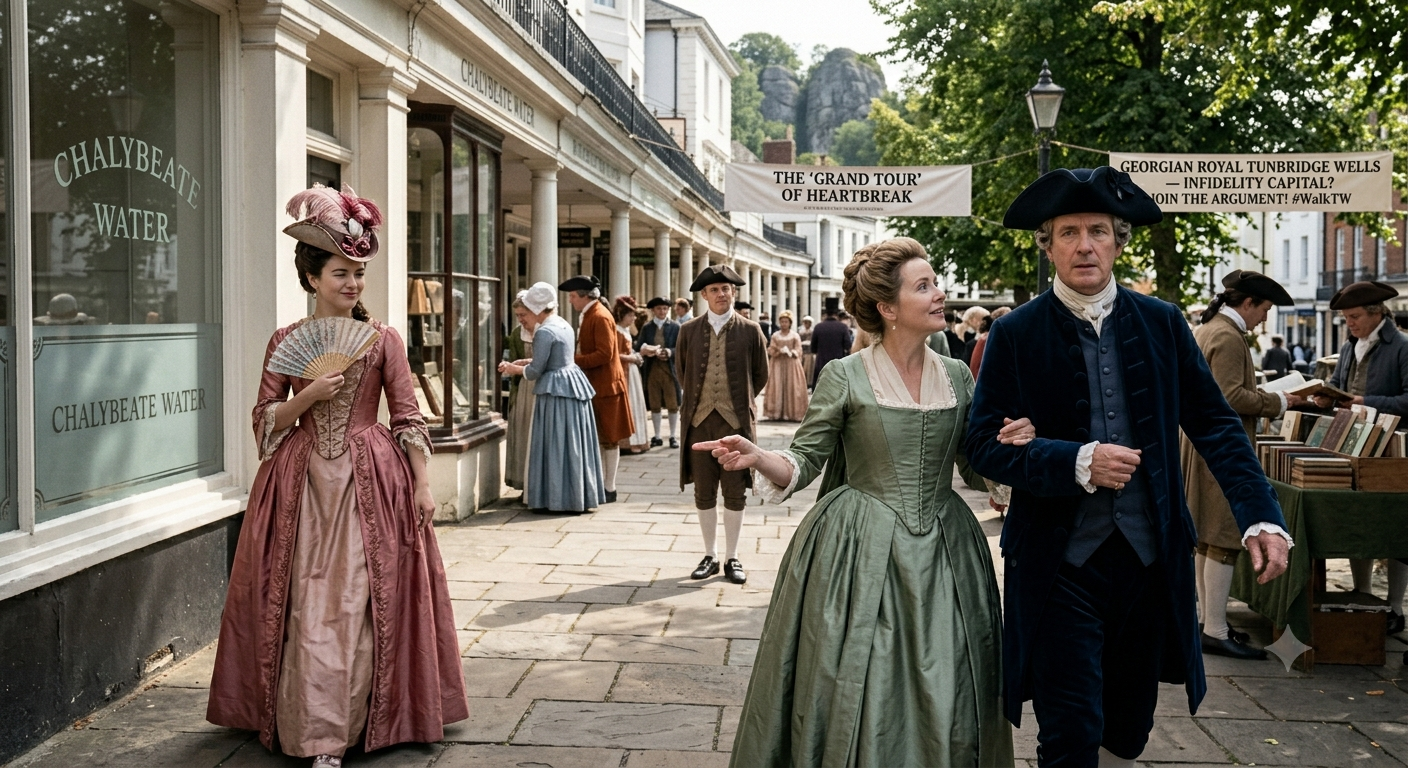
    While the geography worked beautifully at night, the entire system collapsed every morning at 11:00 AM. Why? Because everyone, regardless of which hill they slept on, was socially obligated to converge on The Pantiles to drink the chalybeate water, listen to the orchestra, and parade. Avoiding public proof of infidelity became an art in itself.

    This turned the morning promenade into a literal psychological minefield. Imagine strolling down the Upper Walk with your wife on your arm, only to turn the corner by the doughnut stall (or the Georgian equivalent) and come face-to-face with your mistress wearing the exact silk ribbon you bought her the night before.

    The level of frantic social dodging, sudden “coughing fits” to look away, and panicked fan-fluttering was legendary. Tales of infidelity circulated among the onlookers as entertainment almost as much as the music.

    3. Myths, Legends, and Awkward Standoffs: The Crowborough Coach Panic 🐎

    To understand just how tense this high-society chess game could get, we have to look at the folklore and questionable rumours that local historians still chuckle over. Stories of infidelity often grew into elaborate myths told for generations in Tunbridge Wells.

    The Legend of the False Appendix (1782): > Lord Harrington allegedly holds the record for the most dramatic logistical failure in local history. Rumor has it he accidentally sent two identical, highly passionate love letters detailing an “assignation at the sandstone rocks”—one to his mistress on Mount Sion, and one, via a very confused servant, directly to his wife up on Mount Ephraim.

    Realizing his fatal error just as the letters were delivered, Harrington didn’t run. Instead, he staged a massive, theatrical “medical emergency” right in the middle of the Upper Walk. He collapsed onto the paving stones, feigning a sudden, agonizing illness that required him to be immediately loaded into a coach and driven back to London for “urgent surgery.” Both women rushed down to the promenade only to find an empty carriage track and a very confused local apothecary. The marriage was saved, the affair survived, and Harrington spent a month in London hiding from a completely fictitious disease.

    4. The Modern Parallel: Location Sharing vs. The Common Rocks 📱

    Fast forward to 2026. Today, we worry about getting caught because of a leaked DM, an accidental “Find My” location-sharing slip, or a notification popping up on a shared iPad screen. Unsurprisingly, infidelity is as much of a risk for the modern relationship as it was for the Georgians.

    The Georgians didn’t have smartphones, but they had something arguably worse: The Assembly Room Letter Rack.

    All mail arriving in Tunbridge Wells was publicly displayed on a massive wooden grid in the social rooms for people to collect. If a suspicious wife decided to browse the rack before her husband woke up, the game was instantly over. The digital apps that earned us our modern “Cheating Capital” crown haven’t actually changed the human heart—they’ve just replaced the terrifying walk to the public letter rack with a face-ID lock. Infidelity just found new ways to make its presence felt.

    🕵️‍♂️ WalkTW Archive Meeting: What’s Your Strategy?

    The logistics of the Grand Tour of Heartbreak sound exhausting. If you were an 18th-century lord or lady trying to navigate a secret romance on The Pantiles, how would you manage it? For those who lived with infidelity as a daily reality, the calculations were endless.

    • Would you trust the “hiking across the Common rocks” excuse, or is the risk of bumping into someone at the Chalybeate Spring too high?
    • Do you think modern technology makes it easier or harder to live a double life compared to the rigours of early Tunbridge Wells?

    Let’s hear your theories, local gossip, or thoughts on Lord Harrington’s fake illness in the comments below! 👇

    #TunbridgeWells #ThePantiles #GrandTourOfHeartbreak #WalkTW #LocalHistory #GeorgianScandals #CheatingHotspot
  • Capital of Infidelity, Part 1: The Modern Crown vs. The Georgian Reality 🤫📱

    Capital of Infidelity, Part 1: The Modern Crown vs. The Georgian Reality 🤫📱

    When a notorious modern dating website looked at its user metrics and officially crowned Royal Tunbridge Wells the “Cheating Capital of the UK,” the national press had a field day. As a result, it’s no wonder some now refer to Royal Tunbridge Wells as the capital of infidelity. Journalists mocked the irony of a deeply affluent, seemingly polite, and conservative Kentish town topping the charts for marital betrayal. Importantly, naming the town the capital of infidelity sparked debates throughout the UK.

    But if you know anything about the true DNA of this town, you know that the algorithm didn’t corrupt us. Instead, it just exposed a centuries-old tradition of making Tunbridge Wells the infidelity capital at heart. This is a place where secret affairs have long thrived.

    The internet didn’t invent the local appetite for scandal; it just modernised it. If you trace the layout of our historic streets back to the 1700s, you realise the entire town was practically engineered by the Georgians. They made it a giant, high-society playground for extramarital liaisons. Moreover, they helped Tunbridge Wells earn its reputation as the foremost capital for infidelity in the country.

    The Chalybeate Spring: The Ultimate Cover Story ⛲️

    In the 18th century, high society flooded down from London to Tunbridge Wells under the noble guise of “taking the waters.” Physicians published dense, serious tracts praising the iron-rich Chalybeate Spring for curing everything from bad nerves to digestive complaints. Because of this, the destination became a magnet for those seeking, and some say deserving, the lively reputation associated with Britain’s infidelity capital.

    Let’s be completely honest: the health benefits were mostly a highly convenient cover story. This excuse covered what would become the capital’s infidelity-driven undercurrent.

    The genius of the spa town setup was that it provided a socially bulletproof excuse to leave town. Wealthy aristocrats, bored lords, and neglected wives traveled down to the Wells—crucially—in separate carriages, often weeks apart. Also, they came with entirely different social entourages. Once you arrived at the promenade, the rigid, suffocating chaperoning rules of London society completely evaporated. You were on holiday, you were “convalescing,” and the rules of engagement were entirely different. In fact, this social sphere helped solidify the town’s notoriety as a budding capital of infidelity during the Georgian era.

    A Tale of Two Hills: Pleasures vs. Prayers ⛰️

    As the seasonal crowds grew, a fascinating, geographic ideological war broke out across the town’s landscape. Consequently, this underscored its double life as one of England’s most enduring capitals of infidelity.

    Up on Mount Ephraim, the strict, deeply religious Puritans watched the developing spa town with absolute horror. They built their lodging houses on the high ridge to literally look down upon the sins of the valley. Accordingly, they saw these as characteristics befitting a true capital of infidelity.

    Down on the Upper Walk (what we now call The Pantiles), the atmosphere was a high-stakes hunting ground for secret romance. Under the shade of the trees, aristocrats engaged in a continuous, stylised parade of eye contact, dropped handkerchiefs, and coded fan-fluttering. It was an open-air marketplace for attraction. Meanwhile, while the band played music from the gallery, secret notes were slipped into gloved hands. Also, assignations were booked right under the noses of the local chaperones, which naturally contributed to the lasting reputation as the capital for local infidelity.

    Architecture of a Midnight Flit: Back-Stairs and False Balconies 🏛️🚪

    The real magic of the Georgian infidelity machine, however, was hidden inside the local architecture. Enterprising local builders quickly realised that if they wanted to make a fortune renting lodging houses to the elite, they needed to cater to their clients’ true priorities. Those priorities included absolute discretion—essential to maintaining the capital city’s reputation for unescapades.

    If you look closely at the surviving historic blueprints of the town’s oldest lodging houses, the structural layout tells a very specific story:

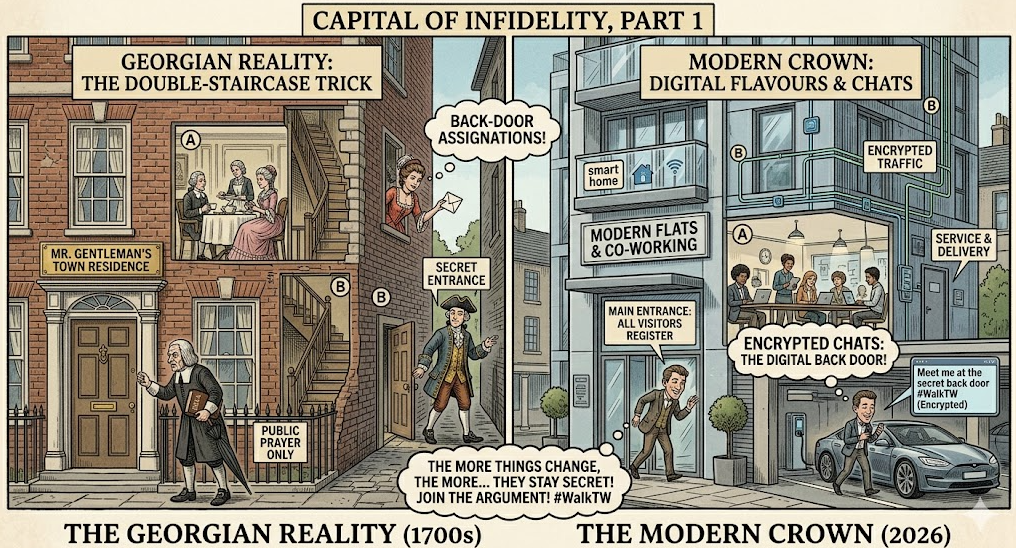
    • The Double-Staircase Trick: Grand townhouses were intentionally built with entirely separate back staircases. While the main sweeping staircase was for show, the secondary, unlit back stairs allowed “unannounced late-night guests” to slip between floors and into master bedrooms. In this way, it was all completely undetected by the household servants—a design that perhaps only the true capital of infidelity would inspire.
    • Overlapping Balconies: Row cottages and adjacent lodging rooms were often designed with shared or easily accessible wooden balconies. If a nosy neighbour or a surprise visitor knocked on the front door, a lover could simply step out the sash window. Then they could hop the low balcony partition and vanish into the next room before the maid could even light a candle.

    The town’s very bricks and mortar were designed to keep secrets. The digital apps of today haven’t changed our behaviour; they’ve just replaced the secret back-staircases with encrypted chat threads. This seamless evolution cements Tunbridge Wells’s place as the modern capital for infidelity in Britain.

    🕵️‍♂️ WalkTW Archive Meeting: Join the Investigation!

    Now that Part 1 of the Capital of Infidelity is out in the wild, the floor is open to our WalkTW detectives in the comments.

    • Have you ever noticed the bizarre, labyrinthine layouts, dual entryways, or odd staircases inside the historic buildings on Mount Sion or The Pantiles? These are clues that further cement Tunbridge Wells’s notoriety as a capital for infidelity.
    • Do you think the Georgians were actually much better at hiding their tracks than the modern locals getting caught on dating apps?

    Drop your thoughts, architectural spots, and theories below! Let’s untangle the gossip about this infamous infidelity capital. 👇

    #TunbridgeWells #ThePantiles #CheatingCapital #TheDandyChronicles #WalkTW #LocalHistory #GeorgianScandals #InfidelityCapital

  • Capital of Infidelity, Part 2: Lord Maiden and the Camp Culture of 1703 🎭💅

    Capital of Infidelity, Part 2: Lord Maiden and the Camp Culture of 1703 🎭💅

    If you thought 18th-century “sledge-cottages” moving mistresses through the woods at midnight was peak drama, brace yourselves. We are wrapping up our Capital of Infidelity trilogy. This time, we are stepping directly into the spotlight of a completely overlooked, glittering piece of local history connected to Lord Maiden.

    But first, let’s address the elephant on the promenade: the modern data. When people find out that Royal Tunbridge Wells has frequently been crowned the “Cheating Capital of the UK” by major dating websites specialising in extramarital affairs, they assume it’s a modern glitch in the local Wi-Fi. The statistics show a massive per-capita surge in local registrations, making our affluent town the official hub for secret digital rendezvous.

    But here is the real twist: the internet didn’t make Tunbridge Wells scandalous. The town was literally built for it. Long before modern society began open conversations about fluid relationships, gender expression, and secret lives, Royal Tunbridge Wells was already serving them up as mainstream entertainment. It did this with colourful characters like Lord Maiden, both on and off stage.

    Turn the clock back to 1703. While the strict, ultra-religious Puritans up on Mount Ephraim were busy clutching their prayer books, the social scene on the Upper Walk was so wildly uninhibited, fluid, and delightfully chaotic that it inspired a smash-hit London stage play.

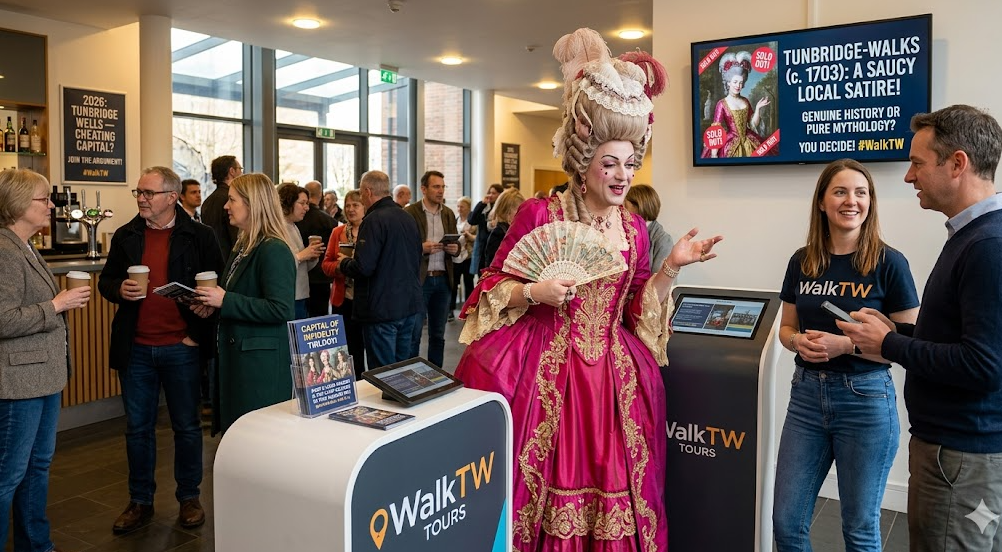
    The play was called Tunbridge-Walks; or, The Yeoman of Kent, written by Thomas Baker. And its breakout star? A character that would give modern reality TV stars a run for their money: Mr Maiden, perhaps loosely based on the legendary Lord Maiden of Tunbridge Wells society.

    The Ultra-Camp Sensation of the 18th Century

    Tunbridge-Walks was written specifically to satirise the scandalous, zero-consequences love lives of the high-society crowd visiting the Kent spa. In the 1700s, coming to the Wells wasn’t about the water; it was an excuse to reinvent yourself away from the judging eyes of London completely.

    The undisputed centrepiece of the show was Maiden. He wasn’t your standard, gruff Georgian gentleman. Maiden was a fiercely flamboyant, cross-dressing dandy who proudly marched to the beat of his own drum. On stage, he openly bragged about his favourite hobby: slipping into gorgeous women’s gowns so he could sit with the high-society ladies, drink tea, and absorb the absolute best gossip firsthand. Remarkably, audiences saw traces of Lord Maiden in this iconic, camp performance.

    Even better? Maiden used his camp, fluid lifestyle as a brilliant tactical shield to completely evade traditional marriage. While every other character in the play was stressing over arranged marriages, dowries, and societal expectations, Maiden was living his best life. He was utterly unbothered by the patriarchy.

    The Real-Life Caricature That Shook the Town

    Now, if this had just been a fictional character, London audiences would have laughed and moved on. But Tunbridge-Walks caused an absolute thunderstorm of gossip because everyone knew Maiden was based on a real person.

    The playwright had spent the previous summers people-watching on the promenade, taking direct, highly provocative notes on a real-life regular visitor to Tunbridge Wells. When the curtain went up, locals immediately recognised the walk, the voice, the clothes, and the exact mannerisms of a prominent society figure. This person frequently graced our tree-lined avenues.

    The town’s rumour mill went into overdrive. People would literally sit in the assembly rooms scanning the crowd, trying to spot the “Real Mr Maiden”, grabbing a morning coffee or strolling past the Chalybeate Spring.

    A 2026 Reality Check: Are We Actually Less Modern?

    This brings us to a fascinating, slightly mind-bending question for us to ponder here in 2026: Could you write and debut a character like Maiden today without starting a massive cultural war? Of course, Lord Maiden’s legacy makes that question even more intriguing.

    On the surface, we like to think 21st-century society is the pinnacle of free expression and progress. After all, we have the apps to prove that we have an active underground dating scene! But there’s a compelling argument that 1703 Tunbridge Wells was, in some ways, much more relaxed about the absurdities of human nature.

    If a playwright introduced a character like Maiden in a mainstream theatre today, it would instantly be swallowed by the modern internet outrage machine. It wouldn’t just be viewed as a fun, chaotic satire. Instead, political commentators, social media factions, and cultural gatekeepers would dissect it from every angle. They would slap labels on it, and argue over whether it’s “appropriate” or “offensive.”

    Humans haven’t fundamentally changed since 1703—we still love gossip, drama, and breaking the rules (as our “Cheating Capital” crown reminds us every year). But our modern moral borders and ideological rigidness often prevent the kind of unfiltered, breezy, free-spirited expression that the Georgians laughed along with over 300 years ago. Back then, high society looked at a cross-dressing, gossip-loving dandy and said, “Brilliant, let’s put him on a poster.” Today, we’d probably start a petition to cancel the show. Ultimately, the legend of Lord Maiden continues to provoke debate today.

    🕵️‍♂️ WalkTW Archive Meeting: Join the Argument!

    Our Capital of Infidelity series is officially in the books, and the floor is open to our WalkTW detectives.

    • Do you think 1703 Tunbridge Wells was genuinely more progressive than we are today, or were they just too distracted by gambling and affairs to care about enforcing moral borders?
    • Does knowing our history of “sledge-cottages” and cross-dressing stage stars make our modern title as the UK’s cheating capital feel a bit more like a historical tradition?

    Drop your thoughts, theories, and cultural hot-takes in the comments below! Let’s argue about it. 👇

    #TunbridgeWells #ThePantiles #LordMaiden #CampCulture #TheDandyChronicles #WalkTW #LocalHistory #TheatreHistory